Backpressure Contracts for Device Ingest
Modern device systems don't usually fail because one request is too large. They fail because many reasonable requests arrive at the wrong time, under the wrong retry behavior, with no shared contract between client and server.
That pattern shows up most clearly during reconnects. Devices go offline for minutes or hours, collect a backlog locally, then come back all at once. If the client also has "replay last N minutes" logic, if the API answers with 429 or transient 5xx under pressure, and if retries are unbounded or poorly shaped, the ingest path can turn into an amplifier. A backlog becomes a burst. A burst becomes a retry loop. That loop pushes storage and indexing layers into unstable territory: hot DynamoDB partitions, overloaded OpenSearch shards, growing queues, rising latency, avoidable cost.
The fix isn't "more throttling" in isolation. It's an explicit backpressure contract across the whole ingest path. Clients need to know how fast they're allowed to send, servers need to communicate partial progress clearly, retries must be made safe through idempotency, and downstream systems need protection from synchronized write spikes. Get that contract right and reconnects stop being chaotic events. Recovery becomes predictable.
The real failure mode is replay amplification
A reconnect storm is rarely one mechanism. It's usually several small design choices multiplying each other:
- Devices buffer data while offline. - Reconnect logic replays a recent time window "just in case." - APIs reject excess load with 429 or intermittent 5xx. - Clients retry too aggressively, often with many concurrent requests. - The same data gets written multiple times because deduplication is weak. - Indexing pipelines treat duplicates as fresh work and reprocess them.
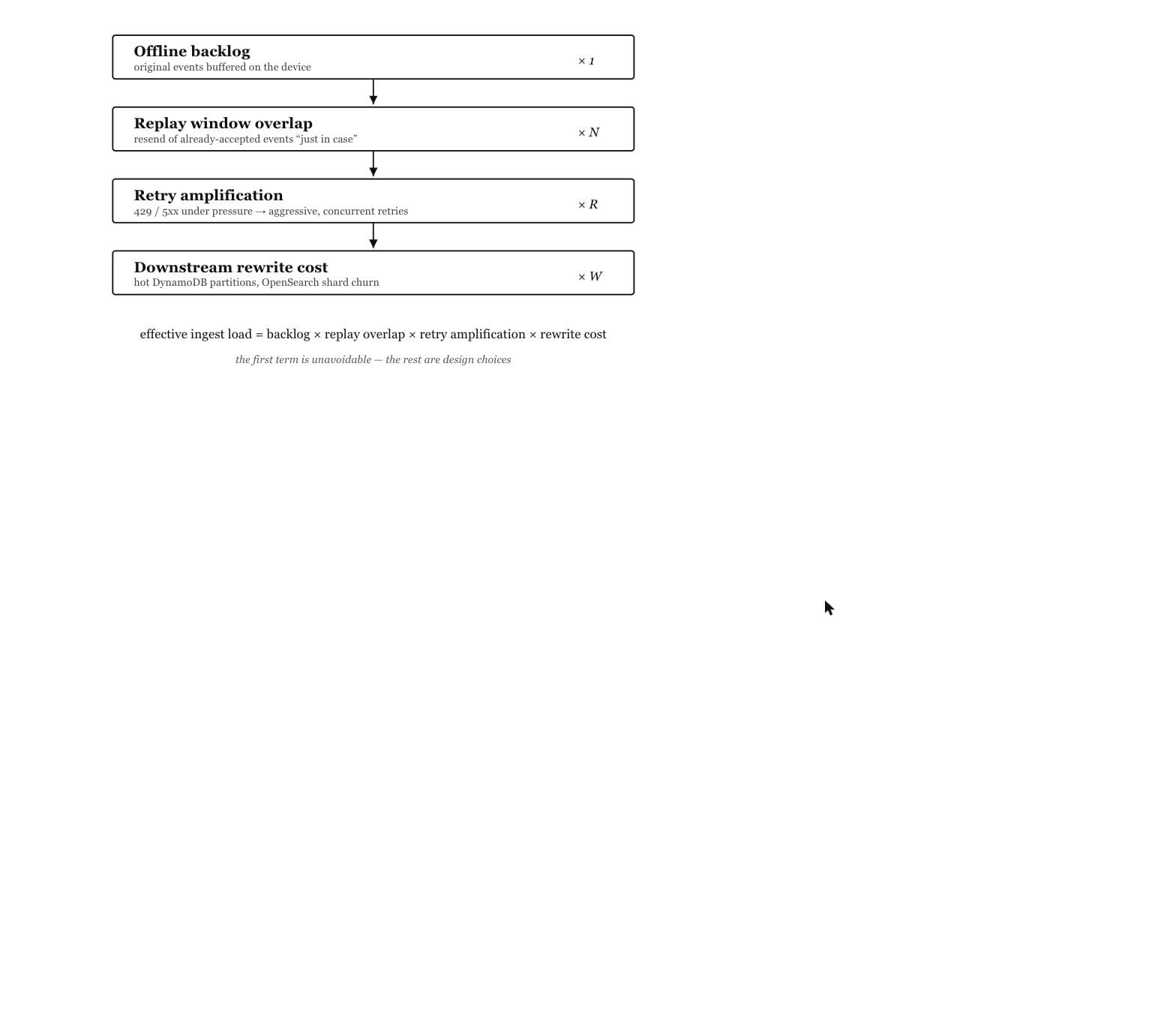
That's replay amplification: one unit of original data creates multiple units of ingest work. In healthy systems, retries raise request volume modestly. In unstable ones, they multiply it.
A useful way to frame it: effective ingest load equals original backlog times replay overlap times retry amplification times downstream rewrite cost. The first term is unavoidable. The rest are design choices. A disciplined backpressure contract shrinks those multipliers. It won't eliminate reconnect bursts, but it makes them degrade into controlled recovery instead of runaway load.
Backpressure is not a throttle, it's a contract
Many pipelines apply throttling only at the edge: reject requests when traffic is high and hope clients back off. That protects the service for a moment but doesn't create coordinated behavior. It often makes things worse, because clients get a generic failure and respond independently, each retrying on its own schedule.
A backpressure contract is broader. It answers five questions explicitly. What can be accepted now, since not every request needs an all-or-nothing answer and servers should accept part of a batch and make that progress visible. How should the client resume, meaning a concrete watermark or cursor so it doesn't resend already-accepted data. When should the client retry, since timing has to be communicated rather than guessed, with Retry-After treated as part of the protocol, not a nice-to-have header. What happens if data gets resent anyway, which means idempotency has to hold all the way down, not just at the API layer. And how is downstream capacity protected, since even a stable API can't let storage and indexing backends take synchronized spikes beyond their sustainable write envelope.
Framed this way, backpressure becomes an architectural discipline rather than a narrow rate-limit feature. At Hoomanely, this matters because systems connected to real devices don't behave like clean web clients. Connectivity is intermittent, power cycles happen, local buffering is normal. Ingest reliability is part of product trust here. A device only feels dependable if reconnects recover cleanly without silent loss, runaway duplication, or unstable downstream behavior.
Start at the API: partial acceptance and explicit progress
The most important improvement in reconnect-heavy ingest systems is moving away from binary success or failure for large batches.
When a device sends a backlog, the server shouldn't be forced into only two choices, accept everything or reject everything. Under pressure, the better move is partial acceptance: accept up to a safe amount, persist exactly what was accepted, and return a response telling the client where to resume.
That response should include a high-watermark for the last accepted event, the accepted count, the rejected or deferred range, a Retry-After value reflecting current capacity, and optionally a reason code such as queue_saturated, tenant_rate_limited, or search_backpressure.
Most ingest storms get worse from ambiguity. If a client doesn't know whether event 712 was accepted, it often resends 680 through 750. That overlap is where replay multiplication starts. A better contract looks like this: client sends batch [601..750], server safely accepts [601..690], server returns watermark 690 with retry-after 8s, client resumes from 691 rather than 601. That single change removes a large class of overlap-driven duplicates.
Servers should also cap per-request work deliberately. Large backlog flushes should be segmented by policy, not by accident. A request trying to push 30 minutes of buffered data shouldn't monopolize API workers, queue slots, and downstream write bandwidth. Bounded work per request creates fairness and keeps latency predictable for the rest of the fleet.
Admission control before storage pain appears
A common mistake is discovering backpressure too late, only when DynamoDB throttles or OpenSearch indexing slows down. By then the system is already in the failure path.
Admission control should happen earlier, while the system still has choices. That usually means three layers. Concurrency caps at the API layer limit how many ingest batches can run at once, globally and per tenant or device group, so a single reconnect wave can't consume every worker. Queue-backed smoothing avoids forcing every accepted batch into immediate downstream writes; a queue gives the system a pressure buffer and lets workers pull at a sustainable rate. Rate shaping by tenant or device identity matters because different fleets behave differently, and a small number of noisy devices shouldn't destabilize a larger healthy population.
None of this is about slowing everything down. It's about keeping the pipeline inside a controllable operating envelope. Under a spike, predictable slowness beats oscillation every time. Many teams over-index on average throughput here, when the real target is recovery stability: how gracefully the system drains backlog after a reconnect without triggering error storms or backend hotspots. Sustainable ingest is usually worth more than peak ingest.
The backpressure contract across the ingest path
The contract spans the entire path. API admission, queue smoothing, worker pacing, storage-safe writes, and search-aware indexing all have to agree:
Devices
  |
  v
Ingest API -> partial acceptance + watermark + Retry-After
  | (concurrency caps)
  v
Queue / buffer -> smoothing
  |
  v
Worker pool -> paced writes
  |
  v
DynamoDB (idempotent writes) + OpenSearch (bounded bulk indexing)
Idempotency is the line between safe retries and destructive retries
Backpressure alone isn't enough if every retry creates duplicate work. In reconnect-heavy systems, idempotency isn't optional plumbing. It's the mechanism that turns retries from a risk into a recovery tool. Without it, every transient failure inflates write volume. With it, retries can be aggressive enough to recover but harmless enough not to amplify storage and indexing work.
Strict idempotency needs a stable event identity that survives retransmission, derived from immutable attributes like device ID plus a monotonic sequence number, not generated per request. If the same event shows up five times, the system should recognize it as one fact, not five.
That contract has to hold across several layers: the API layer detects duplicate submissions quickly, the queue layer avoids enqueuing duplicate work items, the storage layer upserts or conditional-writes by stable key, and the indexing layer treats repeats as no-ops or cheap overwrites rather than full re-ingest.
This matters especially for search. OpenSearch often becomes the hidden multiplier in replay storms, since duplicated writes do more than consume indexing throughput, they trigger segment churn, refresh pressure, merge pressure, and localized shard heat. Weak deduplication at the ingest layer turns into index thrash later. Good idempotency design also improves observability. Once duplicate detection is real, teams can measure retry amplification directly instead of inferring it from elevated traffic.
At Hoomanely, this pattern isn't theoretical. Device-originated systems replay for legitimate reasons, reconnects, local uncertainty, defensive resend logic, and the platform benefits when those replays are made structurally safe instead of treated as exceptions.
The client has to become a cooperative participant
Many backend teams try to solve replay storms entirely server-side. That rarely works. If clients remain free to dump unlimited backlog concurrently and retry on short timers, the server gets stuck in permanent defense mode.
Two client-side mechanisms are especially effective. Token-bucket sending drains backlog gradually: a reconnecting device shouldn't flush everything immediately, it should spend from a local token bucket that limits burst size and steady-state send rate. The bucket should be sized for the device and connectivity pattern, not peak optimism, since a small controlled burst plus a steady drain almost always outperforms "send everything now" once real backend costs are counted.
Bounded exponential backoff matters too. Retries shouldn't be infinite, synchronized, or aggressively parallel. Use exponential backoff with jitter, cap the maximum retry rate, and honor server-provided Retry-After when it's present. The client should also cut concurrency when it keeps seeing pressure signals. A simple rule that holds up well: never let retry traffic exceed fresh traffic for long. When retries dominate, the system is spending more energy repeating the past than making forward progress.
Protecting DynamoDB from synchronized write spikes
DynamoDB usually isn't the first component teams blame, but it often reveals the true shape of a reconnect storm. If keys are poorly distributed, a reconnect wave can push a narrow slice of partitions disproportionately hard.
Three defenses matter most. Partition-key design should avoid concentration; device-only keys often get too concentrated if a small cohort reconnects simultaneously, so time bucketing, tenant-aware distribution, or deliberate write sharding may be needed. Burst smoothing before persistence helps because even well-designed keys suffer when thousands of writes arrive in lockstep, so queue smoothing and worker pacing reduce synchronized pressure. And write paths that make duplicates cheap matter because if duplicate retries repeatedly hit the same items, storage cost and conditional contention rise fast; stable identities plus idempotent writes cut this dramatically.
The mindset that matters here: backend throttling should be the last line of defense, not the main control plane. Once DynamoDB is visibly hot, the earlier stages already failed to coordinate.
Protecting OpenSearch from bulk-index collapse
OpenSearch tends to fail differently. It may not reject immediately; instead it degrades through indexing latency, shard imbalance, refresh pressure, and merge overhead. In a reconnect storm, this often looks like the API "mostly works" while search freshness and indexing stability quietly erode.
To keep indexing healthy, use bulk indexing with bounded batch sizes, since oversized bulk requests raise tail latency and recovery pain, and batches should be large enough for efficiency but small enough for predictable retries. Separate storage acceptance from indexing urgency, since not every accepted write needs to become an immediate search document; under pressure it's better to preserve the source of truth first and let indexing lag temporarily than to overload both layers together. And apply backpressure-aware fallbacks: if indexing pressure rises past a threshold, reduce indexing concurrency, widen refresh intervals where acceptable, or temporarily degrade non-critical search updates. This is effectively a circuit-breaker posture for search freshness.
The key is deciding intentionally what can lag. Most systems are better served by slightly delayed search than by unstable ingest.
What stable reconnect looks like
A healthy reconnect combines token-bucket drain, server watermarking, queue smoothing, and bounded indexing under pressure:
t0  Device reconnects with local backlog [601..750]
t1  Token-bucket drain begins (controlled burst, not a flood)
t2  Server accepts [601..690] -> watermark = 690, Retry-After = 8s
t3  Client resumes from 691 (duplicates safely ignored)
t4  Queue smooths writes; search lag tolerated, source of truth stable
Measure the contract, not just the errors
A system can have low 5xx rates and still be unhealthy if it's recovering inefficiently. The backpressure contract should be validated with metrics that reflect coordination, not just availability: retry amplification factor (total ingest attempts divided by original events), the 429/5xx spike rate during reconnect windows, p95 ingest completion latency for buffered backlog, queue depth and drain time, duplicate suppression rate, DynamoDB hotspot incidence, and OpenSearch indexing lag and shard pressure.
These metrics make the trade-offs visible. A slightly longer drain time can be completely acceptable if retry amplification drops sharply and backend hotspots disappear, that's often a sign of a healthier system, not a slower one. A mature platform should also test this contract on purpose. Reconnect storms, replay overlaps, partial backend saturation, and retry loops should be simulated before production traffic does it for you. The goal isn't only to survive failure, but to make sure the system recovers in a controlled shape.
Why this matters beyond infrastructure
Backpressure contracts sound operational, but they're product architecture in disguise. For device-backed experiences, reconnects are normal. So are offline gaps. Users don't care whether a burst came from a backlog flush, replay logic, or shard imbalance. They experience the outcome: delayed insights, duplicated events, stale search, battery-heavy retry loops, systems that feel unreliable exactly when they should be recovering.
That's why this topic matters to Hoomanely too. Our broader mission is building dependable, intelligent systems around pet care and connected experiences. In that kind of environment, stable ingest isn't a backend nicety, it's the foundation that lets device data, event pipelines, and downstream intelligence stay trustworthy under real-world connectivity conditions. A strong backpressure contract directly strengthens that trust.
Key takeaways
Replay storms are rarely caused by one bad retry. They emerge when backlog flush, replay overlap, ambiguous failures, weak idempotency, and backend sensitivity reinforce each other. The fix is replacing reactive throttling with an explicit end-to-end contract: partial acceptance instead of binary failure, watermarks instead of ambiguous progress, Retry-After instead of guesswork, admission control before backend distress, idempotency that makes retries safe, client token buckets and bounded backoff, and storage and search layers protected by shaping, batching, and fallback modes.
When those pieces line up, reconnect spikes stop behaving like incidents and start behaving like load the system already knows how to absorb. That's the real value of backpressure contracts. They don't eliminate bursts. They make bursts boring.