
Bounded Intelligence: Operating AI Systems That Remain Stable, Predictable, and Trustworthy
As AI systems move from experimental features to core product capabilities, the definition of "good intelligence" changes. In early stages, intelligence is judged by fluency, creativity, or raw problem-solving ability. In production systems, those qualities matter far less than consistency, predictability, and control.
A production AI system doesn't operate in isolation. It runs inside distributed infrastructure, under fluctuating traffic, partial failures, retries, cost ceilings, and strict latency expectations. In that environment, intelligence without boundaries becomes volatile. Small changes in timing or context can produce meaningfully different outputs. Parallel executions can diverge. Costs can drift. User trust can erode, not because the AI is incorrect, but because it behaves inconsistently.
Bounded intelligence is the discipline of designing AI systems that remain stable under real conditions. It focuses on intentional constraints on context, time, concurrency, authority, and failure behavior. These constraints don't weaken AI systems, they make them reliable enough to earn long-term trust.
The core idea: intelligence must operate within explicit limits
Bounded intelligence starts with a simple premise: in production, every AI capability is a finite resource that must be governed. This includes how much information the model is allowed to see, how long it's allowed to think, how many times it's allowed to run, what parts of the system it's allowed to influence, and how it behaves when conditions aren't ideal.
Unbounded systems implicitly assume best-case execution. Bounded systems assume retries, contention, partial failure, and human unpredictability as normal operating conditions. Rather than asking "can the model answer this," bounded intelligence asks: can it answer within a defined time window, can it answer consistently across retries, can it answer without destabilizing surrounding systems, and can it answer without exceeding its intended authority. These questions define production readiness.
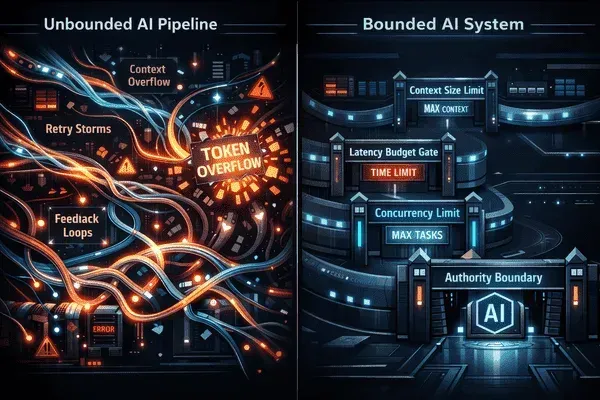
Context is a budgeted resource
Context is often treated as an unlimited well. When answers degrade, the instinctive response is to add more, more retrieval chunks, more conversation history, more system instructions, more tool outputs. This approach works briefly, then collapses under scale.
Unbounded context introduces several systemic risks: latency amplification as retrieval and prompt assembly grow, signal dilution where relevant information gets drowned in noise, non-determinism where small timing differences produce different context windows, and retry divergence where the same logical action sees different inputs. Bounded intelligence reframes context as a fixed envelope, not an elastic buffer.
A bounded context strategy typically includes hard caps on total tokens per request, explicit prioritization rules (recent over relevant over historical), tiered retrieval (primary evidence first, summaries later), and intent-level context snapshots that remain stable across retries. If required information doesn't fit within the budget, the system doesn't stretch, it degrades intentionally, by summarizing, narrowing scope, or asking for clarification. The goal isn't maximal recall, it's repeatable understanding.
Time is part of semantic correctness
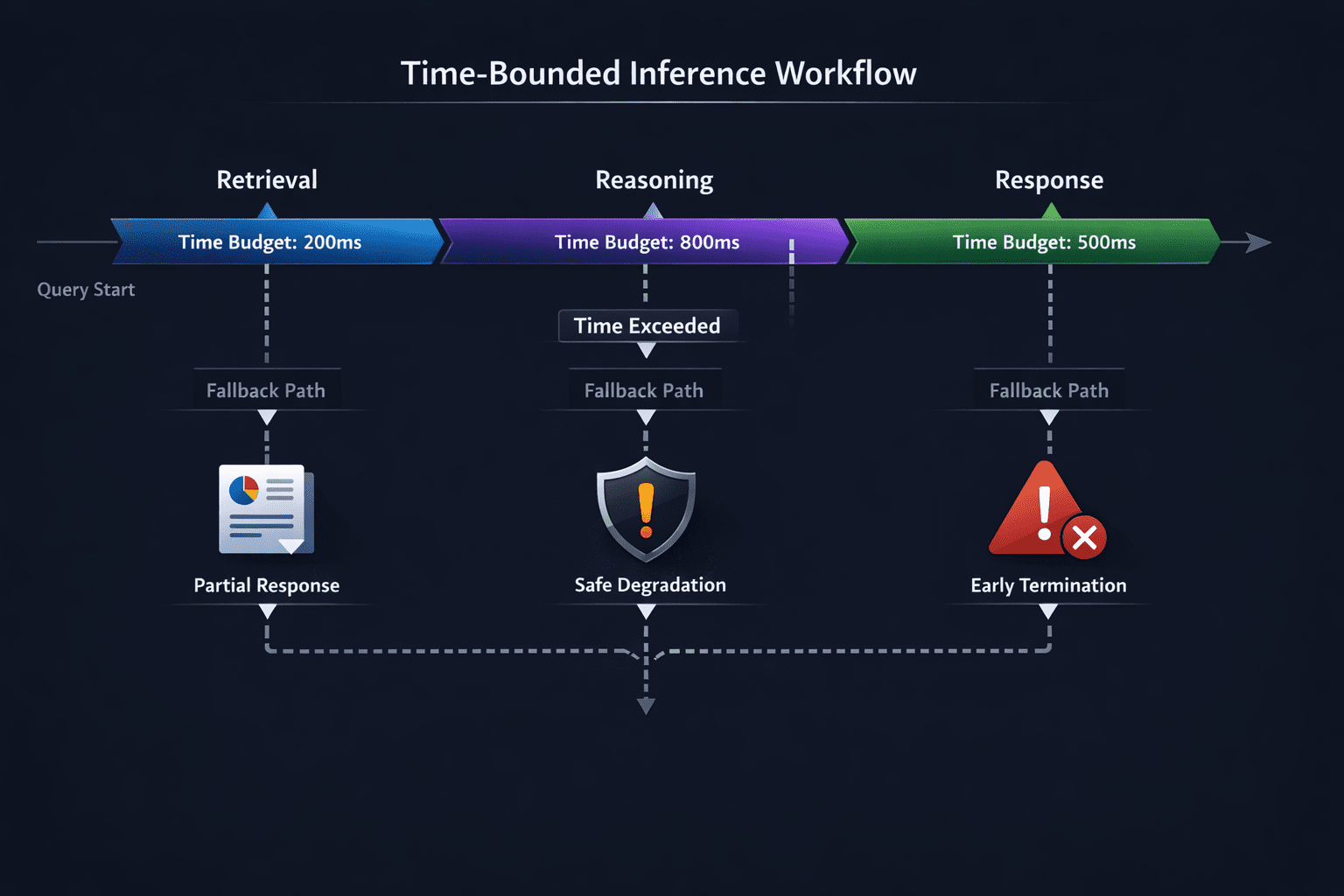
Latency is often framed as a performance concern. In AI systems, it's also a correctness constraint. An answer delivered too late may be factually accurate yet semantically wrong, the user has already taken another action, state has changed, a retry has been triggered, or the interaction context has shifted. Bounded intelligence treats time as a first-class input.
Production-grade AI systems enforce end-to-end latency budgets, per-stage deadlines for retrieval, reasoning, and post-processing, early termination with safe partial outputs, and explicit "no-answer" or "deferred" states. Rather than blocking indefinitely, bounded systems return the best possible answer within the allowed window. This keeps AI aligned with real user timelines, not theoretical model limits. Predictable timing is often more valuable than deeper reasoning delivered inconsistently.
Concurrency defines system stability
Concurrency is where AI systems encounter real-world physics. Mobile reconnects, background jobs, retries, and user bursts all converge here. Without bounds, concurrency introduces duplicate inferences, conflicting outputs, exponential cost growth, and inconsistent user experiences.
Bounded intelligence enforces limits such as fixed inference concurrency per user or session, shared execution keys to deduplicate identical intents, cancellation of stale or superseded requests, and backpressure instead of uncontrolled queue growth. Retries are treated as normal, expected behavior, not exceptional cases. The system is designed so that executing the same logical AI action multiple times produces the same observable result. Stability emerges not from eliminating concurrency, but from shaping it deliberately.
Retries must preserve meaning
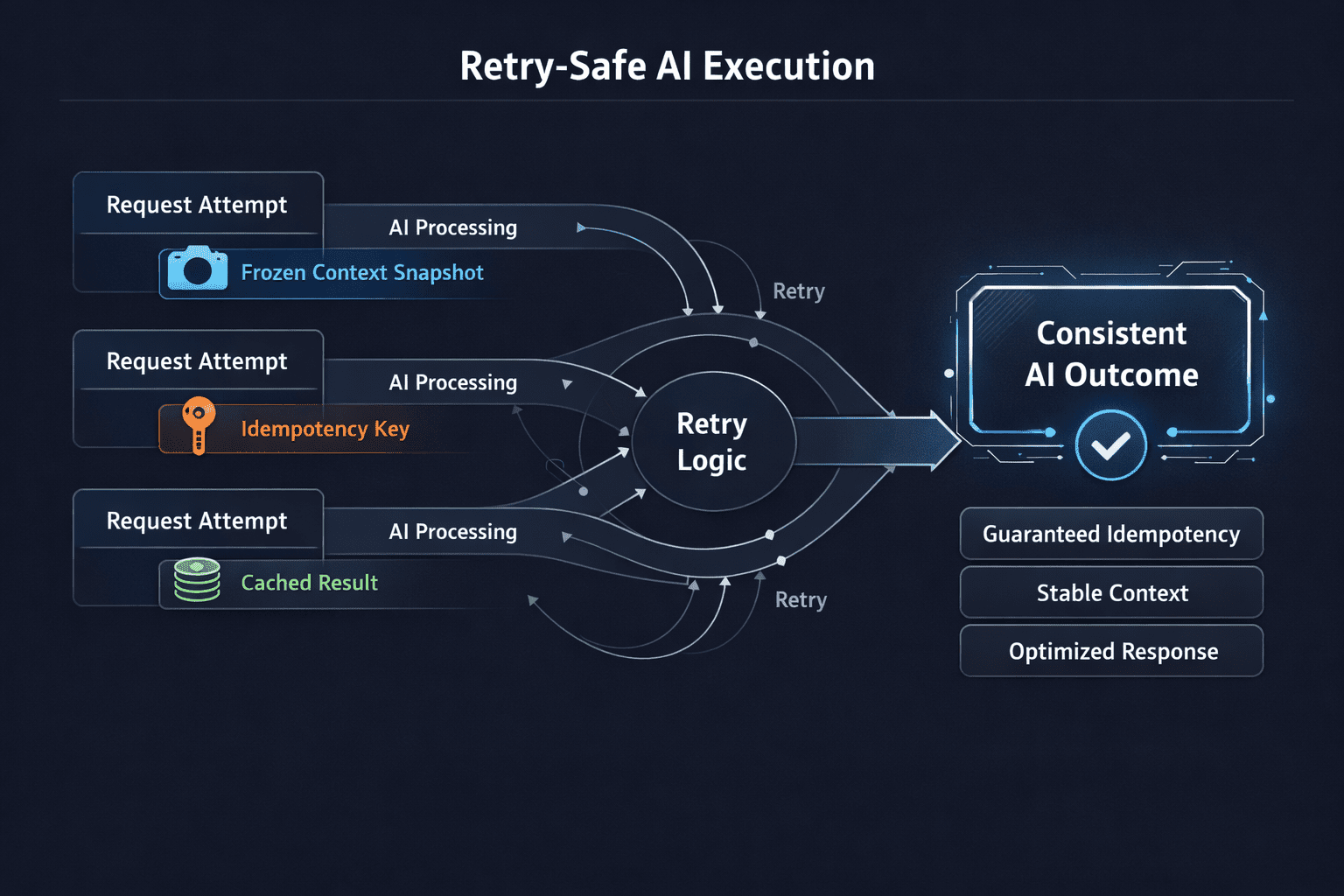
Distributed systems retry by default. AI systems must be designed with this assumption, not layered on afterward. When retries are unbounded, context can change subtly between executions, model stochasticity can introduce variation, tool calls may repeat with unintended effects, and costs can multiply invisibly. Bounded intelligence prevents retries from altering meaning.
Retry-safe AI design typically involves idempotency keys tied to logical user intent, frozen context snapshots per action, cached or memoized outputs reused across retries, and separation between inference execution and result commitment. The principle is simple but strict: retries may repeat computation, but must not change outcomes.
Authority must be explicitly limited
One of the most important boundaries in production AI systems is authority. AI is exceptionally good at generating recommendations, explanations, and insights. Problems arise when those outputs silently cross into decision-making power.
Bounded intelligence enforces a clear separation: AI systems generate advice, insights, and suggestions; deterministic systems apply rules, validations, and state changes; and every mutation of system state passes through non-AI checks. This separation ensures AI errors don't directly corrupt state, decisions remain explainable and auditable, and governance and compliance remain intact. AI informs the system, it doesn't replace it.
Degradation is a designed capability
Every AI system will encounter slow retrieval, partial data, model unavailability, or cost/quota limits. Bounded intelligence treats degradation as a first-class design requirement, not an afterthought. Well-designed degradation may include reduced answer scope instead of speculation, summaries instead of detailed reasoning, cached insights instead of fresh inference, and clear user prompts for missing information.
What bounded systems never do is silently hallucinate or block indefinitely. Degradation is visible, explainable, and predictable, and that preserves user trust even when conditions are imperfect.
At Hoomanely, bounded intelligence is treated as a foundational design principle rather than a reactive safeguard. AI systems are built to operate close to real-world signals, user interactions, device data, and behavioral patterns, where variability is inherent. In such environments, stability comes from constraints: fixed inference budgets, clear separation between insight and action, time-aware decision pipelines, and observable degradation behavior. The emphasis is not on extracting maximum intelligence from every request, but on delivering consistent intelligence across long-running user relationships. Bounded intelligence ensures AI remains dependable as usage scales, features evolve, and systems grow more interconnected.
The outcomes of bounded intelligence
When AI systems are intentionally bounded, several effects compound over time: latency distributions tighten, costs become predictable and controllable, outputs stabilize across sessions and retries, failures become understandable rather than mysterious, and engineering teams regain operational confidence. Most importantly, users learn to trust the system, not because it's always perfect, but because it behaves consistently and transparently.
Key takeaways
Bounded intelligence is a production discipline, not a model limitation. Context, time, concurrency, and authority must be explicitly constrained. Retries are normal, divergence is not. Advisory AI must remain separate from authoritative system state. Graceful degradation is a feature, not a fallback. And predictability beats occasional brilliance in real systems. AI systems earn trust not through spectacular outputs, but through reliable behavior over time.