Designing Boards That Tolerate Assembly Order Variations: A Guide to Hardware Resilience
In the early stages of hardware development, it's incredibly common for engineers to imagine assembly as a perfectly linear, flawless process. Components arrive exactly on time, boards get populated in a strict sequence, firmware is flashed immediately after assembly, cables are connected correctly, and every subsystem powers on exactly when expected. On paper, the process looks impeccably clean.
Reality rarely behaves that way. In actual manufacturing environments, especially during rapid scaling, repair handling, EVT/DVT/PVT transitions, or contract manufacturing transfers, assembly order variations become one of the most heavily underestimated sources of system instability. A PCB that works perfectly on a pristine lab bench may suddenly behave unpredictably when a sensor board powers up before the primary MCU, when one module is connected before another, or when a ribbon cable is inserted while power rails are partially active.
These failures are rarely dramatic. Instead, they appear as frustratingly inconsistent boot behavior, random current spikes, partial system initialization, communication lockups, or devices that only fail sometimes on the production line. The most maddening part? The schematic may still be perfectly correct from a purely electrical standpoint. The root issue is a lack of architectural tolerance. Good hardware does not assume a perfect assembly sequence, it survives imperfect sequencing gracefully.
At Hoomanely, this principle became glaringly apparent while developing modular systems around the EverBowl architecture. Different compute modules, sensor boards, wireless interfaces, and power subsystems often evolved entirely independently during bring-up. Some modules were assembled weeks earlier than others. Some PCBs arrived from fabrication long before their companion boards. The systems that ultimately behaved most reliably were never the ones with the most complex, clever circuitry. They were the systems intentionally designed to tolerate uncertainty in assembly and power-up sequences.
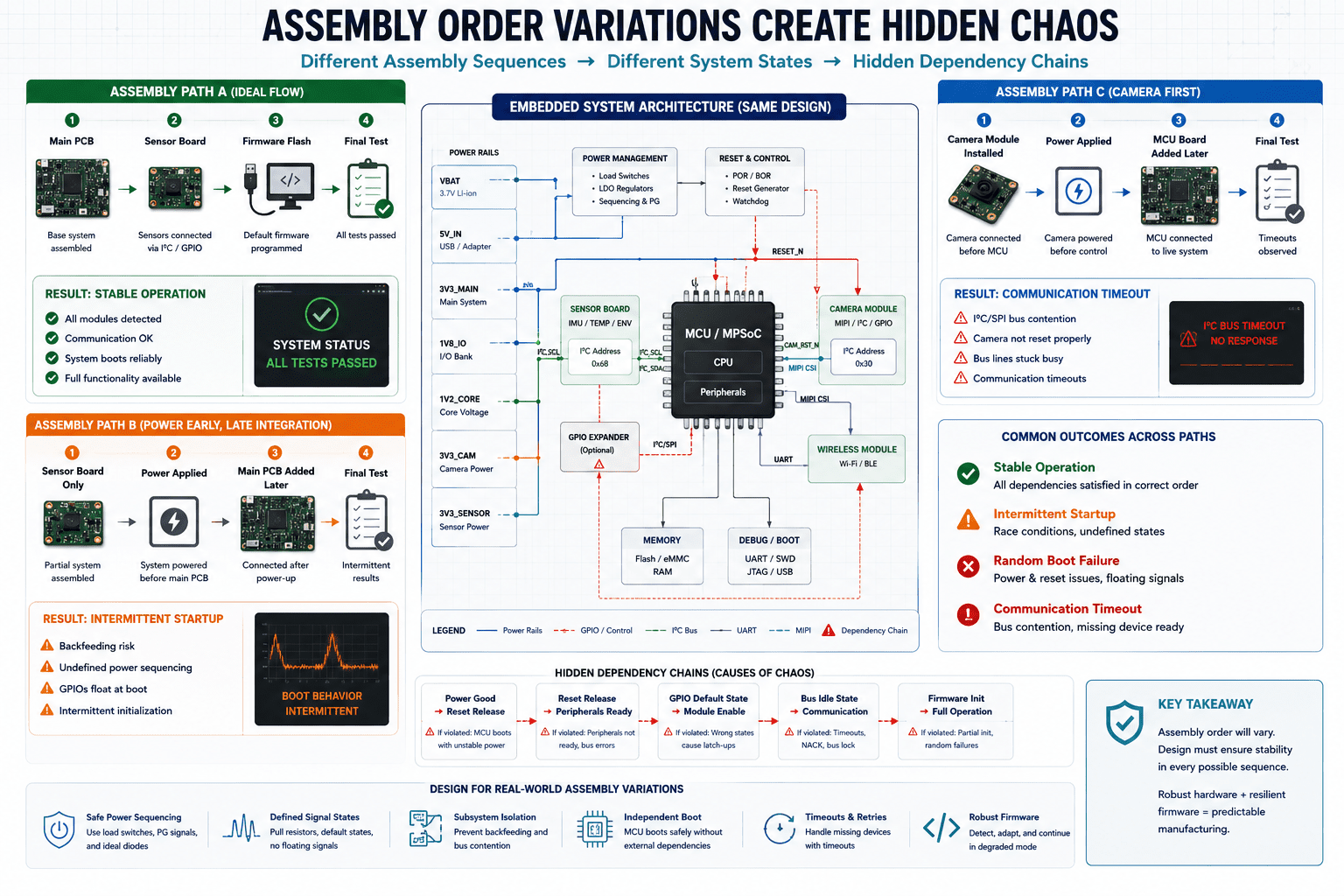
Why assembly order variations create hidden chaos
Modern embedded systems are deeply interconnected. Power rails, GPIOs, reset lines, communication buses, and boot configuration pins frequently cross boundaries between multiple boards, creating hidden dependencies invisible on a high-level block diagram. A dedicated sensor module might inherently expect the main processor rail to be stable before its I/O buffers become active. A wireless module might aggressively drive UART lines high before the host MCU has even finished its boot ROM execution. A PMIC might enter an entirely undefined state if its enable pins are left floating during partial system assembly. When assembly happens differently than expected, these fragile assumptions instantly collapse.
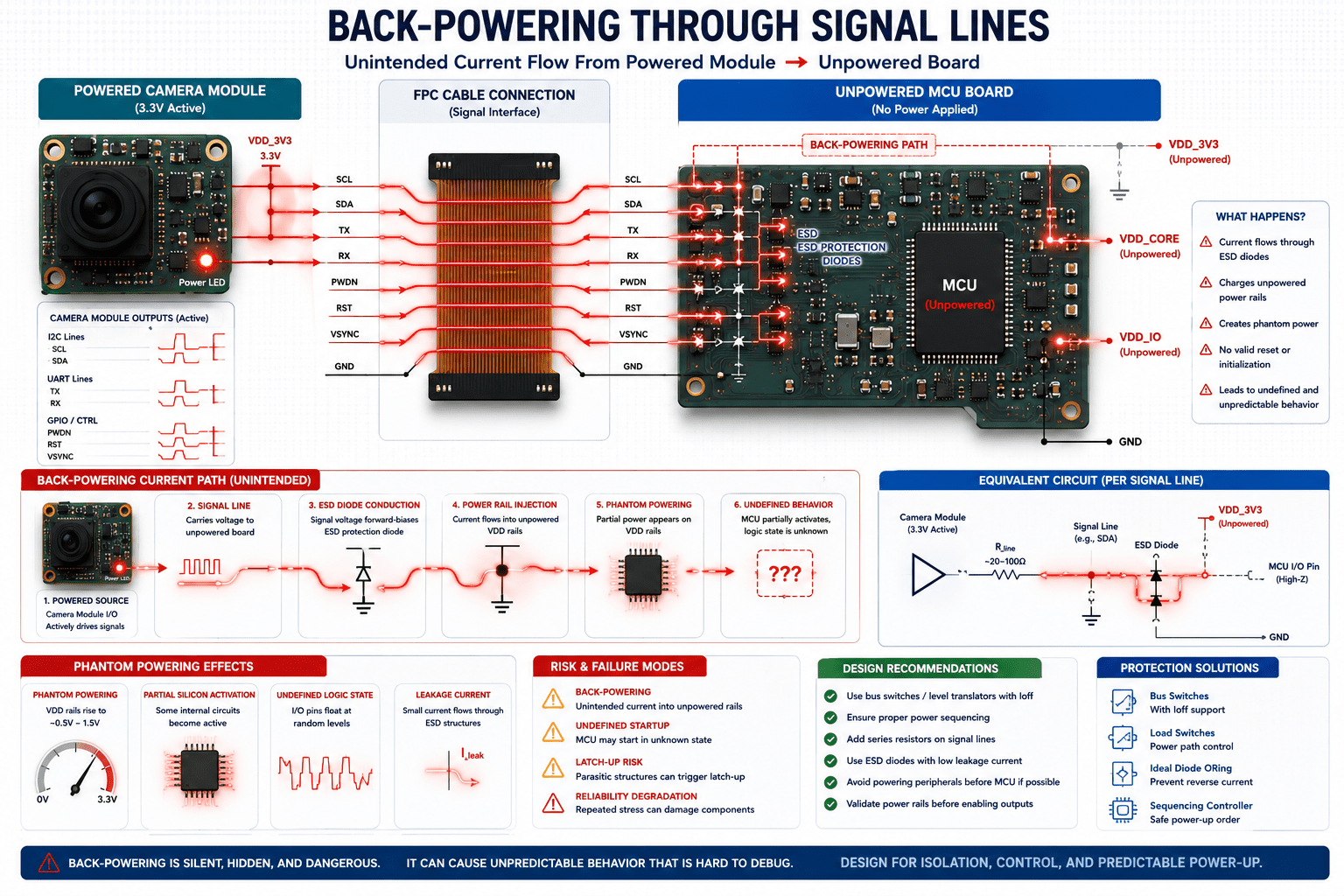
One notoriously common example is back-powering through signal lines. Imagine a high-resolution camera board connected to a mainboard via an FPC cable. The processor board is currently unpowered, but the camera module receives auxiliary power first during a specific bench test. If communication lines like UART, I2C, or CSI lanes contain standard internal ESD protection diodes tied to their local internal rails, current can flow backward from the camera, through the signal lines, across the ESD diodes, and into the processor's power domain. The processor is technically "off," but isolated portions of its internal silicon become partially energized.
This phantom powering leads to severe consequences:
- Undefined logic states where internal gates sit at intermediate voltage levels
- Incomplete resets where watchdog timers and power-on resets fail to trigger cleanly
- High leakage currents leading to localized heating
- Boot ROM corruption where the processor boots into unknown or test states
- Bus contention from multiple devices driving the same lines simultaneously
- Latch-up risks where parasitic thyristors in the CMOS structure can short VDD to ground
The failure may disappear entirely once full assembly happens in the intended order, making root-cause debugging incredibly difficult. The board appears inherently unreliable, even though the real culprit is a lack of sequencing tolerance.
Designing for partial system presence
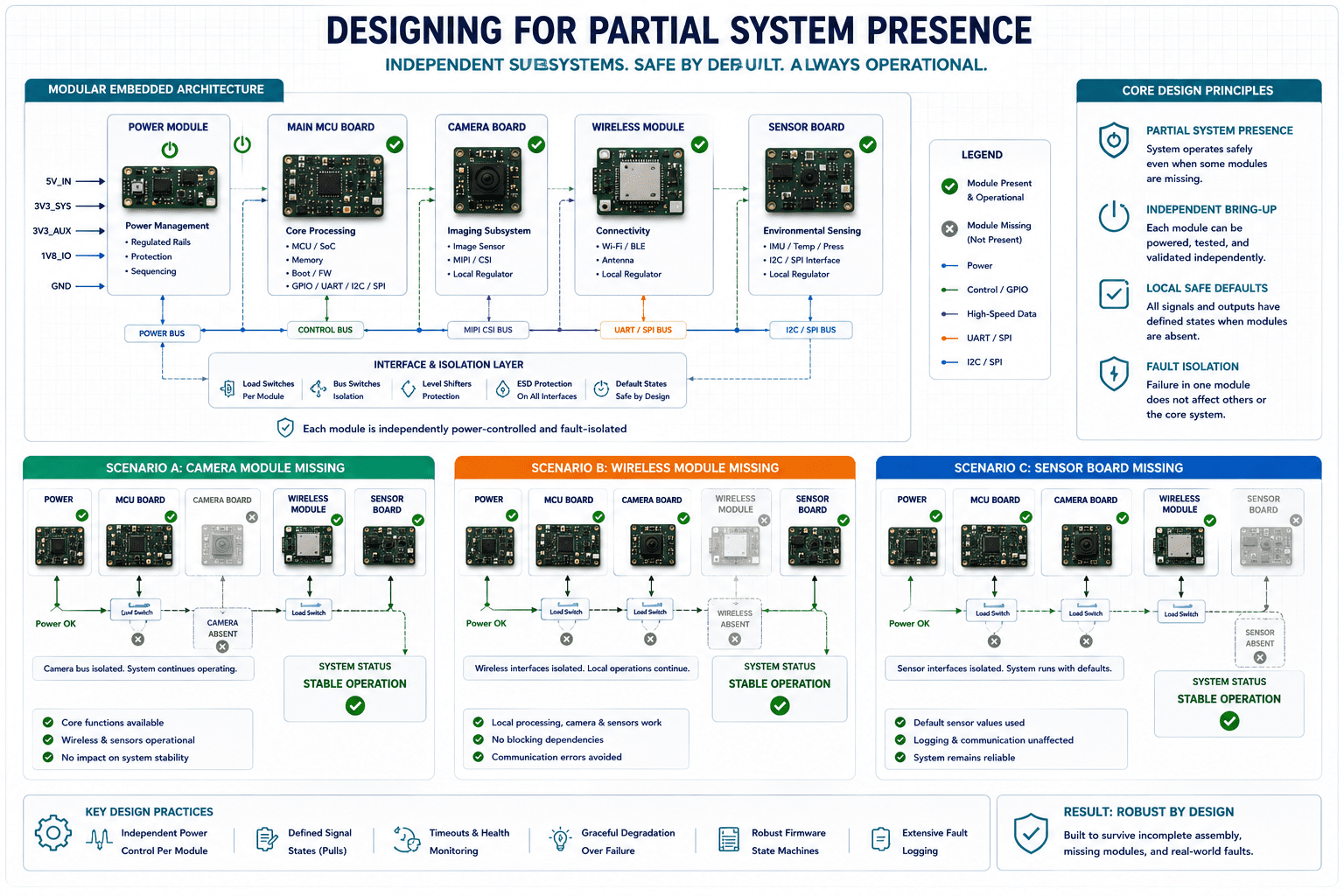
One of the most vital mindset shifts a hardware engineer can make is designing for partial presence. Every subsystem must behave safely, electrically and logically, even if its neighboring subsystems are entirely absent, significantly delayed, unpowered, or only partially connected.
This principle fundamentally changes how hardware interfaces are designed. Instead of assuming a connected peripheral will always be there, the hardware must tolerate floating communication buses, delayed power rail arrival, connector hot-plugging during active debug sessions, partial or incomplete harness assembly, total absence of application firmware, uninitialized or high-impedance GPIO states, and missing companion modules during the manufacturing flow.
In EverBowl's modular architecture, several development boards were intentionally designed to operate fully independently long before full-stack integration occurred, requiring deeply stable, localized defaults rather than relying on the main application firmware to set the rules. The difference in system stability was significant. Boards became testable weeks earlier. Manufacturing line diagnostics improved substantially. Complex integration failures became easier to isolate. Most importantly, those unpredictable "sometimes" failures were reduced considerably.
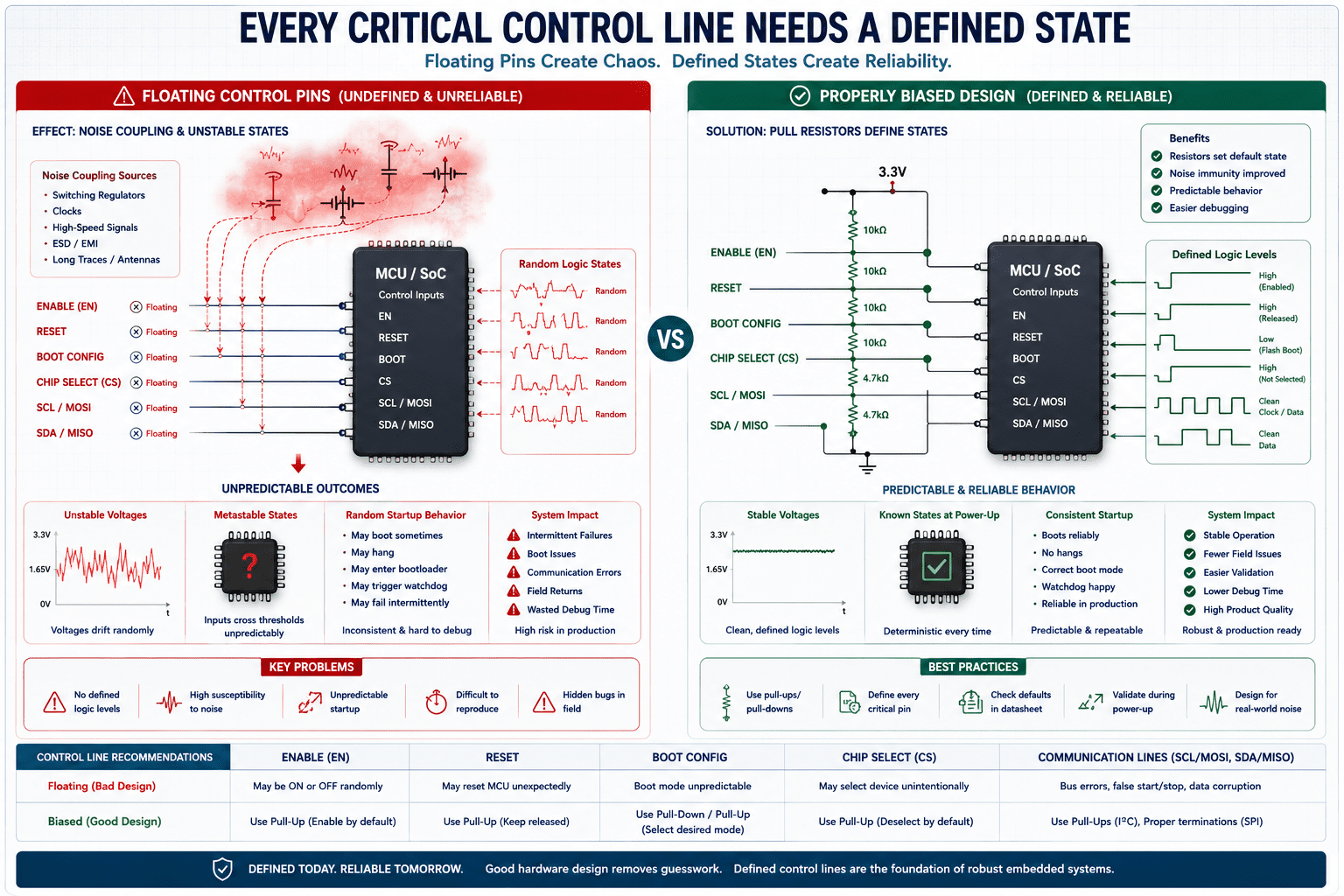
Mitigating the danger of floating control lines
Assembly-order instability frequently originates from a single, uncontrolled logic pin. Enable pins, system reset lines, boot mode selectors, interrupt outputs, and power-good signals are almost always assumed to be actively driven by a master controller. During real-world manufacturing conditions, these lines may float in a high-impedance state for seconds, minutes, or even hours.
Floating control pins create unpredictable states because standard CMOS inputs consume virtually zero current, and their internal gate capacitance can easily drift toward undefined middle-voltage thresholds due to ambient electromagnetic noise or microscopic board leakage. This directly causes inconsistent startup behavior:
- A floating enable pin on a buck regulator may cause it to oscillate violently during a rail ramp-up
- A floating reset line may keep critical peripherals trapped in a half-initialized zombie state
- A floating boot configuration pin might accidentally place a production MCU into a factory programming mode
The solution is deceptively simple yet frequently overlooked: every critical control line must have a rigidly deterministic default state. Enable pins should always include physical pull-ups or pull-downs establishing an off or safe default. Reset lines should bias heavily toward the active-reset state until explicitly released by a stable source. Boot configuration should be hardwired using physical resistor strapping. Chip selects should be pulled to their inactive state locally. Communication interfaces should be designed idle-safe so they don't trigger false start bits. The most critical detail is that these defaults must exist electrically, they cannot depend on firmware execution. Stability must exist physically before a single line of software begins to run.
Making power domains independent during bring-up
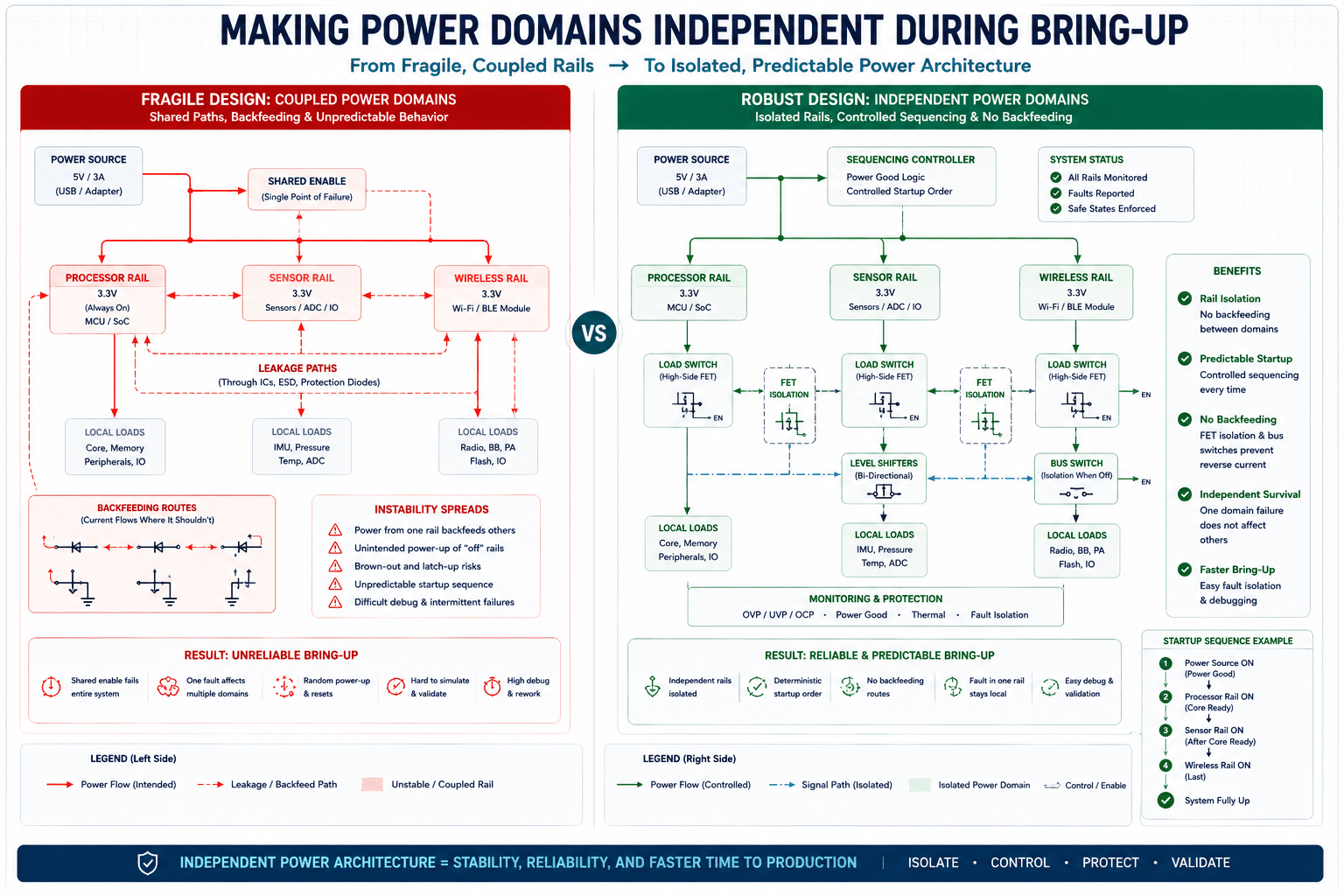
A major cause of sequencing-related catastrophic failures is excessive, undocumented coupling between different power domains. In poorly isolated architectural layouts, one power rail indirectly controls or influences another through signal line leakage, shared enable logic trees, or internal protection structures. When domains are tightly coupled, power-up timing becomes fragile, partial startup states become physically dangerous to the silicon, debugging becomes inconsistent, and field servicing becomes a high-risk operation.
A more resilient design treats every power domain as independently survivable. Rails should never backfeed one another. Disabled domains must remain electrically quiet. Interfaces must tolerate one side being fully unpowered without drawing current, and signal paths must aggressively avoid parasitic powering. Engineers should use series resistors on inter-board signals to limit potential back-drive current, level shifters with guaranteed high-impedance isolation when power is lost on either side, bus switches to physically disconnect I2C or SPI lines until both sides are verified ready, power sequencing supervisors for reliable rail timing management, and FET-based domain isolation to physically cut off power to entire subsystems. The goal isn't merely preventing permanent hardware damage, it's maintaining absolute predictability. A predictable, hard failure is far easier to diagnose and fix than an intermittent, occasional success.
Connector sequencing matters
Connectors introduce an entirely separate layer of assembly-order complexity. Ground pins may make contact milliseconds after active signal lines. High-current power may arrive before the reference return paths have stabilized. Long FPC cables can capacitively inject sharp voltage transitions into neighboring sensitive lines during physical insertion.
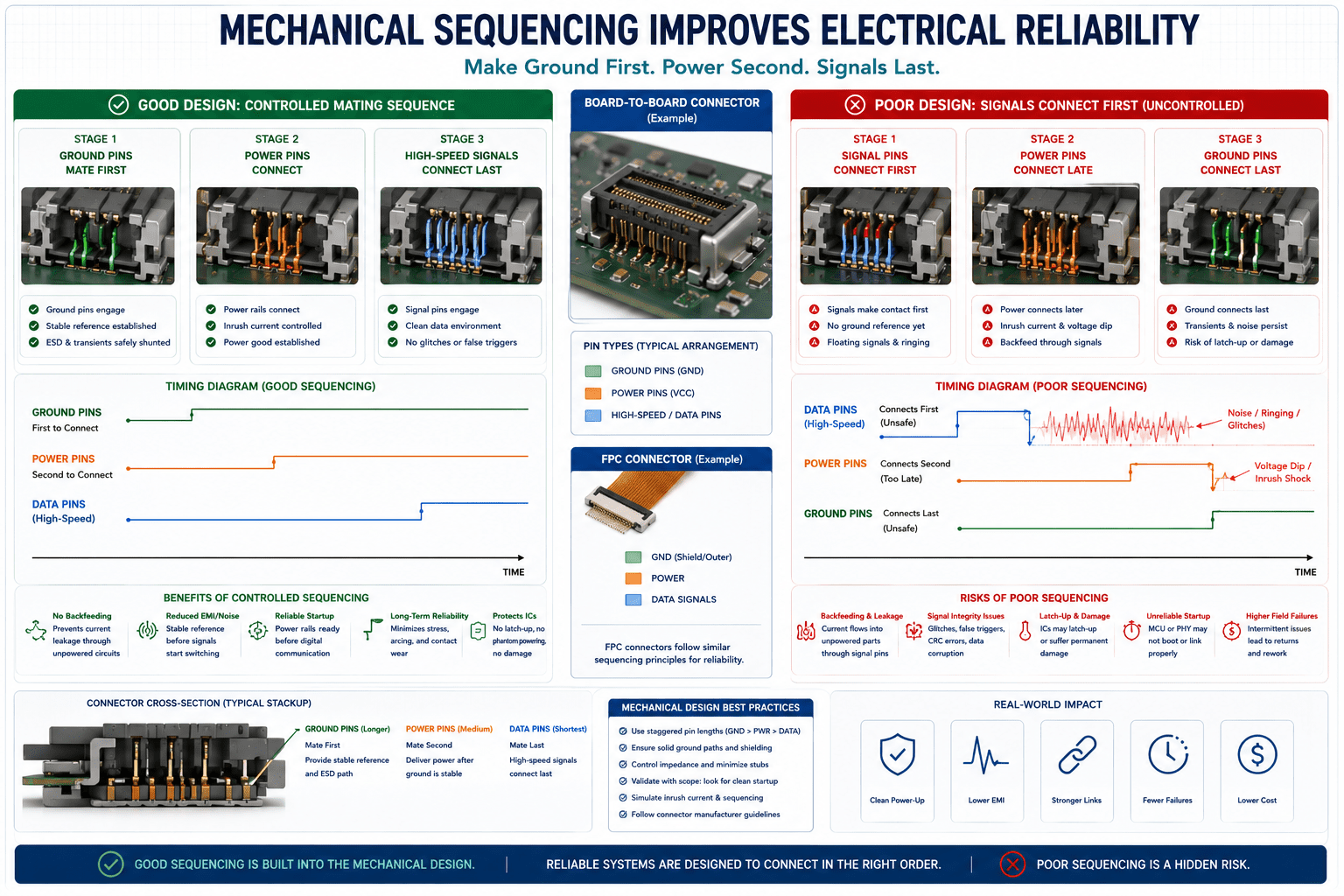
Professional, high-reliability systems often solve this through staged connector mating:
- Ground pins mate first to establish a common reference and safe return path for ESD
- Power pins mate second to energize the circuitry safely
- High-speed signals mate last to ensure data lines only connect when transceivers are fully powered and stable
This mechanical sequencing dramatically improves hot-plug tolerance and eliminates transient instability. Even without specialized staged connectors, engineers can heavily improve robustness through PCB layout:
- Placing grounds immediately adjacent to sensitive signals
- Physically separating high-current power lanes from high-speed data lanes
- Avoiding routing exposed control pins near connector edges
- Adding inline damping resistors plus TVS diodes wherever insertion transients are expected
Breaking hidden dependency chains
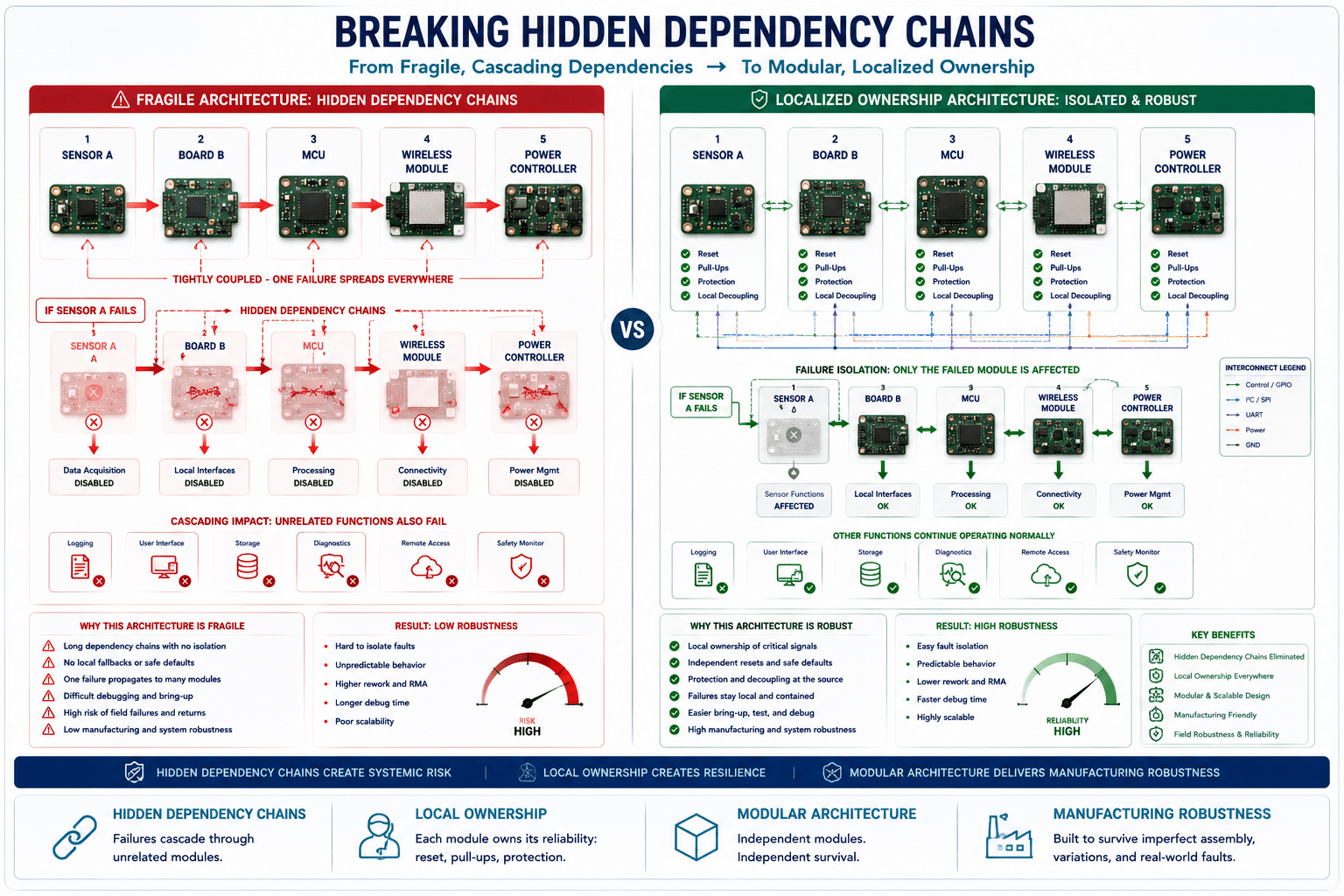
One of the most dangerous, insidious patterns in embedded hardware is the hidden dependency chain, where subsystem A silently depends on subsystem B being perfectly initialized first, even though this relationship is entirely undocumented in the schematic. Examples include routing a sensor's reset line through a completely separate module, or requiring a third, optional board to provide the physical pull-up resistors for an I2C bus.
These highly coupled architectures may appear efficient on paper, saving a few resistors or routing channels, but they become fragile during manufacturing variations. If one board is delayed on the assembly line, temporarily disconnected for rework, or partially assembled, entirely unrelated sections of the product will stop functioning. The superior approach is localized ownership, each discrete subsystem should own its own reset defaults, pull-up and pull-down structures, local bulk decoupling, and protection behavior. Distributed dependency chains destroy modularity and drastically increase a product's sensitivity to the manufacturing environment.
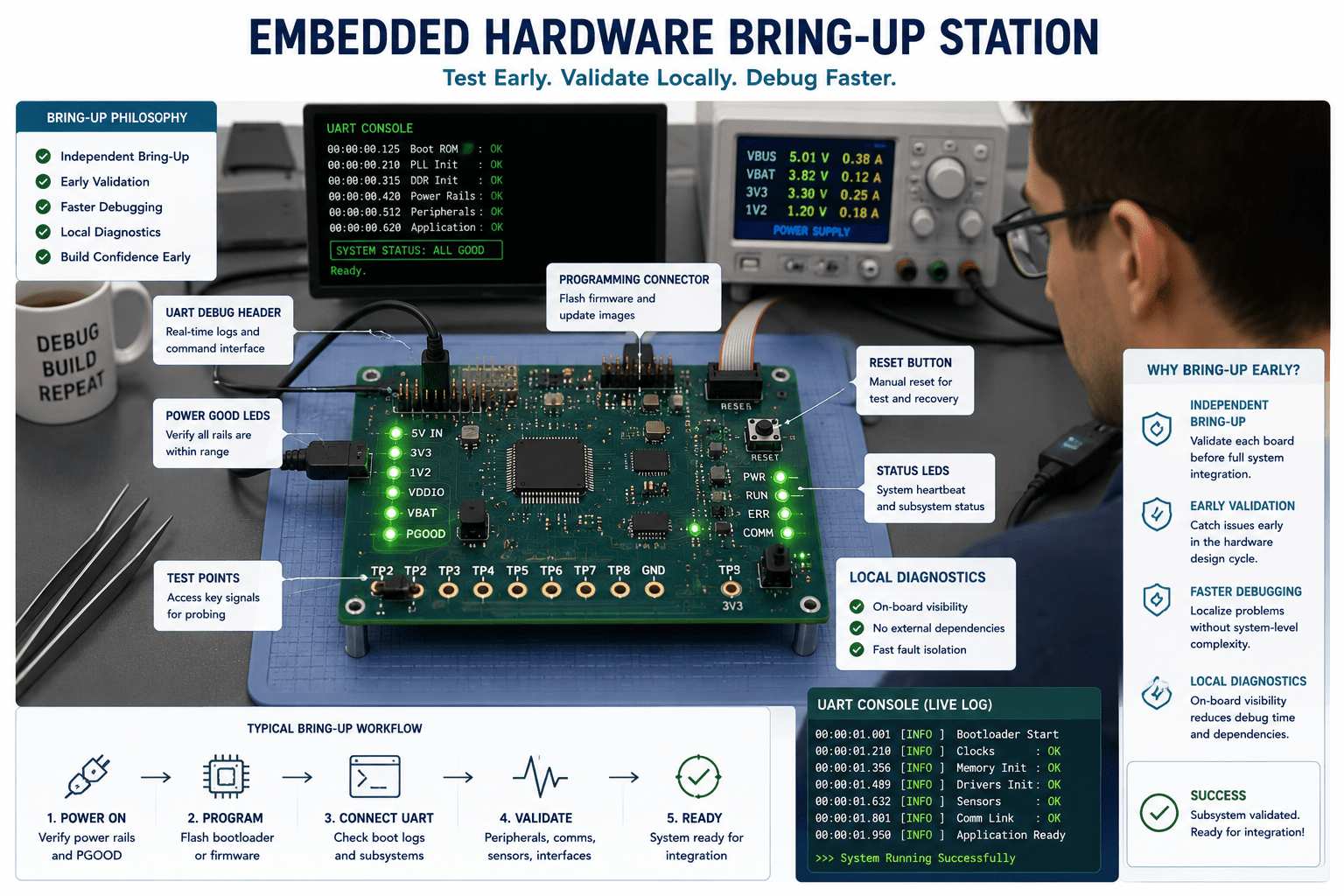
Designing for debugging before full integration
Far too many boards are validated only after complete, final integration, creating a massive bottleneck when the system fails to boot and failures become nearly impossible to isolate. A more scalable approach designs each subsystem for immediate, independent bring-up, exposing enough physical observability to answer basic diagnostic questions even before the rest of the system is plugged in.
Consider adding local power-good indicator LEDs for every major rail, accessible UART test points that stream status data immediately, independent programming headers for secondary MCUs, physical tactile buttons for local resets, and default boot modes triggerable without relying on upstream software. During EverBowl's development cycle, early hardware bring-up became exponentially faster once individual modules could self-identify their power state without waiting for the host processor to ask. Instead of asking "why doesn't the system boot?", the team could ask "why did the vision subsystem fail to achieve power-good?" That shift in observability changes debugging efficiency completely.
Firmware cannot be your only safety layer
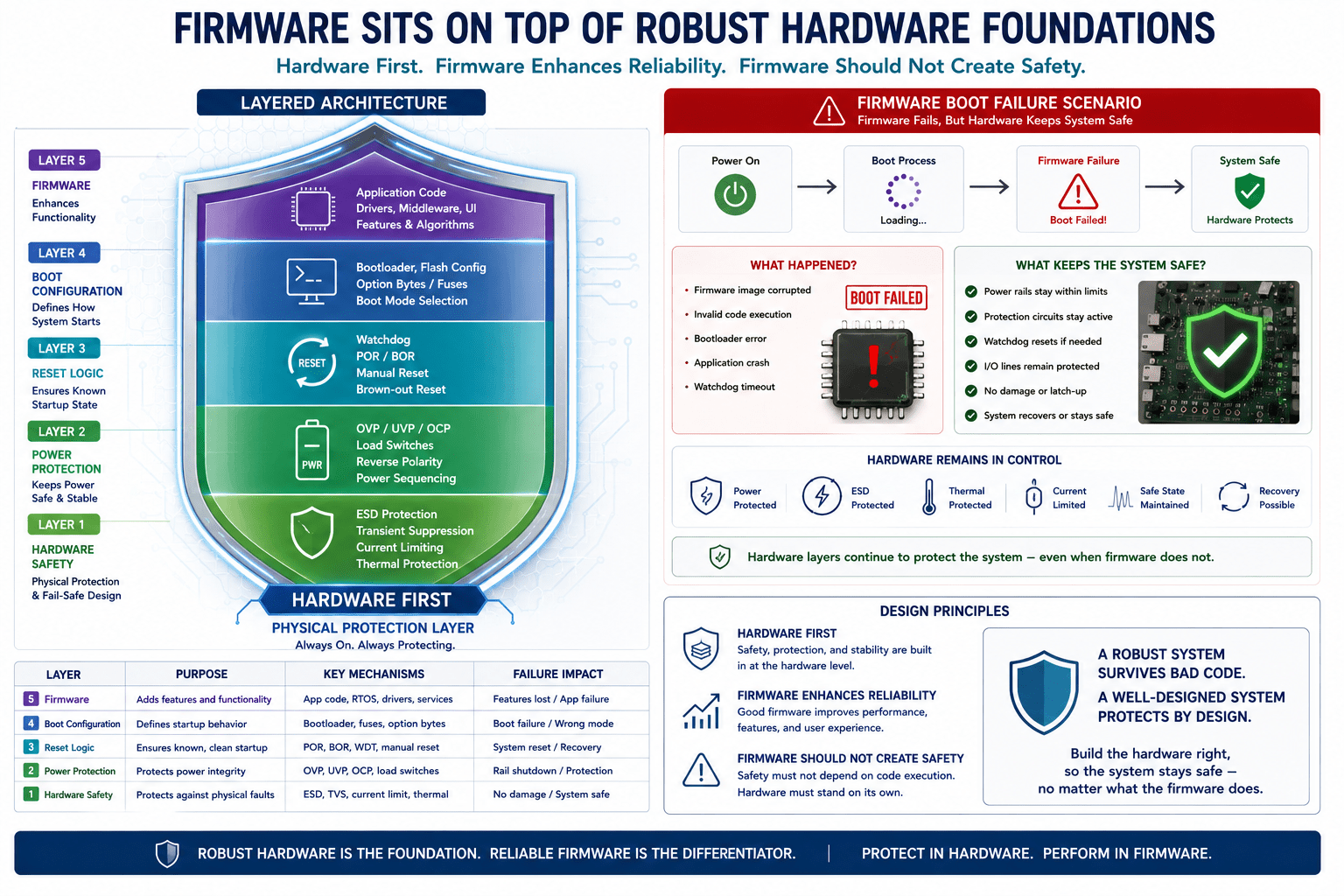
A deeply entrenched trap in electrical engineering is assuming the firmware team will simply initialize the hardware correctly and fix any floating states in software. During assembly-order variations and manufacturing hiccups, the firmware may never even execute. Voltage brownouts, unstable crystal oscillators, undefined hardware reset states, and partially powered MCU domains can easily prevent the bootloader from ever running. Therefore the hardware itself must remain intrinsically safe prior to any firmware intervention.
Regulators must default to safe, low-voltage, or off states. Boot selector pins must never be allowed to float. Communication interfaces should never actively drive unknown logic levels into sleeping chips. Current paths must remain strictly bounded by hardware limits. Firmware is there to enhance system robustness and provide features, it should never be tasked with creating the first and only layer of physical hardware safety.
Final thoughts
Perhaps the biggest lesson in hardware engineering is realizing that manufacturing environments are fundamentally human systems. Circuit boards are handled by technicians working under time pressure, complex assemblies are interrupted by breaks or shift changes, board reworks happen mid-process, ribbon cables are inserted slightly askew, and modules are swapped and replaced individually to test failures.
The best hardware acknowledges this messy, human reality rather than stubbornly resisting it. A truly resilient board doesn't demand perfectly sterile handling and flawless sequencing to survive the day. At Hoomanely, some of the most valuable architectural improvements didn't come from running SPICE simulations, they came from standing on the factory floor, observing exactly how real technicians interacted with prototype hardware during bring-up, testing, and debugging. Perfect assembly order is an illusion. Real-world systems will always experience delayed power rails, missing peripherals, temporarily unstable interfaces, and inconsistent sequencing throughout their lifecycle. Boards designed strictly for pristine lab conditions inevitably become fragile in the field. Boards explicitly designed to handle imperfect conditions become scalable products.