Designing for Reality: When Field Handling Evolved the Product
How Real-World Use Drove Mechanical Design Decisions
No matter how carefully a product is engineered, its first encounter with real users almost always reveals something the design team did not anticipate.
Engineers interact with products differently than users. During development, devices are handled deliberately, assembled with care, and operated according to design intent. In the field, however, products are picked up with one hand, set down abruptly, bumped against hard surfaces, dropped accidentally, cleaned with unfamiliar tools, and transported in ways never considered during the design phase.
These interactions rarely appear in CAD models or finite element simulations, yet they often determine how users perceive a product's quality and reliability.
While developing Everbowl, we realized that the product's mechanical performance could not be judged solely by laboratory testing. Observing how the device was handled during demonstrations, transportation, assembly, and everyday use exposed several opportunities for improvement. Some changes enhanced durability, others improved aesthetics, and many simply made the product more forgiving to human behavior.
This blog explores how field handling influenced the evolution of Everbowl and why designing for real-world interaction is just as important as designing for nominal engineering loads.
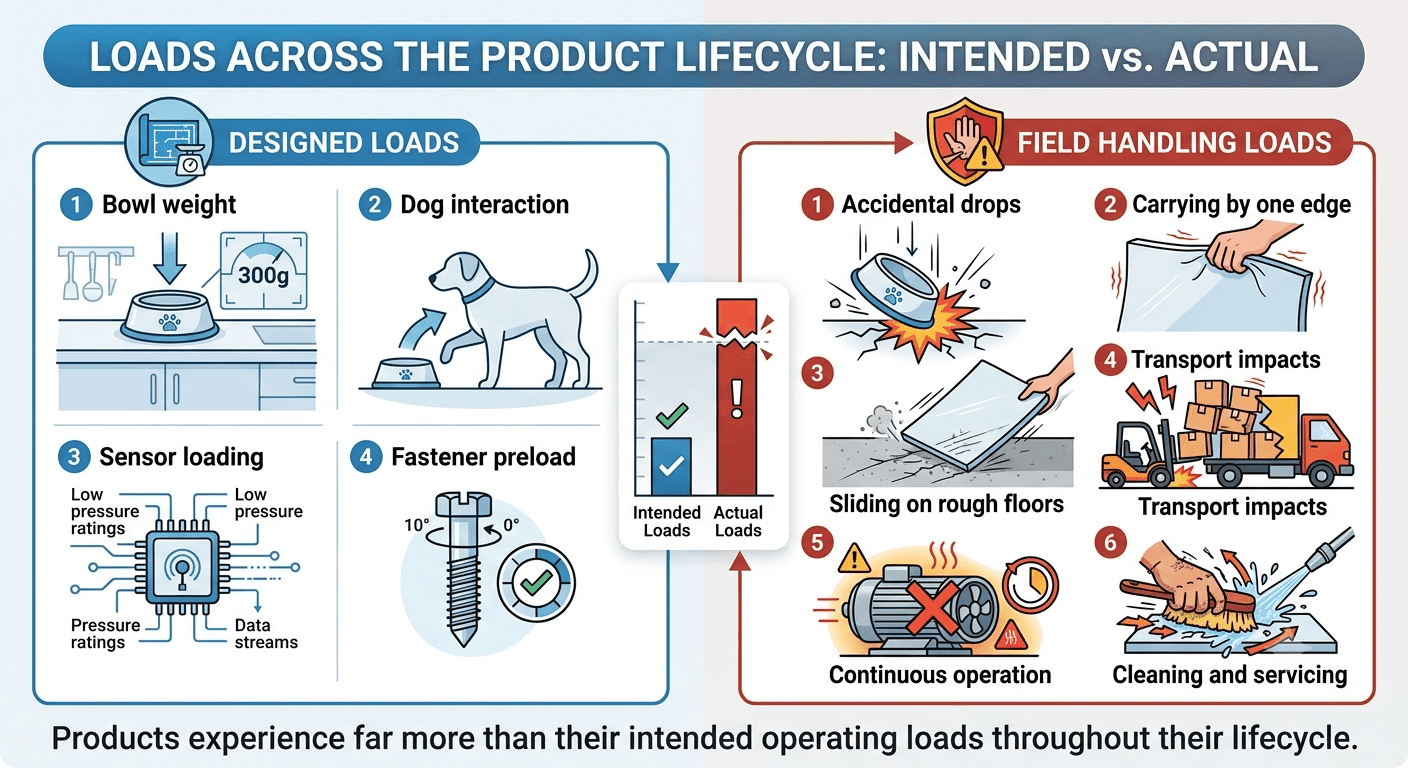
The Difference Between Design Loads and Handling Loads
Mechanical design often begins with well-defined loading conditions.
For Everbowl, these included:
- Static bowl weight
- Dynamic loads caused by dogs eating
- Structural loads transferred through the aluminum load-cell assembly
- Fastener preload
- Long-term operational stresses
These loads are predictable and can be modeled through engineering analysis.
Field handling introduces a different category of loads.
These are not generated by the product's intended function but by the people interacting with it.
Examples include:
- Lifting the product by one edge
- Sliding it across rough surfaces
- Accidental drops during installation
- Impact during transportation
- Twisting while carrying
Unlike operational loads, handling loads are difficult to predict but occur surprisingly often throughout a product's life.
Why Laboratory Success Doesn't Guarantee Field Success
A product can pass every engineering validation test and still disappoint users.
Why?
Because users evaluate products differently than engineers.
Engineers focus on:
- Structural integrity
- Measurement accuracy
- Load capacity
- Factor of safety
Users notice:
- Visible scratches
- Loose components
- Surface wear
- Noise during handling
- Overall perceived quality
A product that remains fully functional but appears worn after a few weeks may still be viewed as unreliable.
This makes cosmetic durability an engineering consideration, not merely an aesthetic one.
Learning from Real Handling
As additional Everbowl units were assembled and demonstrated, several patterns became evident.
The product was frequently:
- Picked up by the bowl rather than the base
- Rested on uneven workbenches during servicing
- Moved repeatedly between testing stations
- Packed and unpacked for demonstrations
- Handled by people unfamiliar with the internal sensing system
These observations highlighted areas where the design could better tolerate unintentional misuse.
Rather than asking users to change their behavior, we chose to adapt the product.
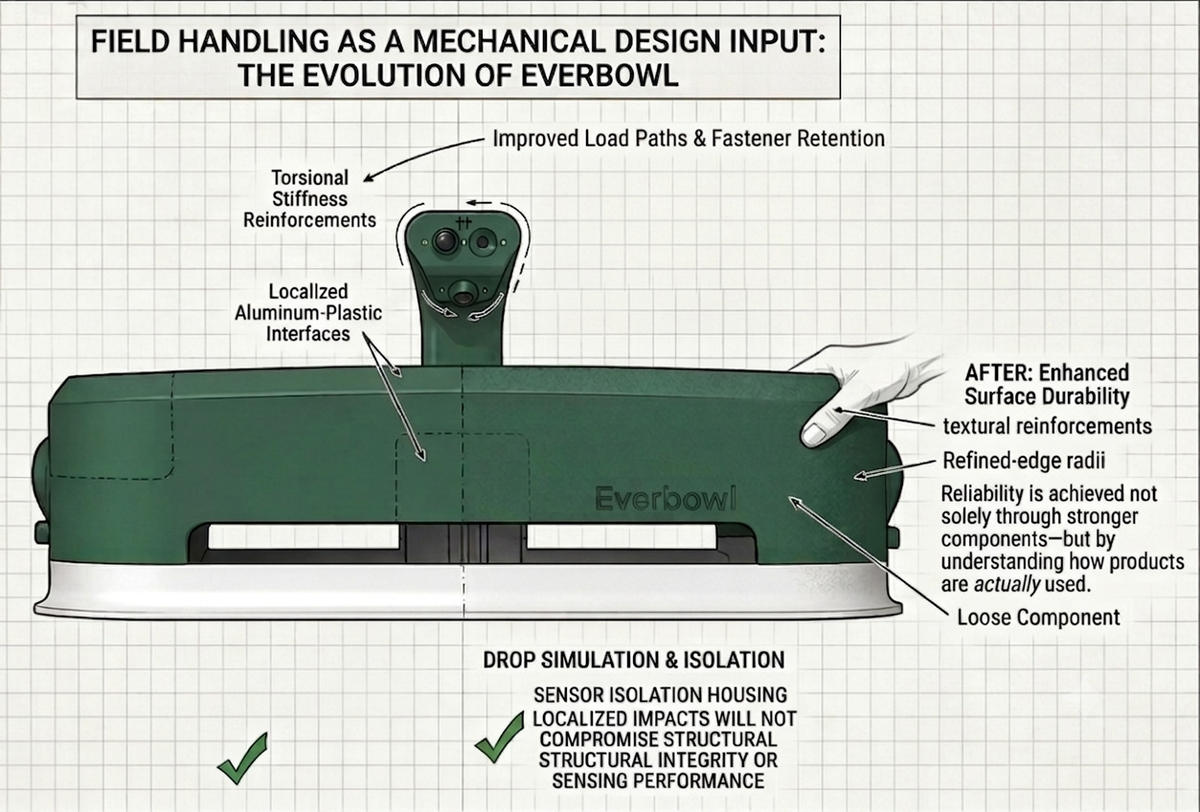
Design Change #1: Improving Structural Robustness
One of the earliest observations was that users rarely apply forces symmetrically.
Instead of lifting the product from its center, it was often lifted from one side.
This introduced torsional loading through the aluminum ring structure.
Although these loads remained well below material limits, repeated off-axis handling could introduce unnecessary stresses into the measurement system.
What We Changed
We, the design team:
- Increased stiffness in key load-bearing regions
- Improved load transfer between aluminum rings and plastic housings
- Refined the structural load path to reduce localized bending
These changes improved the product's resistance to handling-induced deformation without increasing unnecessary weight.
Engineering Insight
Designing for users means assuming that the product will occasionally be handled in ways the design never intended.
Design Change #2: Reducing Cosmetic Damage
Repeated demonstrations exposed another issue.
While the device remained mechanically sound, cosmetic wear accumulated faster than expected.
Common sources included:
- Contact with metal tools
- Sliding across work surfaces
- Transport inside storage cases
- Frequent assembly and disassembly
None of these affected functionality.
However, cosmetic damage influences user perception and stakeholder confidence.
What We Changed
The team improved surface durability through:
- Better paint preparation
- More consistent coating processes
- Improved edge geometries
- Material selection based on expected wear locations
The objective was not simply to make the product look better—it was to ensure it continued looking well-built after repeated use....
Design Change #3: Designing for Accidental Drops
Few products are intentionally dropped.
Almost every product is eventually dropped accidentally.
Drop events introduce impact loads several times greater than normal operating conditions.
Even modest drops from table height can generate peak forces significantly exceeding static loads.
Rather than designing exclusively for nominal conditions, we evaluated likely impact scenarios during handling.
Areas Reviewed
- Plastic enclosure interfaces
- Aluminum ring attachments
- Fastener retention
- Sensor mounting
- Internal component clearances
This review ensured that localized impacts would not compromise structural integrity or sensing performance.
Designing for Human Behavior
One of the most important lessons from field testing was that products should not depend on perfect user behavior.
Good mechanical design anticipates these behaviors.
Rather than resisting human interaction, products should accommodate it.
This philosophy leads to systems that feel more intuitive, more durable, and ultimately more trustworthy.
Engineering Insight
Products rarely fail because users are careless. More often, they fail because designers assumed users would behave predictably.
Future Trends: Designing with Real Usage Data
Modern product development increasingly incorporates field data into mechanical design.
Emerging practices include:
Instrumented Prototype Testing
Using onboard sensors to record real handling loads.
Digital Twin Validation
Comparing field behavior with simulation predictions.
Human-Centered Mechanical Design
Designing products around observed user behavior rather than idealized operation.
Predictive Reliability Engineering
Using field data to improve future product iterations before failures occur.
Hoomanely Context
At Hoomanely, engineering extends beyond calculations and simulations. Every prototype is viewed as an opportunity to observe how people—and in the case of Everbowl, pets—interact with the product in real environments.
Many of the refinements made during Everbowl's development were not driven by laboratory failures but by simple observations during demonstrations, transportation, assembly, and daily handling. These insights helped create a product that is not only mechanically robust but also resilient to the unpredictability of real-world use.
Designing for field handling reinforced an important principle: reliability is not achieved solely through stronger components—it is achieved by understanding how products are actually used.
Key Takeaways
- Laboratory testing cannot replicate every real-world handling scenario.
- Human interaction introduces loads beyond normal operating conditions.
- Cosmetic durability influences user confidence as much as structural integrity.
- Designing for accidental drops improves long-term reliability.
- Separating cosmetic damage from functional failure helps prioritize engineering improvements.
- Real user observations often reveal more valuable insights than controlled testing.
- Products become more reliable when they accommodate natural human behavior instead of expecting perfect handling.
Conclusion
Engineering calculations define how a product should behave. Field handling reveals how it actually behaves.
Throughout Everbowl's development, many of the most meaningful design improvements emerged not from failures under controlled conditions, but from watching the product move through everyday life—being carried, assembled, transported, demonstrated, and occasionally mishandled.
Each observation challenged an assumption. Each redesign reduced a source of vulnerability. Over time, the product became less dependent on careful handling and more resilient to the realities of everyday use.
Ultimately, designing for field handling is not about preparing for the worst. It is about recognizing that the true environment of any product is not the laboratory—it is the hands of the people who use it.