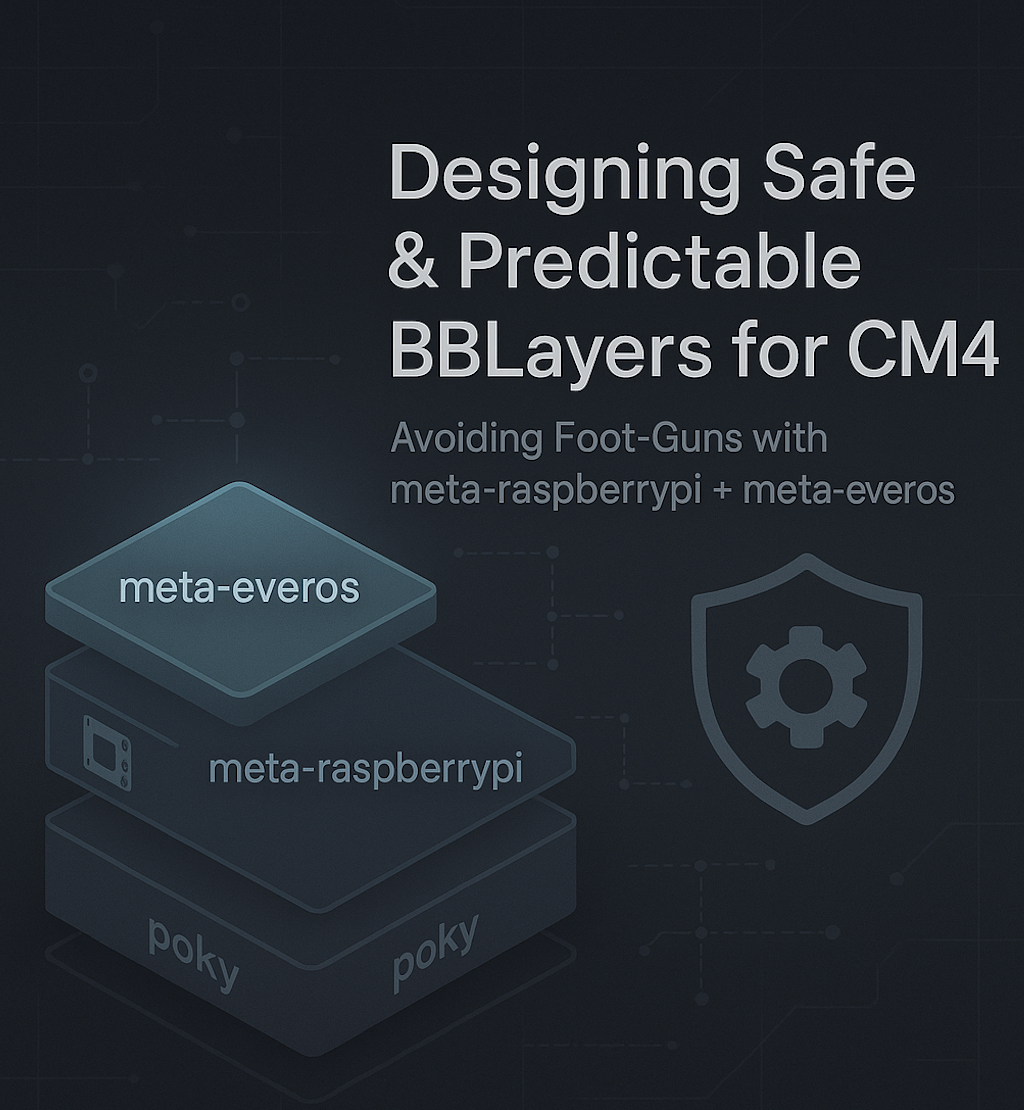
Designing Safe and Predictable BBLayers for CM4
Yocto gives embedded teams extraordinary power, and it gives them just as much power to break their own systems in subtle, silent ways. Anyone who's shipped a commercial Linux-based device knows this: your build system becomes part of your product's architecture. If the layering model is unstable, everything above it inherits that fragility.
At Hoomanely, we build a multi-device pet-care ecosystem powered by modular SoM-driven architectures, EverBowl, EverSense trackers, EverHub gateways, and Yocto is the glue that keeps behavior consistent across those platforms. As we scale machine configurations and SoM variants, we have to prevent hidden overrides, version drift, and bitbake shadowing traps long before they hit a build server.
This post explains how to design a safe, predictable, conflict-free BBLayers model for CM4 using meta-raspberrypi and a custom meta-everos layer.
The problem: layering that looks fine, until it isn't
Yocto layering issues tend to hide quietly until they explode loudly. Bitbake will happily let two layers define the same recipe and pick one via priority rules you forgot existed, allow unintentional FILESEXTRAPATHS shadowing, accept a machine config that partially inherits from another and silently drops critical includes, permit .bbappend files that never actually apply, and build an image that "works" while embedding mismatched kernels, firmware, or BSP patches.
CM4-based systems raise the stakes during prototyping. meta-raspberrypi is opinionated, kernel fragments, GPU stack, firmware blobs, boot partition structure, which means your own layer has to cooperate, not compete. Common anti-patterns show up here: putting BSP overrides in your app layer, adding bbappends without knowing bitbake's search order, mixing machine configs across layers, and overriding Raspberry Pi boot logic without meaning to. Scaling to multiple SoMs, as we do at Hoomanely, makes this even trickier. A tracker, a bowl, and an edge hub all want the same consistent EverOS base, but their hardware differs drastically.
Why it matters: stability over features
A deterministic Yocto layering model buys three things. Predictability means that when a recipe gets overridden, you know who did it and why, no ghost appends, no mystery patches. Portability means the same EverOS layer works across CM4 today and a different SoM tomorrow, which matters a lot for a pet-care ecosystem where EverBowl, tracker-style devices, and EverHub share behaviors despite different sensing and connectivity profiles. And scalability means new machine variants, new SoM families, and new products don't require reinventing the layering model, you just add new conf/machine/*.conf files that slot cleanly into the existing architecture. A fragile setup makes none of this possible.
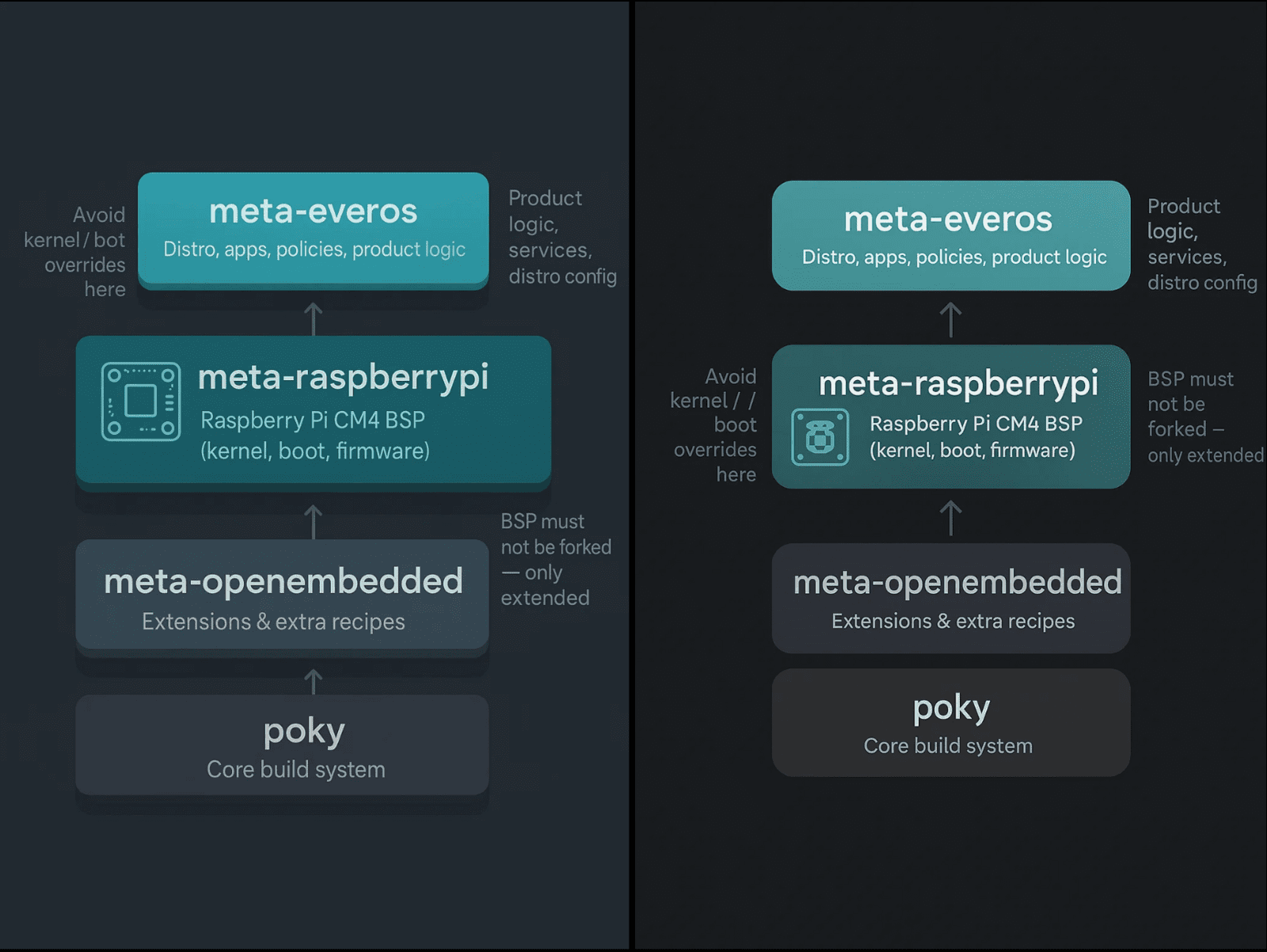
A clean, conflict-free layering model
Three principles hold this together.
BSP belongs to the BSP layer. meta-raspberrypi owns all CM4 BSP responsibilities: kernel, device tree, overlays, bootloader chain, firmware blobs, GPU stack, config fragments, RPi-specific utilities. Our custom meta-everos never overrides these unless explicitly intended. A good structure looks like poky/, meta-openembedded/, meta-raspberrypi/, meta-everos/ sitting alongside each other, not meta-everos/bsp/, meta-everos/linux/, meta-everos/boot/ trying to fork the BSP. You extend it, you don't fork it.
Product logic lives in meta-everos. EverOS defines common distro configuration, product-agnostic policies like logging, security posture, and update flow, the application stack, firmware helpers, a unified filesystem layout, and device orchestration logic. This keeps EverSense-style trackers, EverBowl's vision and sound pipeline, and EverHub's edge compute all sharing a consistent OS base.
Machine configs must be pure and single-purpose. Each SoM or device gets its own meta-everos/conf/machine/<machine>.conf. A machine file shouldn't contain random distro overrides, kernel hacks, bootloader policies, or application-level decisions. It should only define the SoM's hardware characteristics, image format, required features, and BSP layer includes. That keeps every device aligned, especially important running multiple SoMs across the ecosystem.
Implementing everOS for CM4 the safe way
Start with a stable distro configuration. meta-everos/conf/distro/everos.conf should inherit from Poky and define security posture, package selection policy, update mechanism hooks, and filesystem decisions, kept clean and generic with no CM4-specific logic.
Use .bbappend sparingly and explicitly. A common pitfall is a bbappend that silently fails to apply. Mirror the directory structure exactly, avoid globbing filenames, add comments explaining the override's intent, and verify with bitbake-layers show-appends. Good: recipes-core/systemd/systemd_%.bbappend. Bad: systemd.bbappend.
Use a machine include hierarchy for portability across SoMs, something like conf/machine/include/everos-base.inc, conf/machine/cm4.conf, conf/machine/everhub-gateway.conf, conf/machine/eversense-tracker.conf, conf/machine/everbowl-edge.conf. The base include defines shared features like journal settings, rootfs layout, Wi-Fi and BT support, and telemetry services, while each device config only adds SoM type, image type, and additional hardware flags. This structure has saved us from a lot of silent regressions across the ecosystem.
Protect against shadowing traps. The two big offenders are FILESEXTRAPATHS_append and SRC_URI overrides. Keep all patches inside meta-everos/recipes-*/<recipe>/<version>/, avoid renaming upstream patch files, and never overload FILESEXTRAPATHS in machine configs. Isolate everything.
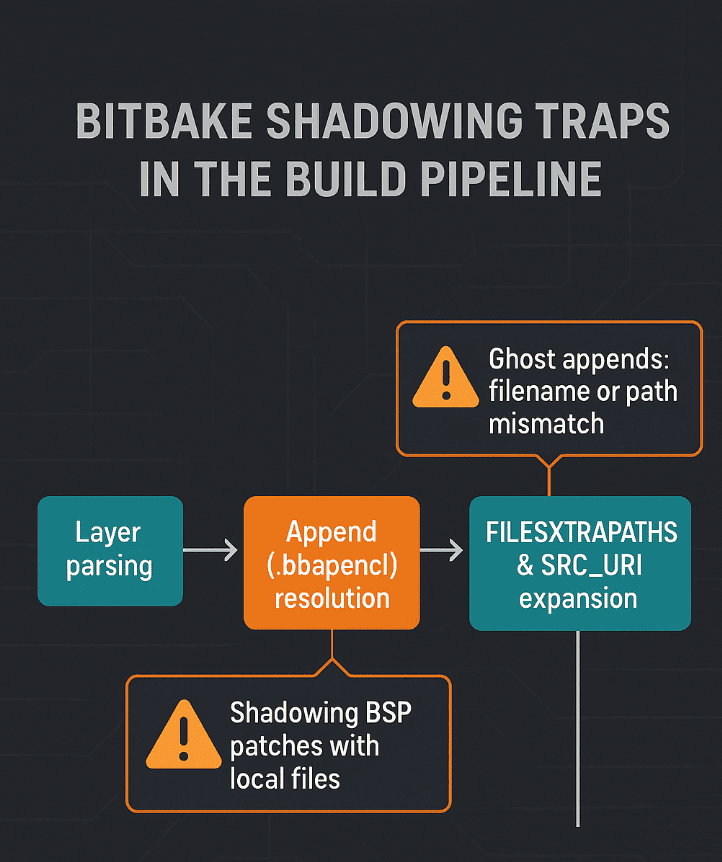
Use layer priority intentionally, but sparingly. BBFILE_PRIORITY helps control overrides, but meta-raspberrypi shouldn't get outranked by accident, meta-everos should only override userland components, and the kernel and bootloader stay untouched unless explicitly overridden. Most breakage comes from implicit priority decisions, not explicit ones.
How this helps a multi-device ecosystem
In Hoomanely's architecture, consistency matters across very different workloads: a tracker running lightweight LoRa telemetry, an EverBowl deriving behavior insights from sensors and edge vision, and an EverHub aggregating and processing data at home. Different hardware, different workloads, the same base OS.
Because the layering model is predictable, adding a new machine config never breaks an existing one. Because it's portable, switching SoM families doesn't require rewriting the distro. Because it's scalable, new services, sensors, and pipelines drop cleanly into meta-everos. Keeping CM4 BSP logic fully contained in meta-raspberrypi avoids kernel surprises and bootloader drift, and isolating product logic in meta-everos keeps device behavior consistent even as underlying hardware evolves. That's the only way to build a long-lived embedded platform.
Takeaways
Treat BSP as a dependency, not a playground, and don't fork CM4 BSP behavior unless you fully understand the impact. Keep product logic in your own layer, since meta-everos is where application-level decisions belong. Machine configs should be minimal and pure, describing hardware and nothing else. Avoid bbappend overuse, since each one is a foot-gun unless clearly intentional. Use layer priority intentionally and never allow accidental overrides. Design for multiple SoMs from the start, even if you only build CM4 today. And remember: the best Yocto setup is the one that doesn't surprise you. Predictability beats cleverness, always.
This is how we build a clean, stable, scalable OS foundation across Hoomanely's pet-care device ecosystem, and it's a model that carries over to any embedded system built on Yocto.