Engineering BLE Reliability: What Building a Pet Wearable Taught Us
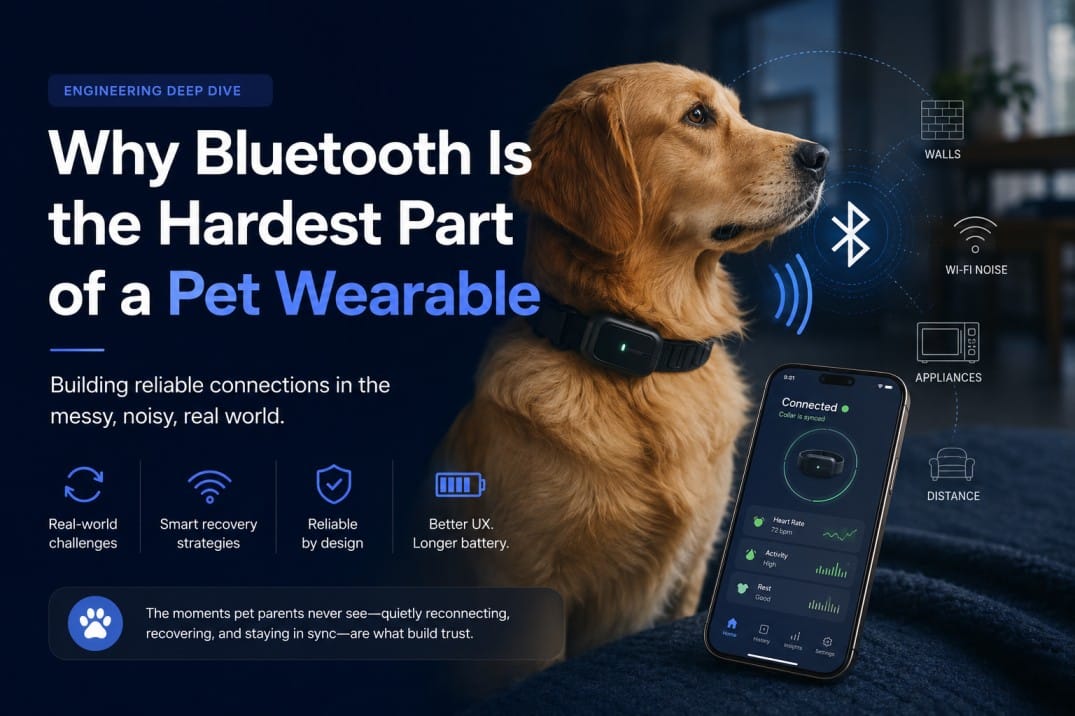
When most people think about the engineering behind a pet wearable, they imagine motion sensors, batteries, AI models, or health analytics. Those are the visible innovations. What they rarely think about is the invisible layer that determines whether any of those innovations reach the user at all: Bluetooth connectivity.
A collar sensor can collect perfect data. The mobile app can be beautifully designed. But if those two devices fail to communicate reliably while a dog runs through the house, plays in the backyard, or briefly moves out of range, none of the underlying engineering matters. To the pet parent, the experience is reduced to one simple conclusion: "The device isn't working."
Reliable Bluetooth connectivity is far more challenging than most engineers expect. At Hoomanely, we learned that building dependable wireless communication wasn't about writing better retry logic—it required rethinking how we modeled the connection itself.
The Myth of the Perfect Demo
Bluetooth Low Energy (BLE) performs exceptionally well in controlled environments. Two devices sitting a meter apart on a clean radio channel connect almost instantly.
Unfortunately, real homes don't resemble lab environments.
Pets constantly move between rooms. Walls weaken signals. Wi-Fi routers, smart home devices, microwaves, speakers, and other Bluetooth accessories all compete within the same 2.4 GHz spectrum.
The result isn't a single failure mode—it is dozens of subtle ones.
The most common issues we observed included:
• Temporary signal loss when pets moved out of range.
• Radio interference caused by crowded wireless environments.
• Application and device state mismatches.
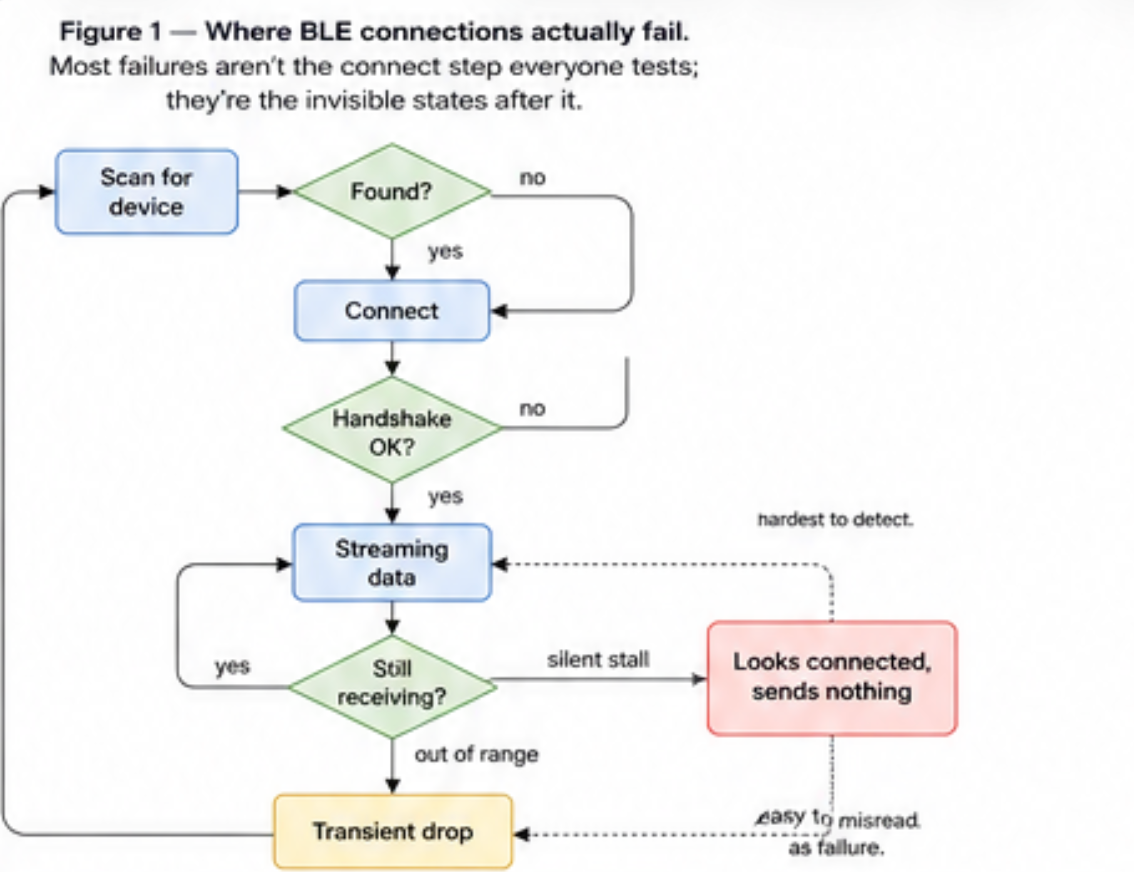
• Silent connection stalls where both devices believed they were connected, yet no data was flowing.
The most dangerous of these wasn't disconnection—it was the illusion of connection.
Why Retry Logic Isn't Enough
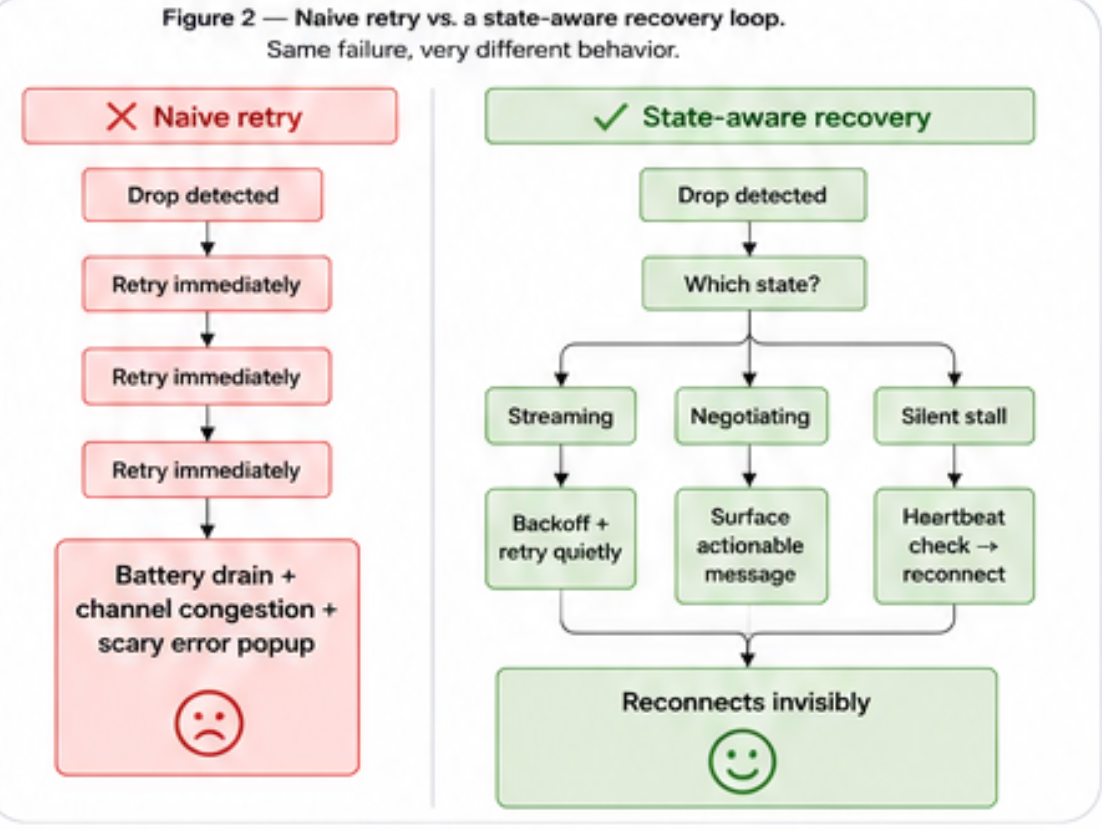
The obvious reaction to a dropped connection is to retry immediately.
Unfortunately, aggressive retries often make the situation worse.
Repeated connection attempts increase radio congestion, consume unnecessary battery, and create a frustrating experience for users who are repeatedly shown error messages for problems that would have resolved naturally a few seconds later.
Connectivity isn't simply about reconnecting quickly.
It's about recovering intelligently.
Thinking in States Instead of Booleans
The biggest architectural improvement came from abandoning a simple Boolean model.
Many applications represent connectivity like this:
Connected = True
Connected = False
Real wireless communication is significantly more complex.
Instead, we modeled the lifecycle as a state machine:
Idle → Scanning → Connecting → Negotiating → Streaming → Degraded → Recovering
Each state has its own responsibilities, transitions, and timeout behavior.
This simple change dramatically improved recovery because every failure could now be handled differently.
For example:
• Losing signal while actively streaming usually means the pet walked away temporarily.
• Failing during negotiation usually indicates a genuine pairing problem.
• Remaining connected without receiving data requires a heartbeat check rather than endless waiting.
Instead of treating every problem identically, the system reacts based on context.
Three Principles That Made the Biggest Difference
1. Exponential Backoff
Rather than reconnecting immediately, retries become progressively slower.
500 ms → 1 s → 2 s → 4 s
Adding slight random delays (jitter) prevents multiple devices from retrying simultaneously and competing for the same radio resources.
2. Liveness Checks
Connection status alone cannot be trusted.
A device reporting itself as connected while producing no data is effectively disconnected.
Periodic lightweight heartbeat messages allow silent failures to be detected long before users notice them.
3. Honest User Experience
Most Bluetooth interruptions are temporary.
Displaying alarming error dialogs every time a pet walks into another room creates unnecessary anxiety.
Instead, the application distinguishes between temporary recovery and genuine user action.
Most interruptions resolve silently.
Users are only interrupted when intervention is actually required.
Measuring Reliability Differently
Interestingly, our initial connection success rate barely changed.
It was already good.
The real improvement appeared after the first connection.
Recovery from temporary signal loss became significantly more reliable.
Cross-room reconnects succeeded far more consistently.
Silent stalls, previously invisible to both users and developers, became detectable and recoverable.
Battery life also improved because unnecessary connection storms disappeared.
Ultimately, the metric that mattered wasn't how quickly devices connected.
It was how rarely users noticed they had disconnected.
Lessons Beyond Pet Wearables
These lessons extend well beyond pet technology.
Whether you're building healthcare devices, fitness trackers, industrial IoT systems, or smart home products, the same principles apply.
A connection is not simply connected or disconnected.
Failures without error messages are often the hardest to detect.
Retrying harder rarely means recovering faster.
Sometimes the best engineering is completely invisible.
Final Thoughts
The most successful wireless systems aren't the ones that never disconnect.
They're the ones that recover so gracefully that users never realize anything went wrong.
For pet parents, trust is built in the quiet moments—the reconnection that happens automatically while they're making coffee, playing with their dog, or heading out for a walk.
Making Bluetooth disappear may not be the most glamorous engineering challenge, but it is one of the most important.
About Hoomanely
Hoomanely is building technology that helps pet parents care for their companions with greater confidence. From health insights and activity tracking to proactive care recommendations, every experience depends on reliable communication between wearable devices and the mobile app. By investing deeply in dependable connectivity, we ensure that technology stays invisible—allowing pet parents to focus on what matters most: their pets.