The Memory Bottleneck: How Quantization Prevents HNSW from Burning Your Cloud Budget
The Hidden Cost of Peak Search Performance
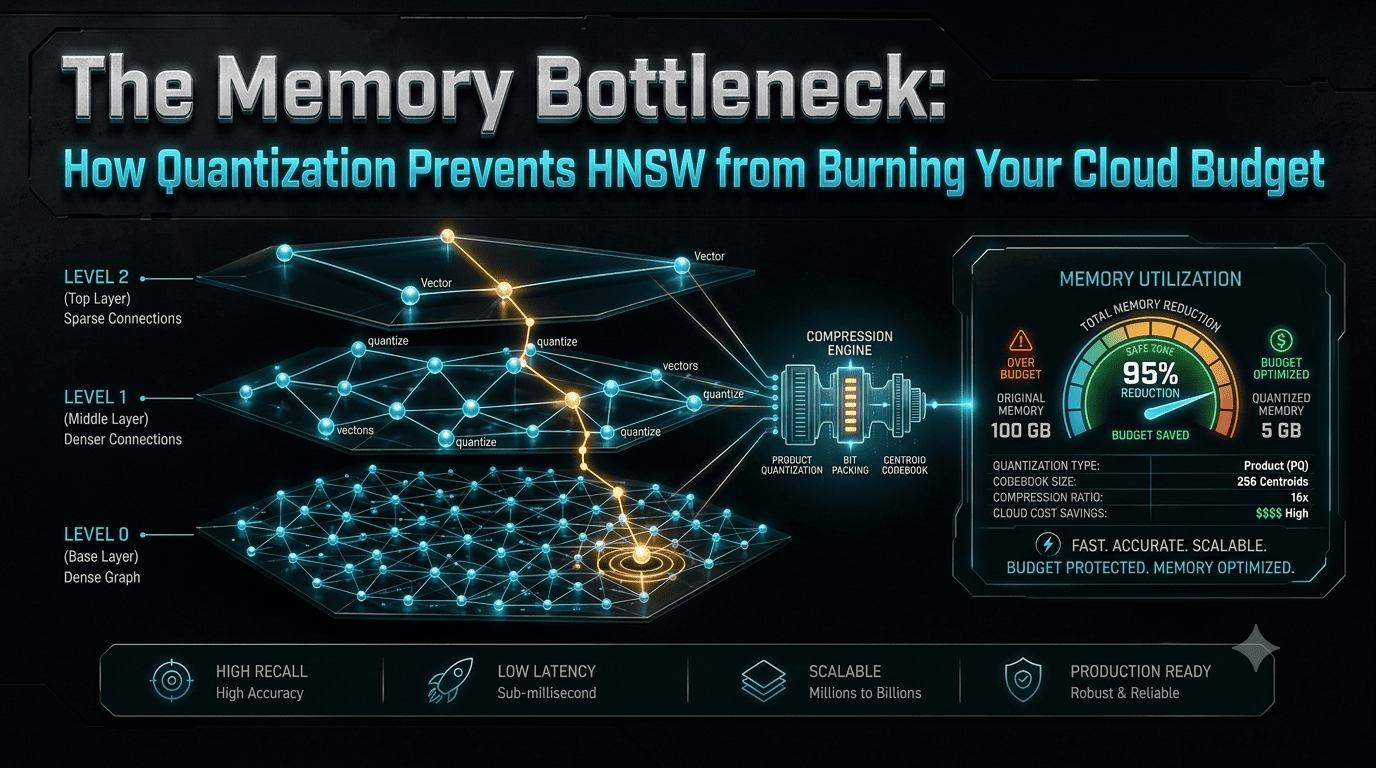
Hierarchical Navigable Small World (HNSW) graphs have rightfully earned their reputation as the speed demons of vector search, delivering sub-millisecond retrieval times across millions of embeddings. However, this lightning-fast performance comes with a steep trade-off: high RAM consumption. Because HNSW relies on keeping both multi-layered graph structures and high-dimensional floating-point vectors directly in memory, scaling your database to tens of millions of records quickly turns into an expensive infrastructure challenge. For engineering teams operating at scale, raw speed eventually collides with the reality of cloud computing costs.
Understanding Vector Quantization as Smart Compression
This is where vector quantization techniques—primarily Product Quantization (PQ) and Scalar Quantization (SQ)—step in to save your infrastructure budget. At its core, quantization acts as intelligent compression for high-dimensional numerical data. Instead of storing full 32-bit floating-point numbers ($f32$) for every vector dimension, quantization techniques project these vectors into lower-precision representations, such as 8-bit integers ($i8$) or compressed codebook indices. By squeezing the memory footprint of individual vectors by 75% or more, you dramatically increase the density of embeddings you can host on a single machine.
How Product Quantization and Scalar Quantization Work
The two most dominant approaches tackle this compression problem through distinct mechanics. Scalar Quantization operates per dimension, mapping continuous floating-point ranges to a discrete set of lower-bit values, keeping things fast and simple with minimal CPU overhead during distance calculations. Product Quantization takes a more sophisticated route: it breaks high-dimensional vectors into smaller sub-vectors, clusters these chunks across your dataset, and represents each chunk using a short codebook index. While PQ introduces slightly more computational complexity during lookup, its ability to achieve massive compression ratios makes it the heavy hitter for ultra-large datasets.
The Trade-off: Recall vs. Memory Footprint
Compressing data inherently means accepting a slight loss in fidelity, introducing the fundamental tradeoff of modern vector engineering: memory footprint versus search accuracy (recall). When you compress vectors, the distance calculations used to find nearest neighbors become approximations of approximations. However, in practice, combining quantization with HNSW often yields a sweet spot—you can reduce your RAM footprint by up to 80% while retaining over 95% of your original search recall. For the vast majority of real-world AI applications, from retrieval-augmented generation (RAG) to visual search, this negligible loss in precision is a price well worth paying for massive cost savings.
Building a Sustainable Vector Architecture
Ultimately, choosing between pure HNSW, scalar-quantized graphs, or product-quantized indices isn't about finding a single best algorithm—it is about matching your access patterns to your operational constraints. If your application demands absolute precision across a modest dataset, raw HNSW remains unmatched. But as your vector store scales toward billions of embeddings, mastering quantization becomes mandatory. By treating vector compression as a core design parameter rather than an afterthought, system architects can build search infrastructure that is not only blindingly fast, but economically sustainable for the long haul.