Flash Endurance: Smart Storage Strategies for Embedded Edge Systems
Storage wear and tear: a practical engineering guide from EverBowl's memory pipeline
This post explains how the EverBowl platform uses PSRAM as a buffer and a flash-aware firmware stack to extend flash lifetime. It covers concrete implementation pitfalls and solutions, datasheet-backed guidance, and a practical checklist for engineers building similar capture systems.
Why storage matters for always-on edge vision
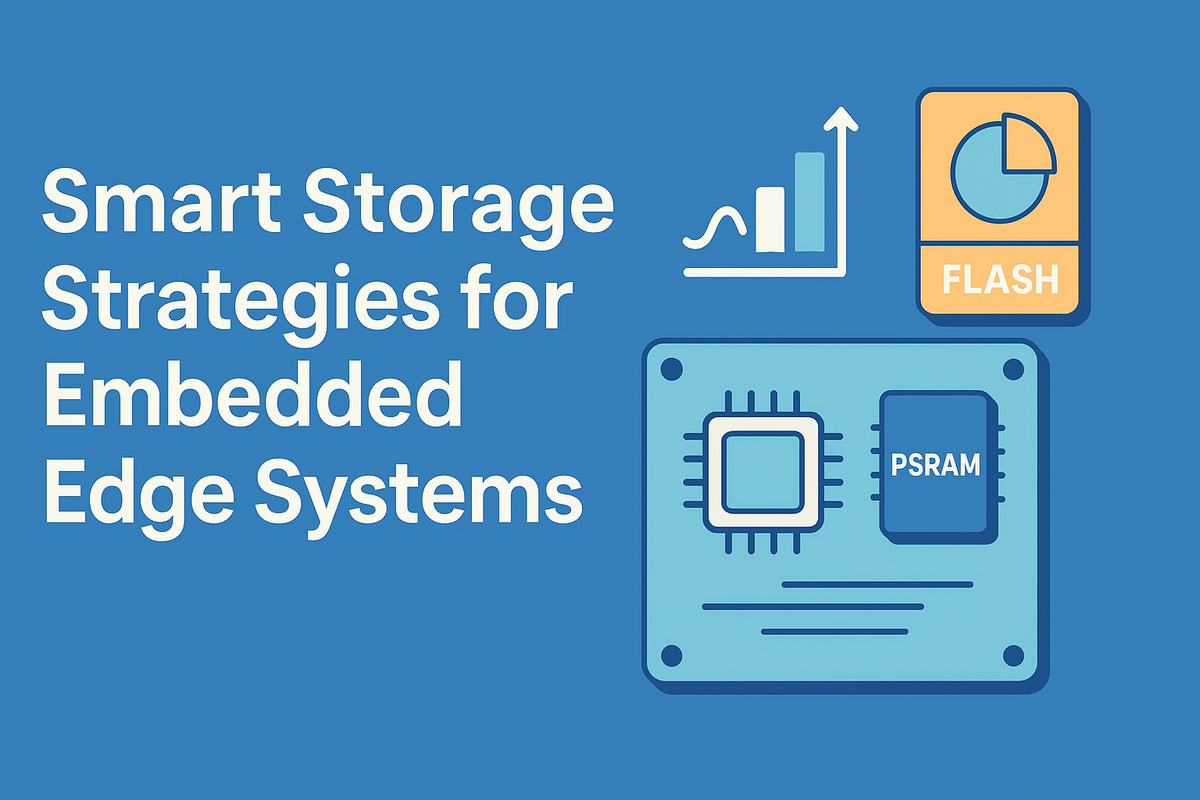
Edge devices capturing high-frame-rate images or thermal maps continuously face two conflicting needs: store large amounts of data reliably, and keep the device alive for years in the field. Flash memory is dense and persistent but has finite program/erase (P/E) endurance and erase-before-write semantics, if unmanaged, frequent small writes (per-frame writes, for example) rapidly exhaust flash life. EverBowl buffers captures in PSRAM, batches and aligns writes to NOR flash, and performs wear-aware allocation to avoid hot spots, balancing throughput, reliability, and longevity for real deployments.
The core problem: NOR flash characteristics you must design for
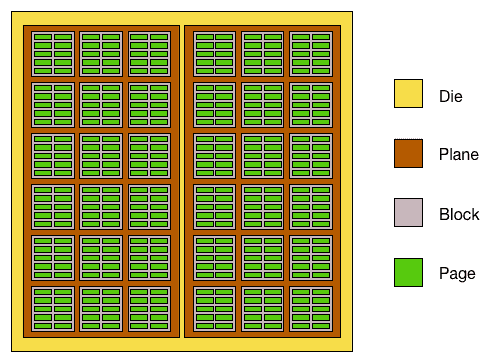
Serial NOR flash devices like the Winbond W25Q256 series present small programmable pages (around 256B), erasable sectors (commonly 4KB), and larger erase blocks (around 64KB), with erase happening per sector or block, not per byte. Typical NOR flash endurance sits in the 10⁴ to 10⁵ erase cycle range, datasheet numbers are the authoritative reference for sizing lifetime guarantees. And erase-before-write semantics mean updating even a small piece of data often forces erasing a large block, accelerating wear.
For capture systems, that means writing each frame as a separate small file forces repeated erases of the same blocks (hot spots), metadata tables (indices) updated frequently concentrate wear unless rotated or avoided, and poor physical layout (signal integrity issues, improper power sequencing) can cause transient write errors, corrupting blocks and forcing retries.
EverBowl integrates a QSPI NOR (W25Q256) and parallel PSRAM on the STM32H5's Flexible Memory Controller domains, giving high-throughput buffering and commits, but the firmware has to be tuned to actually realize those benefits.
Quantifying endurance
A rough lifetime estimate: Lifetime (years) = (Total Cycles x Block Size x Blocks) / (Daily Write Volume x Wear Amplification). For example, a 256MB NOR flash with 100k P/E cycles and 4KB sectors, capturing at 10 fps and 1KB/frame (864,000 KB/day): without batching, roughly one erase per frame with wear amplification around 4 (from metadata) gives a lifetime measured in weeks. With a 4MB PSRAM buffer batching 4,000 frames, roughly one erase per 4,000 KB with amplification closer to 1.1 extends that to several years.
How PSRAM helps
The common harmful I/O patterns are repeated small updates to the same sectors (metadata, logs), in-place updates (rewriting a file header in the same spot), and frequent random writes with no aggregation. PSRAM serves as a volatile shock absorber: fast (roughly 70ns access time for ISSI devices), no wear limits, ideal for circular buffers handling DMA captures. EverBowl uses PSRAM to ingest DCMI/DMA frames from camera sensors, then commits batched, aligned chunks to flash, reducing erase counts and overhead. The ISSI IS66WVE4M16E datasheet's 1.65 to 1.95V operation and 70ns asynchronous access make it well suited to intermediate buffering in low-power edge setups.
EverBowl's storage architecture
The capture path flows from camera sensors through DCMI into a PSRAM circular buffer via DMA. Firmware monitors buffer occupancy and schedules an offload once a configurable threshold is reached, briefly suspending or throttling capture while streaming large aligned chunks from PSRAM into QSPI NOR flash with optimized page/program sequences, then resumes capture and manages indices and wear tables in flash metadata.
Batching and alignment matter because fewer erase cycles result from writing N frames as one contiguous block versus N per-frame writes, often an order-of-magnitude difference depending on chunk size, and QSPI write commands carry fixed overhead that larger writes amortize, boosting throughput.
Flash-level strategies
Partitioning and isolation. Create separate partitions for metadata/index (small, high-update), frame store (append/circular), long-term archive, and logs. Isolating frequently updated data lets you apply targeted wear mitigation, EverBowl keeps indices and frame data in separate logical partitions.
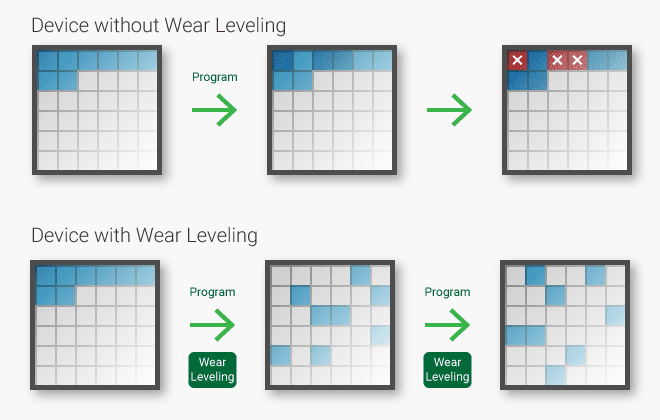
Pseudo wear-leveling. Advance a next-write-block pointer after each commit to distribute writes across the flash:
#define FLASH_START_ADDR 0x90000000  // Example QSPI base
#define SECTOR_SIZE 4096
#define TOTAL_SECTORS 65536  // 256MB / 4KB

static uint32_t next_write_sector = 0;

void advance_write_pointer(void) {
    next_write_sector = (next_write_sector + 1) % TOTAL_SECTORS;
    // Optional: Skip bad blocks from a table
}

HAL_StatusTypeDef write_to_flash(uint8_t* data, uint32_t size) {
    uint32_t addr = FLASH_START_ADDR + (next_write_sector * SECTOR_SIZE);
    // Erase sector, program data using HAL_QSPI_Transmit, etc.
    advance_write_pointer();
    return HAL_OK;
}
This simple technique is effective for fixed-capacity systems under full control, rotating across all blocks in a 256MB flash with 4KB sectors can equalize wear meaningfully.
Append-only or circular buffers. For telemetry or small logs, use append-only areas that wrap, avoiding erasing metadata on every update.
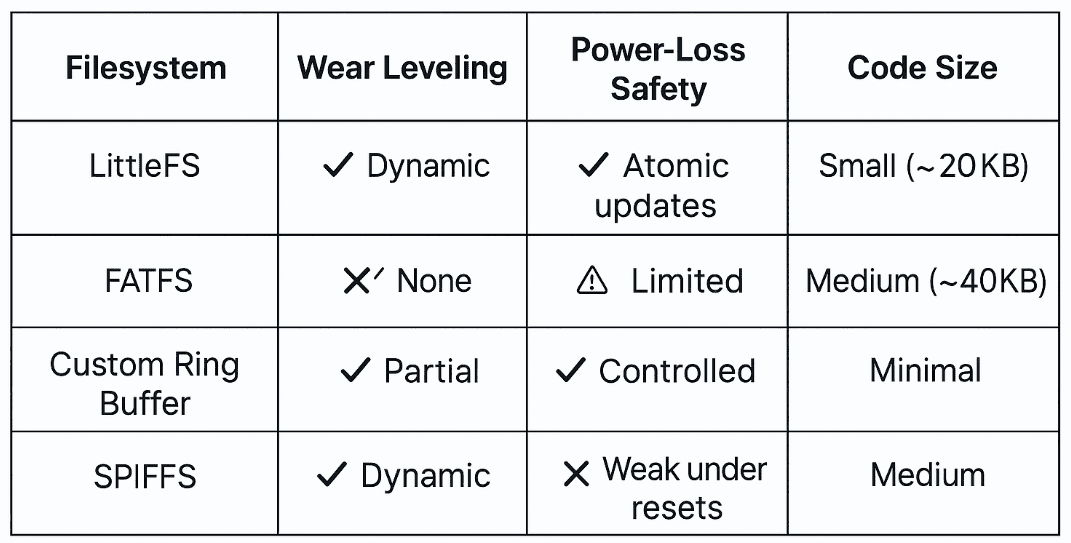
Filesystem choice. A flash-aware filesystem like LittleFS gives dynamic wear leveling and bad-block handling, but it's worth knowing LittleFS provides dynamic wear leveling, balancing wear among free and dynamic blocks, not full static wear leveling. When you have large static data plus a small hot set, design partitions accordingly and check LittleFS's documented limitations before assuming perfect leveling.
Bad-block handling and verification. Always verify writes and erases after the operation. On persistent failures, mark blocks bad and remap using a mirrored table in reserved flash. EverBowl's manager uses conservative error handling, running integrity checks after power events.
Practical checklist
Buffer bursts using PSRAM for fast, wear-free buffering, committing large aligned chunks to NOR. Partition data to isolate hot metadata from bulk frames so you can apply targeted leveling. Rotate and level using zone rotation and a flash-aware filesystem like LittleFS, but review the docs for static-data limits. Verify and handle errors with post-write verification, mirrored bad-block tables, and power-loss recovery. Follow PCB best practices with strict signal integrity, matched traces, and proper termination for high-speed memory. Calculate lifetime using the formulas above to size buffers, then test with real workloads. And integrate incrementally, start with the STM32 HAL for QSPI/FMC, then add custom wear logic on top.
Why it matters at Hoomanely
EverBowl's storage strategies enhance field reliability, minimize returns, and support long-term data for analytics and machine learning. Getting storage wear right isn't a one-time architecture decision, it's an ongoing discipline that determines whether a device survives years in a customer's home or fails quietly a few months in.