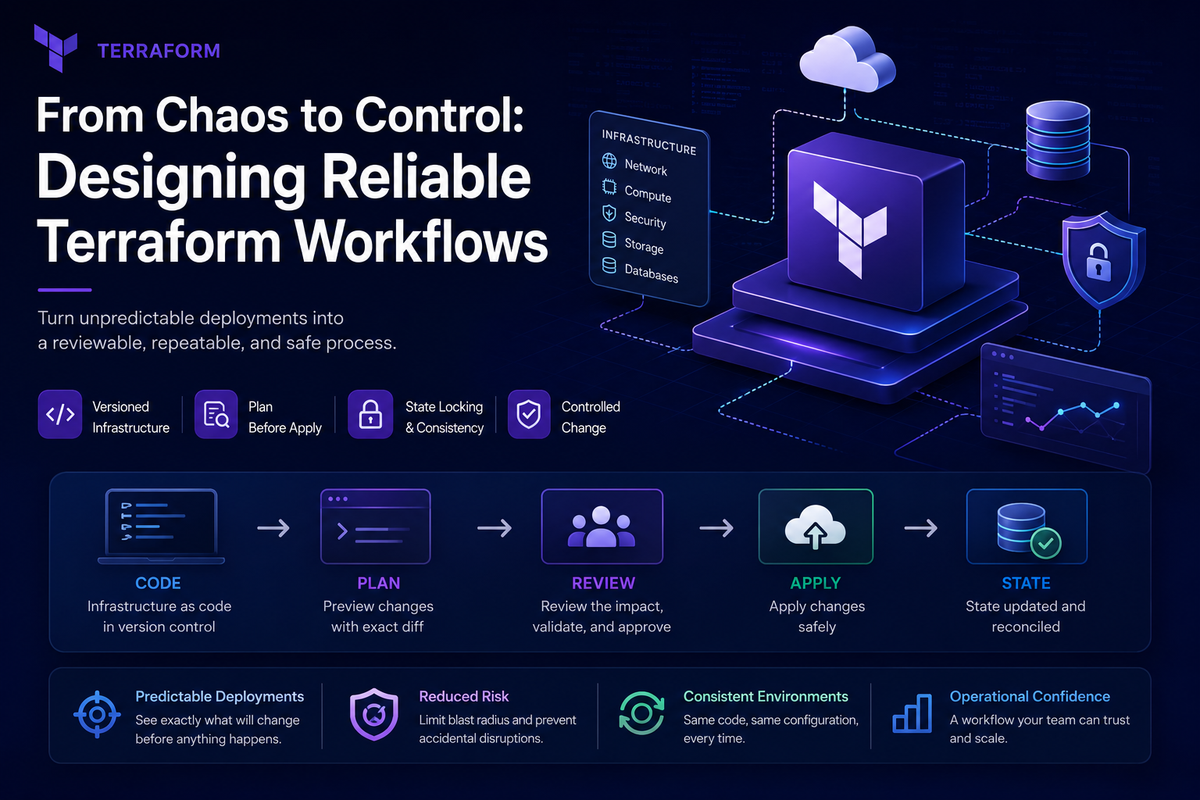
From Chaos to Control: Designing Reliable Terraform Workflows.
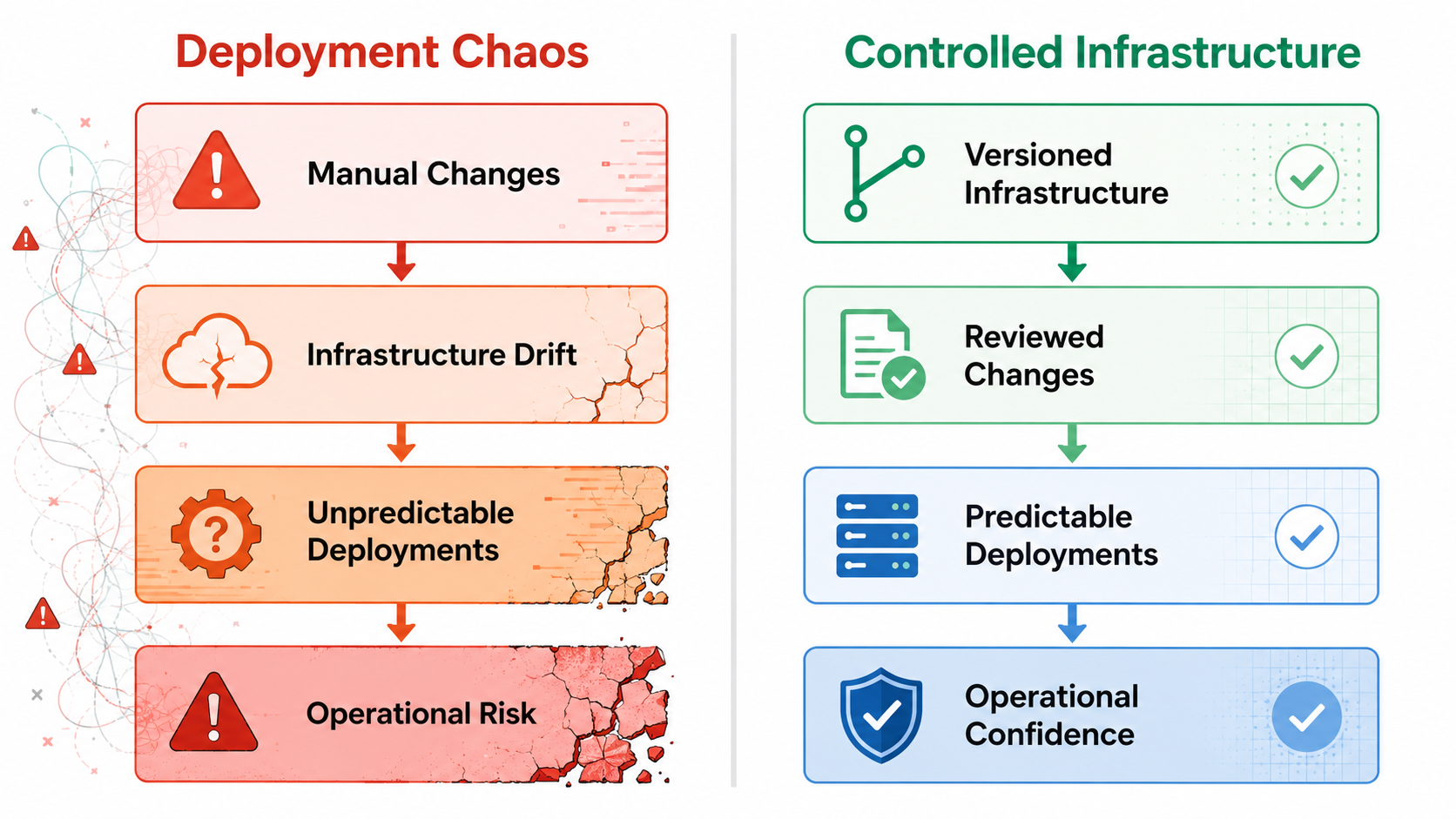
Most production incidents don't start with faulty application code. They start with infrastructure changes nobody fully understood: a security policy edited through a cloud console, a manual config update made during an urgent fix, an environment that's slowly drifted away from the documentation meant to describe it.
On their own, these changes look harmless. Add them up and you get infrastructure that's genuinely hard to reason about. Teams lose confidence in deployments, engineers get reluctant to touch anything, and operational risk climbs with every release. None of this is specific to one company or cloud provider, it's just what happens at scale.
Terraform gets described as an Infrastructure as Code tool, but its real value goes beyond provisioning resources. At its best, it's an architectural framework for managing change, turning infrastructure from an unpredictable pile of resources into something versioned, reviewable, and auditable. This post covers the architectural principles behind reliable Terraform workflows and how they move teams from deployment uncertainty to something closer to operational confidence.
When infrastructure becomes hard to trust
Every growing engineering org runs into the same handful of problems eventually.
Infrastructure drift: changes come in through multiple channels, automation, manual intervention, emergency fixes, platform updates, and over time the deployed environment starts to diverge from whatever's documented or expected. That leaves a simple but dangerous question hanging: what does production actually look like right now? When nobody can answer that with confidence, risk goes up fast.
Lack of predictability: without a reliable way to preview changes, deployments turn reactive instead of deliberate. Engineers can describe what they intend to change, but they can't always predict the full effect across interconnected resources.
Expanding blast radius: cloud environments are deeply interconnected, so a change that looks isolated can cascade across networking, security, compute, storage, or identity. The hard part isn't making the change, it's understanding what it actually touches.
Environment inconsistency: a lot of teams lean on staging as their validation layer, but once staging and production drift apart independently, passing tests in staging stops meaning much. A deployment process is only as trustworthy as how consistent the environments underneath it actually are.
The architectural shift: managing desired state
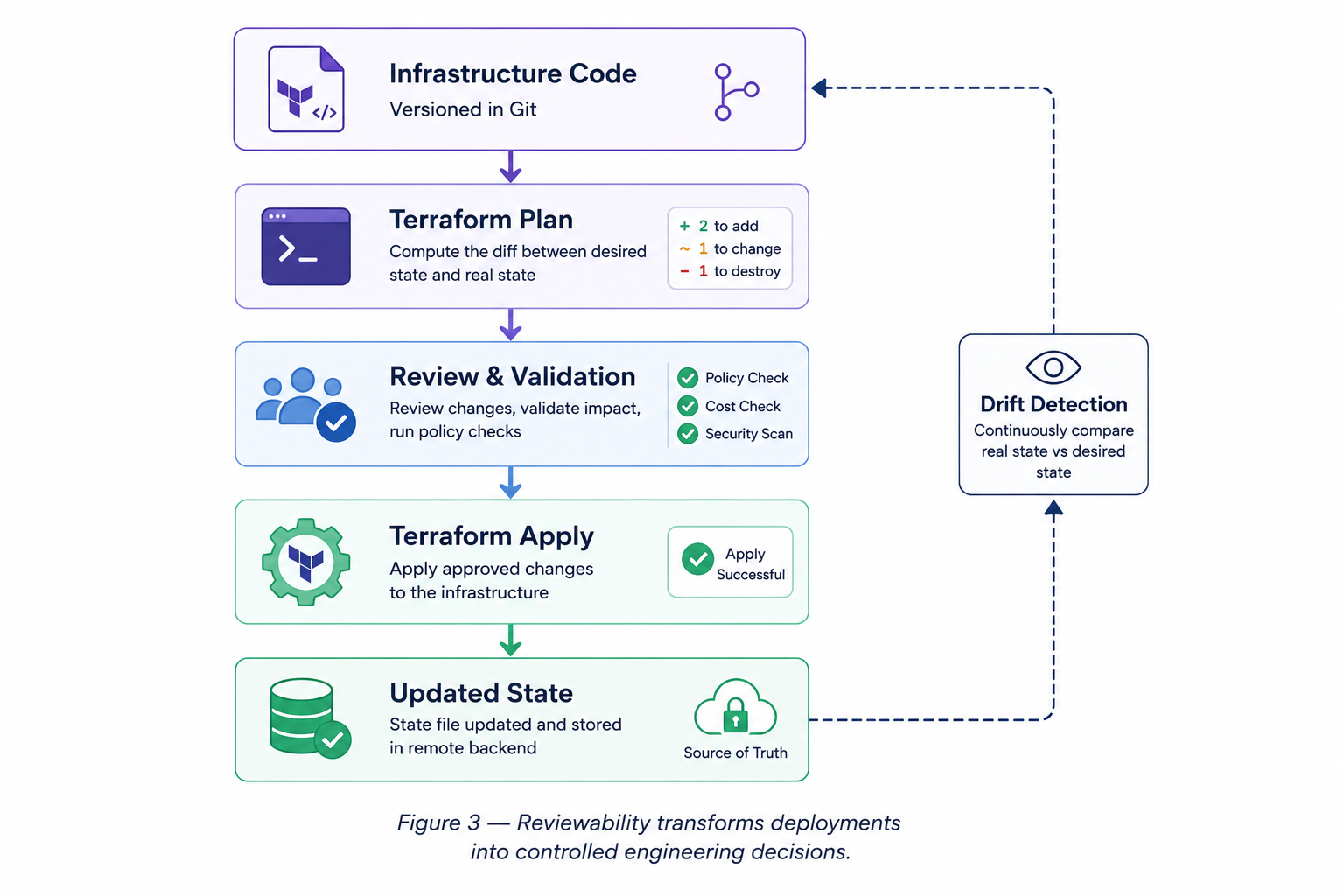
Terraform's real innovation isn't automation, it's desired state management. Instead of describing a sequence of actions, teams describe the infrastructure that should exist, and Terraform works out the difference between the current state and that target. That's a simple idea, but it changes how infrastructure actually evolves.
Rather than blindly executing deployment instructions, teams get visibility into what will change, why it's changing, which resources are affected, and what the result will actually look like. Infrastructure management becomes reconciliation rather than execution, and that distinction matters. Reliable systems don't come from running more commands, they come from reducing uncertainty.
Architecture as reusable building blocks
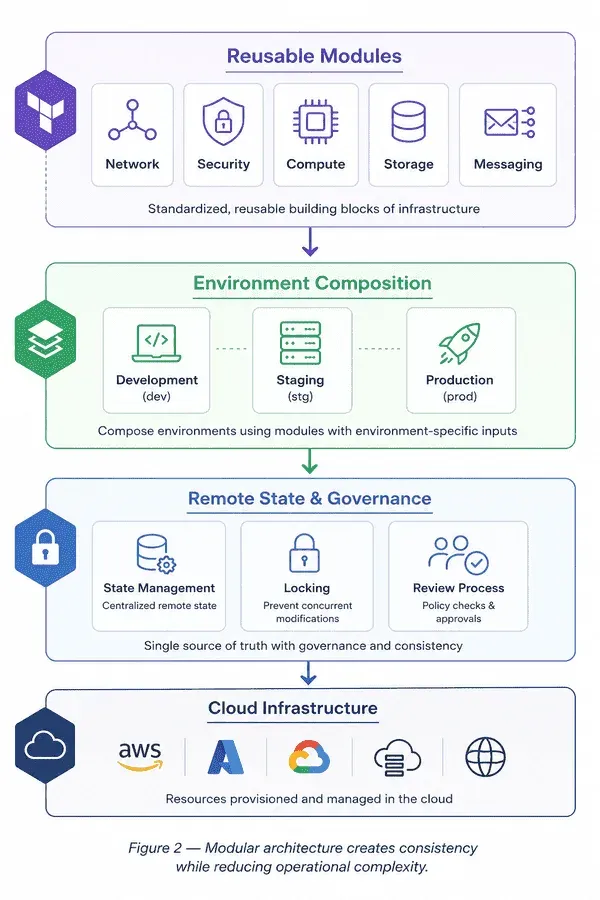
As organizations grow, infrastructure complexity climbs fast. Networks expand, services multiply, security requirements get more sophisticated, compliance obligations show up. Managing that complexity needs architectural boundaries, and Terraform modules provide them.
Instead of treating infrastructure as one monolithic configuration, teams can organize resources into reusable domains: networking, security, compute, storage, messaging, observability. Each module becomes a standardized building block that gets composed into larger systems. That gives two real advantages. Consistency improves because environments get assembled from the same underlying components, and infrastructure evolution gets more manageable because changes stay localized instead of rippling unpredictably through the whole platform.
Why state management matters more than most teams realize
Infrastructure can't be managed reliably without a trusted source of truth, and Terraform's state layer provides that. A centralized state system means every engineer, automation pipeline, and deployment process is working from the same understanding of the environment.
Without shared state, concurrent deployments conflict with each other, drift becomes invisible, resource ownership gets murky, and recovery gets a lot harder. With centralized state and locking, changes become coordinated instead of competing with each other, turning deployments from isolated actions into controlled organizational processes. A lot of deployment failures aren't caused by bad infrastructure definitions at all, they're caused by conflicting assumptions about what state the system is actually in.
The value of reviewable change
One of Terraform's most useful traits is turning infrastructure changes into reviewable artifacts. Every proposed change becomes a diff that can be analyzed, discussed, challenged, and approved before it touches production, which mirrors the code review practices engineering teams already trust for application code. Infrastructure deserves the same rigor.
When changes become reviewable, risk becomes visible, drift becomes detectable, destructive actions stand out, and teams gain real confidence in deployment outcomes. The process shifts from execution to decision-making, and decision-making is where reliability actually comes from.
Separating infrastructure from application delivery
One of the more important lessons in modern cloud operations is that not everything changes at the same pace. Infrastructure evolves slowly. Applications evolve fast. Treating both the same way creates unnecessary friction.
Infrastructure concerns usually cover networking, security policies, permissions, compute definitions, and platform configuration. Application concerns usually cover container releases, feature deployments, bug fixes, and runtime updates. The teams that get this right draw a clear line between the two: Terraform manages the durable shape of the platform, and deployment pipelines manage application releases. That separation lets each layer evolve on its own timeline while cutting the risk of one interfering with the other. A lot of operational maturity comes less from new tools and more from clear ownership boundaries.
The real outcome: deployment confidence
The point of infrastructure architecture isn't automation, it's confidence. A reliable Terraform workflow lets teams answer the important questions before anything changes: what's changing, why, which resources are affected, what's the risk, and can it be safely reversed. Once those questions have clear answers, deployment anxiety starts to fade, and engineering teams spend less time investigating infrastructure behavior and more time actually building the product. That shift in focus is where the real business value shows up.
Key takeaways
- Infrastructure reliability is fundamentally a change-management problem.
- Terraform's biggest value is making infrastructure evolution predictable and reviewable.
- Modular architecture improves consistency and cuts operational complexity.
- Centralized state management gives you a trusted source of truth.
- Reviewable diffs turn deployments from risky actions into informed decisions.
- Separating infrastructure from application delivery improves how well operations scale.
- The real outcome isn't automation, it's deployment confidence.