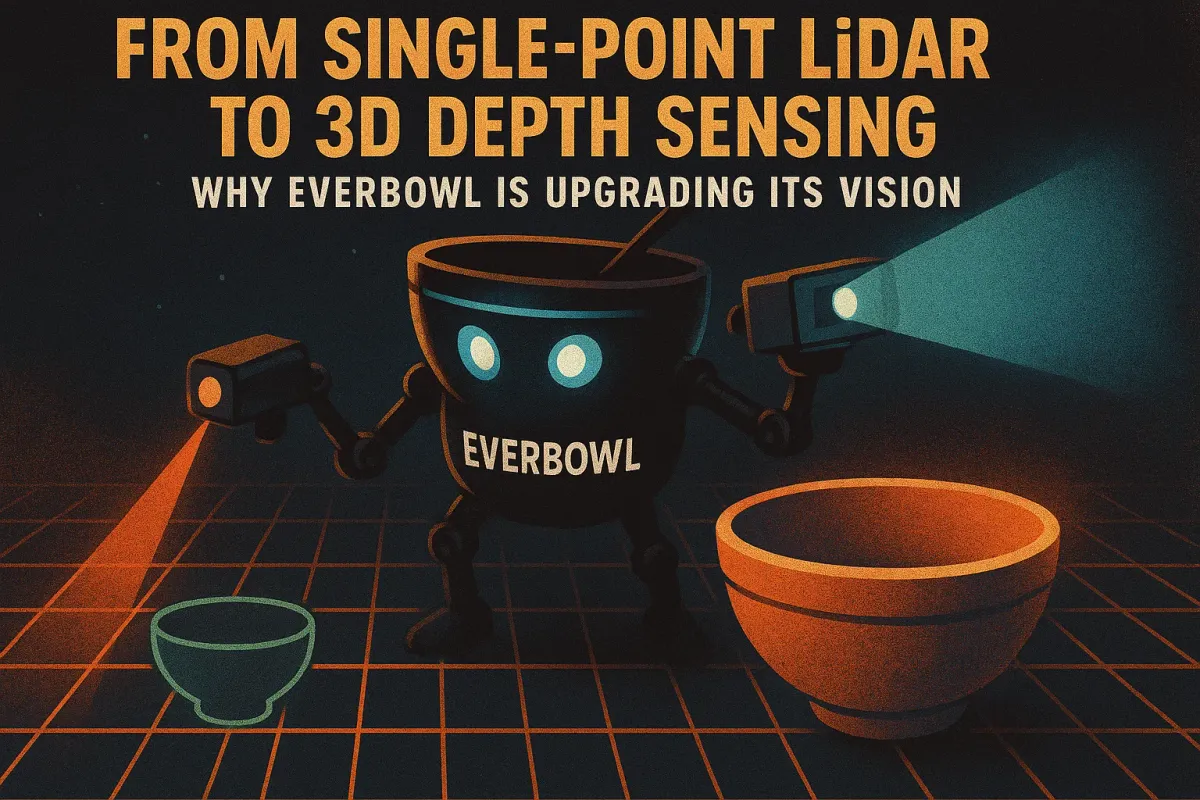
From Single‑Point LiDAR to 3D Depth Sensing: Why EverBowl Is Upgrading Its Vision
Introduction
In pet tech, the gap between something that works and something that's actually reliable usually comes down to how well the hardware reads the real world. At Hoomanely, we've spent months refining EverBowl's proximity pipeline, the system that helps our smart bowl track a dog's face position, keep safe distances, and measure temperature accurately. We'd been relying on a standard single-point LiDAR sensor. It did the job for a while, but as our accuracy targets climbed, its limits became hard to ignore.
That pushed us into a bigger change: moving from 1D single-point LiDAR to a 3D time-of-flight depth sensor that outputs a full depth map. This changes how we read dog face geometry, estimate distance to specific landmarks, and fuse thermal and RGB data, which in turn gives us steadier temperature readings and better eating detection.
This post covers why the upgrade mattered, how 3D depth sensing works, and what it opens up for the next generation of pet health hardware.
Why single-point LiDAR was holding us back
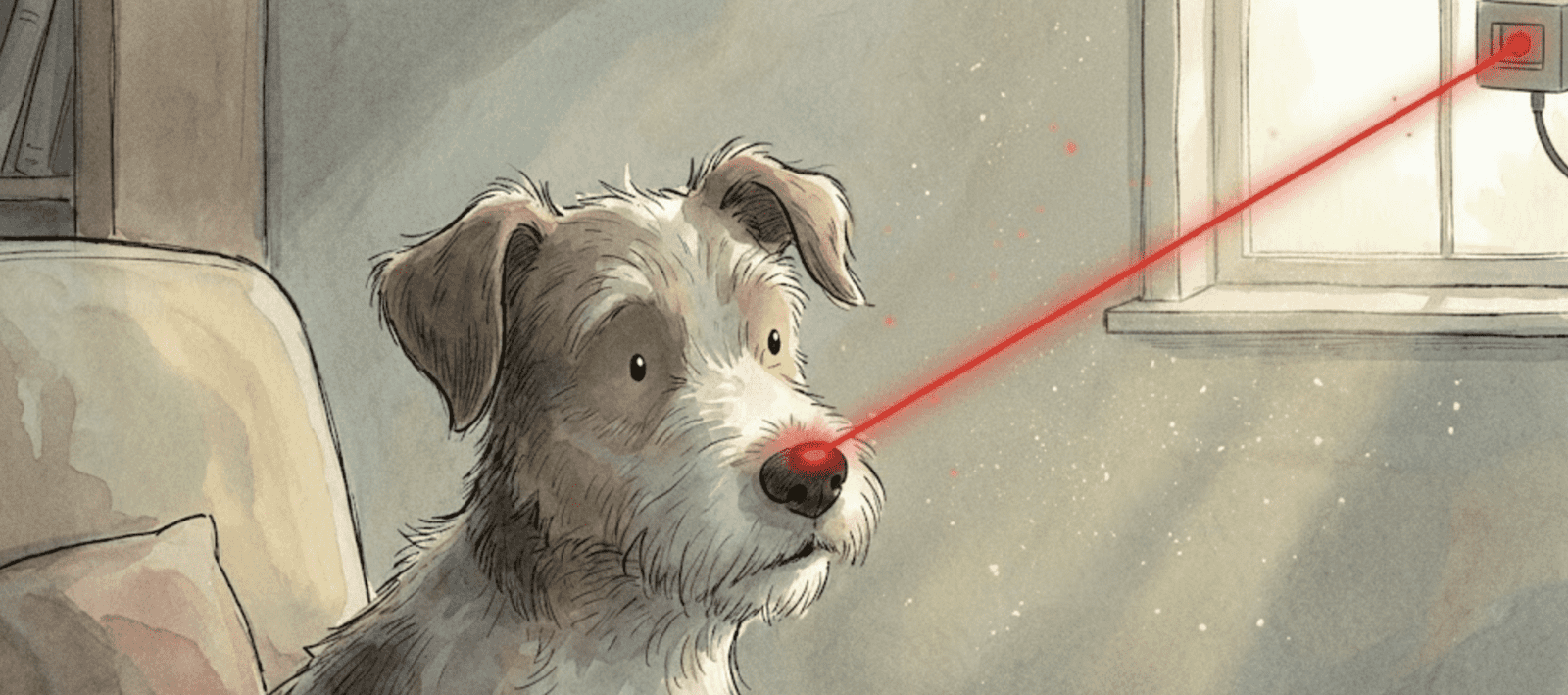
A single-point LiDAR measures exactly one distance at a time, like pointing a laser at a wall and asking it to describe the whole room. For a moving dog's head, with all its contours, that's not nearly enough information.
- Only one dimension of proximity, with no sense of shape or orientation.
- Bowl tilt can send the point onto the wrong surface.
- Ears, fur, or the bowl itself can block the beam.
- Face geometry varies so much between a long snout and a flat one that readings swing wildly.
We patched around this with heuristics, multi-ROI scanning, smoothing, and filtering, but the gap between what we wanted to measure and what a single point could actually see kept growing.
3D time-of-flight sensing: a depth map instead of a dot
A time-of-flight sensor gives us a full depth image instead of one distance, with more than 4,000 pixels each carrying its own distance reading.
How it works: the sensor emits modulated infrared light, the light bounces off the dog's face, the phase shift on return tells us the distance, and the whole sensor grid measures this at once. The result is a low-resolution but genuinely informative 3D map of the dog's face.
Why 3D depth changes things for EverBowl
Stable distance estimation for landmarks: accurate temperature readings, especially around the eyes, depend on knowing exactly how far each pixel is from the camera. Depth maps let us measure distance to the eyes, nose, and muzzle independently, hold readings steady across breeds, and correct for bowl tilt or off-axis entry.
Better thermal-RGB fusion: with 3D depth, we can line up thermal data with RGB landmarks more precisely, which cuts down parallax error and makes temperature readings more consistent.
More reliable eating detection: depth lets us tell a snout entering the bowl apart from tongue movement or a dog just sniffing nearby, which cuts false positives and lets the audio pipeline activate at the right moment.
Better handling of occlusion: when fur, bowl edges, or lighting block part of the view, the depth map still has thousands of other rays to fall back on. A single point doesn't have that redundancy.
Design considerations and challenges
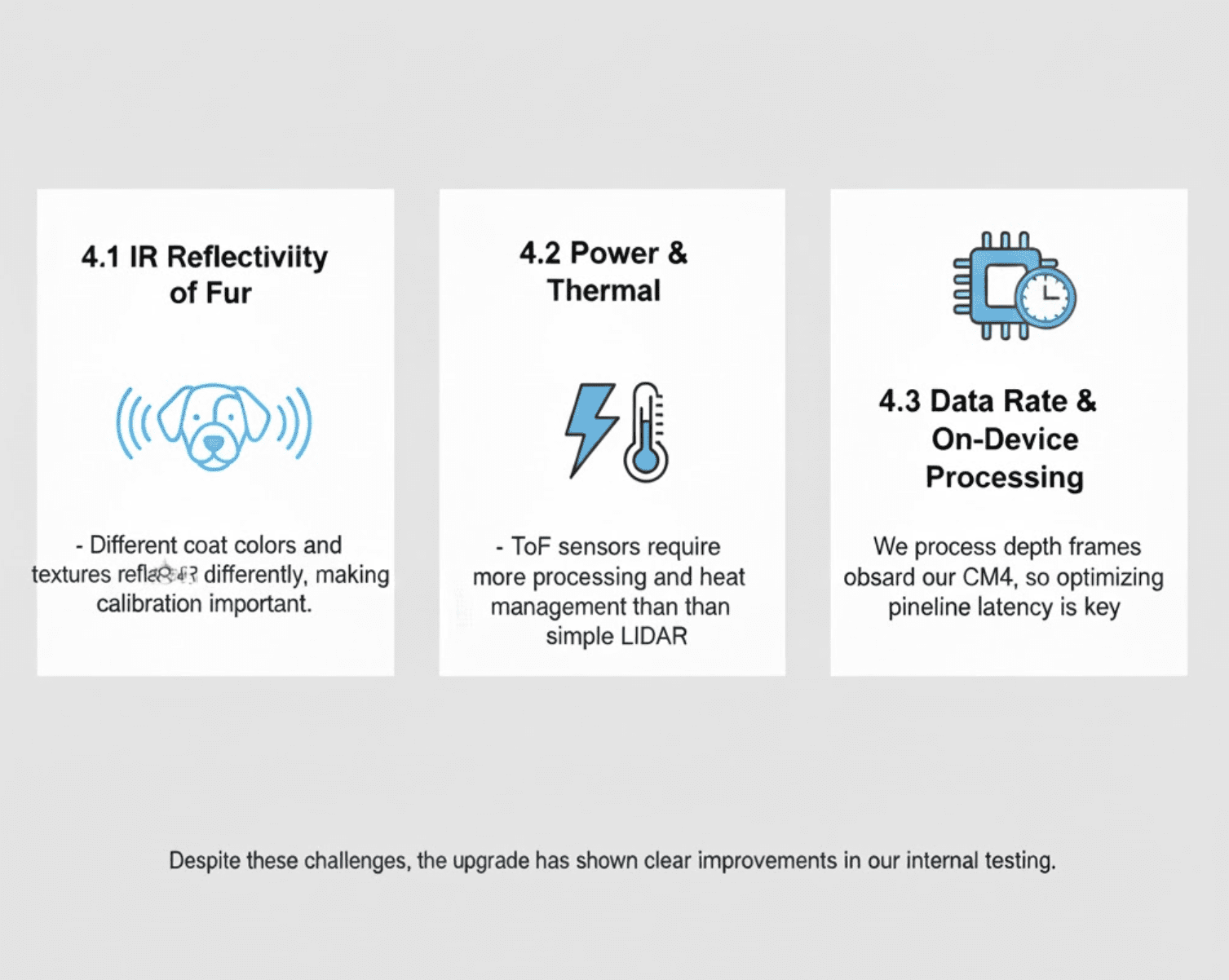
IR reflectivity of fur varies by coat color and texture, so calibration matters more than we expected. Time-of-flight sensors also need more processing and heat management than a simple LiDAR, and since we run depth frames on our CM4 board, pipeline latency needed real attention. Even with those challenges, internal testing has shown a clear improvement from the upgrade.
What this unlocks for future features
- More accurate fever detection through distance-aware thermal correction.
- Breed-agnostic face models built on depth instead of fixed templates.
- Motion segmentation for a richer read on behavior.
- Better safety systems that can catch unsafe proximity or fast, impact-like motion.
All of this feeds directly into what we're trying to build: pet care systems that are advanced without being complicated, and that read a dog's health reliably without getting in the way.
Key takeaways
- Single-point LiDAR only ever gave us one dimension of information.
- 3D time-of-flight sensing captures the full geometry of a dog's face as a depth map.
- The upgrade improves landmark detection, thermal fusion, and eating detection together.
- Depth sensing makes temperature estimation more accurate and more consistent across breeds.
- It sets up safer, smarter pet health hardware down the line.