Golden Journeys: Synthetic Conversations as Regression Tests for AI Assistants
AI assistants are becoming deeply embedded across apps, devices, and internal tools. They read context, recall previous turns, guide users through troubleshooting, analyze data, and invoke tools on behalf of the user. Yet the systems beneath them, models, prompts, routing layers, retrieval indexes, formatting logic, safety filters, are in constant motion. A simple prompt refinement, a quiet model upgrade, a small schema update, or a retrained retriever can subtly shift the assistant's behavior.
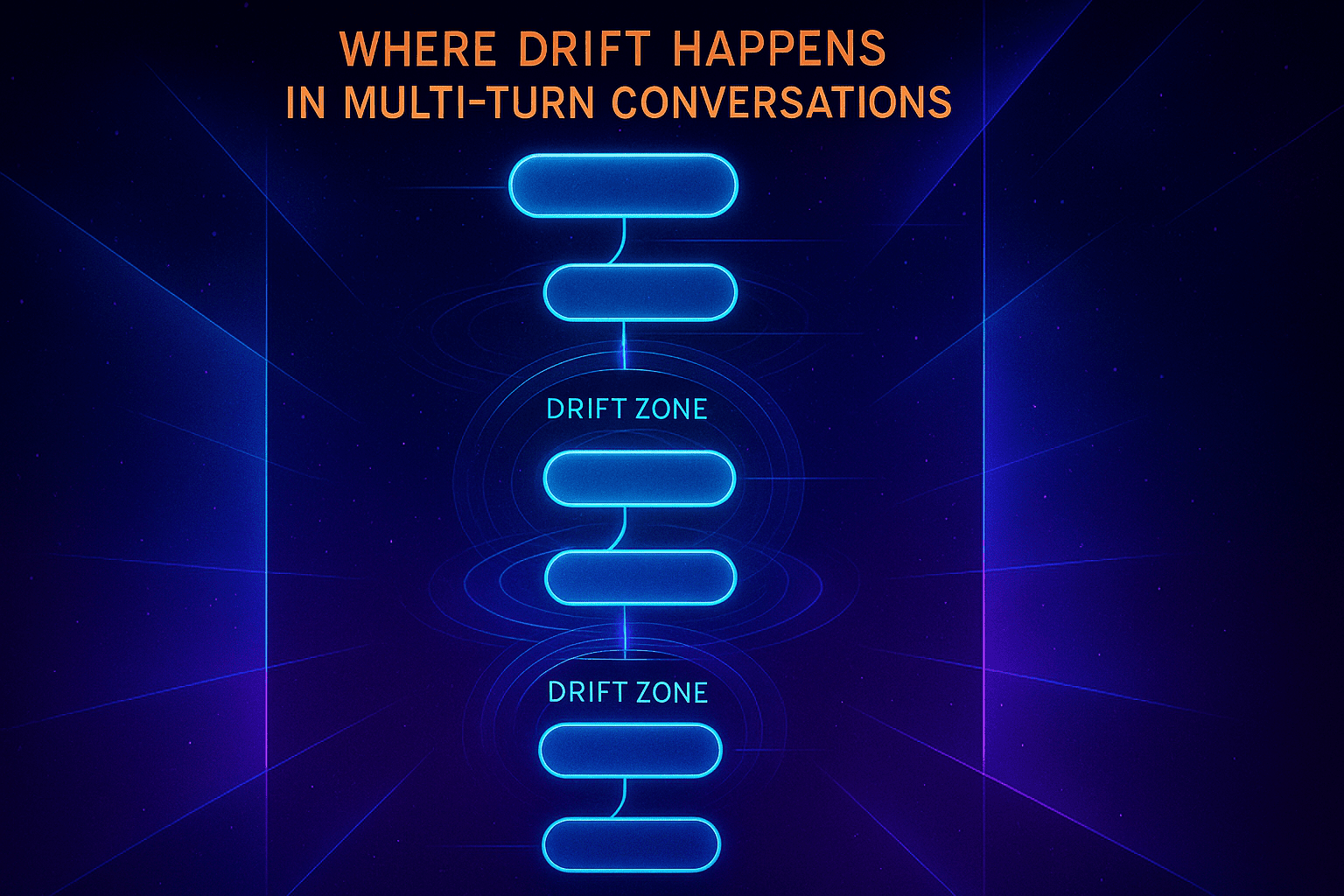
Users don't notice these changes in isolation. They notice when a familiar flow suddenly feels different. The assistant becomes vague in turn five. It forgets context. It offers steps that no longer align with documentation. It over-refuses safe queries. It calls the wrong tool. These aren't catastrophic failures, they're micro-regressions that confound teams because they emerge only in the space between turns.
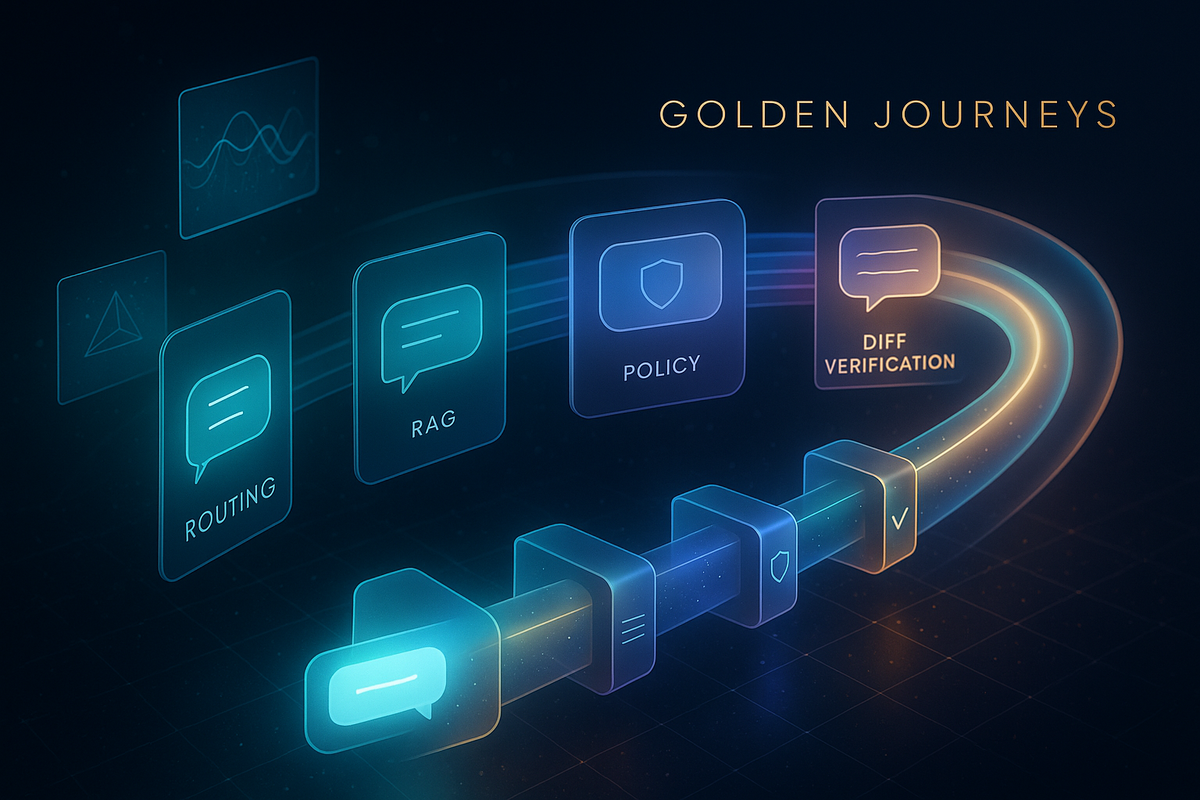
Golden Journeys are a way to bring order to that chaos. They're curated, synthetic, multi-turn conversations that define how your assistant should behave across its most important scenarios. Each journey is serialized, replayed deterministically, evaluated structurally and semantically, and incorporated into CI/CD. Instead of guessing whether a model changed or a routing tweak affected reasoning, Golden Journeys give engineering teams precise, reproducible evidence. They turn "the assistant is acting weird" into "turn 4 of this journey failed for a clear reason." Used consistently, they become one of the strongest quality guarantees you can add to an AI-driven platform.
Why AI assistants drift in subtle, hard-to-debug ways
Traditional software regresses in familiar patterns. Bad merges break APIs. Incorrect schemas cause crashes. Unhandled exceptions make functions fail. With LLM-based assistants, regressions are rarely so explicit, they manifest in tone, structure, reasoning, step sequencing, retrieval quality, and context carryover.
The source of drift often comes from many small changes blending together. Prompt revisions, as teams add safety instructions, refine clarity, adjust verbosity, or update formatting, change how the model interprets intent and structures outputs. Model shifts happen because vendors may roll out silent updates, and even deterministic settings like temperature zero aren't enough to guarantee identical behavior across versions. Routing changes, moving flows onto cheaper models or adjusting thresholds, directly affect follow-up responses and task sequencing. Retrieval variations, chunk sizes, ranking methods, document structure, embeddings, can degrade recall in specific flows even when total accuracy numbers stay stable. Post-processing refactors, JSON parsers, formatting layers, metadata extraction, chain-of-thought suppression logic, all influence downstream turns. Safety-layer evolution, a stricter classifier or newer policy, may push previously normal queries into a refusal zone. Tool integration changes, small shifts in signatures, naming, or argument structures, break tool-dependent flows without immediately failing conventional tests. None of these are easily caught by unit or integration tests, they're multi-turn, context-rich regressions that appear only when a user walks through a real scenario. Golden Journeys target exactly these cases.
What Golden Journeys really are
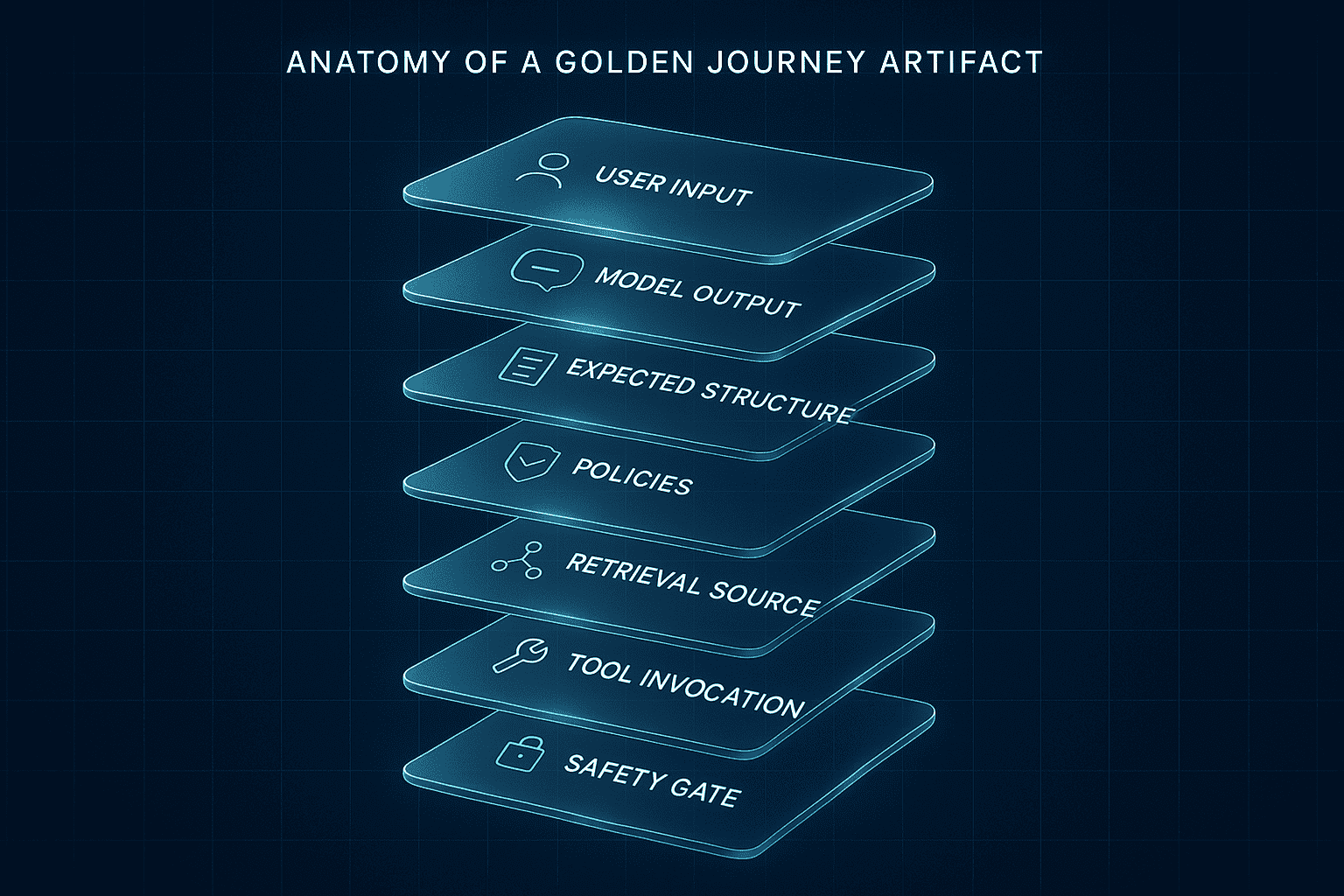
A Golden Journey is a serialized, multi-turn conversation designed to test whether your assistant behaves predictably across the entire flow. Unlike brittle "golden answers" or single-prompt tests, a journey encodes expectations at multiple levels: the shape and structure of responses, the reasoning steps the assistant should take, policies it must follow, retrieval it must use, tools it must call, safety conditions that must not trigger, model routing decisions that must remain consistent, and semantic meaning that must be preserved even if wording varies.
Journeys don't require exact text matching, instead they assert patterns, structure, intent, and metadata, giving them longevity even as your system evolves. A good journey represents a real scenario, onboarding, troubleshooting, planning, interpretation of data, or contextual guidance. For a system like Hoomanely's assistant, that includes flows such as interpreting EverSense activity patterns, explaining feeding behavior captured by EverBowl, or helping users resolve device issues. But the concept is entirely generic and applies to any AI assistant operating in multi-turn mode. When your system works correctly, Golden Journeys pass quietly. When something subtle breaks, they produce high-signal diffs that make the cause obvious.
Why Golden Journeys matter for engineering teams
Golden Journeys create a shared understanding between engineering, ML, QA, and product teams. Each journey encodes what "correct behavior" means in the context of your product, bridging silos naturally. Backend teams use journeys to verify prompt formatting, routing, post-processing, and tool execution. ML teams use journeys to validate retrieval quality, semantic robustness, safety behavior, and hallucination boundaries. QA teams use journeys to elevate conversational testing beyond manual, ad-hoc checks. Product managers use journeys as living artifacts of expected user experience. The greatest value of Golden Journeys is turning qualitative evaluations, "it feels off," into quantitative signals, "structure missing at turn 3." They scale organizational intuition into engineering rigor.
How to design a Golden Journey that will last
Good journeys aren't transcripts, they're specifications, defining what should remain stable even as the assistant becomes more powerful, more concise, or more context-aware. The journey should represent genuine user behavior, feeling like a real conversation with incomplete sentences, backtracking, clarifying questions, and interruptions, avoiding overly formal exchanges since real users don't speak in polished, structured sentences.
Capture intent and structure, not keywords, a journey shouldn't fail because the assistant used synonyms. What matters is whether it offered a correct troubleshooting sequence, asked clarifying questions at the right time, recalled earlier context, used the correct data, chose an appropriate tone, performed or avoided a tool call, and cited relevant knowledge when required. This approach makes the journey resilient across model upgrades.
Layer expectations thoughtfully, each turn may specify structural elements, follow-up prompts, policies (like "no internal implementation details"), retrieval context, safety boundaries, routing constraints, and tool behavior, these expectations define the contract for the journey. And keep journeys focused, a journey should validate a scenario, not a feature set, too many expectations turn journeys brittle, too few make them uninformative. The right balance takes experience, improving as your library of journeys grows.
Inside a Golden Journey runner
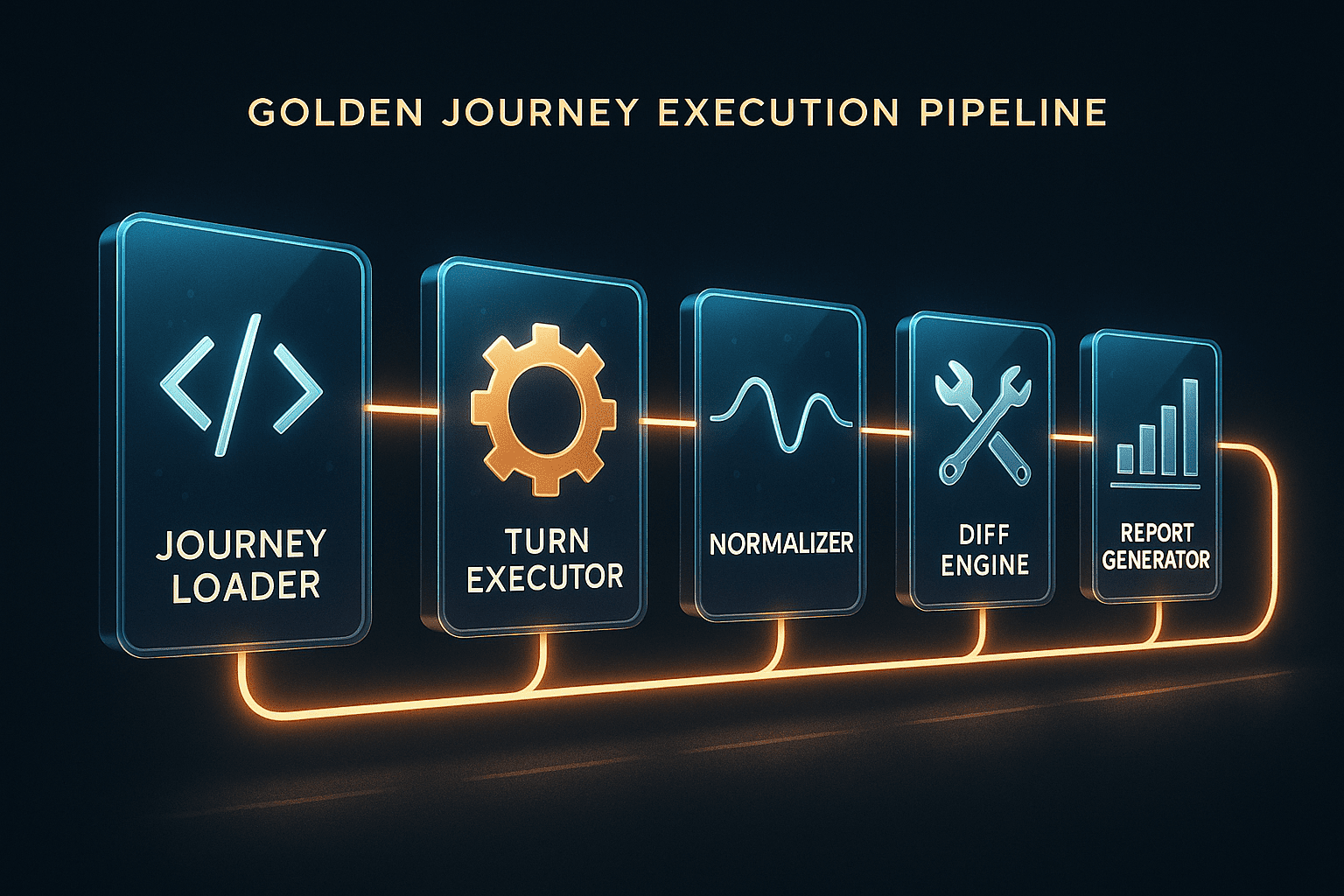
A Golden Journey runner is the engine that brings these scenarios to life inside CI/CD. It loads the journey, replays it turn by turn, applies normalization, performs diffing, and generates reports. The loader discovers journey files, validates structure, resolves shared configs, and prepares execution context. The executor sends each turn to the AI gateway, capturing model output, routing decisions, retrieval traces, tool calls, safety flags, and optionally latency and token usage, using the same gateway path real users hit.
The normalizer cleans model output so comparisons stay stable, normalizing punctuation, structuring lists, parsing JSON tool calls, extracting markdown, and removing formatting artifacts, preventing false failures. The diff engine is the core of the system, performing structural comparison, semantic similarity evaluation, policy enforcement, safety rule checks, retrieval validation, routing verification, and tool-call alignment. Golden Journeys work because this diff engine is flexible enough to allow healthy variation yet strict enough to detect behavioral regressions. The reporter produces human-friendly HTML reports, journey summaries, and turn-level annotations, enabling fast debugging even for subtle regressions.
Integrating Golden Journeys into CI/CD
The real power of Golden Journeys emerges when they become part of your continuous deployment lifecycle, preventing subtle behavioral regressions from reaching production even when each change seems small. Run journeys whenever prompts or templates change, model routing gets updated, a new model rolls out, the KB gets restructured, safety classifiers get modified, tool schemas get updated, gateways get refactored, or on nightly drift checks and weekly deep evaluations.
A mature implementation uses three execution modes. Fast Mode is lightweight, using cached or stubbed responses to detect schema or post-processing regressions. Live Mode uses real model calls, detecting semantic, structural, and retrieval drift. Deep Mode runs multiple models, fallback paths, heavy RAG scenarios, and safety evaluations, useful for weekly test cycles.
Not all deviations are harmful, journeys should fail on structural or safety violations, fail on incorrect routing or retrieval, and warn on stylistic deviations. A smart diff engine prevents pipelines from breaking over harmless variations. Journeys can be organized by category, core user flows, troubleshooting, RAG-heavy conversations, long-term memory scenarios, safety-related flows, model-routing checks, and personalization flows, making it easier to expand, audit, or prune journeys over time.
Rolling out a Golden Journey framework in 60-90 days
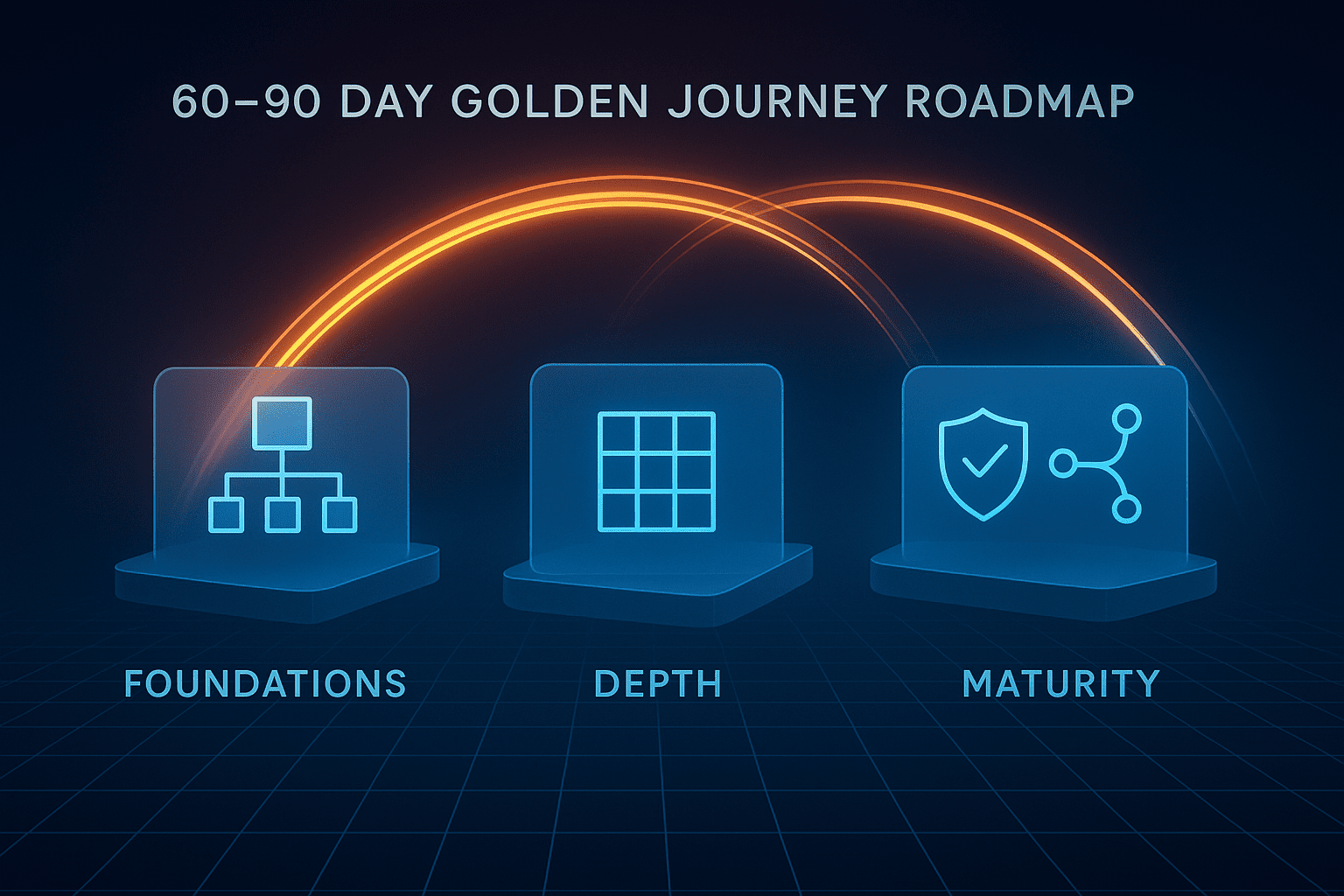
Phase 1, foundations: define the schema, build the loader and executor, write the first 20 journeys, add a deterministic sandbox mode, and integrate fast-mode checks into CI. Phase 2, depth: add semantic and metadata diffing, implement HTML reporting, add nightly live walks, and increase journey count to 60. Phase 3, maturity: introduce multi-model evaluation, add safety and privacy journeys, test fallbacks, expand to 100+ journeys, and visualize journey coverage. By the end of this period, your assistant becomes noticeably more stable and predictable, even as the underlying AI stack continues to evolve rapidly.
A realistic regression caught by Golden Journeys
A troubleshooting flow for a blinking LED on a connected device initially worked perfectly. It retrieved the correct KB chunk, offered targeted steps, and escalated appropriately. Then a refactor changed metadata fields used by the retriever. Retrieval still looked correct for generic queries, but in this specific case an important chunk lost relevance ranking. The assistant shifted from LED-specific guidance to generic troubleshooting recommendations.
Manually, this regression looked like harmless variation. But the Golden Journey encoded expectations: retrieval must use LED-state KB, output must contain LED-state interpretation, and follow-up must diagnose based on color. When replayed, the journey caught the deviation instantly, and the regression got fixed before reaching production. That's the power of Golden Journeys, elevating subtle conversational problems into clear, actionable diffs.
Hoomanely's assistant guides pet parents through understanding activity patterns, feeding schedules, sensor anomalies, and device states. These flows rely on synchronized knowledge from EverSense, EverBowl, and the app's RAG system. Firmware updates, new KB docs, additional model routing strategies, and expanded insights all introduce noise. Golden Journeys ensure the assistant's reasoning, explanations, troubleshooting sequences, and safety guidelines remain dependable, structured, and accurate, no matter how fast the ecosystem evolves.
Key takeaways
Golden Journeys transform conversational AI reliability from guesswork into engineering discipline. They capture multi-turn behavior that isolated tests can't see. They validate structure, semantics, routing, retrieval, tools, and safety. They integrate into CI/CD to detect real regressions early. They scale from a dozen journeys to hundreds without failing on harmless variation. They offer a 60-90 day path to full maturity. And they strengthen the stability and predictability of AI assistants in fast-moving ecosystems like Hoomanely. Golden Journeys convert vague "it feels wrong" feedback into precise test failures, and that changes how teams build, ship, and trust AI behavior.