How Edge AI Is Redefining Real-Time Intelligence
How AI models are shrinking without losing their minds.
Many of our real-time models, from detecting dog motion to analyzing eating patterns, run directly on embedded systems. At Hoomanely, we pair lightweight CNNs like MobileNet with quantization and pruning to get low-latency inference without giving up reliability. Processing data locally is what makes our smart bowl and camera systems fast, private, and power-efficient. Models that used to live comfortably on cloud servers are now being pushed onto tiny edge devices, drones, wearables, cameras, IoT sensors, and the challenge is delivering real-time intelligence without the luxury of a GPU or a lot of memory.
This post walks through edge inference: how models get optimized to run efficiently on limited hardware. We'll look at lightweight architectures like MobileNet, and optimization techniques like quantization, pruning, and knowledge distillation that make AI possible in the field.
What edge inference is, and why we need it
Fitting real intelligence into something as small as a dog bowl is exactly what edge inference does. It means running models on the local device instead of sending data to the cloud, so cameras, drones, and pet sensors can act on their own.
Why does this matter? Because milliseconds count. A drone can't wait on the cloud to decide which way to turn, and a health tracker shouldn't need Wi-Fi just to notice a change in eating habits. Edge inference lets devices decide where the action happens, fast, private, and in real time.
What makes it useful: low latency for real-time response without waiting on a server, privacy since sensitive data like video or health patterns never leaves the device, offline capability that keeps things working when the network drops, and energy efficiency since less transmission means longer battery life. The catch is that edge devices operate under tight compute, memory, and power budgets, so building AI that holds up under those constraints takes careful architectural choices and real optimization work.
Lightweight model architectures
MobileNet, efficiency by design: when you picture AI on a small device, a camera that recognizes your dog, a drone avoiding obstacles, it's probably running something like MobileNet. Built by Google, it became the standard blueprint for edge inference by rethinking how convolutions work. A normal convolution mixes and merges every pixel across every channel, which is powerful but slow. MobileNet splits that into two lighter steps: depthwise convolution, where each filter looks at just one channel and learns local patterns, and pointwise (1x1) convolution, which combines those patterns across channels into something meaningful. This depthwise separable convolution cuts computation by nearly 8 to 9x while keeping accuracy close to the original.
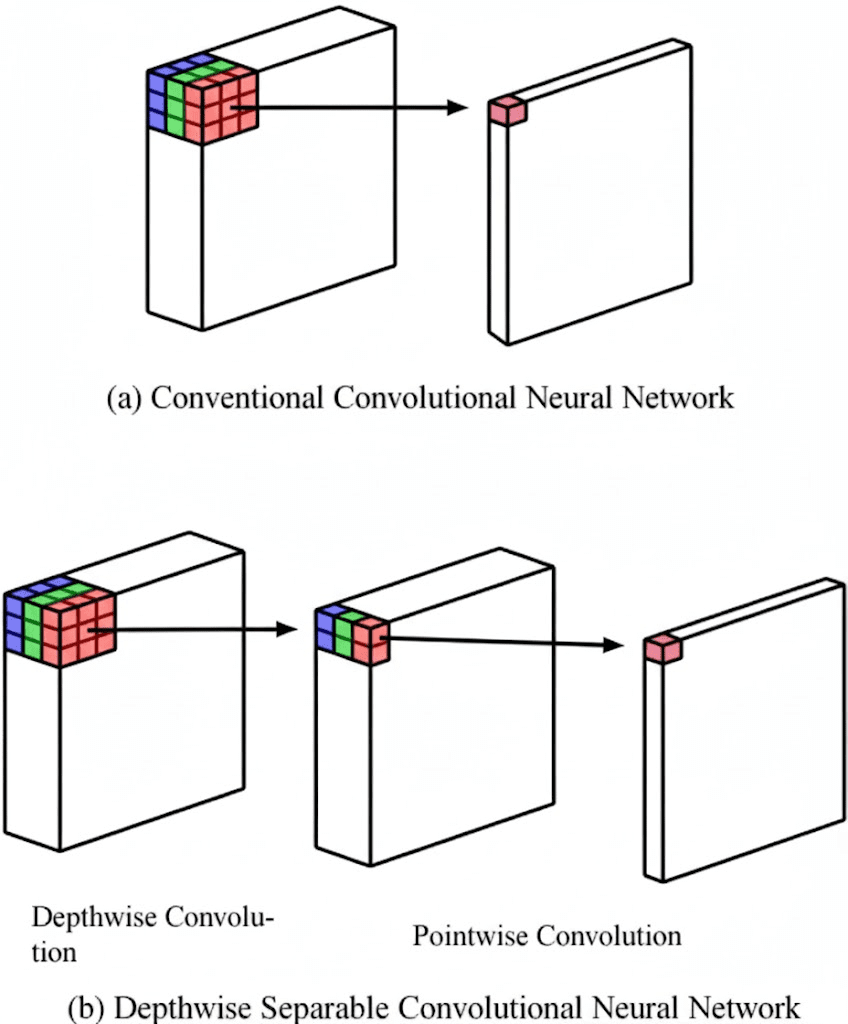
MobileNet kept improving from there. V1 (2017) introduced depthwise separable convolutions. V2 (2018) added inverted residuals, skipping unnecessary expansions, and linear bottlenecks to reduce overfitting. V3 (2019) used neural architecture search plus squeeze-and-excitation attention to fine-tune what actually matters. Rather than brute-forcing more compute, MobileNet chose to do less work, smartly.
And while MobileNet laid the groundwork for efficient design, further gains come from techniques that tune these models after training, making them leaner and ready for real-time deployment.
Model optimization techniques
Even with a lightweight architecture, real-time edge inference usually needs further optimization. Here are the three that matter most.
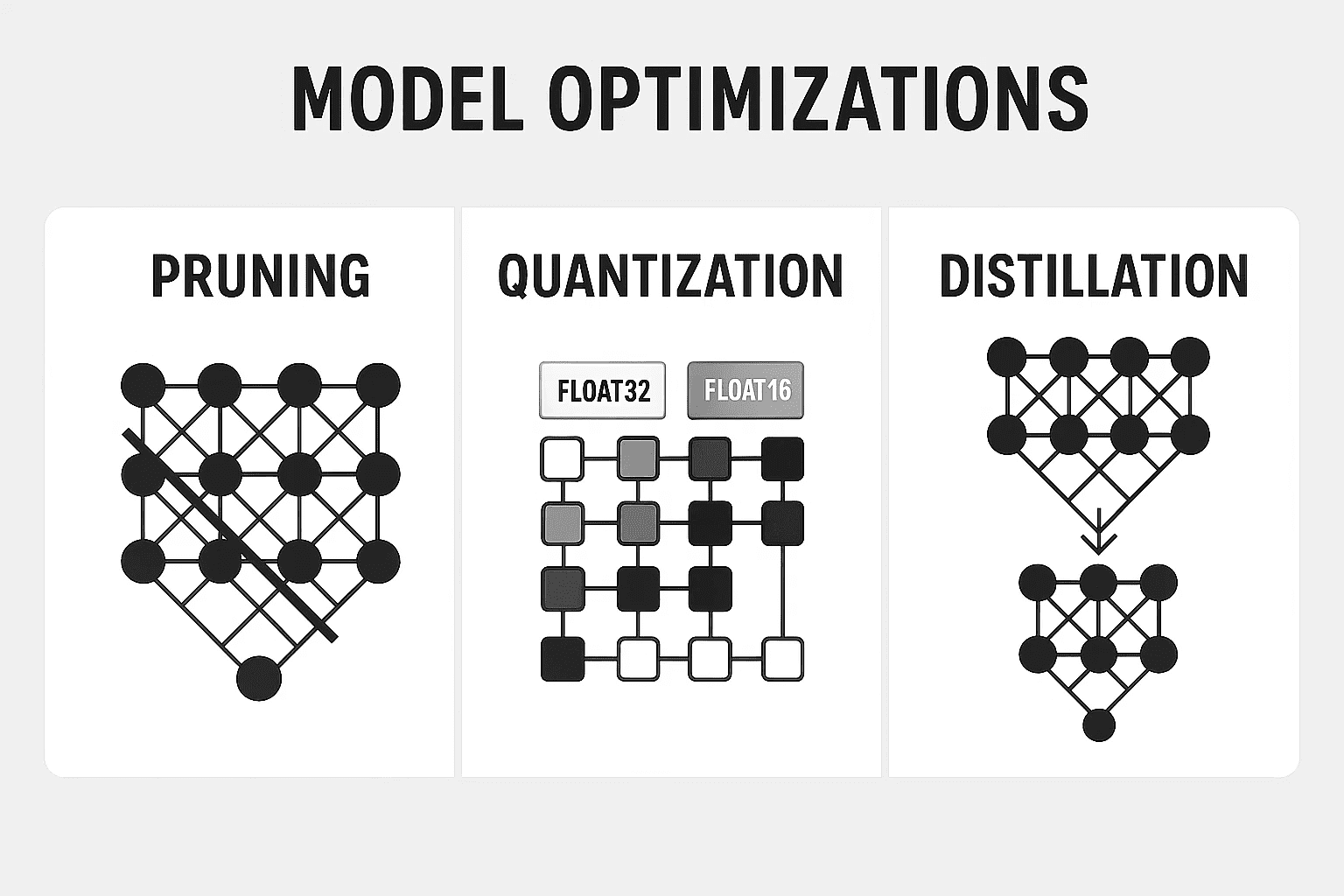
Quantization, shrinking the numbers: most networks use 32-bit floating-point weights. Quantization converts them to smaller formats like INT8 or FP16, cutting memory and computation. Post-training quantization converts after training; quantization-aware training simulates the quantization noise during training for better accuracy. Once quantized, the new weights load into the model graph through conversion tools like TensorFlow Lite's converter or PyTorch's torch.quantization APIs, letting the same trained network run on low-precision math with minimal accuracy loss. Benefits include 2 to 4x smaller model size and faster inference, especially on CPUs and NPUs. TensorFlow Lite and PyTorch Mobile both rely on INT8 quantized models for mobile CPUs.
Pruning, cutting the fat: not every neuron matters equally, and pruning removes the unimportant weights or channels while keeping most of the model's accuracy. Unstructured pruning removes individual weights, good for sparsity; structured pruning removes whole filters or channels, better suited to hardware acceleration. In practice, pruning happens during or after training using libraries like PyTorch's torch.nn.utils.prune or the TensorFlow Model Optimization Toolkit, and the model gets retrained for a few epochs afterward to fine-tune what's left, similar to trimming a tree and letting it grow back stronger. The result is fewer parameters, a smaller model, and faster inference.
Knowledge distillation, learning from a mentor: introduced by Geoffrey Hinton, this trains a smaller student model to mimic a larger teacher model's outputs. Both models run on the same data, the teacher provides soft probability outputs, and the student learns from those softened targets, controlled by a temperature parameter, instead of hard labels, picking up nuanced patterns from the teacher. Frameworks like PyTorch Lightning and TensorFlow make this straightforward by combining loss from both teacher and student predictions.
Putting it all together
Real-world edge AI systems usually stack several of these techniques.
Combined, these can deliver up to 20x efficiency improvement over the baseline model, which is what lets something like object detection or speech recognition run on microcontrollers and smartphones.
Emerging trends
Neural architecture search now automatically designs models optimized for edge hardware, as with MobileNetV3 or EfficientNet-Lite. Mixed precision inference dynamically mixes FP16 and INT8 for a speed-accuracy trade-off. And dedicated edge accelerators, like Google's Edge TPU, NVIDIA Jetson, and Apple's Neural Engine, are purpose-built for inference. Together these are blurring the line between cloud and edge, spreading intelligence across both.
Key takeaways
- Edge inference puts AI where the data actually lives, on the device itself.
- Lightweight architectures like MobileNet and EfficientNet make deep learning practical on constrained hardware.
- Quantization, pruning, and distillation are the essential post-training tricks for shrinking and speeding up models.
- The future of edge AI is hybrid optimization: combining architectural innovation with hardware-aware design.
The edge isn't just catching up to the cloud anymore. It's changing what "smart" even means.