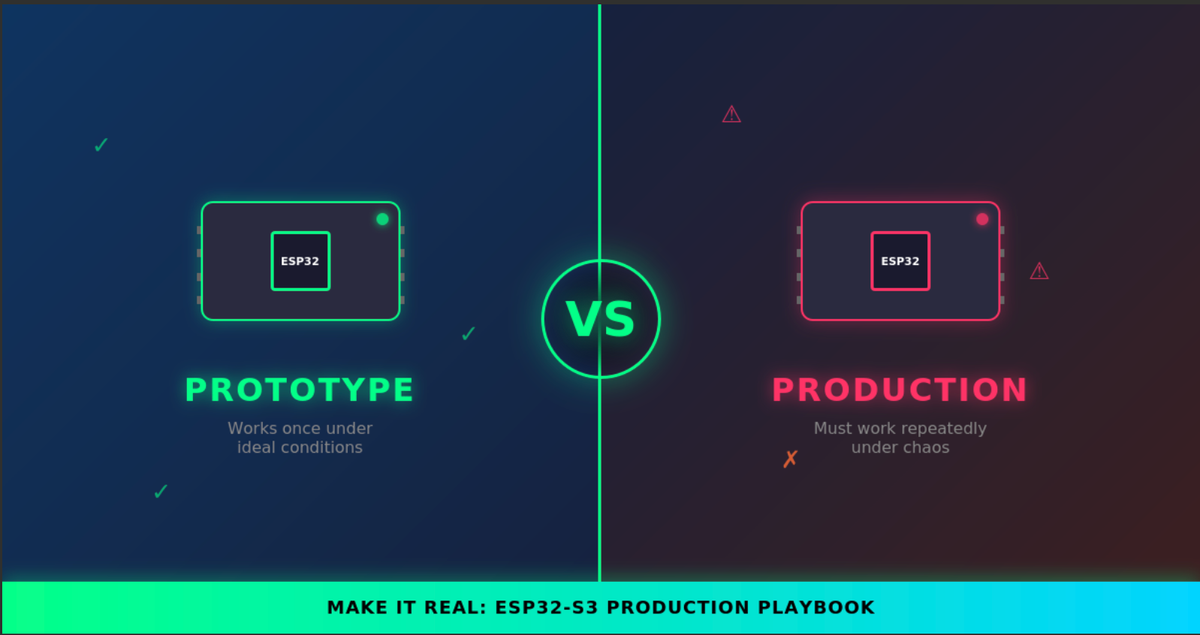
Make It Real: ESP32‑S3 Production Playbook
That ESP32-S3 prototype working perfectly on your desk? It'll brick itself in production. Here's the checklist that separates hobbyists from engineers shipping real products.
You've built something magical. Your ESP32-S3 prototype streams 9-axis IMU data flawlessly. The BLE connects every time. Battery lasts for days. You're ready to manufacture 10,000 units. Then production starts. Units randomly brick themselves during OTA updates. BLE pairing works, sometimes. Filesystems corrupt when users pull the battery. Your customer support inbox explodes.
The brutal truth: a prototype works once under ideal conditions, a product works repeatedly under chaos. Power cuts mid-write. Dropped BLE connections during handshakes. Filesystem corruption from unexpected resets. Failed OTA updates. Your device needs to survive all of it, every time, or your returns will bankrupt you. This playbook contains the seven gates that separate working prototypes from shippable products.
Understanding the journey: where you actually are
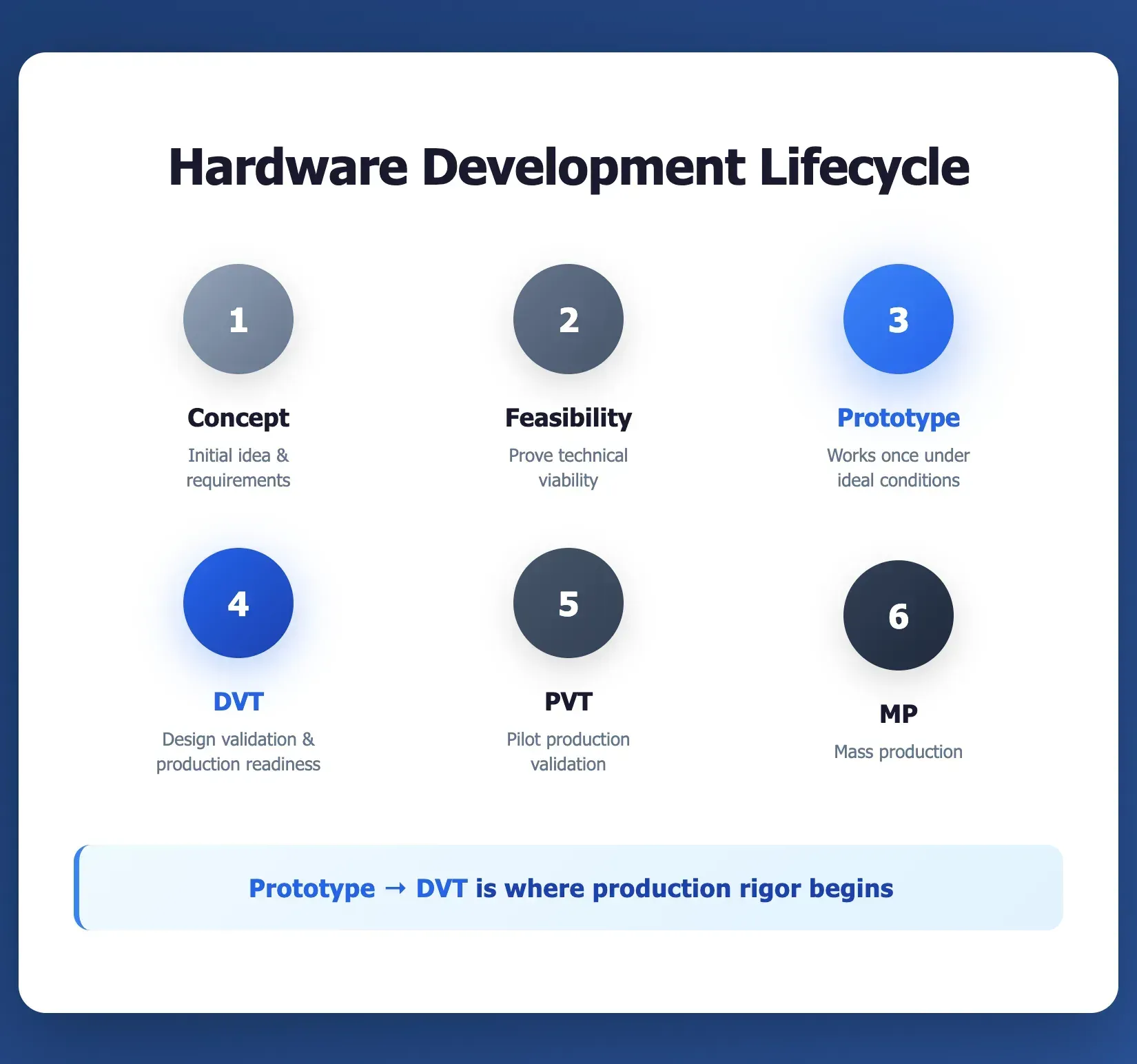
Most hardware teams blow past critical validation stages and pay for it later. The real timeline runs from Concept through Feasibility, Prototype, DVT, PVT, to Mass Production. The killer zone is Prototype to DVT, this is where "it works" transforms into "it works 10,000 times in a row."
Gate 1: explicit state machine
Implicit state management killed more production devices than any other firmware bug. Random flags scattered everywhere, timers fighting each other, race conditions that only appear at 3 AM in the field, that's what happens when you don't have an explicit state machine.
The fix is simple but non-negotiable:
typedef enum {
    STATE_BOOT,
    STATE_SELF_TEST,
    STATE_IDLE,
    STATE_ADVERTISE,
    STATE_CONNECTED,
    STATE_STREAMING,
    STATE_ERROR,
    STATE_OTA_UPDATE,
    STATE_REBOOT
} device_state_t;
Every state is explicit, every transition is deterministic, invalid transitions become impossible. Critical checklist: use enums for all states, no magic strings or ad-hoc booleans; define valid state transitions in a table and enforce them religiously; log every state change with timestamps; guard transitions with clear conditions, no wishful thinking; and enable a watchdog timer to catch lock-ups in bad states. The test: can a junior engineer look at your code and draw the state diagram in 5 minutes? If not, you're not done.
Gate 2: BLE L2CAP contract
More products fail in the field from BLE pairing issues than any other single cause. iOS CoreBluetooth is unforgiving about timing. Miss any step in the handshake sequence, or do them out of order, and your device pairs once then mysteriously fails on reconnects. Users blame your hardware, support blames your firmware, everyone's right.
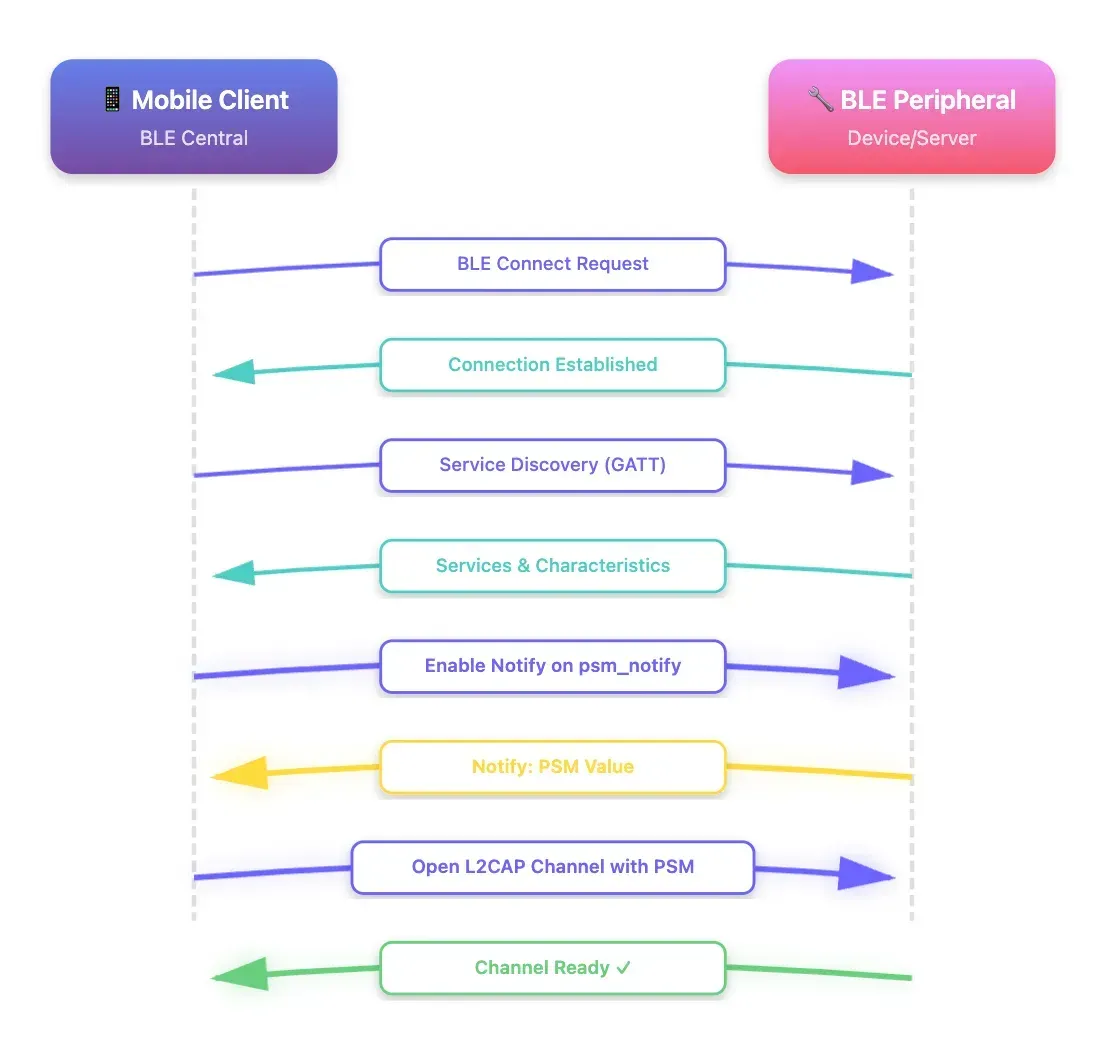
Non-negotiable checklist: publish the L2CAP PSM via a GATT characteristic before iOS attempts connection; follow the exact handshake sequence, no shortcuts, no "optimizations"; use credit-based flow control, initializing with 10 credits on both sides; append CRC16 to every frame for integrity verification; and stress test with 100-plus reconnect cycles, reboots, out-of-range, airplane mode, battery pulls. The reality check: if you haven't tested 100 reconnects, you haven't tested anything.
Gate 3: journaled storage
Real users don't shut down gracefully, they pull batteries mid-write, devices crash, power cuts happen. Your filesystem needs to survive all of it. Bulletproof storage checklist: mount the filesystem early, before any tasks that read or write; implement journal headers every N records as recovery points for interrupted operations; add a CRC or checksum to every record written to flash; always check free space before writes and handle low-space gracefully; and run power-cut testing, 100 forced resets during intensive write operations, the device must recover every time. The torture test: pull power during writes 100 times, if even one corrupts, you're not production-ready.
Gate 4: power budget validation
Datasheet numbers are fantasy. Real-world power consumption will embarrass you if you don't measure it. The shocking reality across modes: deep sleep draws 10-15 microamps for negligible daily consumption around 0.3 mAh, advertising draws 0.5-1mA for 12-24 mAh daily, connected idle draws 2-3mA for 50-70 mAh daily, and streaming draws 40-50mA for over 1000 mAh daily. Translation: your "lasts 3 months" claim becomes "dies in 36 hours" when users actually use it.
Power optimization checklist: measure everything with a real power profiler, not datasheets; enable modem sleep during BLE idle periods; replace always-on LEDs with 5% duty cycle blinks or remove them; duty-cycle sensors, sampling at 50Hz only during motion, otherwise sleep; and run a reality-check, putting the device through actual usage patterns on real battery to verify claims. The truth bomb: if measured battery life doesn't match your marketing claims, change one of them before production.
Gate 5: safe OTA updates
A failed OTA update that bricks devices is a company-ending event. Design for failure from day one. OTA robustness checklist: dual firmware slots, an A/B system, never overwriting running firmware; download resume capability, saving progress to NVS and continuing after interruption; a self-test sequence on first boot after update, verifying sensors, connectivity, and critical functions; automatic rollback after 3-plus watchdog resets, so bad firmware can't survive; and torture testing, cutting power during download, during flash write, during reboot, across 10-plus different failure points. The survival metric: the device must recover from an interrupted OTA 100% of the time, no exceptions.
Gate 6: security and identity
Insecure BLE pairing and missing device IDs will haunt you during support and diagnostics. For security, use LE Secure Connections with modern BLE pairing via ECDH, not legacy pairing, and store bonding keys in NVS so users don't re-pair every connection. For identity, burn a unique 128-bit device ID at the factory via eFUSE or OTP, expose it via a read-only GATT characteristic, and put a QR code or serial number on the device label. Why this matters: when device number 7,482 fails in the field, you need to know its firmware version, production batch, and calibration data. A unique ID makes this possible.
Gate 7: factory self-test
Even perfect firmware can't fix a bad solder joint. Factory test is your last line of defense. Factory test checklist: an automated test sequence covering all critical components; test results stored in NVS as a bitfield, one bit per test passed; calibration data saved with version and timestamp for traceability; visual indicators for the assembly line, green LED for pass, red for fail; and device ID printed as a QR code on passing units. The quality gate: no test results stored means the device refuses to boot, simple as that.
The data pipeline: from sensor to cloud without losing a sample
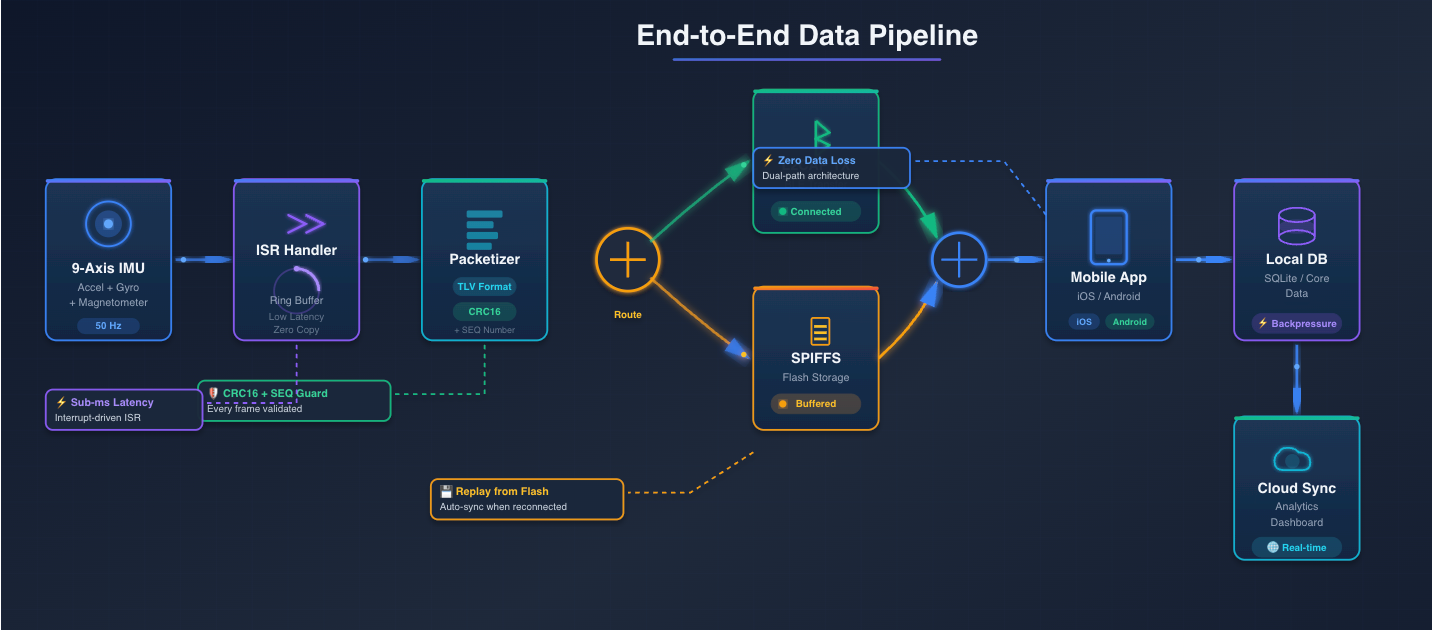
Understanding how data flows reveals where things break. Key insights: an ISR feeds a ring buffer to smooth timing jitter, TLV format plus CRC16 ensures data integrity, data stores to flash if disconnected so nothing is lost, replay happens from flash on reconnect, backpressure handling prevents mobile app crashes, and cloud upload happens when internet is available.
The truth nobody tells you
Production readiness isn't about perfection, it's about predictability. Your device will face power cuts mid-operation, BLE disconnections during handshakes, filesystem corruption from crashes, failed OTA updates, manufacturing defects, and users who do unexpected things. The question isn't "will these happen," it's "when they happen, does your device recover."
Every gate in this playbook exists because someone learned it the hard way. The BLE L2CAP gate came from thousands of devices with intermittent pairing issues. The OTA gate came from bricked units requiring manual recovery. The power budget gate came from angry customers posting one-star reviews about battery life. You can learn from their mistakes, or make your own.
Key takeaways
You have two choices. Skip gates, ship fast, spend 18 months firefighting field failures, issue recalls, and pray your company survives. Or work through every gate systematically, test beyond the happy path, and ship a device you can predict. The second choice is harder, it takes longer, it's not as exciting as rushing to production. But it's the only choice that leads to success. Pick your weakest gate, whichever one makes you nervous, implement the checklist without skipping items, test until it breaks, then fix it and test again, and repeat for every gate, no shortcuts. When you can predict how your device behaves even in chaotic conditions, you're ready. Until then, you're building expensive prototypes that happen to sometimes work.