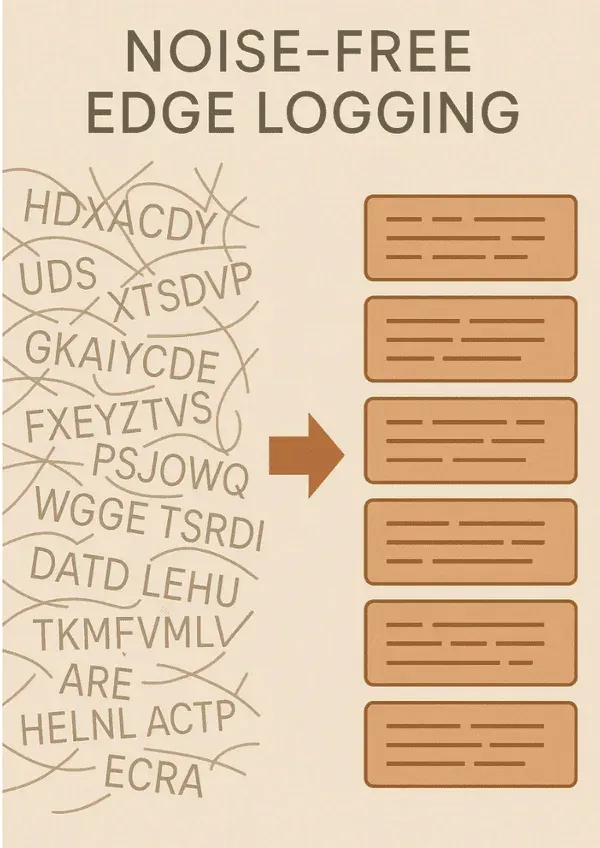
Noise-Free Edge Logging: Architecting Verbose, Tagged, and Remotely Capturable Logs That Don’t Break Your System
If there's one thing every embedded engineer learns the hard way, it's that logging is both a diagnostic superpower and a silent system killer. Too much verbosity buries the actual signal. Too little structure makes triage impossible. And remote-capture methods, if naively designed, can distort the very timing bugs you're trying to debug.
This post covers why edge-logging failures happen, what a safe logging architecture looks like, and how to design logs that scale from development builds to field deployments. Drawing from experience across Hoomanely's sensor-rich, SoM-based pet-care ecosystem, where EverSense trackers, EverBowl behavioral analyzers, and the EverHub edge gateway all need to run predictable pipelines, here's what it takes to design logs that stay valuable, stable, and production-safe.
The real problem with edge logging
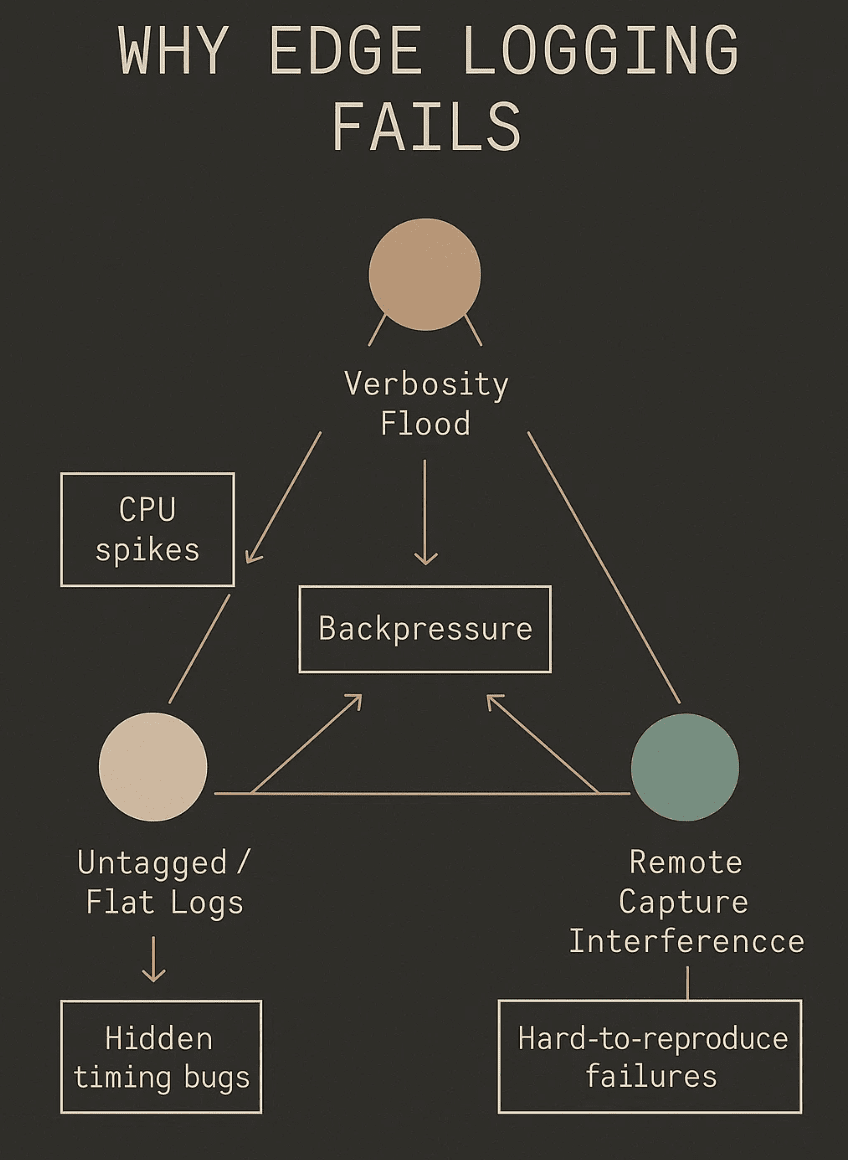
Most logging failures come from one of three issues. Verbosity becomes noise: engineers turn on DEBUG or TRACE everywhere, and suddenly the logs are a continuous firehose of unstructured text. Logs are untagged and semantically flat: without stable categories like SENSOR, I2C, POWER, PIPELINE, CONNECTIVITY, you can't filter, triage, or correlate events. And remote capture alters system behavior, which is the most subtle failure of the three. A 5 KB/s stream of logs might seem harmless, but emitted during a race condition or a DMA freeze, the timing shifts enough to hide or mutate the very bug that triggered logging in the first place.
Edge systems don't just run code, they orchestrate sensors, connectivity, memory, and real-time work, and logging touches all of it. A good logging system has to make the system observable without becoming part of the problem.
Why this matters in IoT and edge systems
In cloud applications, logging is cheap. In embedded systems, it's a resource negotiation across CPU cycles, RAM buffers, flash wear, radio bandwidth, and real-time constraints. In a multi-device ecosystem like Hoomanely's, the EverSense tracker logs accelerometer spikes, environmental shifts, and LoRa or GPS decisions. The EverBowl unit logs sound pipeline transitions, image-capture events, weight-sensor adjustments, and inference decisions. The EverHub gateway logs edge-compute workflows, telemetry aggregation, and cloud-sync retries.
Without controlled logging, a burst of DEBUG logs from a sensor task could starve the connectivity subsystem, making field behavior impossible to diagnose. Good logging isn't about more information. It's about structured, intentional information that supports real debugging.
What a safe logging ecosystem looks like
A predictable, production-safe logging architecture rests on five pillars.
A strict verbosity hierarchy. Most systems misuse verbosity levels. Production logs should come from INFO, WARN, and ERROR, occasionally CRITICAL. Everything below that, DEBUG, TRACE, PERF, should be compile-time gated or runtime-toggleable with upper bounds. This prevents accidental chatty logs from eating cycles.
Semantic tagging. Every log should belong to a stable tag namespace: [SENSOR.ACCEL] Sample spike detected, [POWER.LDO] Voltage dip detected, [NET.LORA] Tx retry #2, [PIPE.IMAGE] Capture triggered by rule 4. Tags make triage effortless, and they let remote collectors subscribe selectively to categories instead of pulling entire logs.
A buffered log pipeline. Logs shouldn't write directly to UART, flash, or sockets. They need to flow through a bounded ring buffer or lock-free queue, with overwrite-oldest mode for DEBUG, drop-newest mode for INFO and above, and backpressure flags for remote capture. That way logs never block real-time execution.
Remote capture that doesn't shift timing. Safe approaches include snapshot pulls, where the hub requests the last N seconds of logs after an error, bandwidth-aware streaming with burst caps, and semantic subscriptions that stream only specific tags. Unsafe approaches include streaming all logs over BLE, writing logs synchronously into SPI flash, or UART traces in ISR-heavy systems. Timing-neutral capture is the difference between finding bugs and hiding them.
Unified timestamping. Logs are useless if ordering is unclear. You need monotonic timestamps for local ordering, wall-clock timestamps when available, delta timestamps for ISR-driven events, and event correlation IDs across tasks. Hoomanely's systems use monotonic timestamps for synchronous sensor work on EverSense, and shared correlation IDs when EverHub aggregates multi-device telemetry.
Implementation principles
This isn't about code, it's about design behavior.
Logs should be formatted, not concatenated. Avoid hand-built strings and use a structured macro or builder instead, which keeps the format stable, memory usage predictable, and timestamps and fields consistent across log types.
Logging must be O(1) in hot paths. ISR logging has to be conditional, non-blocking, and free of heap allocation. Violate this and CPU jitter skyrockets.
Don't log success paths unless they're meaningful, since they pollute logs and hide anomalies. Better patterns: log only transitions (idle to sampling to inference to upload), log only threshold crossings, and log debug-level detail only when explicitly enabled.
Use sampling logs during high-frequency events. Instead of logging a hundred sensor events per second, log one out of every N, log on value deltas, or log aggregated summaries every few seconds. This cuts volume dramatically while preserving meaning.
Protect non-volatile memory. Flash-based logging is dangerous because of write amplification, so batch commits, limit frequency, and keep DEBUG logs out of NVM entirely. UART or RAM buffers are safer for transient data.
A multi-device scenario
Picture a pet's nighttime activity spike. The EverSense tracker detects a burst of motion and altitude change. Its logging system emits [SENSOR.MOTION] spike_detected at INFO, quietly stores [DEBUG.ACCEL] raw_window=... into a DEBUG ring buffer that never streams, generates correlation ID C123 for the event, and forwards lightweight logs to EverHub only if SENSOR tag subscriptions are active.
The EverBowl simultaneously detects sound and weight anomalies, and those logs share the same correlation ID because EverHub aggregates the context. EverHub examines all logs tagged SENSOR, PIPE, and EDGE_RULES, reconstructs the behavior, and, if configured, pulls a five-second snapshot of DEBUG logs around the timestamp without touching real-time behavior.
That model keeps triage possible, bandwidth safe, timing bugs visible, and production systems predictable. The value of good logs isn't volume, it's coherence.
Key takeaways
Logging is not I/O, it's architecture. A poorly designed logging system can destabilize a real-time device. Verbosity without boundaries is worse than no logs at all, since production-safe logs need to be predictable and bounded. Tags bring semantic clarity and turn debugging into a filtering problem instead of a treasure hunt. Remote logging has to be timing-neutral, because logs that alter the bug are worthless. Correlated logs turn multi-device systems into coherent narratives, the way Hoomanely's trackers, bowls, and hubs collectively explain behavior. And your logging system is never really done, it evolves with features, sensors, and whatever the field throws at it.
Build logs that support engineering, not ones that collapse under engineering pressure.