ONNX Runtime: The Engine Behind Fast and Flexible AI Inference
Intro
You spend weeks training a model, then realize deploying it efficiently across devices, from cloud GPUs down to a Raspberry Pi, is a whole separate problem. That's where ONNX Runtime comes in. Built by Microsoft with a large open community behind it, ONNX Runtime (ORT) is the high-performance engine that lets AI models run almost anywhere with minimal friction.
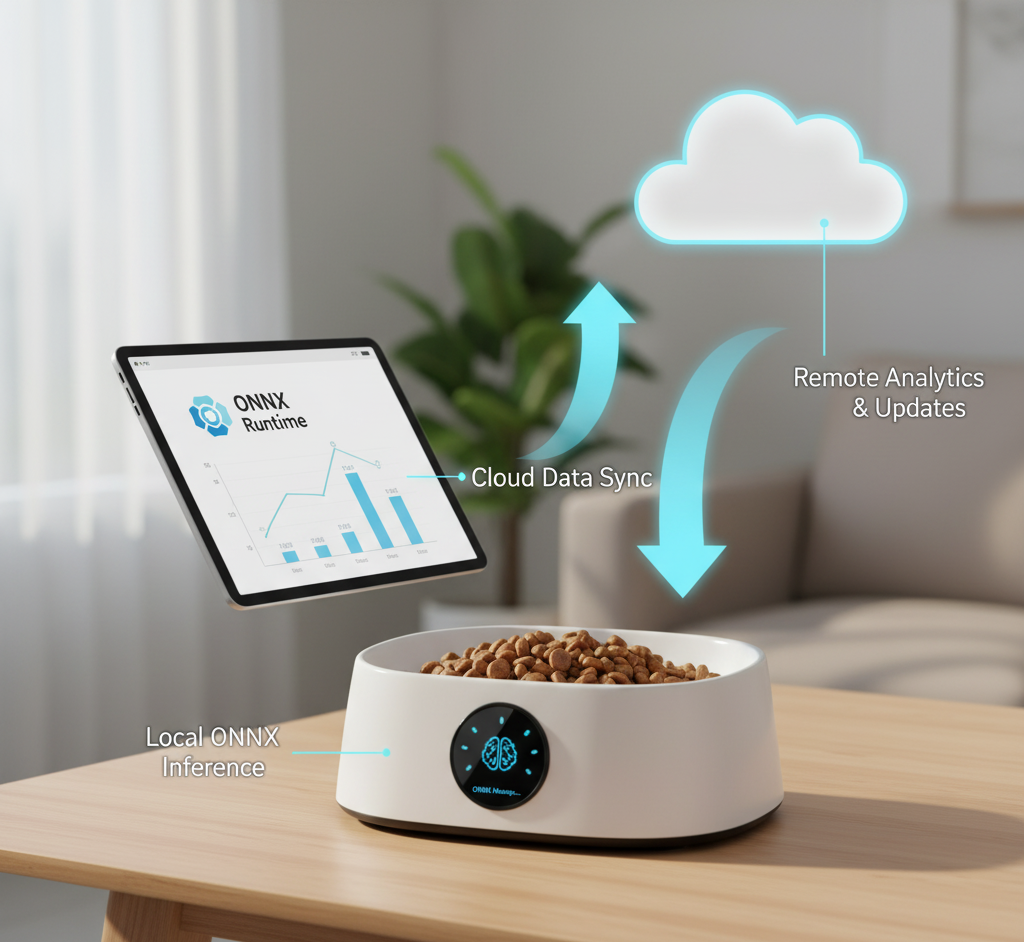
At Hoomanely, where we deploy models on embedded systems like the Raspberry Pi CM4 to detect dog behavior in real time, ONNX Runtime is central to that. It lets us bring the same networks we train on servers down to small devices while keeping inference fast and power-efficient.
The need for a common runtime
PyTorch, TensorFlow, and Keras each have their own ecosystems and model formats, and that creates friction at deployment time: a model trained in PyTorch can't run directly in TensorFlow Serving, each platform has its own optimization quirks, and smaller devices can't handle heavyweight runtime dependencies. This fragmentation made deployment genuinely cumbersome until ONNX, the Open Neural Network Exchange, stepped in.
What ONNX is
ONNX is an open standard for representing machine learning models, essentially a universal file format, like a PDF for documents, that lets a model trained anywhere run everywhere. You export models from PyTorch or TensorFlow into .onnx format, then run them with ONNX Runtime on CPUs, GPUs, or specialized accelerators like NPUs. That's the foundation. The real value is in how ONNX Runtime executes these models.
Under the hood: how ONNX Runtime works
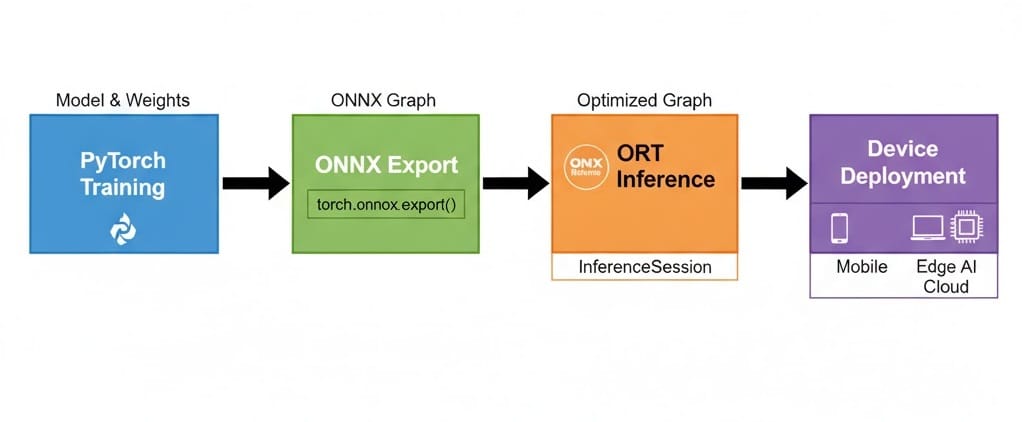
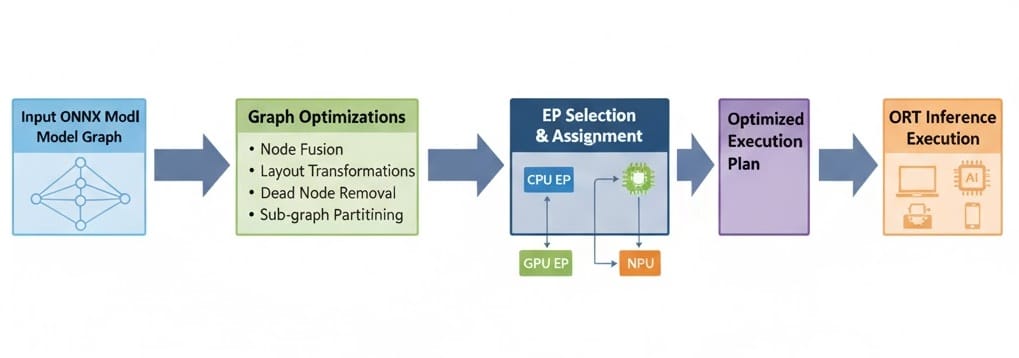
ONNX Runtime is a modular, extensible inference engine built around a few key pieces.
Graph optimization: before running anything, ORT analyzes the model's computational graph and applies optimizations like constant folding (precomputing operations with static inputs), operator fusion (combining operations like Conv, BatchNorm, and ReLU into a single kernel), and memory reuse (cutting down redundant allocations). These reduce both latency and memory footprint, which matters a lot at the edge.
Execution Providers (EPs): ONNX Runtime runs on almost any hardware through its Execution Provider architecture, with each provider optimized for a specific backend, CPU as the default general-purpose option, CUDA and TensorRT for NVIDIA GPUs with FP16 and INT8 acceleration, DirectML and ROCm for AMD GPUs, OpenVINO and CoreML for Intel and Apple silicon, and NNAPI and QNN for Android and Qualcomm devices. In practice, that means switching hardware without rewriting model code, just swap the execution provider.
Quantization and mixed precision: ORT supports converting FP32 weights down to INT8 and running mixed precision inference to cut computation with barely any accuracy loss. For edge devices, that can mean 2 to 4x faster inference, up to 75% smaller model size, and lower power draw, which matters a great deal for battery-powered devices.
Why it's fast
ONNX Runtime's speed comes from several layers stacked together: pre-execution graph transformations that simplify the graph before it ever runs, kernel-level optimizations using custom kernels for convolution or attention backed by vectorization, parallelization, and low-level libraries like cuDNN, MKL, or Eigen, execution fusion and threading that minimizes context-switching between layers, and lazy initialization with memory pools that reduces dynamic allocation and loads only what's actually needed, which matters on low-RAM systems like the CM4.
From cloud to edge
At Hoomanely, we rely on ONNX Runtime to deploy models like audio anomaly detectors and vision-based behavior trackers, running efficiently on the Raspberry Pi CM4s inside our smart bowls. That gets us the same model running on cloud and edge, 2 to 3x faster inference than native PyTorch, a runtime binary under 15MB that's easy to integrate with C++ or Python, and cross-platform support spanning ARM64, x86, macOS, Android, and iOS. It lets us bring complex ML pipelines directly into the pet's environment, cutting cloud dependency and keeping data more private.
Extending ONNX Runtime
If a model has non-standard layers, say a custom activation, ONNX Runtime lets you register custom operators or build execution providers around specialized hardware. We've used this to add a thermal sensor fusion op for our temperature-detection pipeline, and to integrate Qualcomm DSP support for low-power inference on mobile. That flexibility makes it a foundation for new work, not just a deployment tool.
Fitting into modern ML toolchains
ONNX Runtime plugs cleanly into today's workflows: torch.onnx.export() from PyTorch, tf2onnx.convert() from TensorFlow, and optimum.onnxruntime from Hugging Face for optimized transformers. That makes it a solid fit for teams that experiment in research frameworks but need stable, fast inference once something ships.
The future of ONNX Runtime
ONNX Runtime keeps evolving, from better transformer acceleration to growing support for LLM inference. Features like ORT GenAI and memory-efficient attention kernels are bringing it closer to high-end frameworks like TensorRT while keeping its cross-platform advantage intact. For edge and embedded AI, where every millisecond and milliwatt counts, that direction matters.
Key takeaways
- Portable: train anywhere, deploy everywhere.
- Optimized: uses hardware acceleration through execution providers.
- Lightweight: small binary, well suited to the edge.
- Extensible: supports custom ops and new hardware.
- Proven: used in production by Microsoft, NVIDIA, and smaller teams like ours.