Reliable Backend Workflows on AWS: Idempotency, Retries, and Failure Modes
Modern backend systems rarely fail loudly. They fail quietly, through duplicated requests, partially completed workflows, retried executions, and replayed messages that look successful but slowly erode correctness. On AWS, these behaviors aren't edge cases or misconfigurations, they're the default operating conditions of a resilient, distributed platform.
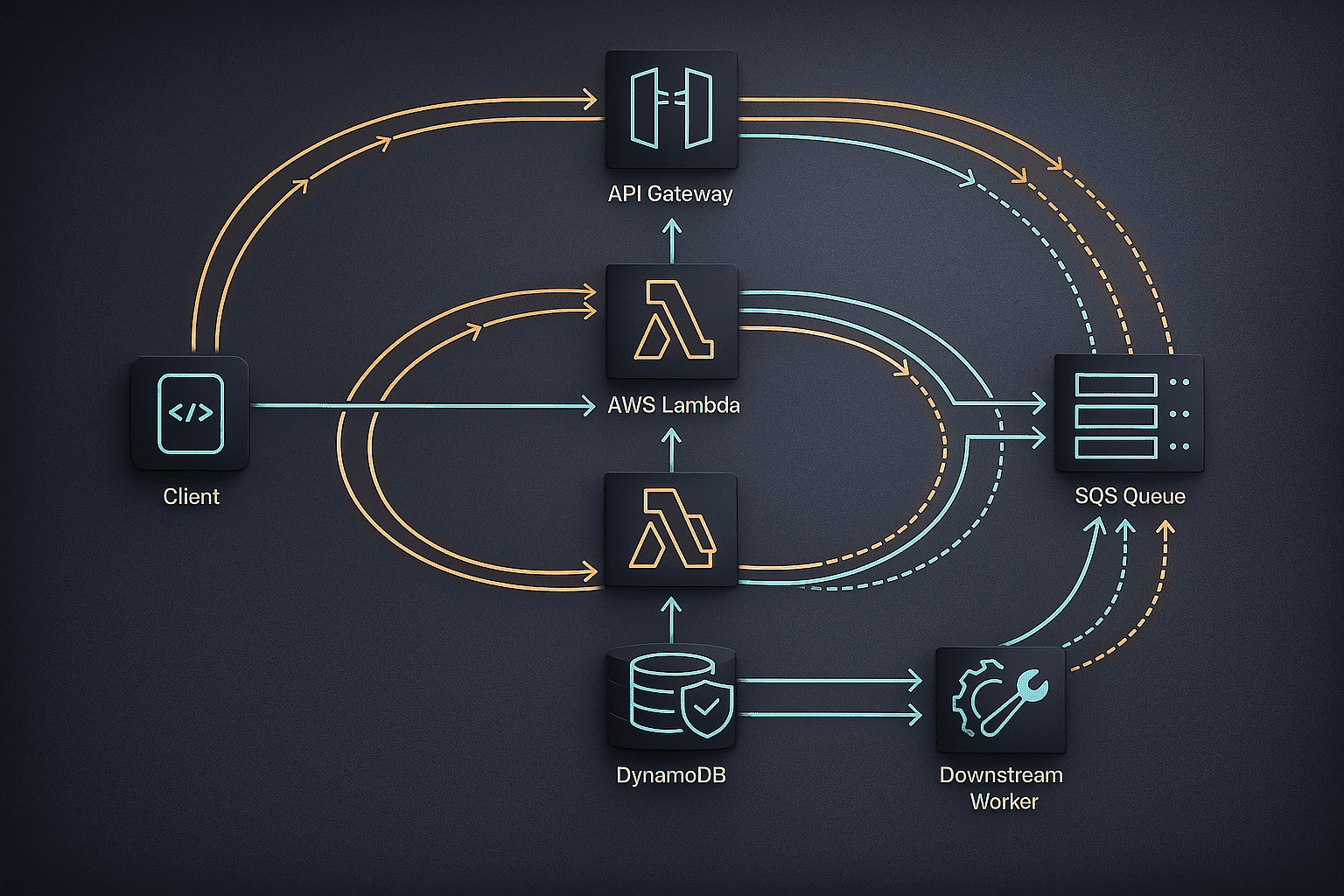
API Gateway retries requests when responses are ambiguous. AWS Lambda may re-execute handlers after timeouts or partial failures. SQS redelivers messages to guarantee durability. Mobile clients reconnect and resend actions after flaky network conditions. Each of these behaviors is individually reasonable. Together they form an environment where backend workflows must assume duplication, reordering, and retries as normal.
This post explores how Hoomanely designs reliable backend workflows on AWS by embracing this reality. Rather than trying to simulate "exactly-once" execution, the focus is on building systems that remain correct under retries, partial failure, and duplication. The discussion is grounded in Python services running on AWS Lambda, DynamoDB, and queues, and reflects production patterns rather than theoretical guarantees.
The at-least-once reality of AWS
AWS prioritizes durability and availability over execution purity. This design choice shows up as at-least-once delivery across many core services. A request may be processed more than once, and a message may be delivered multiple times, but the platform ensures work is never silently dropped.
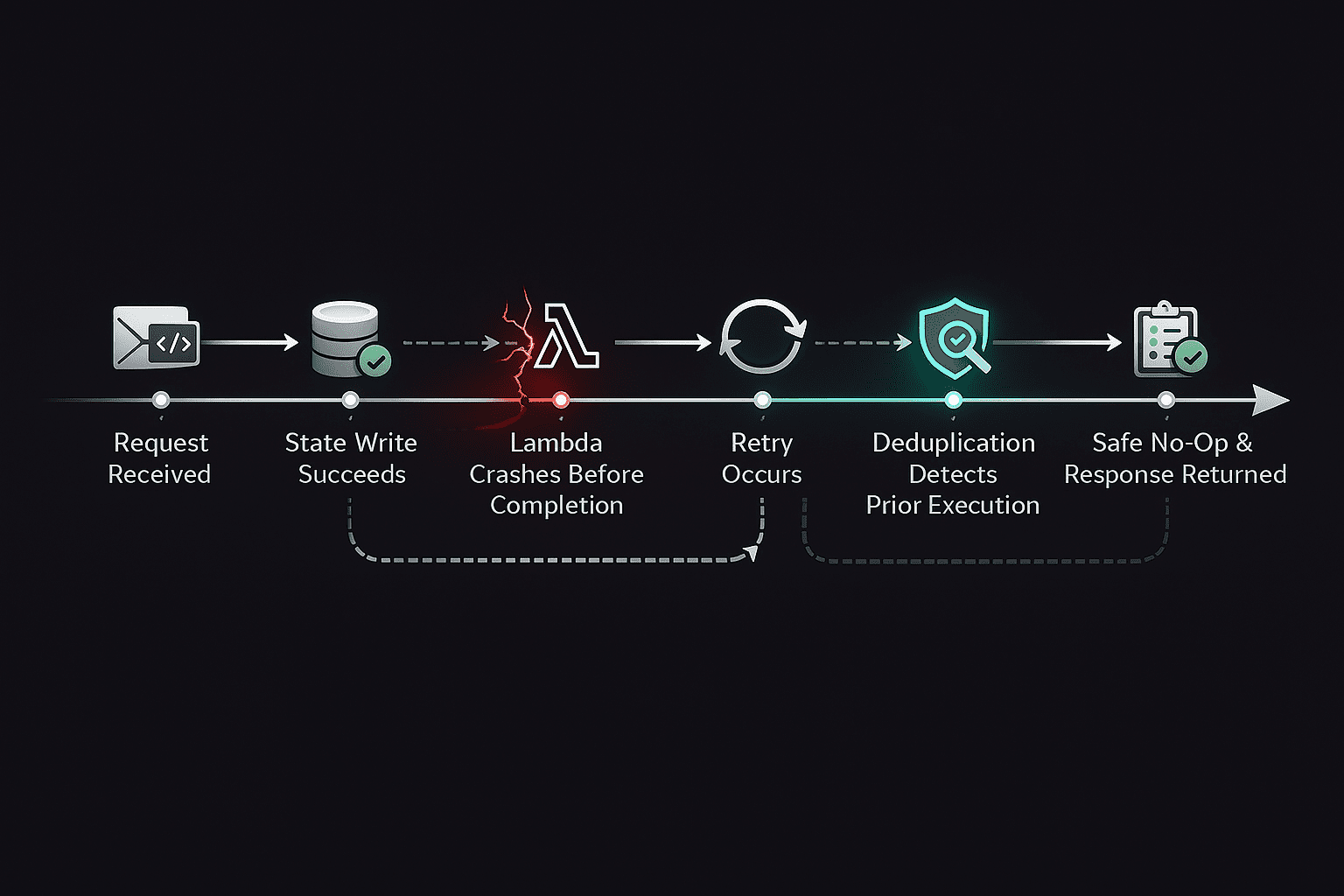
From an application perspective, this means several things happen regularly: a client times out and retries while the server continues processing; a Lambda invocation completes a write but crashes before returning a response; a queue message becomes visible again due to a transient worker failure; a Step Functions state retries automatically after a perceived failure. These scenarios aren't failures of AWS, they're signals that the application layer must be designed to tolerate re-execution.
The key mistake many systems make is assuming retries are exceptional. In reality, retries are the steady state. Correctness must be preserved even when the same logical action gets processed multiple times.
Failure as a design input, not an exception path
In many codebases, failure handling lives at the edges, catch blocks, retry decorators, generic error handlers. This often leads to brittle systems where success paths are carefully designed but failure paths are loosely considered. Answering the failure-mode questions early, before implementation, lets workflows be designed to be safe under replay rather than patched after issues appear in production.
Idempotency as a system property
Idempotency is often reduced to a single mechanism, like storing an idempotency key in a table. Useful, but incomplete. True idempotency isn't an attribute of an endpoint, it's a property of the entire workflow. A backend operation is idempotent if executing it multiple times produces the same final system state as executing it once. Achieving that requires alignment across several layers: request identity has to be stable, writes have to be conditional or fenced, side effects have to be guarded, and downstream consumers have to tolerate duplication. If any layer violates these principles, retries can leak into incorrect state.
Stable request identity in Python APIs
Every mutating request must carry a stable, client-defined identity representing the logical action being performed. This identity is distinct from infrastructure-generated request IDs and has to remain consistent across retries. Common examples include action identifiers such as meal log IDs, timeline event IDs, or update transaction IDs. These identifiers get generated once on the client or upstream service and reused whenever the request is retried. On the backend, this identity becomes the anchor for deduplication. Without it, retries are indistinguishable from new actions, and correctness becomes probabilistic.
Deduplication as a guardrail, not a feature
Deduplication shouldn't be an optional optimization, it's a guardrail protecting core state from corruption. A typical pattern involves maintaining a deduplication record keyed by the action identifier and action type. When a request arrives, the backend checks whether this action has already been processed. If so, the handler short-circuits and returns the previously recorded result or a safe acknowledgment. This ensures retries don't reapply state changes, even if they occur minutes or hours later. More importantly, it decouples correctness from timing assumptions.
Conditional writes and storage-level enforcement
Application-level checks are insufficient under concurrency. Two retries may arrive simultaneously, both pass an in-memory check, and both attempt to write. Storage-level enforcement is required to close this gap. DynamoDB conditional writes are central to this strategy, allowing writes to succeed only if specific conditions hold true, such as the absence of a record or a matching version number. Examples of conditional enforcement include creating a record only if it doesn't already exist, updating a record only if the expected version matches, and appending data only if a specific event ID hasn't been seen before. These conditions ensure retries become harmless no-ops rather than duplicated state changes.
Multi-step workflows and write fencing
Single-write operations are relatively easy to make idempotent. Multi-step workflows are more complex, particularly when steps involve different data models or side effects. Consider a workflow that records an event, updates an aggregate, and triggers downstream fan-out. If the function crashes after the aggregate update but before fan-out, a retry may re-execute all steps, duplicating effects.
Write fencing addresses this by associating each execution with a unique fence or execution token. Each write checks whether it's already been applied for that fence, and skips if so. This ensures retries resume safely rather than restarting blindly, and it also allows partial progress to be preserved without duplication.
Retry-safe background workers
Queues and event-driven workers amplify the impact of retries. A single message can be delivered multiple times, potentially long after the original processing attempt. Workers must assume every message may be a replay, visibility timeouts and retry delays aren't locks or guarantees, they're best-effort coordination mechanisms. To remain correct, background workers must treat message payloads as immutable commands, use stable identifiers for deduplication, guard side effects with conditional writes, and avoid relying on in-memory state for correctness. These principles ensure replayed messages don't produce duplicated or inconsistent outcomes.
Fan-out as a duplication multiplier
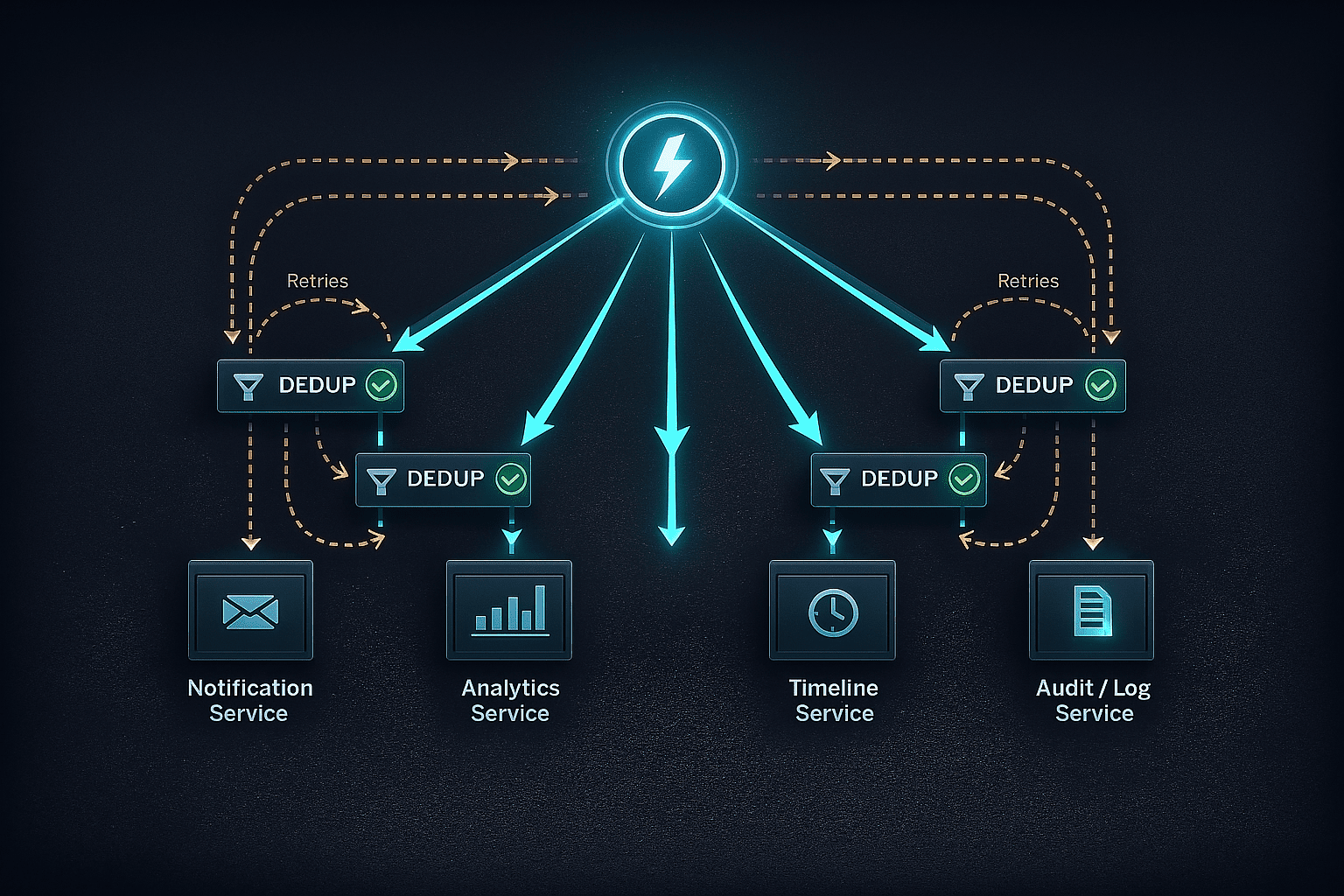
Fan-out is where retry-related bugs become most visible. A single retried action can trigger multiple notifications, duplicate analytics events, or repeated downstream updates. To contain this, fan-out has to be treated as a chain of idempotent operations rather than a single fire-and-forget step. Each downstream consumer must independently enforce deduplication based on stable identifiers. This distributes correctness across the system, preventing a single failure from cascading into widespread inconsistency.
Observability of retries and failure modes
Retry-safe systems are only trustworthy if retries are observable. Silent retries are dangerous because they hide failure patterns and make debugging difficult. Key signals to monitor include retry rates, deduplication hits, conditional write failures, and replayed workflow executions. These metrics provide insight into how often the system is operating under retry conditions and whether safeguards are working as intended. At Hoomanely, retries get logged as structured events rather than treated as errors. This lets teams audit behavior, identify hotspots, and refine workflows without conflating retries with genuine faults.
Designing for mobile-induced retries
Mobile clients are particularly retry-prone. Network interruptions, background suspensions, and user impatience all contribute to duplicate requests. Backend workflows must assume mobile-originated actions may be resent multiple times and may arrive out of order. Idempotency and deduplication aren't optional in this context, they're fundamental to preserving user trust. By designing backend workflows that are retry-safe by default, mobile behavior becomes predictable rather than problematic.
Explicit failure modes to design for
Reliable backend systems explicitly account for common failure scenarios rather than treating them as anomalies: handler crashes after partial writes, concurrent retries racing each other, delayed message redelivery, and downstream timeouts. Each of these scenarios has to result in a system state that's consistent, non-duplicated, and recoverable. Achieving that requires deliberate modeling of failure modes during design, not reactive fixes after incidents.
Reliability as an architectural discipline
Retry-safe design isn't a collection of tricks, it's an architectural discipline rooted in stable identifiers, conditional writes, idempotent side effects, and observable behavior. At Hoomanely, these principles let backend systems remain correct even as AWS aggressively retries operations to preserve availability. Rather than fighting the platform, the architecture works with it. Exactly-once execution is a comforting abstraction, but it doesn't reflect how distributed systems behave in production. AWS favors resilience over purity, and backend systems have to be designed accordingly.
Key takeaways
Reliable workflows are built by assuming retries, duplication, and partial failure are inevitable. Idempotency isn't a feature you bolt on later, it's a property that emerges from careful system design. Correctness is engineered, not assumed.