Scaling Software Without Losing Simplicity
Every software product begins with a simple vision. The first few features are straightforward, the codebase is easy to understand, and engineering decisions are made with confidence because the system is still small. As products mature, however, the landscape changes. New capabilities are added, teams expand, delivery timelines become tighter, and the number of engineering decisions grows exponentially.
What often causes long-term maintenance challenges isn't a single architectural mistake—it is the gradual accumulation of small inconsistencies. Multiple ways of solving the same problem emerge, duplicated logic spreads across the codebase, and development gradually becomes slower despite increasing engineering effort. Over time, complexity becomes the biggest obstacle to innovation.
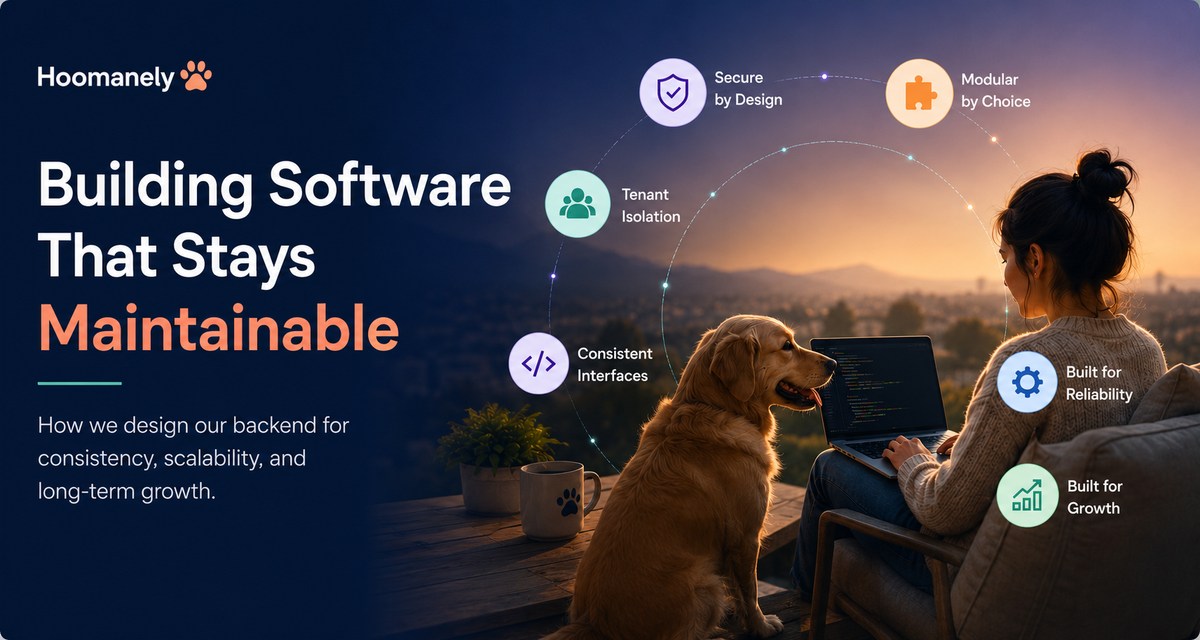
At Hoomanely, we've learned that building software capable of supporting long-term growth isn't about selecting the newest architectural trend. It's about creating an engineering culture where consistency, simplicity, and thoughtful design guide every decision. The most scalable systems are often the ones that make good engineering practices feel natural rather than enforced.
This philosophy has shaped the way we think about building technology—not only to solve today's challenges, but to remain adaptable for the years ahead.
The Problem: Complexity Is a Natural Outcome of Growth
Software rarely becomes difficult to maintain overnight. Instead, complexity accumulates gradually as products evolve.
Every new feature introduces another decision. Every engineer brings fresh perspectives and preferred approaches. Every deadline creates pressure to optimize for immediate delivery rather than long-term consistency. None of these are inherently problematic—in fact, they are signs of a growing product. The challenge lies in ensuring that growth doesn't gradually erode the simplicity that made the system effective in the first place.
Many engineering teams eventually encounter familiar questions:
- Why are similar problems solved differently across the product?
- Why does introducing a small feature require changes across multiple areas?
- Why has onboarding new engineers become increasingly difficult?
- Why do releases feel riskier as the product grows?
These aren't simply technical issues—they are symptoms of architectural entropy.
Entropy in software is the tendency for systems to become more complicated over time unless deliberate effort is made to preserve clarity. Left unchecked, complexity spreads naturally. New implementation patterns appear alongside existing ones, documentation becomes outdated, and maintaining consistency requires increasing amounts of manual effort.
The consequences extend beyond engineering productivity. Complex systems are harder to test, slower to evolve, and more difficult to reason about during incidents. Teams spend more time understanding existing behaviour than delivering new value.
The most successful engineering organizations recognize that preventing unnecessary complexity is far less expensive than eliminating it later.
How Complexity Grows
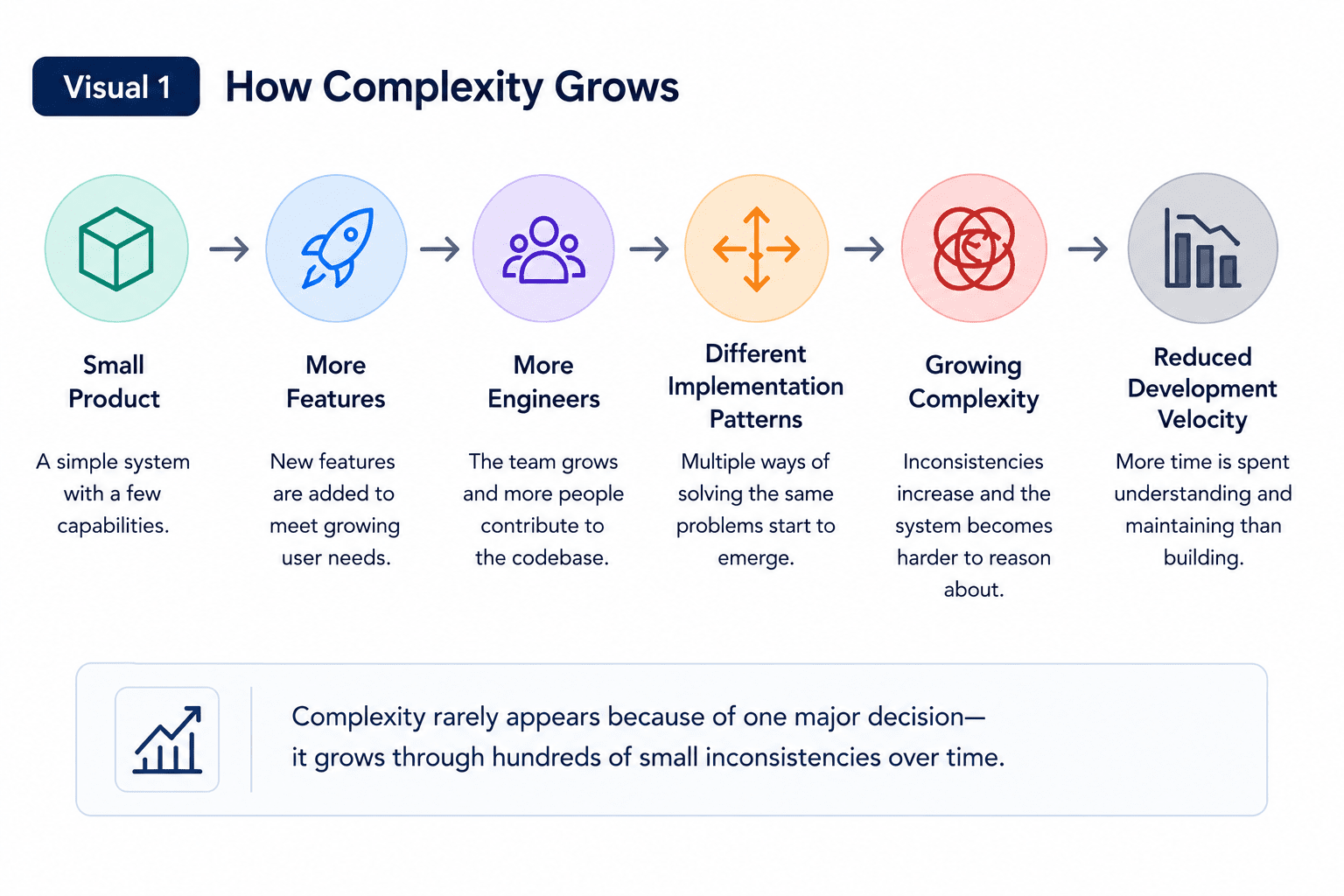
Complexity rarely appears because of one major decision—it grows through hundreds of small inconsistencies accumulated over time.
The Approach: Design for Consistency, Not Convenience
When engineering teams discuss scalability, the conversation often centers around infrastructure, cloud platforms, or distributed systems. While these are important, scalability begins much earlier—with the everyday decisions engineers make while writing software.
A product becomes easier to evolve when there is a shared understanding of how common problems should be solved. Consistency reduces cognitive load because engineers spend less time deciding how to implement something and more time focusing on what they are building.
Rather than encouraging multiple equally valid approaches, mature engineering organizations establish clear patterns that become the default. These patterns aren't intended to limit creativity; they exist to eliminate unnecessary variation where variation provides little value.
This shift has several long-term advantages.
First, knowledge becomes transferable. Engineers moving between different parts of the product encounter familiar design principles rather than entirely different implementation styles. As a result, onboarding becomes faster and collaboration improves naturally.
Second, improvements become easier to introduce. When common capabilities follow consistent patterns, enhancements can be applied broadly instead of requiring dozens of independent updates. Engineering effort compounds rather than fragments.
Finally, consistency creates confidence. Predictable systems are easier to debug, easier to review, and easier to extend. Engineers can spend their time solving product problems instead of navigating architectural differences.
Designing for consistency doesn't mean sacrificing flexibility. Instead, it creates an environment where innovation happens within well-understood boundaries. Those boundaries provide stability while allowing individual components to evolve independently over time.
Consistency Enables Sustainable Growth
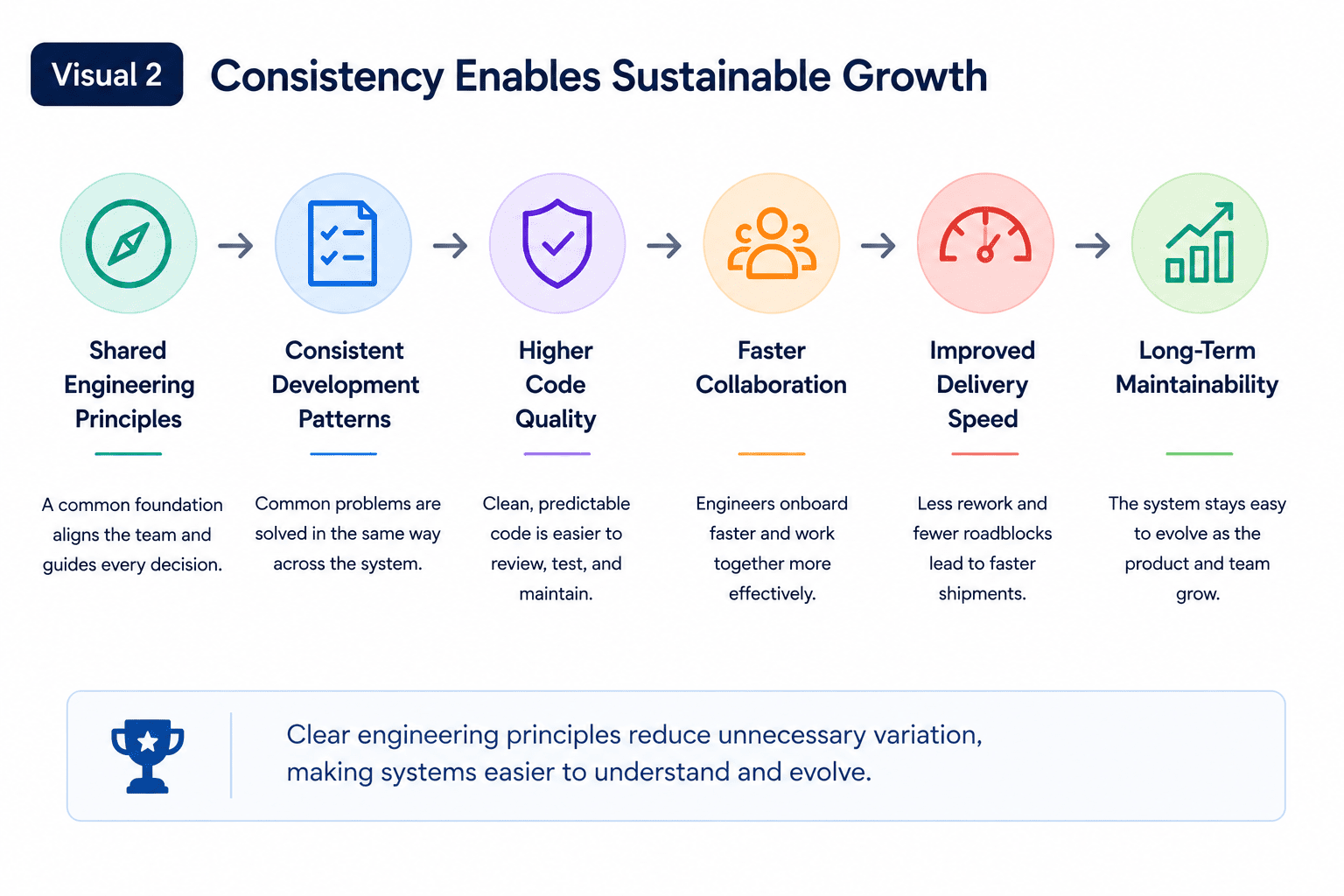
Clear engineering principles reduce unnecessary variation, making systems easier to understand and evolve.
Engineering Principles That Stand the Test of Time
Technology evolves rapidly, but the principles behind reliable software remain remarkably consistent. Languages change, frameworks come and go, and infrastructure continues to advance, yet maintainable systems are almost always built upon the same foundational ideas.
Prioritize Simplicity
Simple systems are easier to understand, easier to maintain, and easier to improve. Simplicity doesn't mean building less capable software—it means removing unnecessary complexity wherever possible. Every additional abstraction, dependency, or special case should provide meaningful value; otherwise, it becomes future maintenance overhead.
Establish Clear Ownership
As products grow, clarity becomes increasingly important. When responsibilities are well defined, engineers can confidently make changes without worrying about unintended side effects elsewhere in the system. Clear ownership also improves accountability, collaboration, and long-term maintainability.
Standardize Common Practices
Every engineering organization has recurring challenges, whether it's handling data, logging activity, processing events, or managing configuration. Solving these problems consistently creates predictability across the product. Standardization reduces duplicated effort while allowing teams to focus on delivering user value instead of reinventing solutions.
Build for Change, Not Perfection
No architecture remains unchanged forever. Successful systems acknowledge this reality by embracing adaptability from the beginning. Rather than optimizing exclusively for today's requirements, they provide room for future evolution without requiring large-scale rewrites.
Let Principles Guide Decisions
Documentation and best practices are valuable, but they are most effective when supported by shared engineering culture. Teams that consistently prioritize maintainability, readability, and simplicity naturally make decisions that strengthen the system over time.
Ultimately, scalable software is not defined by the technologies it uses—it is defined by how easily it continues to evolve as both the product and the engineering team grow.
Key Takeaways
- Complexity grows naturally—simplicity must be intentional. Sustainable software is the result of deliberate engineering decisions that prioritize clarity and consistency over short-term convenience.
- Consistency accelerates innovation. When engineering teams share common patterns and principles, they spend less time solving the same problems repeatedly and more time building meaningful features.
- Scalability starts with maintainability. Infrastructure can support growth, but long-term success depends on creating systems that remain easy to understand, extend, and operate as products evolve.
- Engineering principles outlast technology choices. Frameworks and tools will continue to change, but clear ownership, modular thinking, simplicity, and thoughtful design remain timeless foundations for reliable software.
- Great architecture empowers people. The best engineering systems don't just support software—they enable teams to collaborate effectively, move confidently, and deliver better experiences for users.
- At Hoomanely, engineering is an investment in trust. Every architectural decision is guided by our commitment to building reliable technology that helps pet parents care for their companions with confidence, today and as the platform continues to grow.