The Silicon Errata Trap: Navigating Undocumented Hardware Bugs in Advanced Microcontrollers
When building cutting-edge pet health monitoring devices, encountering undocumented silicon quirks isn't just frustrating, it can derail product timelines and compromise system reliability. While working on Hoomanely's next-generation pet healthcare platform, we found that even sophisticated ARM Cortex-M33 based microcontrollers harbor subtle timing anomalies that demand creative software workarounds.
The hidden reality of modern silicon
Every microcontroller generation brings impressive feature sets, higher clock speeds, and enhanced peripherals. Beneath the marketing specifications, though, lies a more complicated reality: silicon errata. These aren't minor inconveniences, they're fundamental hardware behaviors that can cause intermittent failures, timing violations, and system instability if left unaddressed. Developing a high-performance camera module with integrated AI processing revealed several timing-related issues that needed systematic detection and mitigation.
Case study: RTC clock domain synchronization
One of the most challenging errata involved Real-Time Clock initialization failures under specific power sequencing conditions. It showed up as sporadic HAL_RTC_Init failures, particularly when transitioning between power states, critical for a battery-powered device that needs accurate timestamps.
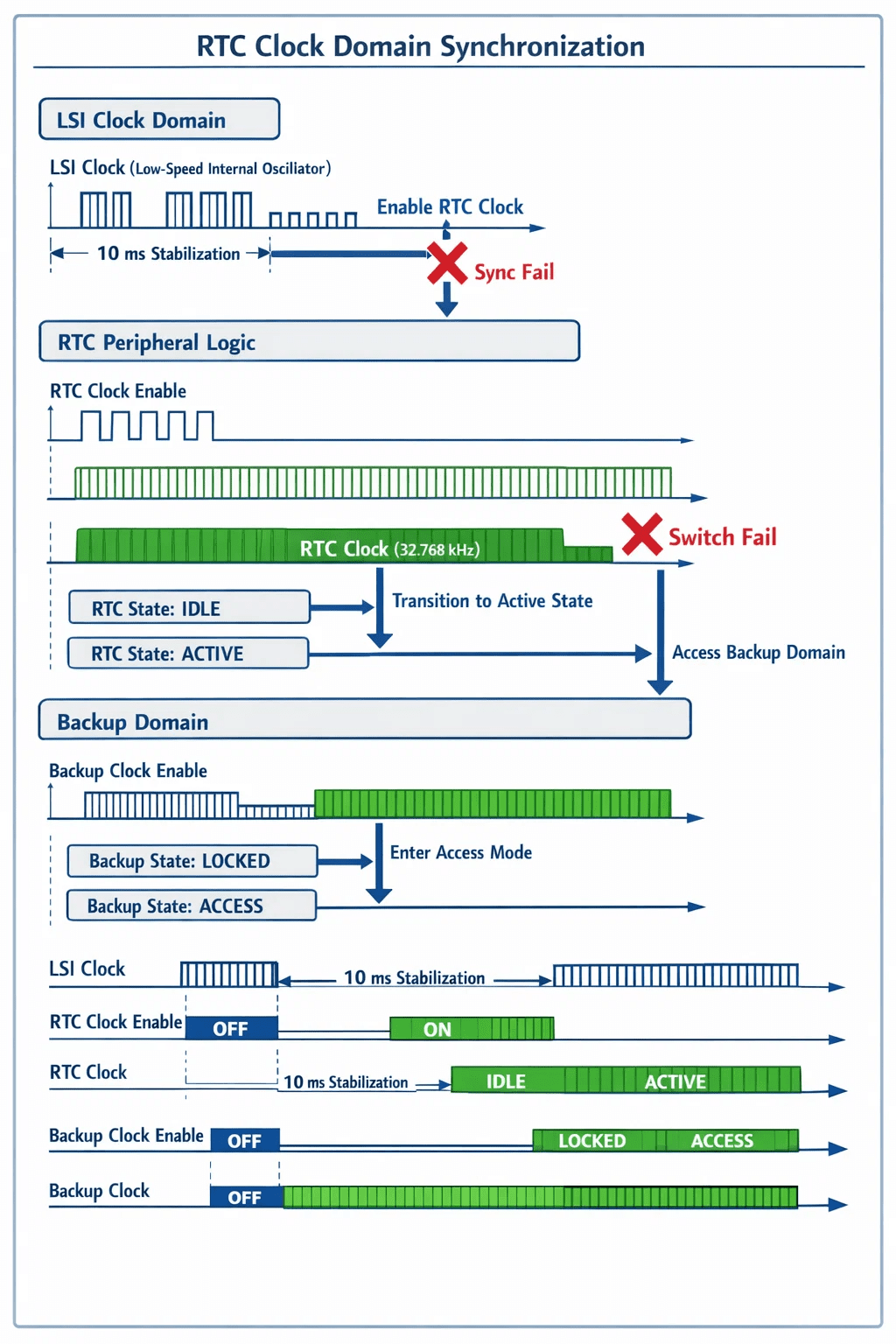
Initial symptoms looked deceptively simple: occasional RTC initialization failures with no clear pattern. Standard debugging gave inconsistent results, pointing to a timing-dependent root cause:
// Original failing approach
HAL_StatusTypeDef RTC_Init(void) {
    hrtc.Instance = RTC;
    hrtc.Init.HourFormat = RTC_HOURFORMAT_24;
    hrtc.Init.AsynchPrediv = 127;  // LSI: 32000/(127+1) = 250Hz
    hrtc.Init.SynchPrediv = 249;   // 250/(249+1) = 1Hz

    return HAL_RTC_Init(&hrtc);  // Sporadic failures here
}
Through systematic analysis, we found the RTC peripheral needs specific clock domain sequencing not documented in the standard reference manual. The fix was a multi-stage initialization with explicit clock domain management:
HAL_StatusTypeDef RTC_ClockConfig(void) {
    // Step 1: Enable backup domain access FIRST
    HAL_PWR_EnableBkUpAccess();

    // Step 2: Configure LSI oscillator with verification
    RCC_OscInitStruct.OscillatorType = RCC_OSCILLATORTYPE_LSI;
    RCC_OscInitStruct.LSIState = RCC_LSI_ON;
    if (HAL_RCC_OscConfig(&RCC_OscInitStruct) != HAL_OK) {
        return HAL_ERROR;
    }

    // Step 3: Force reset if in error state
    if (hrtc.State == HAL_RTC_STATE_ERROR) {
        __HAL_RCC_BACKUPRESET_FORCE();
        HAL_Delay(10);  // Critical timing delay
        __HAL_RCC_BACKUPRESET_RELEASE();
        HAL_Delay(10);  // Allow stabilization
    }

    // Step 4: Enable peripheral clocks in sequence
    __HAL_RCC_RTC_ENABLE();
    __HAL_RCC_RTC_CLK_ENABLE();

    return HAL_OK;
}
The key insight was that clock domain transitions need explicit stabilization delays, typically 10ms, that aren't mentioned anywhere in the peripheral documentation.
Memory subsystem timing anomalies
Working with 8MB of external PSRAM via the FMC interface revealed another category of errata: memory access timing dependencies that vary with system load and peripheral activity. Standard FMC timing calculations based on datasheet specs proved insufficient under high-bandwidth conditions. Camera data streaming while simultaneously accessing PSRAM created bus contention that needed adaptive timing adjustments:
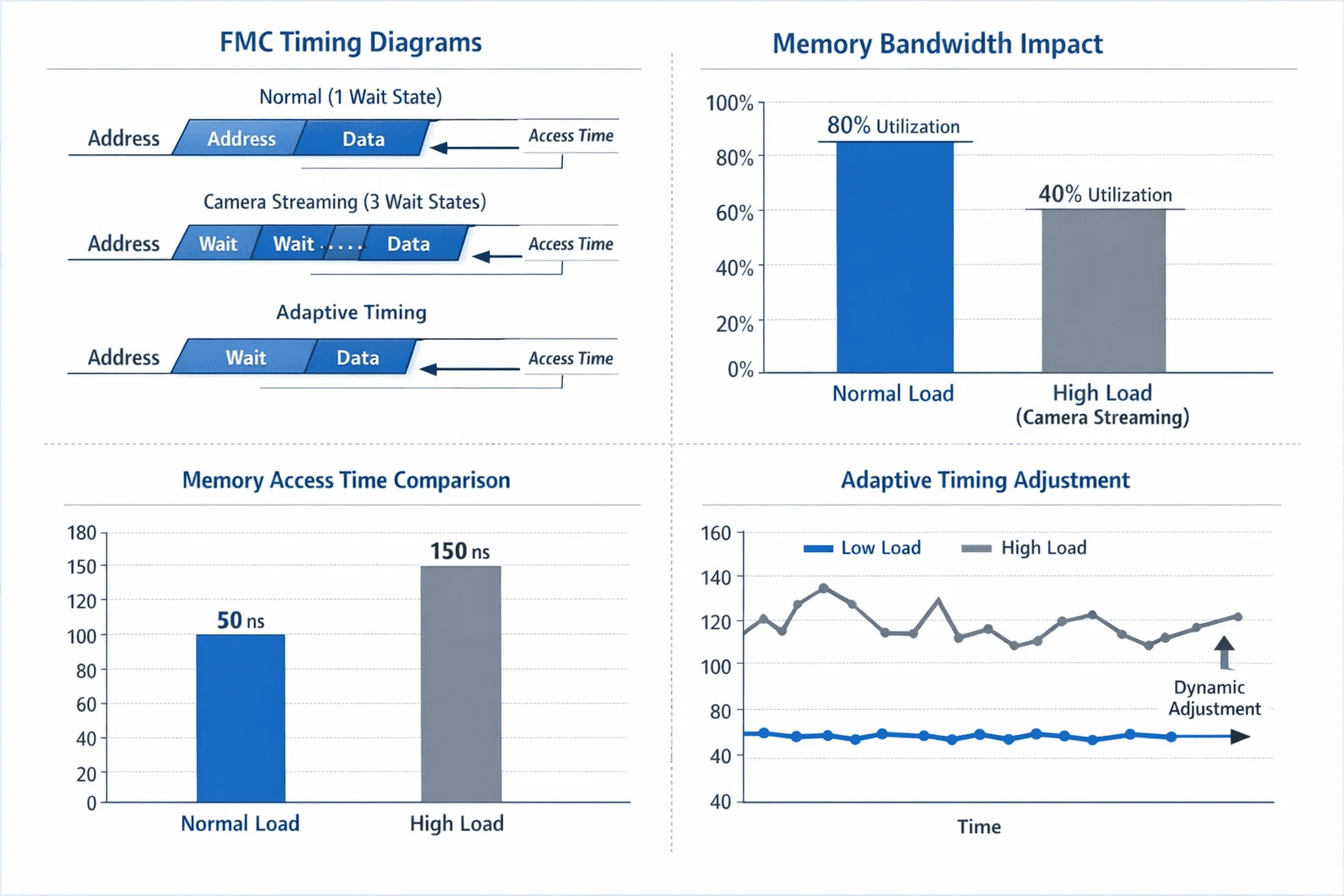
// Adaptive PSRAM access with timing compensation
void PSRAMwrite(void *psram_addr, const void *src_data, size_t size) {
    // Check current system load indicators
    if (is_camera_streaming() || is_dma_active()) {
        // Insert additional wait states for high-load conditions
        configure_fmc_extended_timing();
    }

    // Perform write with error checking
    memcpy(psram_addr, src_data, size);

    // Verify write integrity
    if (memcmp(psram_addr, src_data, size) != 0) {
        // Retry with conservative timing
        configure_fmc_safe_timing();
        memcpy(psram_addr, src_data, size);
    }

    // Restore optimal timing
    configure_fmc_default_timing();
}
OCTOSPI flash interface synchronization
External flash operations via the OCTOSPI interface brought timing challenges tied to delay block configuration, a feature meant to provide phase adjustment for high-speed operations but prone to instability at boundary conditions. The delay block needs periodic recalibration, particularly after thermal cycling or power transitions, so we implemented proactive calibration:
HAL_StatusTypeDef octospi_maintain_timing_integrity(void) {
    static uint32_t last_calibration = 0;
    uint32_t current_time = HAL_GetTick();

    // Recalibrate every 60 seconds or after significant events
    if ((current_time - last_calibration) > 60000 ||
        thermal_event_detected() ||
        power_transition_detected()) {

        // Perform delay block recalibration
        HAL_XSPI_DLYB_GetClockPeriod(&hxspi, &delay_config);
        HAL_XSPI_DLYB_SetConfig(&hxspi, &delay_config);

        last_calibration = current_time;
    }

    return HAL_OK;
}
Building robust detection strategies
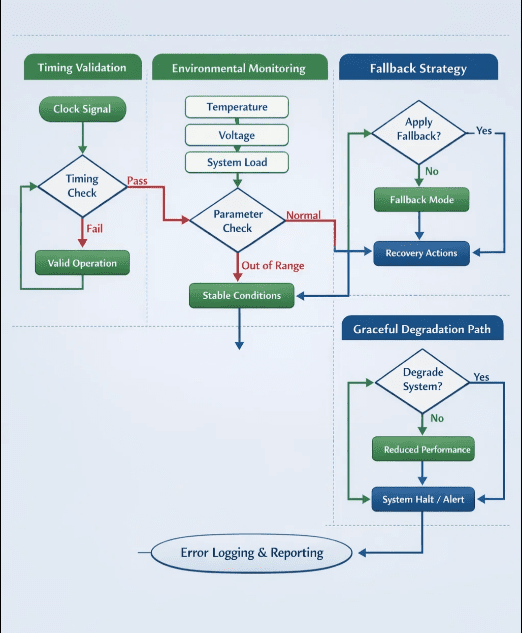
Managing silicon errata successfully needs proactive detection and systematic validation. A timing validation framework verifies timing during initialization:
bool validate_peripheral_timing(peripheral_type_t peripheral) {
    uint32_t start_time = HAL_GetTick();
    bool success = initialize_peripheral(peripheral);
    uint32_t end_time = HAL_GetTick();

    // Log timing patterns for analysis
    log_timing_data(peripheral, success, end_time - start_time);

    return success && (end_time - start_time) < expected_max_time;
}
Environmental monitoring tracks the conditions that trigger errata, temperature, supply voltage, and system load, and applies conservative timing when thresholds are crossed. And graceful degradation gives critical operations a fallback chain, primary optimized attempt, then conservative timing, then maximum-safety-margin as a last resort.
Why it matters at Hoomanely
Our goal to improve pet healthcare through advanced technology that continuously monitors and analyzes pet health requires embedded systems that operate with real reliability, the kind that only comes from thoroughly understanding and mitigating silicon-level behaviors. When our edge AI devices process critical health data from multiple sensors, timing precision matters. A missed sensor reading from a memory access failure or an RTC desynchronization could mean the difference between early health intervention and reactive treatment.
Key takeaways
Expect the unexpected, even well-documented peripherals harbor timing dependencies that only emerge under specific operational conditions. Build defensive programming into critical code paths from the start, timing validation and fallback strategies included. Monitor environmental factors, temperature, voltage, and system load can trigger latent errata. Document everything, detailed logs of errata encounters and solutions matter for future reference and team knowledge. And test under stress, real-world conditions often reveal errata that never appear during development testing.