Timeline Assembly as Infrastructure
A user-visible history blends signals that behave nothing alike: taps and toggles from the app, device-originated events, backend jobs that complete later, human edits, and increasingly AI insights that evolve as models improve. These inputs arrive asynchronously, often out of order, sometimes duplicated, and occasionally retracted. If you treat the timeline as a UI problem, you end up with flicker, reordering, and "why did that change?" moments that quietly break trust.
Treating timeline assembly as infrastructure flips the mindset: the timeline becomes a deterministic, replayable pipeline that converts noisy distributed inputs into a stable narrative, one that can explain itself, tolerate late data, and improve intelligence without rewriting the user's reality.
The real problem: a timeline is a trust contract
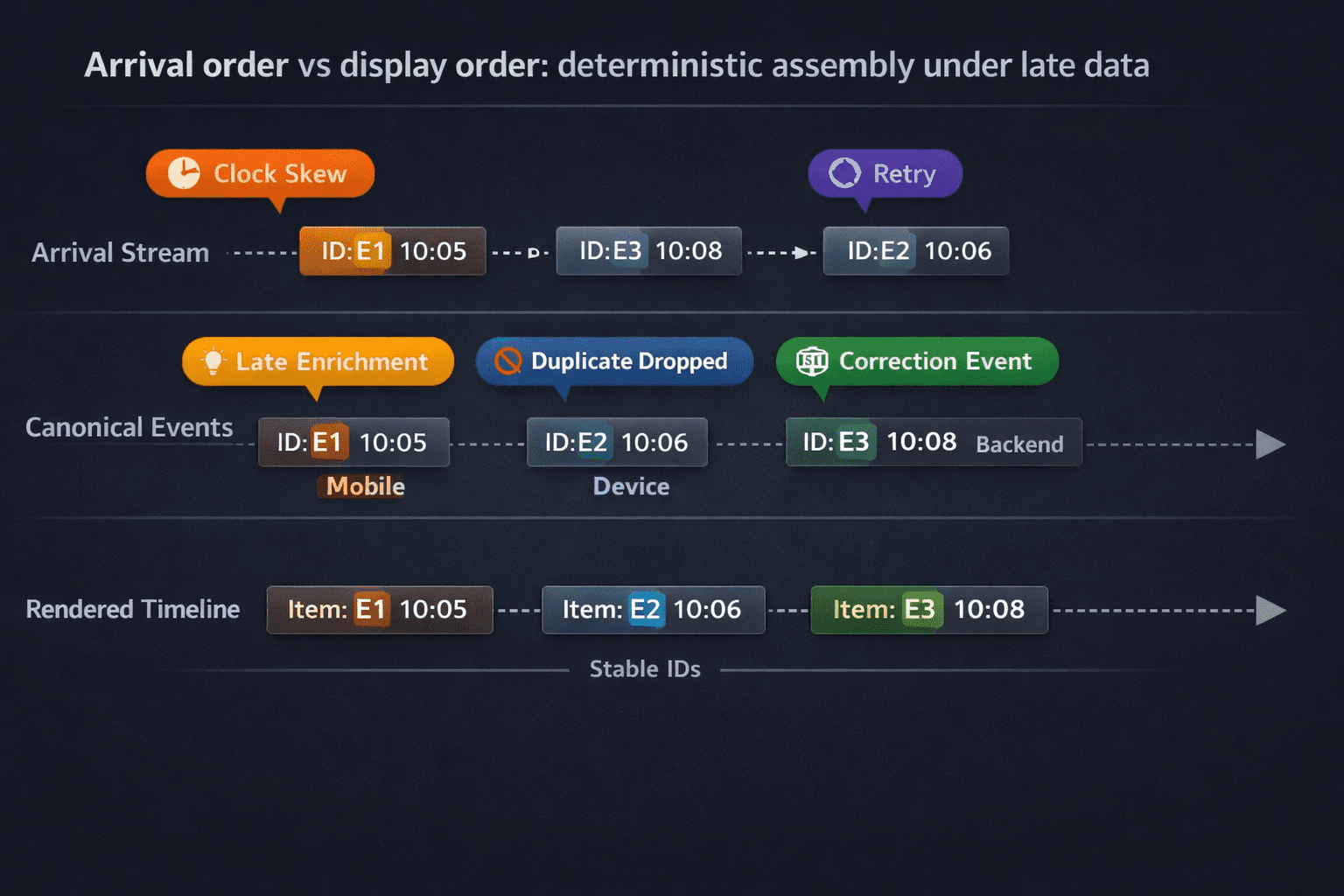
A "correct" timeline is not just one that reflects what happened, it's one that stays stable as systems catch up. Common failure patterns look harmless in logs but painful in UX. Out-of-order arrivals mean an enrichment shows up after the user has already seen the base event. Retries and duplicates happen when an at-least-once pipeline replays the same logical action. Corrections occur when a device reports new calibration, a backend job revises a value, or a user edits history. AI overlays change because the model got better or context increased.
If each consumer, mobile app, web app, analytics export, assembles these differently, your timeline becomes inconsistent by surface. Users notice. The infrastructure approach has one goal: make "what the user sees" a deterministic function of inputs, regardless of arrival order or partial failure.
Infrastructure approach
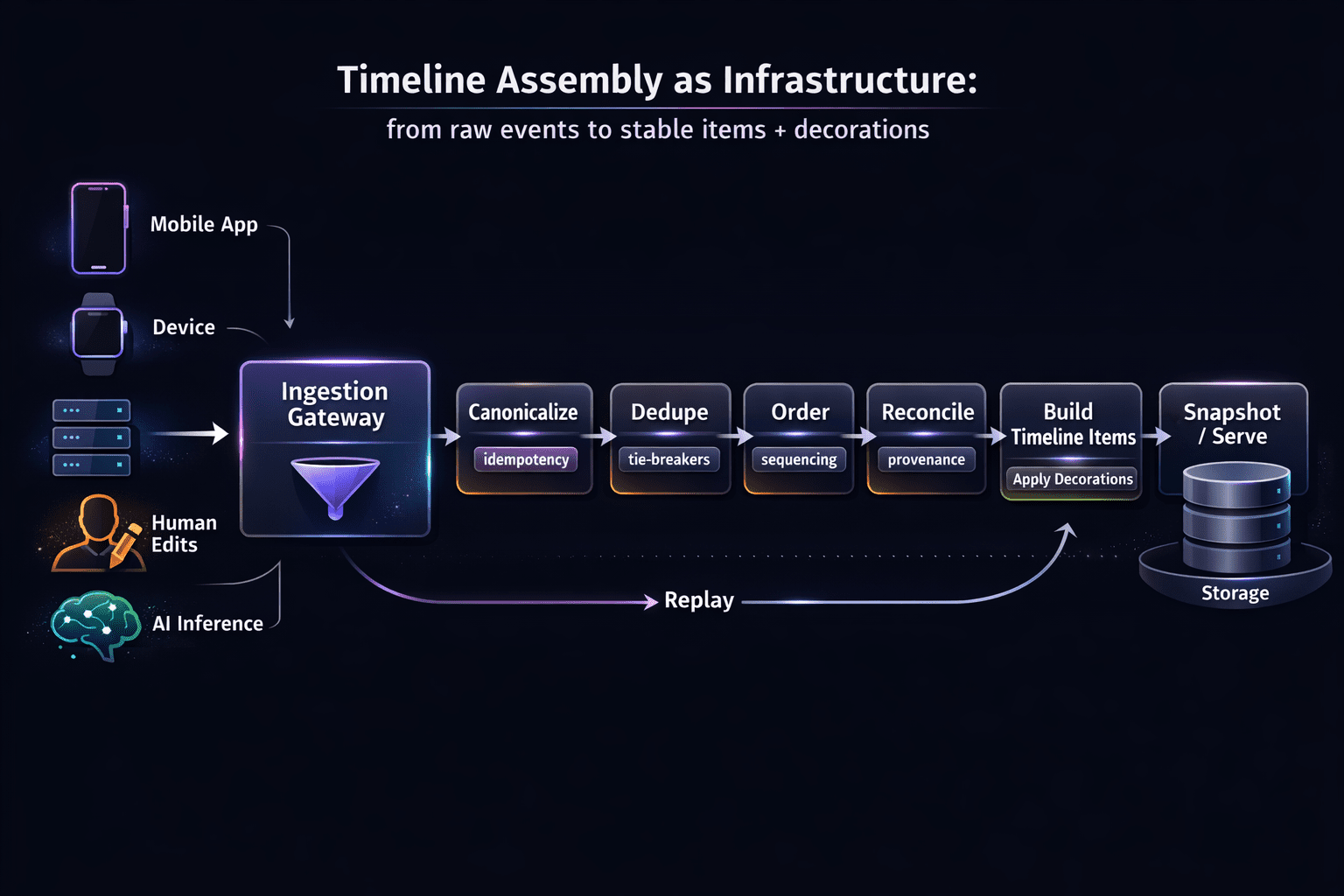
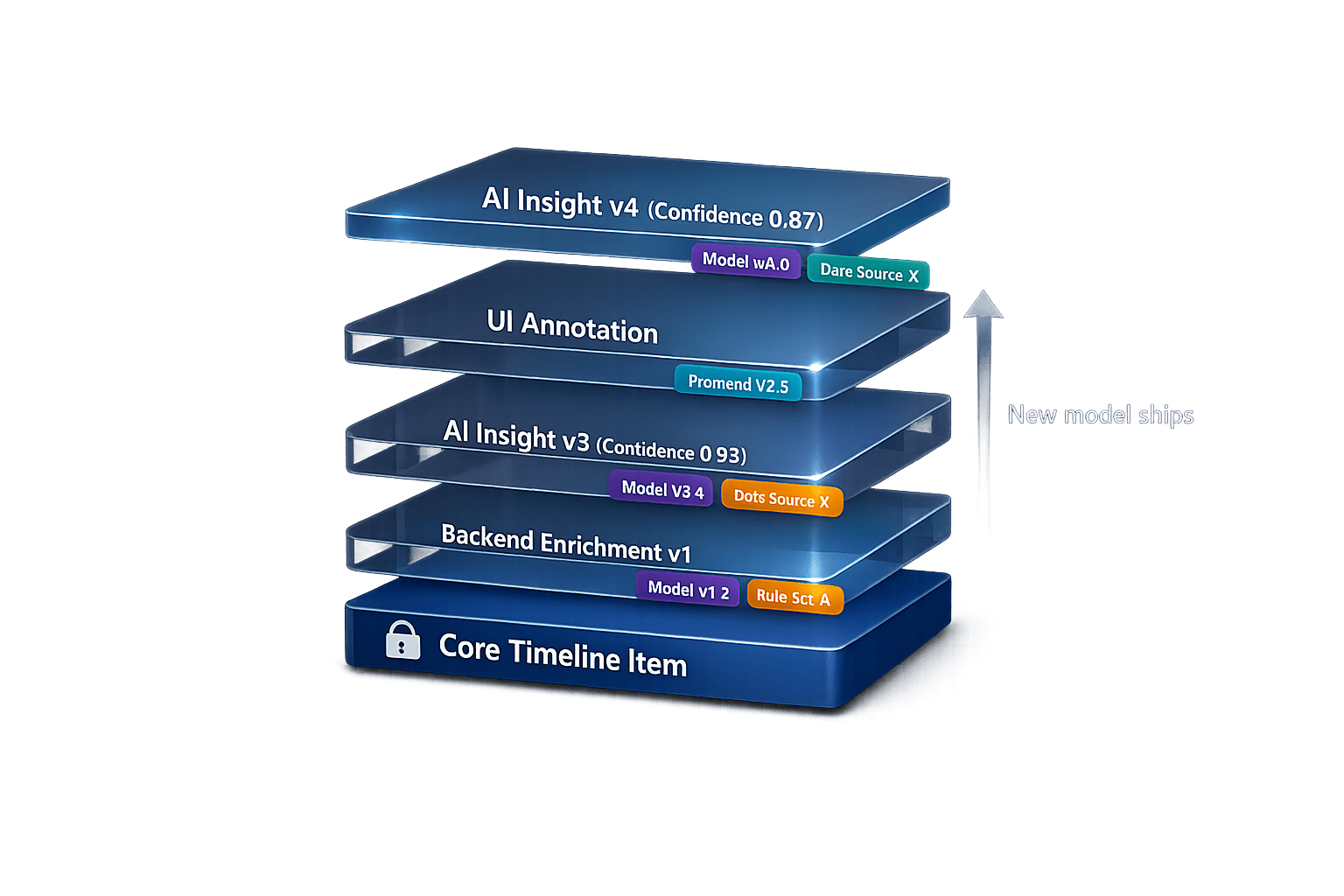
Build an assembly pipeline that produces stable "timeline items" from events, then layers enrichments and AI as versioned decorations, not as edits to the core. That single design choice drives most of the reliability properties you want: predictable ordering, idempotency under retries, safe late-arrival handling, explainability, and evolvability.
Define a canonical event model
Your first enemy is not out-of-order delivery, it's inconsistent meaning. A canonical model should make several things explicit. What happened, the fact, is the core signal that shouldn't change lightly: actor (who or what produced it), entity (what it's about), kind (what type of event), occurred_at (when it happened in source time), source (mobile, device, backend job, human edit), and payload (the raw facts).
Why we believe it, the provenance, answers where it came from: ingestion metadata like topic/partition and request id, signature or device id or auth principal, and processing lineage across pipeline stages. How to dedupe it, the identity, is the backbone of determinism, using both event_id, a unique UUID per emission, and logical_id, an idempotency key derived from intent, something like hash(actor_id + kind + entity_id + client_action_id). This prevents the "same thing twice" problem from being handled ad hoc later.
Convert raw events into timeline items with deterministic rules
A timeline item is the user-facing unit, one row, one card, one moment. Timeline items are not the same as events, multiple events may map to one item ("Meal recorded" plus "Nutrition computed"), and one event may create multiple items in rare fan-out cases.
The golden rule: item identity must be stable. If your item ID changes across replays, your UI can't do diff-based updates safely. A robust item identity usually includes entity_id, logical_id, item_kind, and optionally a scope_key if one logical action produces multiple cards. An illustrative example: timeline_item_id = hash(entity_id + logical_id + item_kind + scope_key). Now you can replay the entire pipeline and the same inputs always yield the same item IDs.
Ordering that ignores arrival time
Arrival time is a lie in distributed systems. Your ordering must be computed from semantic time plus stable tie-breakers. A practical ordering key layers occurred_at (source time, normalized) first, then an ordering_group (session, day-bucket, or device sequence window), then source_priority as a tie-breaker only, then finally timeline_item_id as the final deterministic tie-break.
If you ingest from devices, clock skew is inevitable, you don't need perfect clocks, you need stable rules. Use normalized occurred_at with bounded skew correction, sequence numbers when available (device monotonic counters), and a clear policy: if skew exceeds X minutes, bucket by ingest day but preserve original occurred_at as metadata. That last clause matters, don't hide the truth, annotate it.
Reconciliation rules: merging, superseding, and correcting
Reconciliation is how you prevent a timeline from rewriting itself while still accepting corrections. Think in three operations. Merge decorates the same item, a later enrichment adds fields without changing the core meaning, like "Meal detected" gaining a "calories estimate" later. Supersede replaces with a newer version, a correction invalidates part of the earlier fact, like a weight reading corrected after a calibration update. Retract is rare but real, a signal deemed invalid, like a false positive detection.
The key infrastructure decision: don't mutate history silently. Instead keep the core fact immutable where possible, and represent corrections as new events that map deterministically to either the same item (merge) or a replacement item linked by supersedes_item_id. That lets the UI render stable transitions, an "Updated" badge, a "Corrected value" callout, or a "Reclassified" label.
Late arrivals without user confusion
Late arrivals are normal, the question is whether the timeline jumps. Use snapshot boundaries, a stable rendered view of a timeline segment, commonly per day, per session, or per "story arc" like a meal window. Within a snapshot boundary, accept late arrivals with rules like: if new data only affects decorations, update in place; if it changes ordering, avoid reshuffling unless it crosses a threshold, like within the same minute versus moving across hours.
Prefer "append with context" over "reorder everything." If an event arrives extremely late, the UX-friendly move is often to keep the original position, add a small "Late update" chip, and link to the corrected or related item. Engineers sometimes resist this because it's not a perfect historical ordering, but remember the goal: stable narrative.
Decorations: enrichments and AI insights as overlays, not edits
This is where most timelines become unstable. If AI insights overwrite the base item, you force users to re-learn the past every time the model changes. Instead, treat AI and enrichments as decorations: they have their own IDs, they're versioned, and they carry provenance including model version, feature flags, confidence, and inputs used.
A clean mental model separates facts from interpretations. Facts, the core, might be "A meal event occurred at 7:12 PM." Interpretations, the decorations, might be "Likely eating behavior," "Portion estimate," "Nutrition suggestion." This supports safe iteration, you can improve interpretation logic without rewriting facts, and roll back interpretations without breaking the timeline.
Controlled updates: diff-based rendering and stability
Once items and decorations are stable, you can serve the timeline in a way that prevents UI churn. Serve diffs, not full refreshes. A stable API pattern: GET /timeline?cursor=... returns items with stable IDs, decorations with stable IDs and versions, a next_cursor, and an optional snapshot_id. Then if a decoration updates, send only decoration diffs, and if a correction supersedes an item, send the new item, a link to the superseded ID, and a small state-transition payload the UI can render gracefully.
Track "narrative stability" as a metric, not just relevance: reorder rate, how often items change position after first seen; mutation rate, how often core fields change after initial render; decoration churn, how often AI overlays change meaning versus just adding detail; and explainability coverage, the percentage of items that can show provenance and "why" metadata. These are the metrics that correlate with trust.
Replayability and explainability are non-negotiable
When something looks wrong, you need to answer what inputs produced this, what rules applied, and what changed between yesterday and today. Make the pipeline replayable: given the same event log plus the same config versions, you produce the same timeline items, and given a new pipeline version, you can measure diffs intentionally. Key practices include versioning your reconciliation rules, versioning your decoration logic, storing provenance metadata with outputs, and keeping raw events immutable or at least append-only with retractions.
Provide an "explain" view. Even if users never see it, engineers and support will. An explain response for an item should include contributing events (IDs and sources), applied reconciliation rule IDs, decoration versions and confidence, whether skew correction was applied, and whether the item was superseded.
A practical checklist for building this in production
For your canonical model, every event should have an event_id and logical_id, provenance should be captured (source plus lineage), and occurred time should be normalized and stored alongside raw time. For determinism, timeline item IDs should be stable across replays, ordering should use semantic time plus deterministic tie-breakers, and reconciliation should be rule-driven and versioned. For late data, snapshot boundaries should prevent full reshuffles, and corrections should become explicit transitions rather than silent edits. For AI and enrichments, insights should be decorations with version and confidence, and facts should remain stable while interpretations evolve transparently. For ops, replay tooling should exist for at least a subset, an explain view should exist for every item type, and stability metrics (reorder, mutation, churn) should be tracked.
Hoomanely builds connected pet experiences where device signals, app actions, and intelligence have to come together as a coherent story without surprising pet parents. Treating timeline assembly as infrastructure strengthens that story, it keeps narratives stable as devices retry, enrichments arrive late, and AI improves over time. The result is simple: timelines that feel trustworthy, even when the system behind them is distributed and continuously learning.
Key takeaways
A timeline is a product surface, not a query result. Determinism starts with identity, logical IDs and stable item IDs. Ordering must be arrival-independent, with explicit tie-breakers. Corrections should be modeled as events that reconcile into stable transitions. Enrichments and AI belong in versioned decoration layers, not core edits. And replayability plus explainability turn timeline bugs from mysteries into diffs.