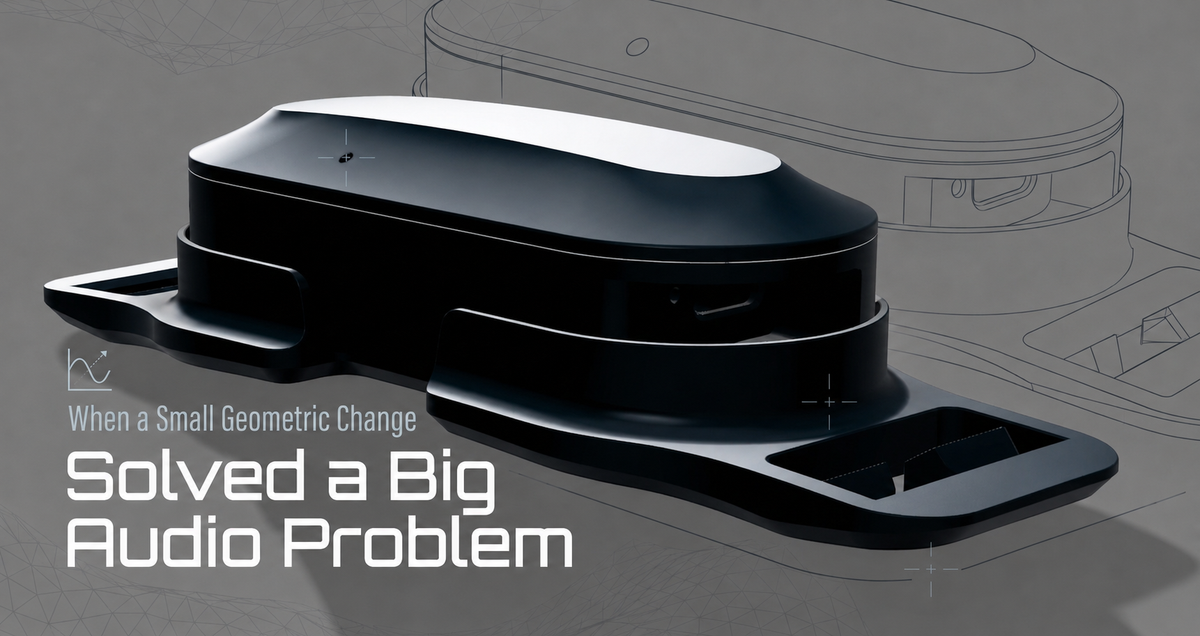
When a Small Geometric Change Solved a Big Audio Problem
Performance gains in product development usually get credited to new electronics, better sensors, or smarter algorithms. Every so often, though, the fix comes from something much smaller: a few millimeters of geometry.
While developing one of our wearable tracking devices, we ran into an issue that looked, at first, like a microphone problem. The device had an onboard microphone meant to capture environmental audio from inside a sealed enclosure. On paper, the microphone met every requirement. In practice, the audio it captured didn't. Chasing that gap down turned into a reminder that acoustics, much like structural mechanics, depend heavily on the physical environment around a component.
The problem wasn't the microphone
The tracker had an internal microphone mounted inside a protective enclosure. Like most wearables, that enclosure was designed mainly around durability, environmental protection, manufacturability, easy assembly, and user comfort. All of those goals were met. But testing showed the audio quality wasn't. Sounds that were clearly audible outside the device came through noticeably attenuated once recorded through the enclosure.
We first looked at microphone sensitivity, firmware settings, signal processing, and mounting conditions. None of it explained the loss. The microphone itself was working fine. The enclosure wasn't.
Understanding acoustic shadowing
Sound travels as pressure waves through air, and for a microphone to capture those waves accurately, the sound needs a mostly unobstructed path to the sensing element. Inside the enclosure, the microphone sat beneath a protective cover, and while openings existed for sound to pass through, the geometry around the microphone was unintentionally interfering with the incoming acoustic energy.
Rather than giving sound a direct path to the microphone, the enclosure geometry made it encounter surfaces, cavities, and obstructions first. The result was a lot like trying to listen through a partially blocked opening: the microphone could still hear, just not efficiently.
Looking at the problem as a mechanical system
Instead of treating this as an electronics issue, we started treating it as an acoustic and mechanical one. The question became: how do we give sound a cleaner, more direct path from the outside world to the microphone?
The answer turned out to be simple. Instead of relying on a flat opening above the microphone, we added a conical tunnel running from the enclosure opening straight down to the microphone inlet.
Why a conical tunnel works
On its own, the feature looked minor, just a tapered passage connecting the outside opening to the microphone. But the geometry changed how sound actually entered the enclosure, and it did that in a few specific ways.
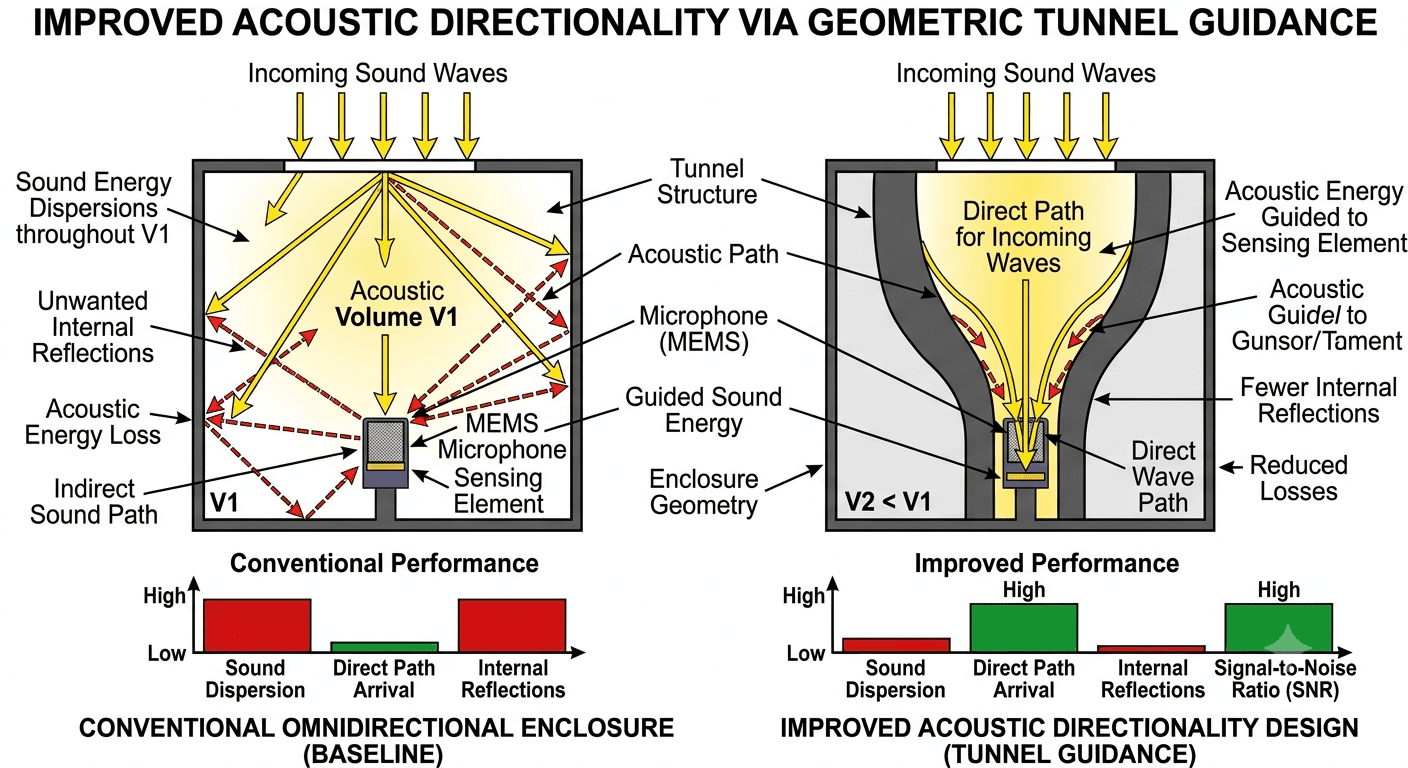
Improved directionality: the tunnel gave incoming sound waves a more direct path. Instead of letting sound energy disperse through the whole enclosure volume before reaching the microphone, the geometry guided it straight toward the sensing element, so more of the sound arrived with fewer reflections and less loss.
Reduced obstruction: without a defined path, parts of the enclosure were effectively acting as barriers between the sound source and the microphone. The conical feature cut that down by giving sound a dedicated channel, so less energy got blocked, scattered, or redirected away.
Better coupling between environment and sensor: microphones perform best when they interact directly with pressure variations in the surrounding air. The tunnel improved that coupling, essentially letting the microphone "see" more of the sound happening outside the enclosure.
Controlled entry: the tapered shape also smoothed the transition between the outside opening and the microphone, encouraging a more gradual flow of acoustic energy instead of forcing it through an abrupt change in cross-section.
The results
After adding the conical extension, audio testing showed an immediate, noticeable improvement: higher clarity, better sound pickup, less attenuation, and clearer overall intelligibility. Just as important, none of that came from changing the microphone, modifying firmware, increasing power draw, or adding new electronics. The fix was entirely mechanical. A small geometric feature transformed the device's acoustic performance.
The broader engineering point
This reinforced something that goes well beyond acoustics: components don't operate in isolation. A microphone's performance depends on more than its spec sheet, it depends on the geometry around it. A sensor's accuracy depends on more than its electronics, it depends on how it's mounted. A structure's strength depends on more than material properties, it depends on load paths and constraints. In every case, the environment around a component can matter as much as the component itself.
Engineering often happens between disciplines
What made this fix interesting was that it sat right at the intersection of several engineering domains. The problem looked electrical. The root cause was acoustic. The solution was mechanical. That kind of cross-disciplinary friction is often exactly where the most useful design improvements come from. Here, a simple conical tunnel gave the microphone a direct acoustic path and improved sound capture without adding complexity anywhere else in the system. Sometimes the best fix isn't more technology, it's a better path for the technology that's already there.
How this shapes development at Hoomanely
At Hoomanely, this kind of problem-solving is core to how we build products for pets and the people who care for them. Real-world performance is rarely down to a single component. A microphone, sensor, antenna, or battery only performs as well as the environment around it allows, which is why we pay close attention to details that are easy to skip over: enclosure geometry, component placement, acoustic pathways, airflow, sealing, and how a device behaves once it leaves the lab and enters everyday use.
The conical tunnel in this device is a small feature, but it reflects a mindset we care about: thoughtful mechanical design can unlock better performance and reliability without touching the core technology at all. For us, that's what good product development looks like: solving real problems with careful engineering, attention to detail, and a real understanding of how products behave in the hands, and on the pets, of the people who use them.