Why Weight Pipelines Break: Designing Stable, Low-Drift Load-Cell Systems with the ADS1234
If you've ever shipped a long-running embedded product that relies on stable weight readings, you've probably learned a painful truth: load-cell systems rarely fail in the analog domain first, they fail in firmware. Not because firmware is the root cause, but because firmware is the first place the failure becomes visible, measurable, and undeniable.
This is a story about those symptoms. At Hoomanely, where EverBowl infers pet behavior from subtle weight changes, we spent months chasing failures that looked like firmware bugs: drifting baselines, noisy channels, overnight saturation, "random" full-scale spikes, and measurements that got worse the longer the device ran.
But the more we instrumented the system, the more firmware revealed a deeper pattern. Weight pipelines break long before the MCU realizes it, and firmware has to be designed to detect, tolerate, and heal those failures. This post covers how we discovered that, what the firmware saw, how logs misled us, and how we built a more resilient system around the ADS1234.
Firmware sees symptoms before anyone sees causes
Most failures in weight systems show up first as firmware anomalies, not hardware faults. We saw slowly climbing "zero" values, sudden full-scale readings without warning, weight flattening into a plateau, rare spikes that filters couldn't smooth out, channels that looked alive but weren't changing, channels that changed too much, drift only after long uptime, and noise that only appeared during "busy" firmware cycles.
For every symptom, firmware initially blamed itself: is the ISR late, did the sample queue overflow, is the filter too slow, did a thread preempt something critical? In reality, firmware wasn't the cause. But firmware was the battlefield where every failure surfaced.
Firmware has to keep the system honest
In our ecosystem, EverBowl uses weight patterns to infer feeding, licking, drinking, and other micro-behaviors. EverHub aggregates weight telemetry before forwarding it to cloud models. Even Tracker occasionally relies on stable analog performance for environmental sensors. If weight data drifts or saturates, every upstream insight becomes misleading.
How weight pipelines actually break
Here are the specific firmware-side patterns we saw, and how they mapped back to deeper architectural issues.
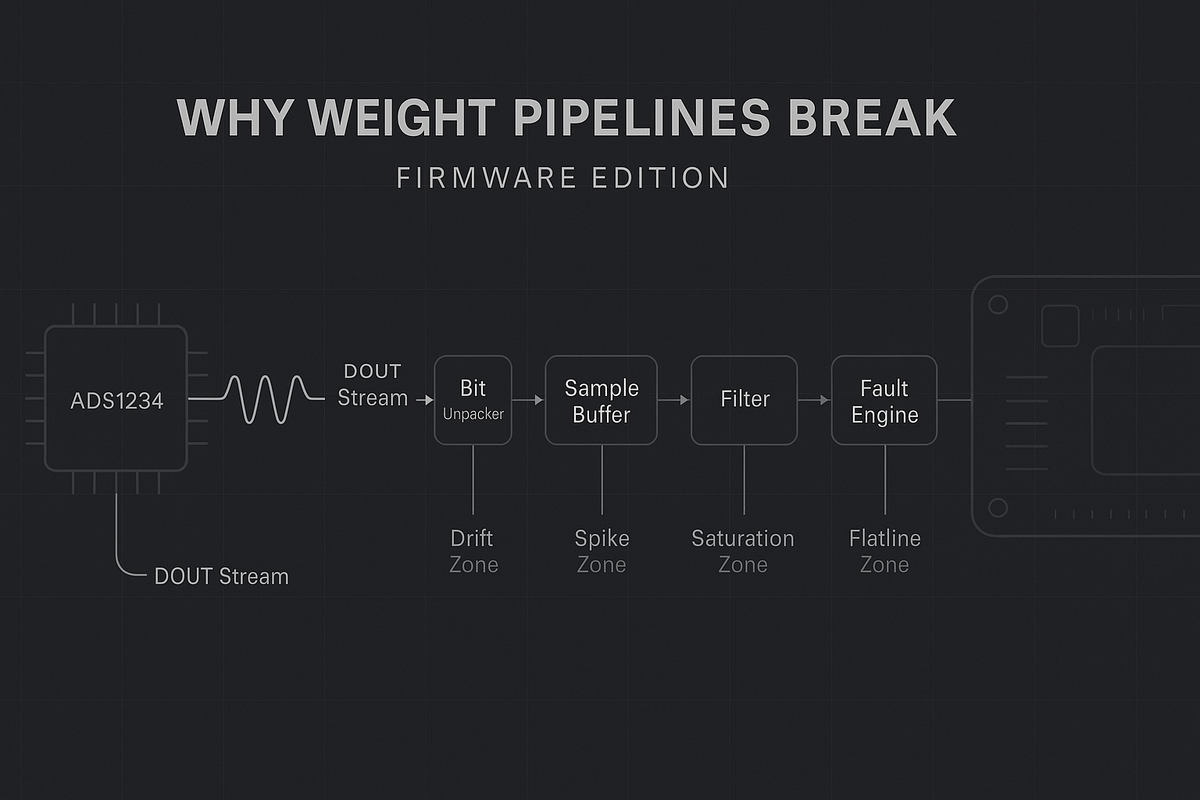
Slow drift that looked like environmental change. The firmware logs told a compelling story: the baseline was creeping up a few units every hour. The filters interpreted it as a long-term trend. The inference engine interpreted it as pet behavior. The UI interpreted it as consumption. Firmware logic guessed the load cell might be warming slightly, or that it was humidity, or that the filter window was too small. Reality: reference path drift that firmware mistook for genuine motion. The mistake was trusting a "stable enough" value for too long. The lesson: all long-term drift should be treated as a fault until proven otherwise, not as behavior.
Sudden full-scale saturation that looked like overflow. We saw the ADC output jump to max value in a single sample and stay there. Firmware guessed the scaling calculation overflowed, or the read function got garbage, or the queue got overwritten. What actually happened was differential imbalance at the analog bridge, but firmware felt like it was its own fault. Lesson: when the ADC rails instantly, assume hardware saturation, not firmware math. Your code is rarely the cause of a perfect max reading.
Rare single-sample spikes that defeated every filter. One of the most frustrating failures was the ghost spike, a single outlier that escaped even large averaging windows. Firmware designers assumed ISR jitter, scheduling delays, DMA timing skew, or a stack overflow corrupting a buffer. We instrumented timestamps, queue sizes, and ISR entry times, and nothing was wrong. The true cause was ADC sampling landing on an unlucky phase relative to a switching regulator, but firmware was the first to see the spike. Lesson: filters must distinguish noise from fault signatures. Spike detection is a diagnostic tool, not just a smoothing function.
Flatline channels that looked like dead threads. Sometimes a weight channel stopped changing entirely, no noise, no drift, just a flat line. Firmware assumed the ISR stopped firing, a task got stuck, a mutex deadlocked, the sample buffer froze, power mode suspended the ADC, or the scheduler starved a thread. We traced logs, instrumented thread timeslices, and verified queue depth, firmware was healthy. The actual cause was one arm of the load cell losing continuity, giving the ADC a perfect, unchanging differential. Firmware couldn't detect the fault without architectural help. Lesson: flat readings require fault-detection logic. Stability isn't always success.
Noise that only appeared when firmware was "busy." Noise increased when CPU load increased. Firmware blamed a delaying task, timestamp jitter leaking into sampling, or queue consumption not keeping up. All wrong. The real cause was analog ground bounce from higher digital activity, but firmware saw a correlation and assumed causation. Lesson: telemetry correlation doesn't equal root cause. Just because CPU load and noise move together doesn't mean firmware caused the noise.
Filtering pipelines amplifying problems instead of fixing them. One of the harshest discoveries: our early filters amplified analog problems. Averaging windows hid drift until it was too late to correct. Filters locked onto the wrong state after a saturation event. Moving medians discarded valuable fault clues. Outlier rejection prevented firmware from seeing the true underlying failure. Filtering is a double-edged sword, it can smooth the signal or blind you. Lesson: filters must help identify failures, not just hide noise.
How we debugged failures using firmware telemetry
Case story: the drift that looked like behavior change. Symptoms included a slow upward baseline movement that filters treated as trend, and weight analytics that misinterpreted it as extended feeding. After instrumentation, we found the drift correlated with board temperature and persisted even when input was stable, and re-baselining temporarily resolved it. Root cause: reference path drift. We added a drift detector that tracks long-term monotonic change and flags it as a reference-domain anomaly rather than behavior.
Case story: the channel flatline that looked like stable weight. Firmware initially celebrated a perfectly stable reading, but stable readings over long periods with zero noise should never happen, noise is a sign of life. Variance monitoring, minimum noise floor enforcement, and stuck-value timers found the root cause: load-cell path failure, discovered only because firmware refused to trust a "too perfect" signal.
Case story: the spikes that survived every filter. Firmware logs showed rare but massive outliers, and we initially suspected concurrency bugs. Timestamping every sample, measuring ISR jitter, and using circular buffers with monotonic read tracking, plus "previous N samples" error analysis, let us rule out firmware and correlate outliers with specific PWM activity, specific regulator phase changes, and temperature thresholds. Root cause: sampling occurring during a noisy regulator phase.
Case story: the saturation that looked like integer overflow. Firmware's first instinct was to blame the code. Logging raw ADC codes before scaling, adding saturation counters per channel, adding recovery attempts with measured return behavior, and comparing saturation timing across devices revealed that devices saturating earlier had more mechanical stress in the connector. Root cause: differential imbalance. Saturation isn't a math bug, it's a hardware signature.
How firmware must be designed for fragile analog systems
Firmware must never trust a value without context. Every sample should come with drift state, noise signature, last saturation time, temperature trend, variance window, and stuck-value history. Raw weight isn't enough, metadata is what saves you.
Build filters that reveal failures, not hide them. Good filters keep short windows for responsiveness, keep long windows for drift detection, understand when state is invalid, reject impossible transitions, and surface anomalies instead of smoothing them away. Filtering is a diagnostic system, not just a smoothing system.
Validate the analog domain using logic. A completely stable value for too long is a fault. A monotonic drift without user interaction is a fault. A sudden jump to rail is a fault. Zero variance across hundreds of samples is a fault. A noise floor below expected suggests possible disconnection. Spikes matching periodic intervals suggest a coupling signature. Software can catch what hardware doesn't notice on its own.
Implement multi-stage fault handling. Our most robust pipeline uses fast sanity checks that reject impossible values immediately, slow behavioral checks that detect drift, stuck values, and creeping anomalies, recovery actions like re-baselining, resetting the ADC interface, and widening filter windows, and persistent-fault escalation that flags a channel as degraded, notifies upper layers, and adjusts inference.
Correlate across signals. We correlated weight anomalies with CPU load, Wi-Fi bursts, temperature logs, peripheral activity logs, and power mode transitions. These correlations exposed failure patterns that would have been impossible to find from hardware alone.
Build self-healing systems. When saturation happened, firmware didn't reboot, it performed a controlled ADC reset, re-baselined, ran short-term higher-frequency sampling, verified recovery, and returned to normal mode. These strategies kept long-term corrupt data from ever reaching inference.
Takeaways: firmware is the first responder in analog failure
Firmware sees failures before anyone else does. Drift, spikes, saturation, and flatlines all show up in logs long before hardware suspicion arises. Filters must diagnose, not decorate, their job is informing the system about anomalies, not hiding them. Drift is a fault condition, not slow motion, if it's monotonic without interaction, firmware must flag it. Stable readings are suspicious, zero variance usually means hardware or mechanical failure. Correlation is the firmware superpower, correlating temperature, CPU load, ADC timing, and peripheral activity turns firmware into a detective. And recovery logic should be deliberate, not reactive, re-baseline, re-sync clocks, reset the ADC, widen filters, firmly controlled rather than impulsive.