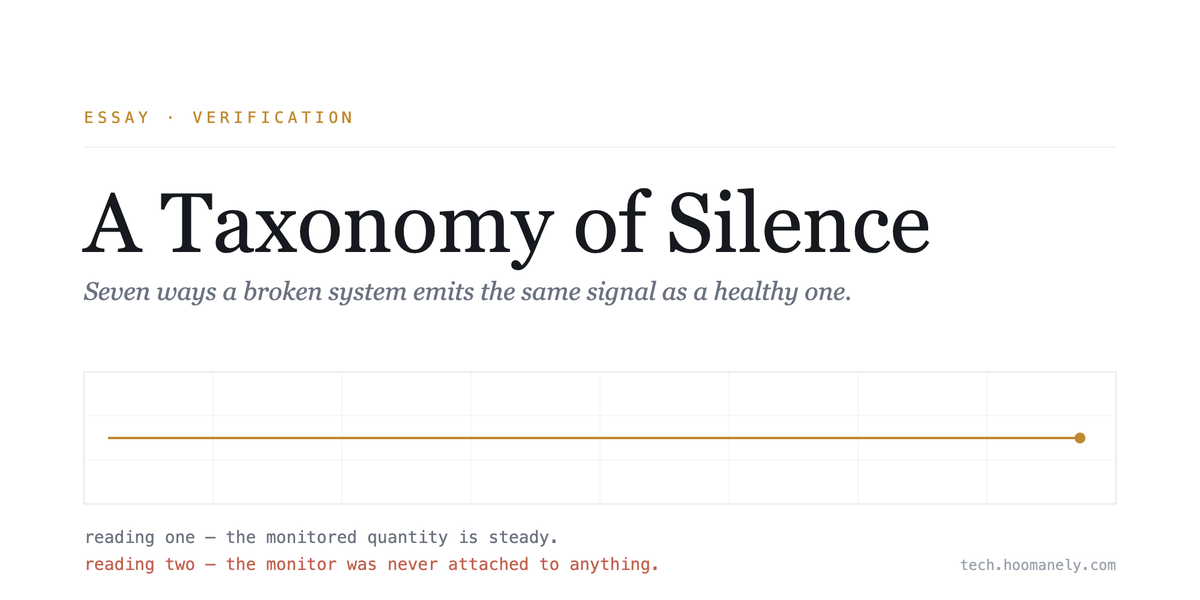
A Taxonomy of Silence
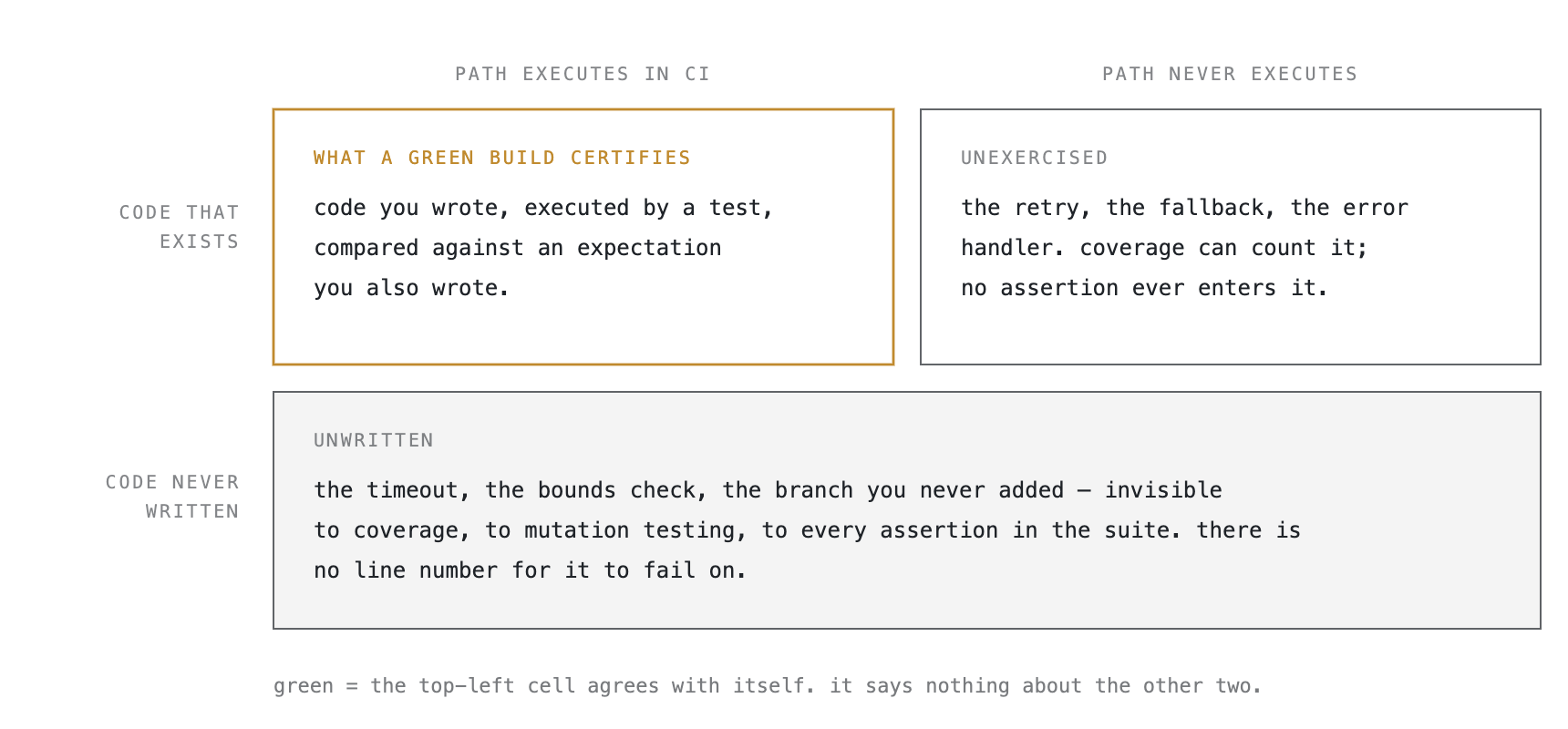
Every automated check answers a question about code that exists and paths that run. The defects that survive a mature pipeline live outside both — and they announce themselves the same way a healthy system does.
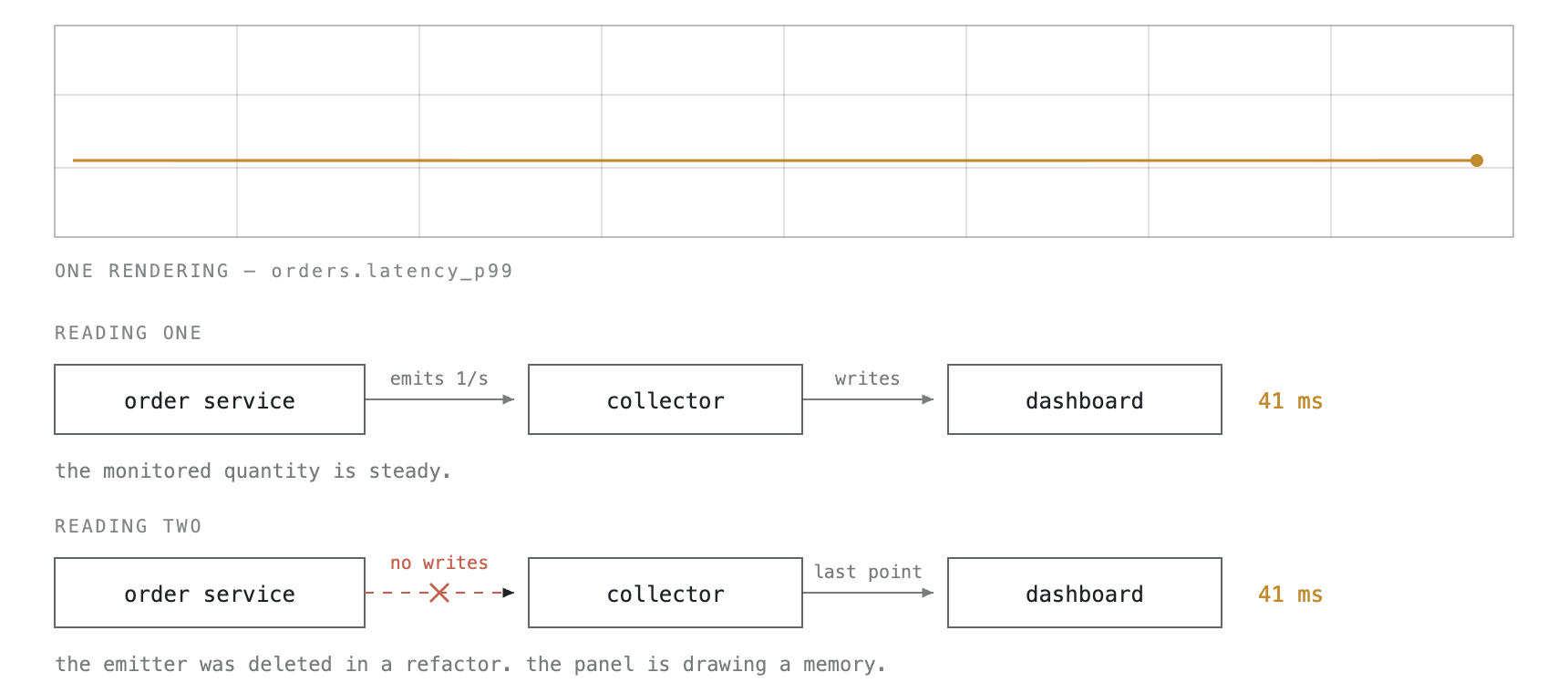
The same line, twice over
A flat line on a dashboard is not an observation. It is the rendering of an observation, and renderings are lossy in exactly the direction that matters.
The pipeline is in good shape. Unit tests, integration tests, contract snapshots, a linter that fails the build on an unused import, coverage parked above eighty percent, three dashboards, and an on-call rotation that has been quiet for a month. All of that machinery answers one question with great precision: does the code I wrote behave the way I said it would when the paths I thought of are executed?
That is a real question and it is worth answering. It is also a question about a small, well-lit region of the space where defects live. A test is a comparison between a thing you built and an expectation you wrote down. Both halves come from the same head on the same afternoon. Where that head had a blind spot, the test has one too — not a failing test, not a skipped test, but no test at all, which registers as nothing.
Now add the second half of the problem. A defect that produces a loud symptom — a stack trace, a 500, a crashed pod — is cheap. It is discovered by the system itself and routed to a human within seconds. Natural selection runs on defects too: the loud ones die young in a mature pipeline. What survives to production, and then survives in production for weeks, is the subset that has learned to look like health.
A survivor is not a bug that hid. It is a bug whose failure mode is indistinguishable from correct behaviour at every point where anyone is looking.
So the useful question is not "what did we forget to test?" — you cannot enumerate that. It is narrower and answerable: what are the ways a system produces no signal? There are not that many. They recur across languages, stacks and companies, and they can be catalogued. What follows is that catalogue: seven silences, each with the shape it takes in code and the specific instrument that breaks it.
Seven silences
Each entry is one mechanism by which a wrong system emits the same signal as a right one. The signature line is what you would have seen on the dashboard at the moment the defect was doing damage.
01 — The unwritten branch
SIGNATURE
100% line coverage. Zero failing assertions. The condition has no line number.
A test can fail on a branch that is wrong. It cannot fail on a branch that is absent. If you never wrote the check for an empty cart, a negative quantity, or a second webhook delivery of the same event, then there is no code for coverage to mark red and no expectation for a test to contradict. The suite is complete with respect to itself.
This is why coverage plateaus feel so much better than they are. Coverage is a ratio whose denominator you also wrote. It answers "how much of what exists did we run" — a question that gets less interesting the more experienced the team is, because the code that exists is the code someone already thought about.
02 — The swallowed error
SIGNATURE
Error rate 0.0%. Latency improved. One number downstream is quietly wrong.
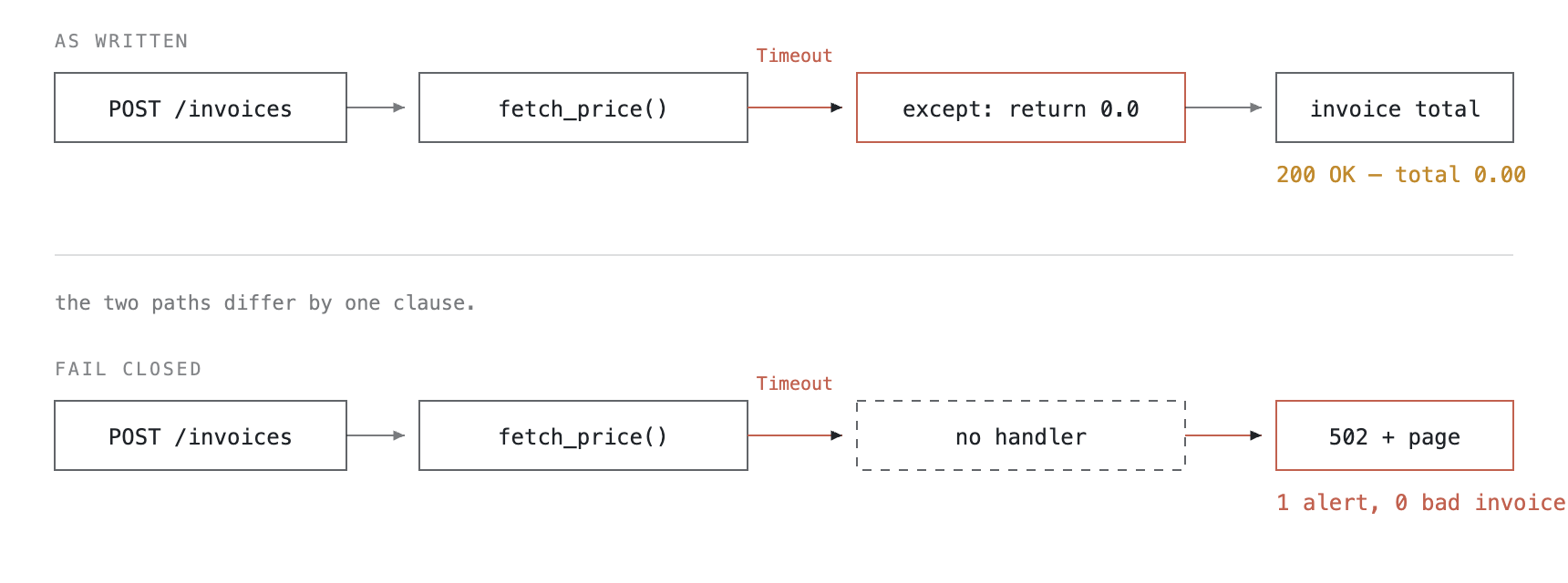
Somewhere between the first incident and the second, someone wrapped a flaky call in a try and gave it a default. The intent was resilience; the effect is a translation layer that converts a failure into a plausible value. Failures have provenance and values do not — by the time the zero reaches the invoice, nothing about it remembers that it was once a timeout.
# the shape it always takes
try:
    price = pricing.get(sku, timeout=2)
except Exception as e:
    log.debug("pricing lookup failed: %s", e)   # a level nobody ships
    price = Decimal("0")                        # a lie with good manners

total += price * qty                            # 200 OK, amount wrong
Three things conspire here and each is individually defensible: a broad except, a log level below the retention threshold, and a default that type-checks. Together they form a machine for producing clean dashboards.
03 — The detached probe
SIGNATURE
All checks green, because the check is not attached to the thing it is named after.
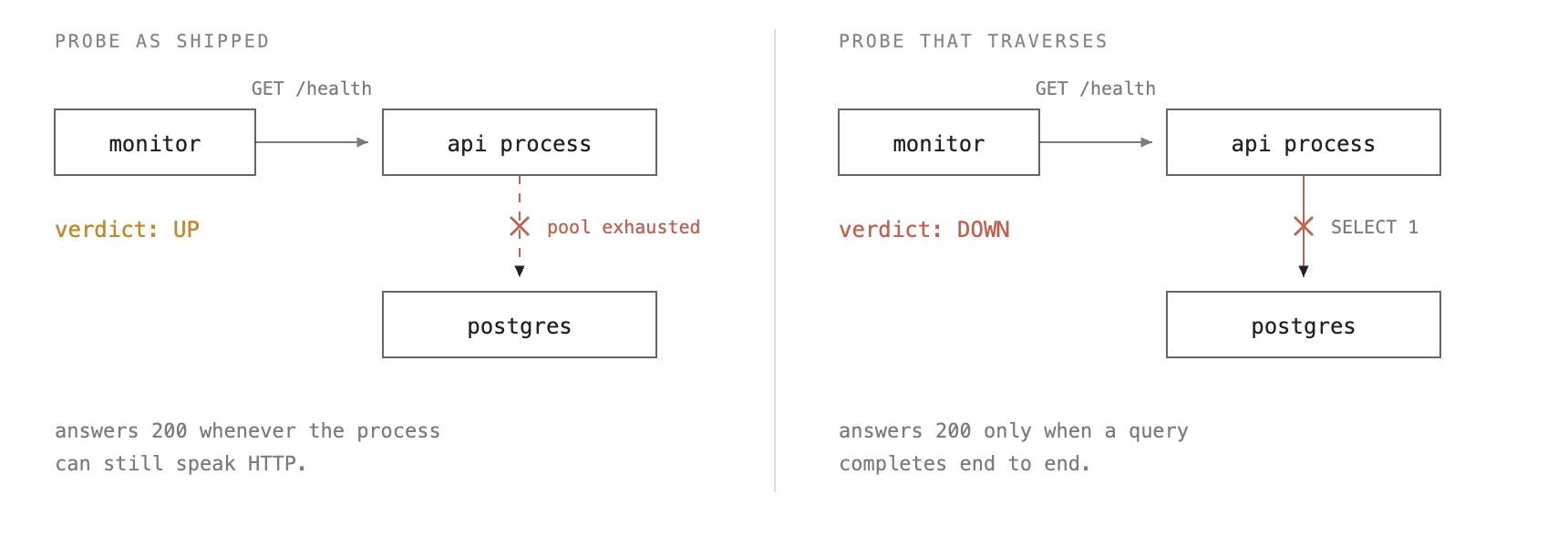
Instruments drift away from what they measure, and nothing about the drift is visible in the instrument's own output. A liveness endpoint that returns 200 as long as the HTTP server can answer is measuring the HTTP server. A metric emitted from a code path that a refactor stopped calling keeps reporting its last value. An alert built on count(errors) > 10 fires never once the error label is renamed, because the query now matches nothing — and nothing is not a violation.
04 — The agreeing mock
SIGNATURE
Two suites green on both sides of an integration that is broken in the middle.
A test double is a written record of what you believed about a dependency on the day you wrote it. It is not connected to the dependency. When the other team renames a field, widens a nullable, starts returning 202 where it used to return 200, or begins paginating a list that used to arrive whole, their suite goes green on the new behaviour and yours goes green on the old one. Both teams are correct locally. The edge between them is the one surface neither suite crosses.
05 — The convenient interleaving
SIGNATURE
Green a thousand times. The thousand-and-first run is production, on a Friday.
Tests do not execute a program; they execute one schedule of a program. A concurrency defect — a lost update between read and write, a cache filled before the transaction commits, a consumer that assumes an ordering the partition does not promise — is a property of the schedules you did not run. The suite selects the friendly interleaving structurally: single worker, empty queue, no contention, a clock that never crosses a boundary.
The tell is that these defects are usually reported as data, not as errors. Two rows where there should be one. A balance off by exactly one increment. Nobody gets an exception, because nothing exceptional happened — two correct operations simply ran in an order you never wrote down as forbidden.
06 — The plausible number
SIGNATURE
Type-correct, schema-valid, in range, and off by three orders of magnitude.
ttl = config.get("cache_ttl", 300)   # seconds, per our docs
redis.expire(key, ttl)               # milliseconds, per the client
# result: 300ms of caching. every type checks. the p99 does not.
Units, precision and rounding produce the quietest defects in the catalogue, because the output is always well-formed. A float that should have been a Decimal does not raise; it settles a cent short. A percentage applied twice gives a smaller number, not an error. A timestamp read as local and written as UTC is a valid timestamp everywhere it goes. Validation layers check shape, and shape is precisely the property these defects preserve.
07 — The unasked requirement
SIGNATURE
Nothing is broken. The system does exactly what it was asked to do.
The last silence is not a coding defect at all. Nobody said what should happen when a subscription is cancelled mid-billing-period, so the system does whatever falls out of the code — and what falls out of the code is a decision that was never made by anyone. There is no failing test because no test was ever owed. The gap surfaces months later as a support ticket, an angry finance spreadsheet, or a regulator's letter: the slowest feedback loop in the whole system.
Breaking the silence
The catalogue is only useful if each entry maps to something you can build. Every instrument below makes the same underlying move: force the system to distinguish between nothing is wrong and nothing is known.
Make absence a value
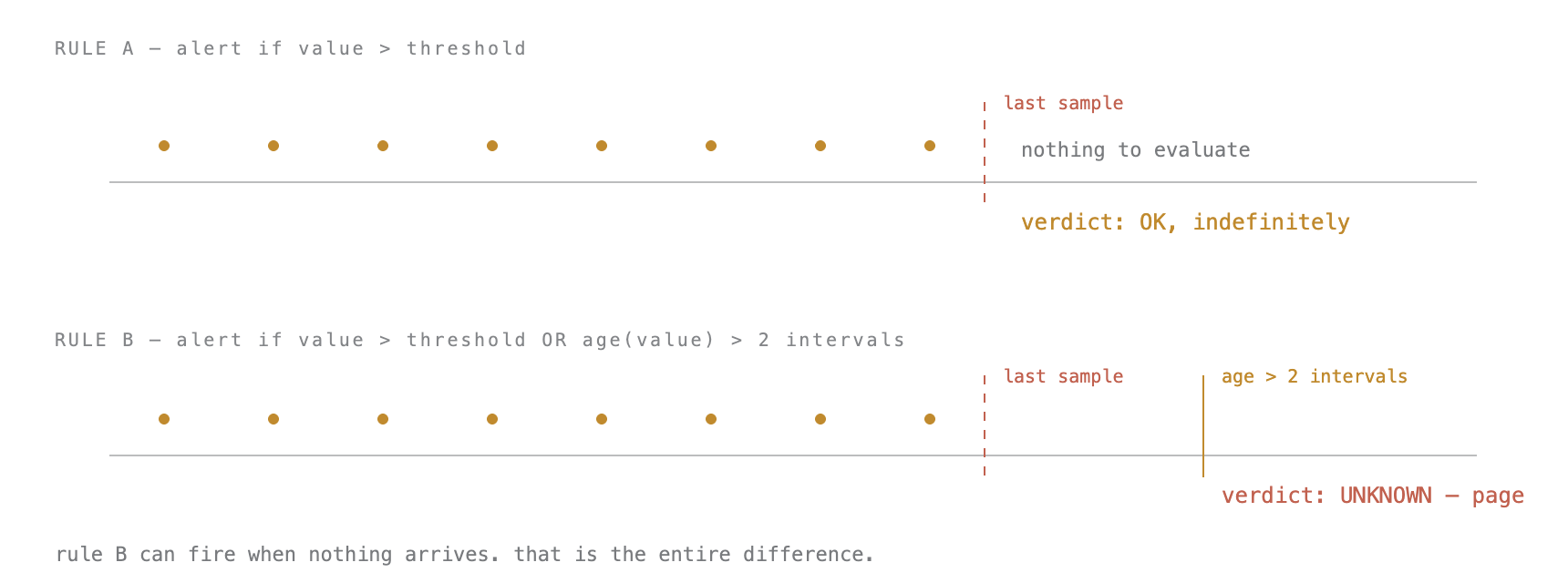
Most alerting is written as a predicate over samples, which means it cannot fire when there are no samples. Give every important signal a companion: the age of its most recent observation. Then a rule can say value > threshold OR age > 2 x interval, and the second clause is the one that catches silences 01 and 03. The same idea appears as a dead man's switch: a job that must check in, and that pages when the check-in does not arrive. Health becomes something a system keeps earning rather than something it retains by default.
In the code itself, this is the argument for a three-valued state — OK, FAILING, UNKNOWN — instead of a boolean. A boolean forces ignorance to be encoded as one of the two answers, and it is always encoded as the good one.
Test the negative space
Example-based tests can only assert on inputs you imagined, which is the exact failure in silence 01. Property-based testing inverts the authorship: you state an invariant — the ledger sums to zero, decoding after encoding is the identity, the total never decreases when a line is added — and let a generator hunt for the counterexample, including the empty list and the negative quantity and the duplicate id you would not have typed.
Mutation testing goes one level up and audits the suite instead of the code: flip a comparison, delete a line, and see whether anything turns red. A surviving mutant is a piece of your code that no assertion depends on. It is the closest thing there is to a direct measurement of what your green build is worth — and unlike coverage, its denominator is not something you wrote.
Probe through the dependency, never around it
Every check inherits the meaning of the deepest thing it touches, so make the important checks touch deep: a health endpoint that runs a real query through the real pool; a synthetic transaction that creates an order in production every minute, reads it back through the public API and asserts on the number that comes out; contract tests generated from recorded traffic rather than from your beliefs, run in the provider's pipeline so that their change breaks their build. Each of these is a probe with a physical connection to the thing it claims to describe.
Refuse to substitute silently
Fallbacks are not the problem; unmeasured fallbacks are. If a degraded path is worth having, it is worth counting — and the count is worth alerting on. A fallback rate that moves from 0.01% to 4% is an outage report written in advance.
except PricingUnavailable as e:
    metrics.increment("pricing.fallback", tags=["sku:" + sku])
    log.warning("degraded price for %s: %s", sku, e)
    # degrade if you must, but leave a mark a query can find,
    # and never let a substituted value reach a ledger.
    price = last_known(sku)   # not zero, not None, and flagged on the row
The same discipline belongs in the type system. Units in the type (Milliseconds, Money) stop silence 06 at compile time; an exhaustive match makes the compiler write the branch you would have forgotten; a NOT NULL with a CHECK constraint is an assertion that runs on every row in production forever, which is more than any test in your suite can claim.
Reconcile against reality, on a schedule
Silences 05, 06 and 07 share a property: the damage lands in stored data, where no request-time check will ever see it. The instrument for stored damage is reconciliation — a job that re-derives a number by a second, independent route and alerts on the difference. Sum the ledger and compare it against the balance column. Recount yesterday's orders from the event log and compare against the aggregates table. Diff what the payment provider says it settled against what you recorded. These are the only assertions that run against real data at real scale, and they are the reason finance teams keep finding defects engineering never saw.
Make health and ignorance look different
Everything above collapses into one design rule, and it is a rule about representation rather than about testing. A system should never be able to render I am fine and I have not checked with the same pixels. Wherever those two states share a rendering — a flat line, a green tick, an empty error log, a passing build — you have built a place where a defect can live indefinitely at no cost to itself.
Which makes the sharpest question in a design review not "how will we test this?" but the blunter one: if this were already broken right now, which specific thing on which specific screen would look different? If the honest answer is "nothing, until a customer writes in," that is not a testing gap. It is a missing instrument, and it stays missing until someone draws the wire.
The default state of anything unmeasured is not fine. It is unknown — and a system that cannot say so out loud will keep telling you it is fine right up until the invoice arrives.