
Advanced Memory Architecture for Edge AI Applications
Modern IoT and edge AI applications demand embedded systems that can process large amounts of sensor data in real time while staying reliable and power-efficient. Whether you're building smart home devices, industrial monitoring systems, or precision health monitoring platforms, the foundation is sophisticated memory management and storage architecture.
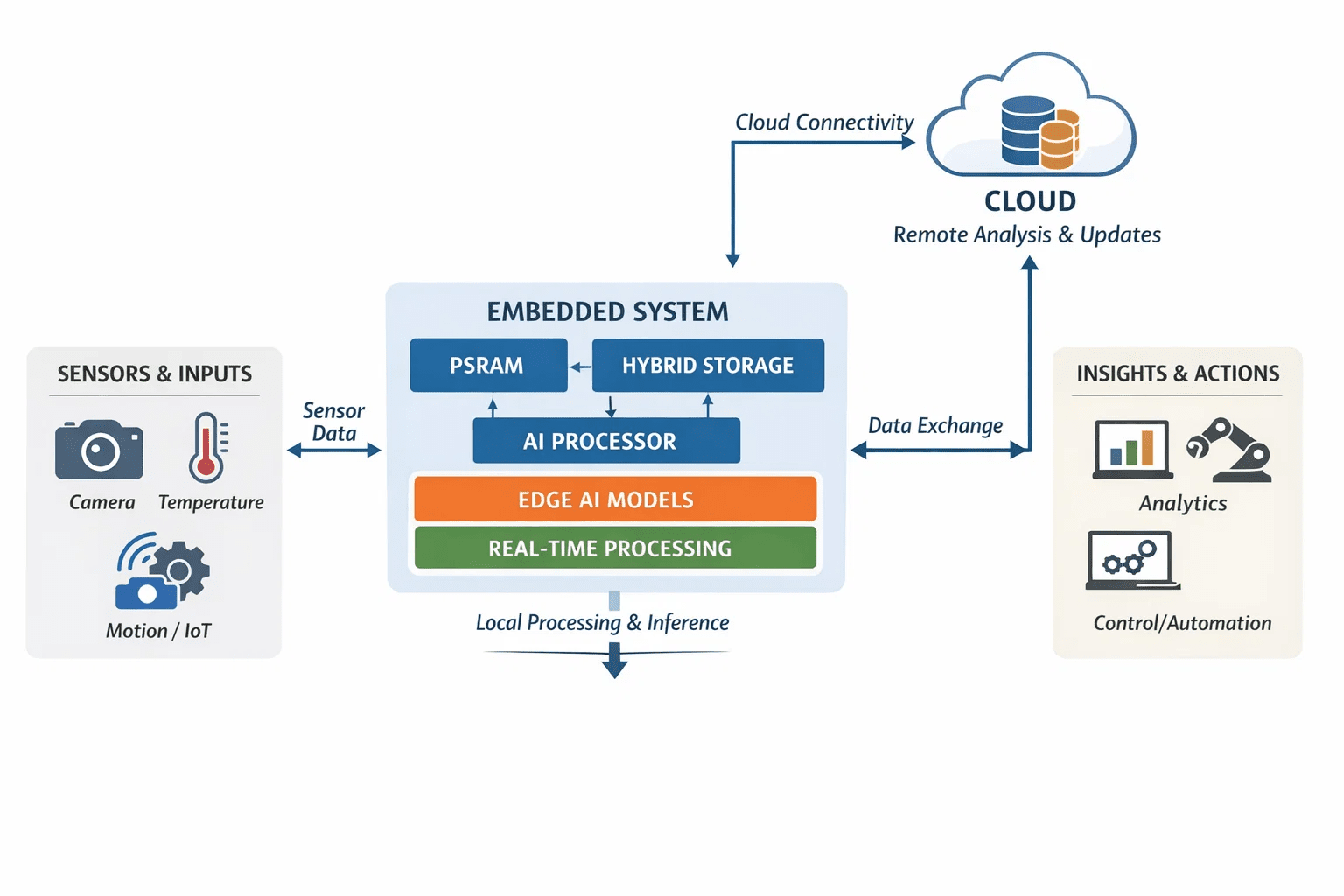
This post covers how to design and implement high-performance embedded systems using advanced ARM Cortex-M microcontrollers paired with external PSRAM and hybrid storage, drawing on real implementation strategies for high-resolution sensor data, real-time compression, and robust data persistence. This architecture has proven essential in edge AI systems for precision monitoring, where millisecond-level response times and reliable data handling directly affect system effectiveness.
The challenge: memory constraints in modern embedded systems
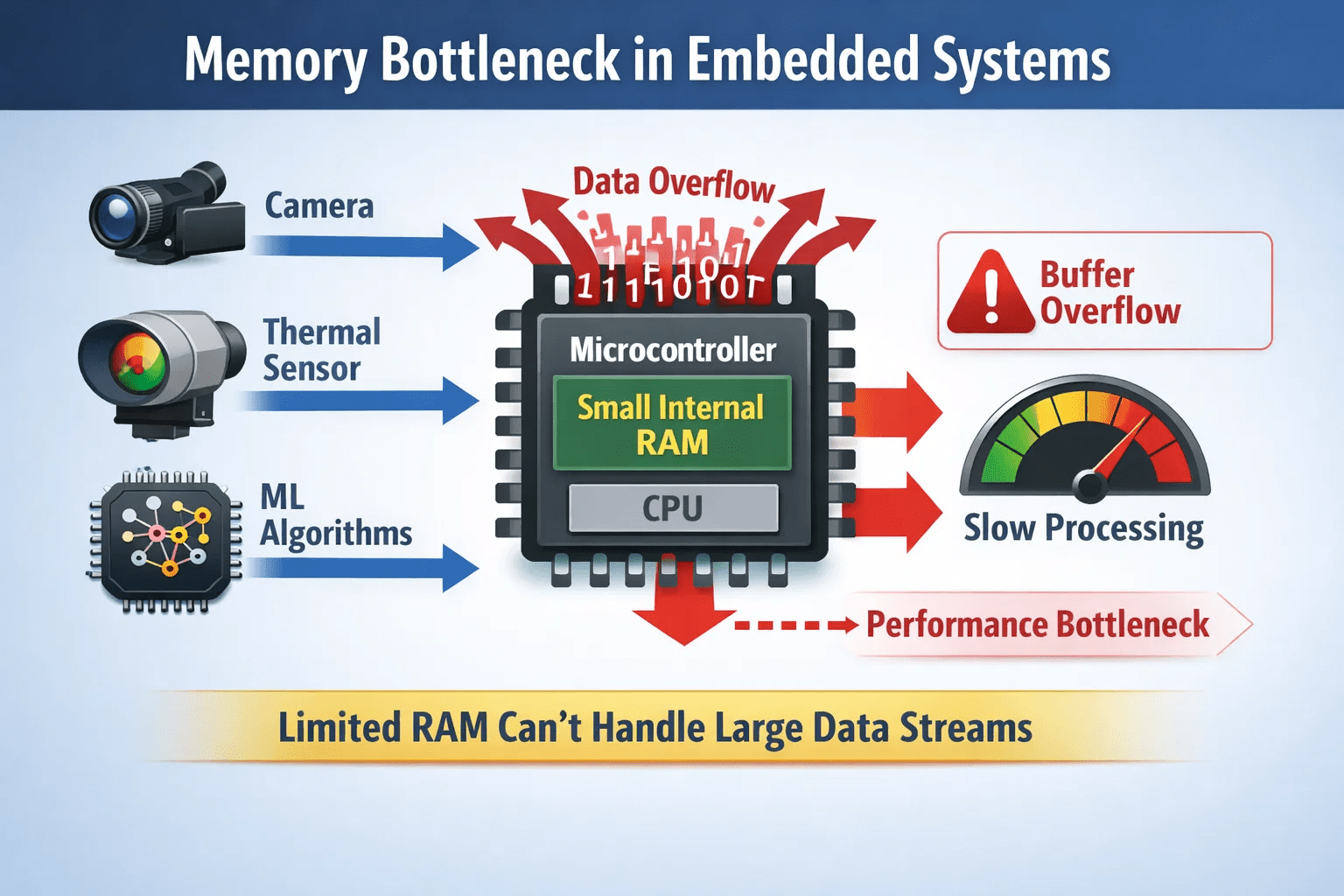
A real-time sensor fusion system might need to simultaneously process high-resolution camera feeds (640x400 pixels, 12-bit Bayer data), thermal imaging arrays (32x24 temperature matrices), machine learning inference for pattern recognition, and robust data logging and transmission. Traditional embedded systems with limited on-chip RAM, typically 128KB to 1MB, simply can't accommodate all of that. The solution lies in sophisticated external memory integration and intelligent storage management.
External PSRAM integration
Pseudo Static RAM bridges the gap between high-speed SRAM and high-capacity DRAM. Unlike traditional SRAM, PSRAM uses DRAM cells with built-in refresh circuitry, giving high capacity (8MB to 32MB in compact packages), fast access (sub-100ns), a simple SPI/QSPI interface, and low power through self-refreshing design.
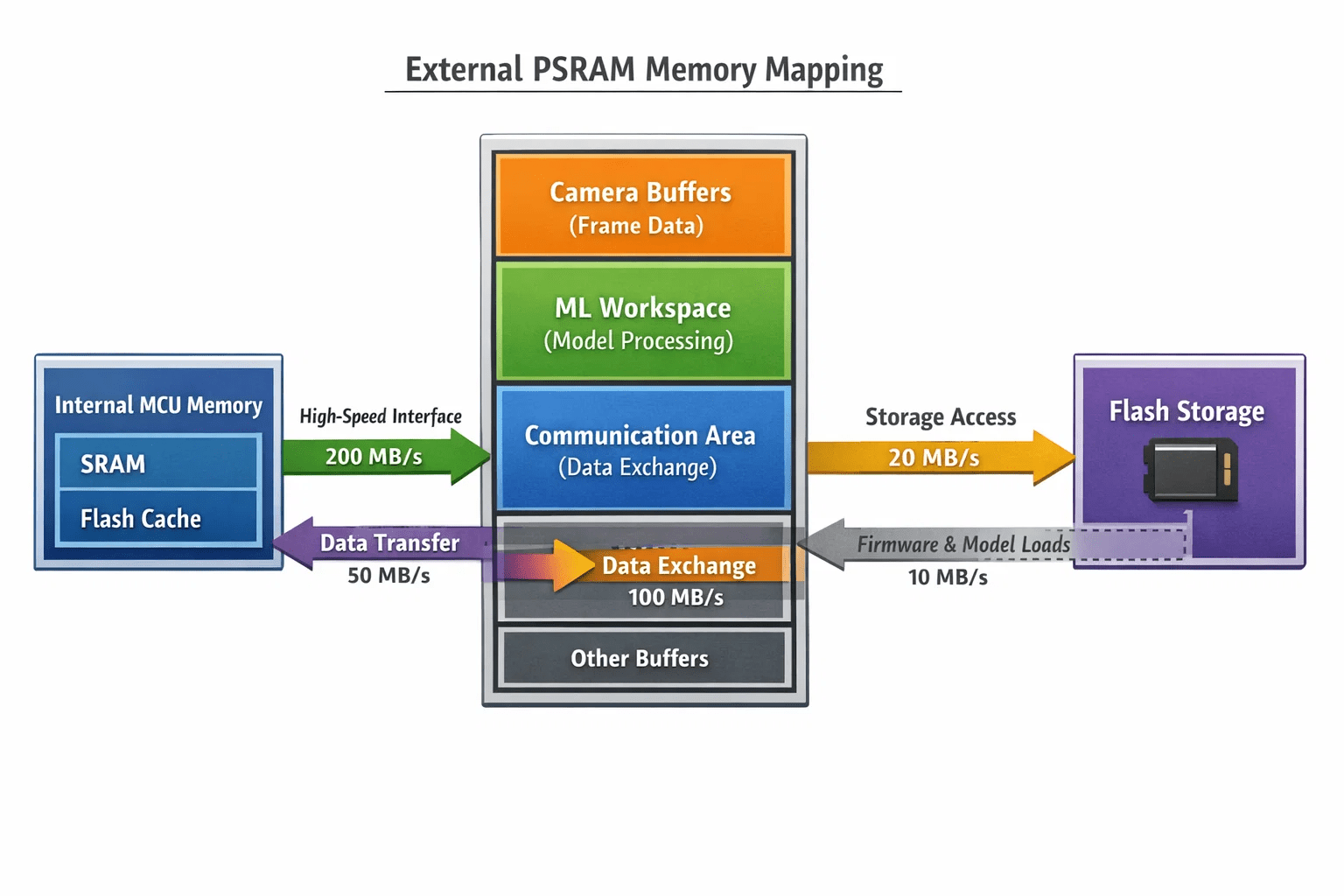
Successful integration comes down to careful peripheral configuration and memory mapping. Our implementation uses the OCTOSPI controller for maximum throughput:
// OCTOSPI Configuration for High-Speed PSRAM Access
OCTOSPI_RegularCmdTypeDef sCommand = {0};
sCommand.OperationType = HAL_OSPI_OPTYPE_COMMON_CFG;
sCommand.FlashId = HAL_OSPI_FLASH_ID_1;
sCommand.InstructionMode = HAL_OSPI_INSTRUCTION_1_LINE;
sCommand.InstructionSize = HAL_OSPI_INSTRUCTION_8_BITS;
sCommand.AddressMode = HAL_OSPI_ADDRESS_1_LINE;
sCommand.AddressSize = HAL_OSPI_ADDRESS_24_BITS;
sCommand.DataMode = HAL_OSPI_DATA_4_LINES; // Quad SPI for maximum speed
The external PSRAM gets mapped to distinct zones by data type: a camera buffer zone for raw sensor data, a processing workspace for algorithm buffers, an ML inference space for model weights and activations, and communication buffers for protocol stacks. Giving each data type its own address range keeps allocation predictable and avoids fragmentation across dissimilar workloads.
Hybrid storage: LittleFS plus raw flash
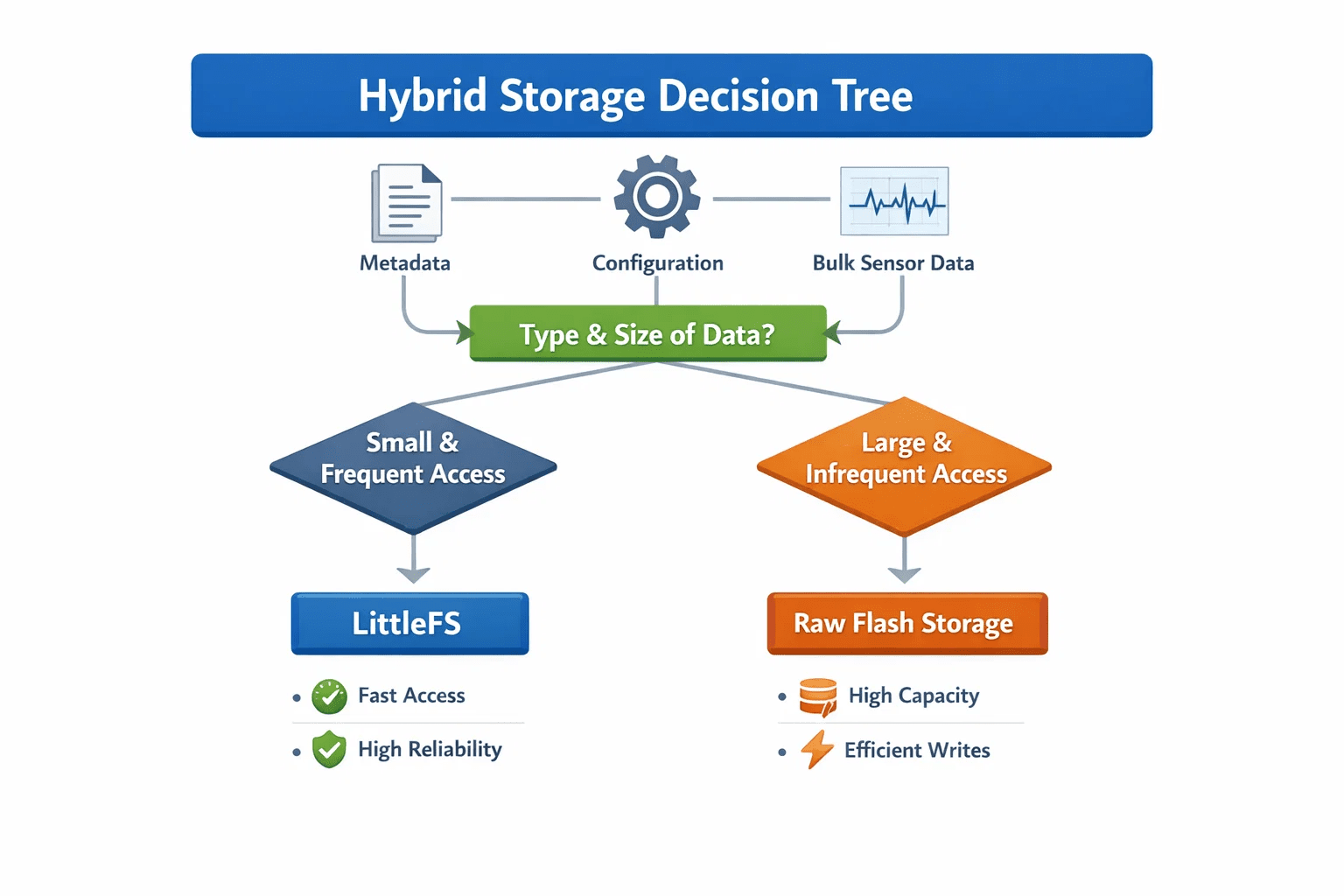
Edge AI applications generate continuous data streams that need both structured metadata management and high-speed bulk storage. Traditional filesystems handle organization well but sacrifice performance; raw flash access is fast but unstructured. Our approach combines both: a LittleFS zone for structured metadata, configuration, and small files, and a raw flash zone for high-speed bulk data storage.
// Storage Zone Configuration
#define LITTLEFS_BASE_ADDR    0x90000000  // Structured data
#define RAW_STORAGE_BASE_ADDR 0x90200000  // Bulk storage
#define IMAGE_PAIR_SIZE       (CAMERA_SIZE + THERMAL_SIZE)
#define MAX_IMAGE_PAIRS       (RAW_STORAGE_SIZE / IMAGE_PAIR_SIZE)
The hybrid system routes data intelligently: metadata goes to LittleFS for structured access while bulk pixel and thermal data goes straight to raw flash for speed.
// Hybrid Storage Decision Logic
int hybrid_storage_save_pair(const uint8_t *camera_data,
                            const uint8_t *thermal_data,
                            uint64_t timestamp,
                            uint32_t *out_image_id) {

    // Metadata goes to LittleFS for structured access
    ImageMetadata meta = {
        .image_id = g_next_image_id,
        .timestamp = timestamp,
        .camera_flash_addr = camera_addr,
        .thermal_flash_addr = thermal_addr,
        .status = IMAGE_STATUS_CAPTURED
    };

    // Bulk data goes to raw flash for speed
    result = octospi_dma_write(camera_addr, camera_data, CAMERA_SIZE);
}
Real-time performance optimization
Eliminating CPU bottlenecks during transfers is critical, so we use DMA-accelerated OCTOSPI operations with explicit cache management for coherency:
// Cache-Coherent DMA Setup
#if defined(__DCACHE_PRESENT) && (__DCACHE_PRESENT == 1U)
    // Ensure cache coherency for DMA operations
    const uint32_t line_size = 32U;
    uintptr_t clean_start = start_addr & ~(line_size - 1U);
    SCB_CleanDCache_by_Addr((uint32_t *)clean_start,
                           (int32_t)(clean_end - clean_start));
#endif

// High-speed DMA transfer
result = octospi_dma_write(flash_addr, data_buffer, transfer_size);
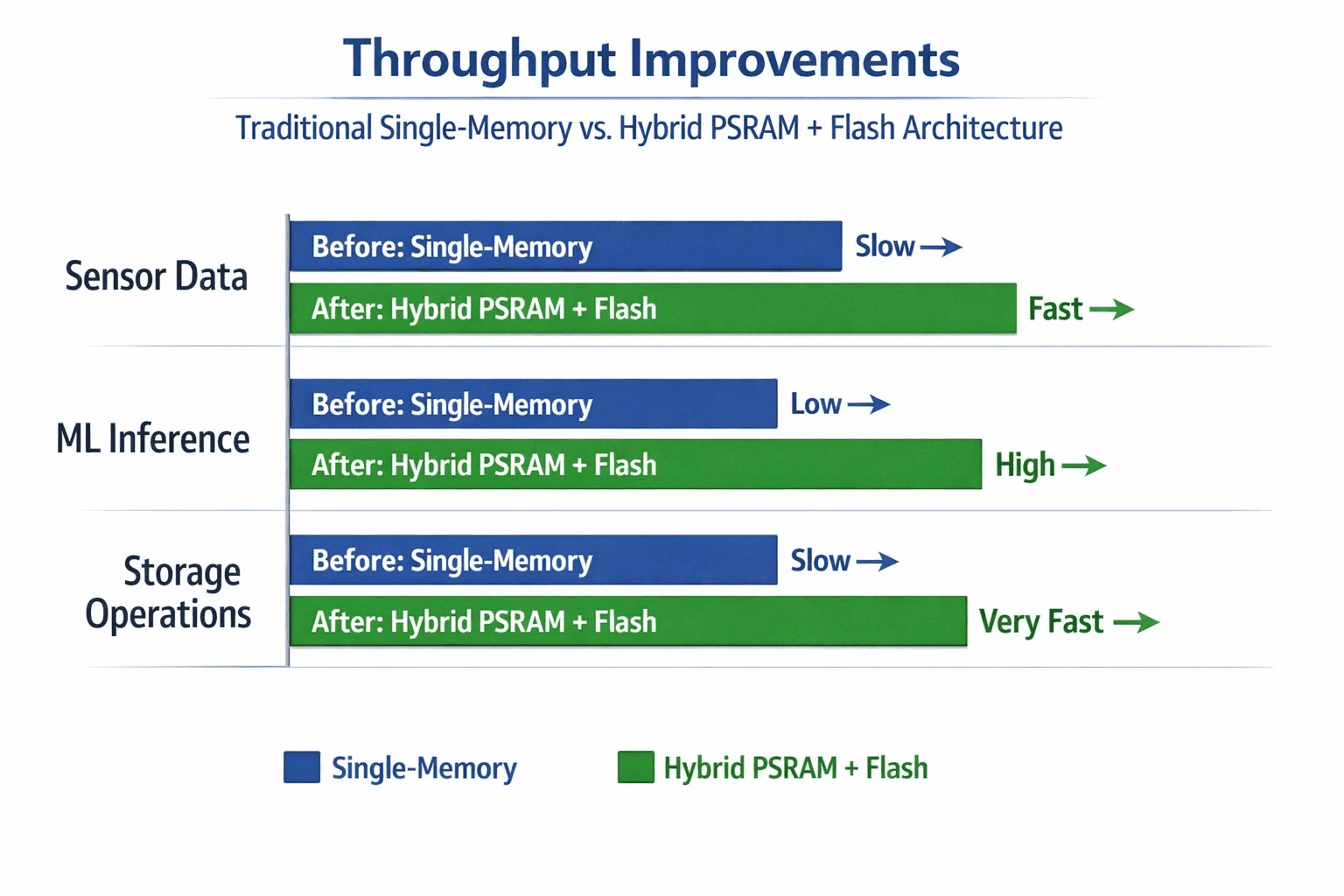
With this architecture, flash writes sustain tens of megabytes per second, PSRAM access latency stays under 100ns for random access, and total pipeline latency from sensor to storage stays under 200ms.
Compression and error recovery
Real-time compression helps maximize storage efficiency:
// Adaptive Compression Strategy
int camera_compress_image(const uint8_t *src, size_t src_size,
                         uint8_t *dst, size_t dst_capacity) {

    // Use LZ4 for general purpose compression
    int compressed_size = LZ4_compress_default((const char *)src,
                                              (char *)dst,
                                              (int)src_size,
                                              (int)dst_capacity);

    float ratio = (float)src_size / compressed_size;
    // Typical compression: 529KB -> 180KB (2.9x ratio)

    return compressed_size;
}
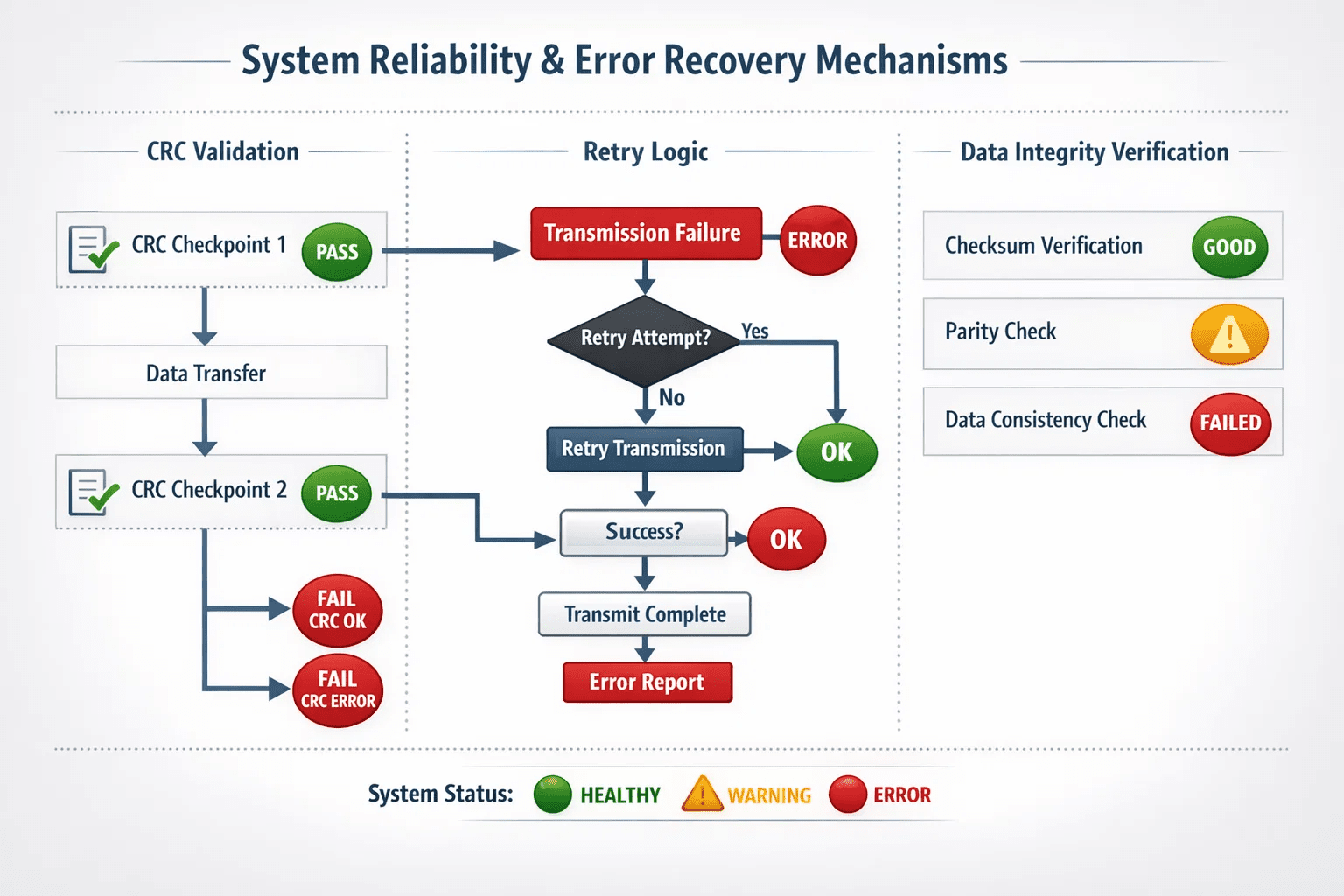
Robust systems also need CRC32 validation for all stored data, automatic retry for failed operations, graceful degradation as storage approaches capacity, and background verification during idle periods.
Memory management for ML inference
ML models need careful memory allocation, typically static model weights in PSRAM plus rotating buffers for sensor input:
// Dynamic Memory Allocation for ML Models
typedef struct {
    uint8_t *model_weights;     // Static allocation in PSRAM
    uint8_t *input_buffer;      // Rotating buffers for sensor data
    uint8_t *inference_scratch; // Temporary computation space
    uint32_t buffer_index;      // Current active buffer
} ml_memory_context_t;

// Efficient buffer rotation for continuous inference
void rotate_inference_buffers(ml_memory_context_t *ctx) {
    ctx->buffer_index = (ctx->buffer_index + 1) % NUM_INFERENCE_BUFFERS;
    ctx->input_buffer = &ctx->psram_base[ctx->buffer_index * BUFFER_SIZE];
}
In production, this architecture supports continuous camera processing with ML inference at real-time frame rates, sub-second end-to-end latency from sensor to decision, high data retention reliability under normal operation, and months of unattended operation.
Why it matters at Hoomanely
This architecture is the foundation of our precision monitoring platform. Our edge AI system processes continuous streams of visual, thermal, and behavioral sensor data to generate clinical-grade insights about pet health. The hybrid memory architecture enables real-time analysis of complex sensor fusion data while maintaining robust logging for longitudinal health tracking, letting our biosense AI engine process large amounts of pet health data locally, preserving privacy while giving pet parents immediate insight.
Implementation guidelines
On the hardware side: design a clean power supply for external memory, minimize trace lengths for high-speed signals, use proper impedance matching for OCTOSPI lines, and account for EMC from switching noise. On the software side, use thread-safe memory management:
// Thread-Safe Memory Management
typedef struct {
    SemaphoreHandle_t access_mutex;
    uint32_t allocation_map;
    memory_pool_t pools[NUM_MEMORY_POOLS];
} psram_manager_t;

// Safe allocation with timeout
void* psram_alloc_safe(size_t size, uint32_t timeout_ms) {
    if (xSemaphoreTake(psram_mgr.access_mutex, pdMS_TO_TICKS(timeout_ms))) {
        void *ptr = internal_psram_alloc(size);
        xSemaphoreGive(psram_mgr.access_mutex);
        return ptr;
    }
    return NULL; // Allocation timeout
}
Common pitfalls worth watching for: cache coherency issues (always clean the D-cache before DMA), memory fragmentation (use fixed-size pools for predictable allocation), power-loss recovery (use atomic operations for critical metadata), and missing performance monitoring (build in profiling from the start).
Key takeaways
External PSRAM integration enables processing of datasets that exceed internal MCU memory. Hybrid storage architectures give you both structured data management and high-speed bulk storage. DMA acceleration and cache management are critical for optimal performance. Real-time compression and error recovery keep the system both efficient and reliable. And careful memory allocation strategy is what makes complex edge AI workloads possible on resource-constrained devices.