Advanced Multi-Channel ADC Signal Processing for Precision Measurements in Embedded Systems
In precision measurement systems, the difference between a stable 0.1g reading and a value oscillating across several grams lies not in the hardware, but in the signal processing that transforms raw ADC data into reliable measurements. Environmental noise, thermal drift, electrical interference, and dynamic loading conditions can render even expensive hardware useless without sophisticated processing behind it.
The challenge goes beyond simple noise reduction. Traditional averaging fails badly in dynamic environments where rapid, real changes have to be distinguished from noise artifacts. This post covers advanced multi-channel ADC signal processing techniques that deliver clinical-grade precision in demanding embedded applications, turning unreliable raw sensor data into stable, accurate measurements.
The signal processing challenge
Real-world embedded measurement systems operate far from lab conditions. Environmental vibration from nearby machinery, electrical interference from switching power supplies, thermal expansion and contraction cycles, and electromagnetic fields from wireless communications all add measurement uncertainty that can easily exceed acceptable tolerances.
Consider a scenario requiring roughly plus-or-minus 1g accuracy across a 2000g range, about 0.05% full-scale accuracy. Raw ADC readings there typically show noise floors of 10 to 50 counts, temperature coefficients introducing systematic drift, and intermittent spikes from electrical transients. Simple moving averages amplify outliers and introduce unacceptable lag; basic filtering can't distinguish legitimate signal changes from noise artifacts. The problem compounds in multi-channel systems, where cross-channel interference, timing synchronization, and channel-specific noise characteristics all need addressing at once.
Architectural foundations for multi-channel precision
A robust multi-channel system needs a unified control approach rather than treating each channel independently, with temporal synchronization and electrical isolation maintained together. A hardware abstraction layer provides precise GPIO-based sequencing timing, so channel multiplexing happens with deterministic intervals, eliminating the jitter that introduces systematic error in differential measurements. Channel selection logic manages settling time automatically, letting each analog path stabilize before measurement begins.
A key architectural decision is sliding window processing per channel. Rather than processing samples individually, windowed processing keeps historical context while staying real-time responsive. The optimal window size balances noise reduction against response time, 16 samples typically gives excellent noise suppression while keeping sub-second response.
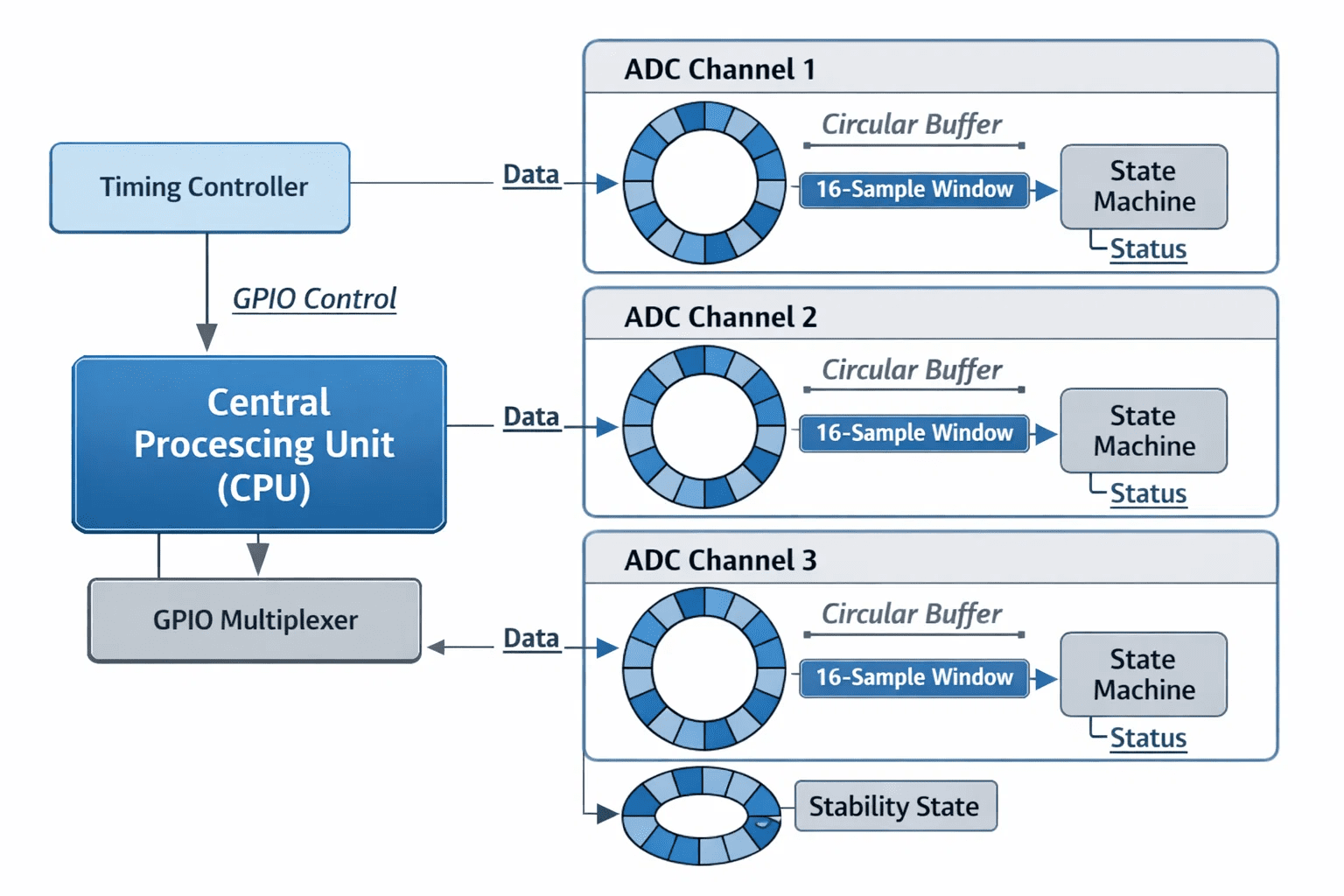
Stability detection runs as a state machine tracking measurement confidence across three states: UNSTABLE, STABILIZING, and STABLE, with hysteresis preventing oscillation between states during marginal conditions. This avoids premature reporting during transients while staying responsive to legitimate changes. Circular buffer implementations handle historical data storage without dynamic allocation, essential for real-time operation, with each channel maintaining independent buffer management while sharing common processing algorithms.
Advanced filtering for noise rejection
The heart of precision measurement is filtering that extracts meaningful signal from noise. Simple averaging or basic low-pass filtering fall short against the complex noise found in real deployments.
A median-plus-statistical approach improves meaningfully on conventional filtering. First, calculate the median value from the current sample window, which eliminates extreme outliers that would skew a traditional average. The median is a robust central-tendency estimator that stays unaffected by occasional large deviations. Following that, statistical outlier detection removes samples deviating significantly from the median, with the rejection threshold adapting to the window's standard deviation, keeping the system sensitive to real changes while rejecting obvious noise. Samples beyond roughly two standard deviations from the median typically get excluded.
The remaining samples go through weighted averaging, where the weighting can factor in temporal position, measurement confidence, or channel-specific characteristics, preserving the benefits of averaging while removing the damage outliers would otherwise cause.
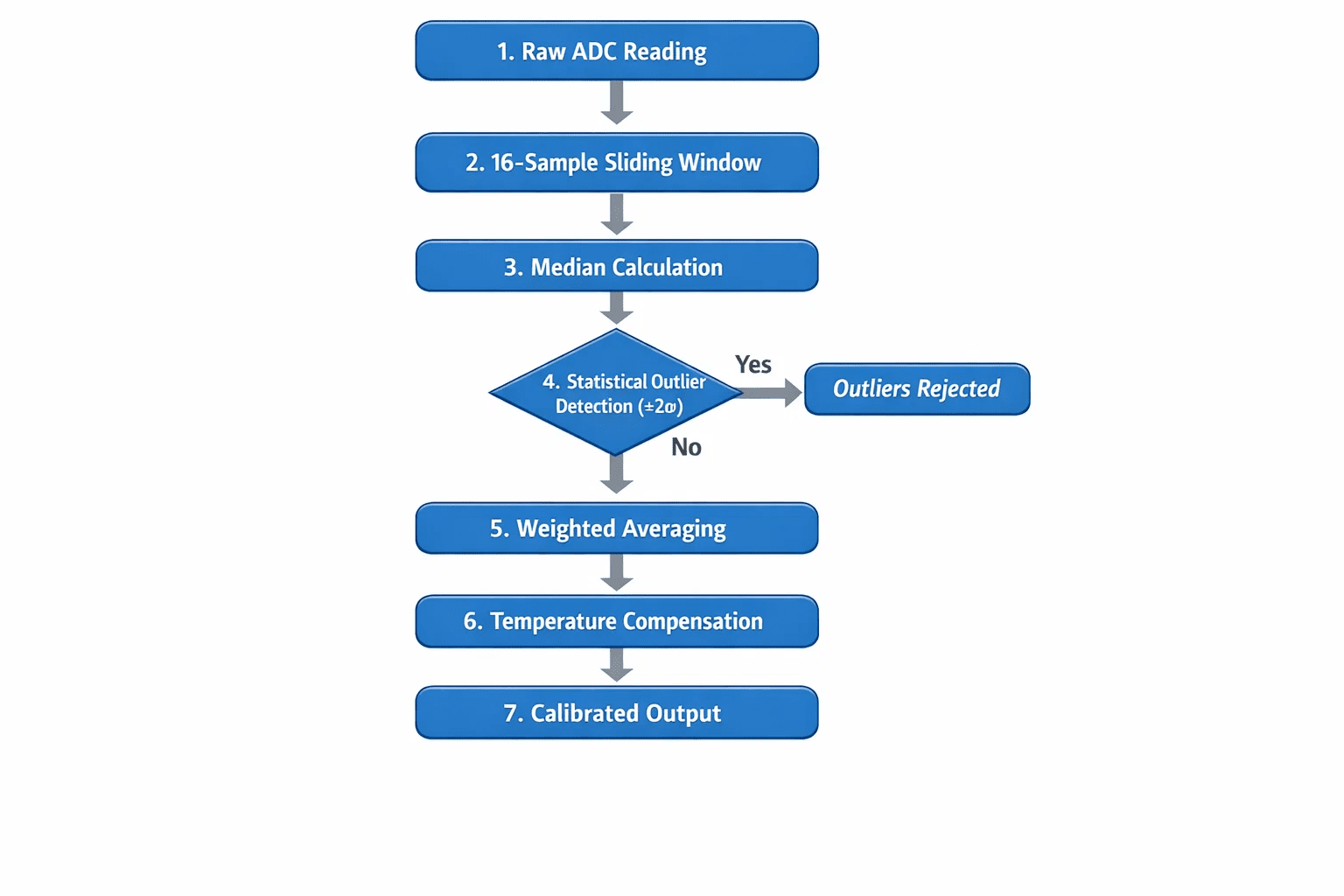
Temperature compensation adds a further layer for long-term stability. Correction for thermal effects needs calibration data stored with temperature coefficients, applying temperature-compensated corrections during operation. Multi-point calibration goes beyond simple offset and gain correction to include linearity compensation and cross-channel correlation, with correction parameters stored in non-volatile memory so calibration survives power cycles and resets, and periodic recalibration maintaining accuracy over extended operation.
Implementation and optimization
Successful implementation needs careful attention to computational efficiency. Bit masking, masking the least significant bits of ADC readings, reduces noise floors elegantly without complex digital filtering, effectively increasing resolution while cutting sensitivity to low-level noise. The optimal masked-bit count depends on noise characteristics and required resolution, typically 2 to 4 bits for most applications.
Fixed-point arithmetic removes the overhead of floating-point operations while keeping adequate precision for most measurement applications, with careful scaling factor selection to avoid overflow. Thread-safe design matters in multi-threaded systems where measurement processing runs concurrently with acquisition and communication tasks, and lock-free circular buffers give efficient inter-thread communication without the overhead and priority-inversion risk of traditional locking.
Error handling and recovery matter too: timeout detection prevents lockup when ADC conversion fails to complete, automatic retry handles intermittent communication errors, and graceful degradation lets the system keep operating with reduced functionality when individual channels fail. Calibration data persistence needs robust storage surviving power interruptions and failures, checksums and redundant storage protecting against corruption, versioning allowing calibration updates without losing history, and validation checks detecting corrupted data and reverting to safe defaults.
Performance results
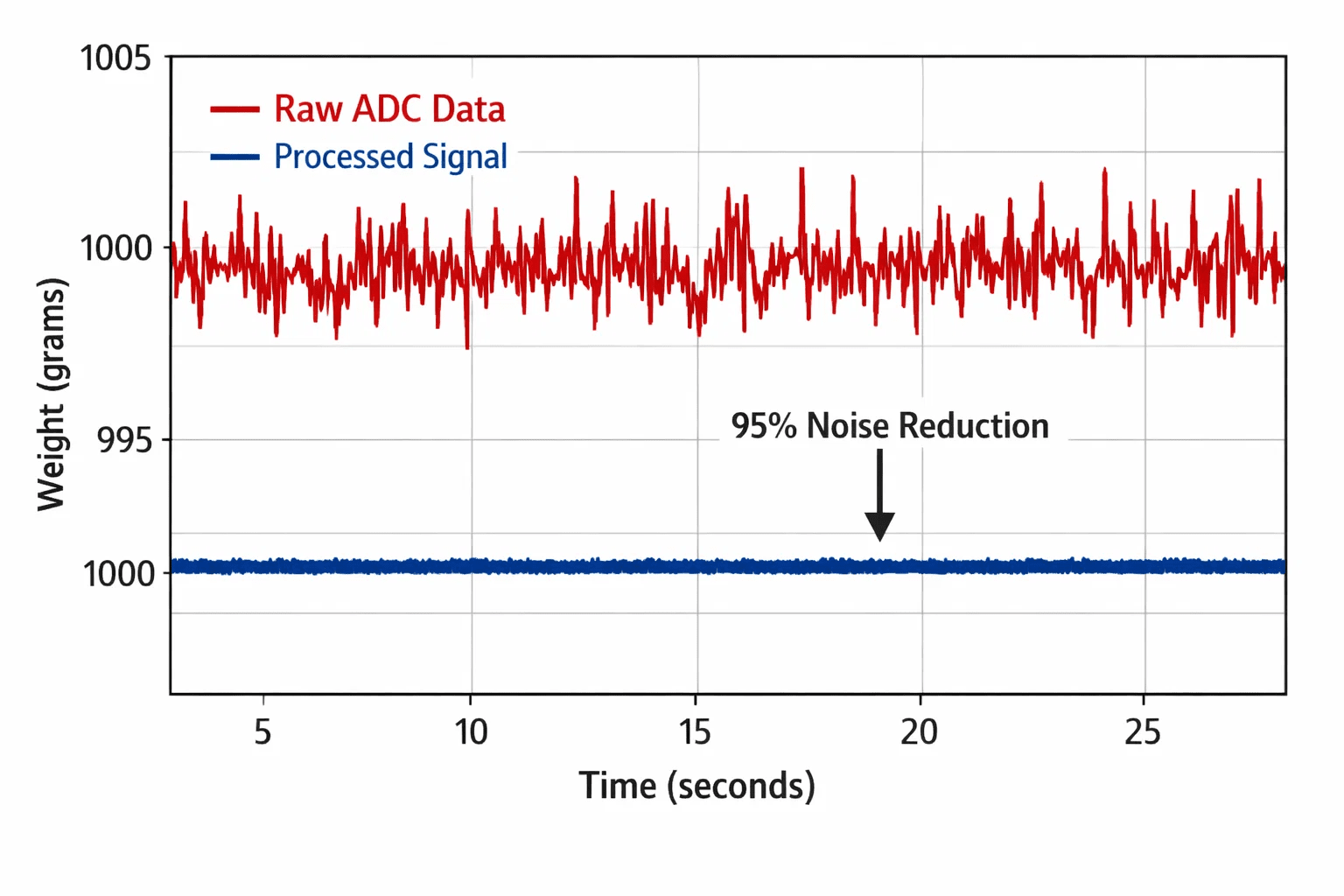
Comprehensive testing shows these techniques cutting noise substantially compared to simple averaging, turning unusable raw data into stable, reliable measurements. Stability detection response times improved significantly too, with systems achieving stable readings within a couple of seconds of a signal change, versus the 10 to 20 seconds traditional approaches often need.
Accuracy validation across operational temperature ranges confirms the compensation algorithms work: systems hold roughly plus-or-minus 1g precision from -10°C to +60°C, better than 0.05% full-scale accuracy, with long-term drift staying well within acceptable limits over six-month testing periods. Reliability held up under vibration and electromagnetic interference testing, and power supply rejection kept operation stable through supply voltage variation.
Why it matters at Hoomanely
These techniques enable continuous pet health monitoring through ultra-precise weight tracking. Sophisticated multi-channel ADC processing lets us detect subtle weight variations of just a gram or two that indicate early health trends, giving pet parents proactive insight before symptoms become visible. That's the same precision measurement discipline that ensures clinical-grade accuracy across our broader vision of sensor fusion and edge AI health tracking.
Key takeaways
Hybrid filtering, median plus statistical outlier rejection, consistently outperforms simple averaging by removing the impact of noise spikes while preserving fast response to real changes. State-based stability detection with hysteresis prevents false readings during transients while staying responsive to actual change. Multi-point calibration with temperature compensation keeps long-term accuracy across operating conditions without frequent manual recalibration. And robust error handling, timeout detection, retry logic, and graceful degradation, keeps embedded measurement systems running despite individual component failures or transient conditions.