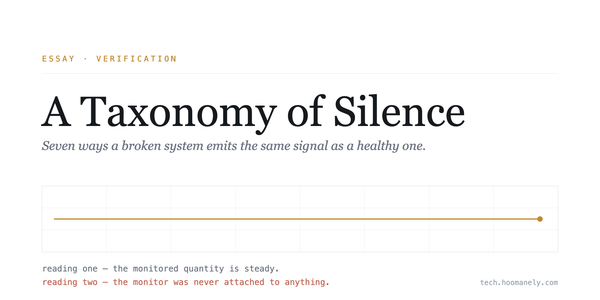
A Taxonomy of Silence
Every automated check answers a question about code that exists and paths that run. The defects that survive a mature pipeline live outside both — and they announce themselves the same way a healthy system does.
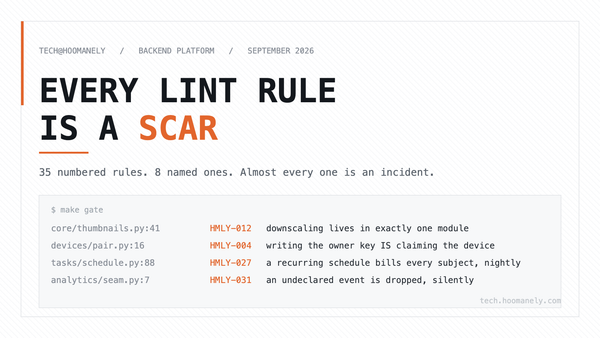
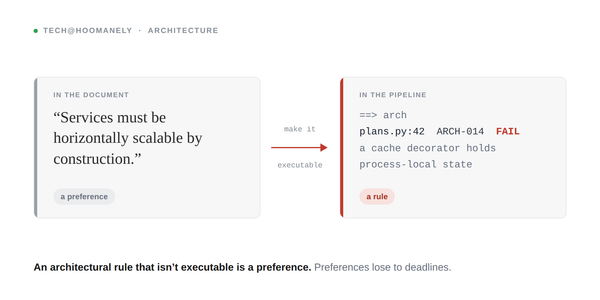
How architecture rules stop being preferences. Someone on the team opens a pull request. One line, added to a service class: @cache def resolve_plan(code: str) -> Plan: ... It gets approved, and of course it does. It's memoization on a lookup that looks pure, it takes
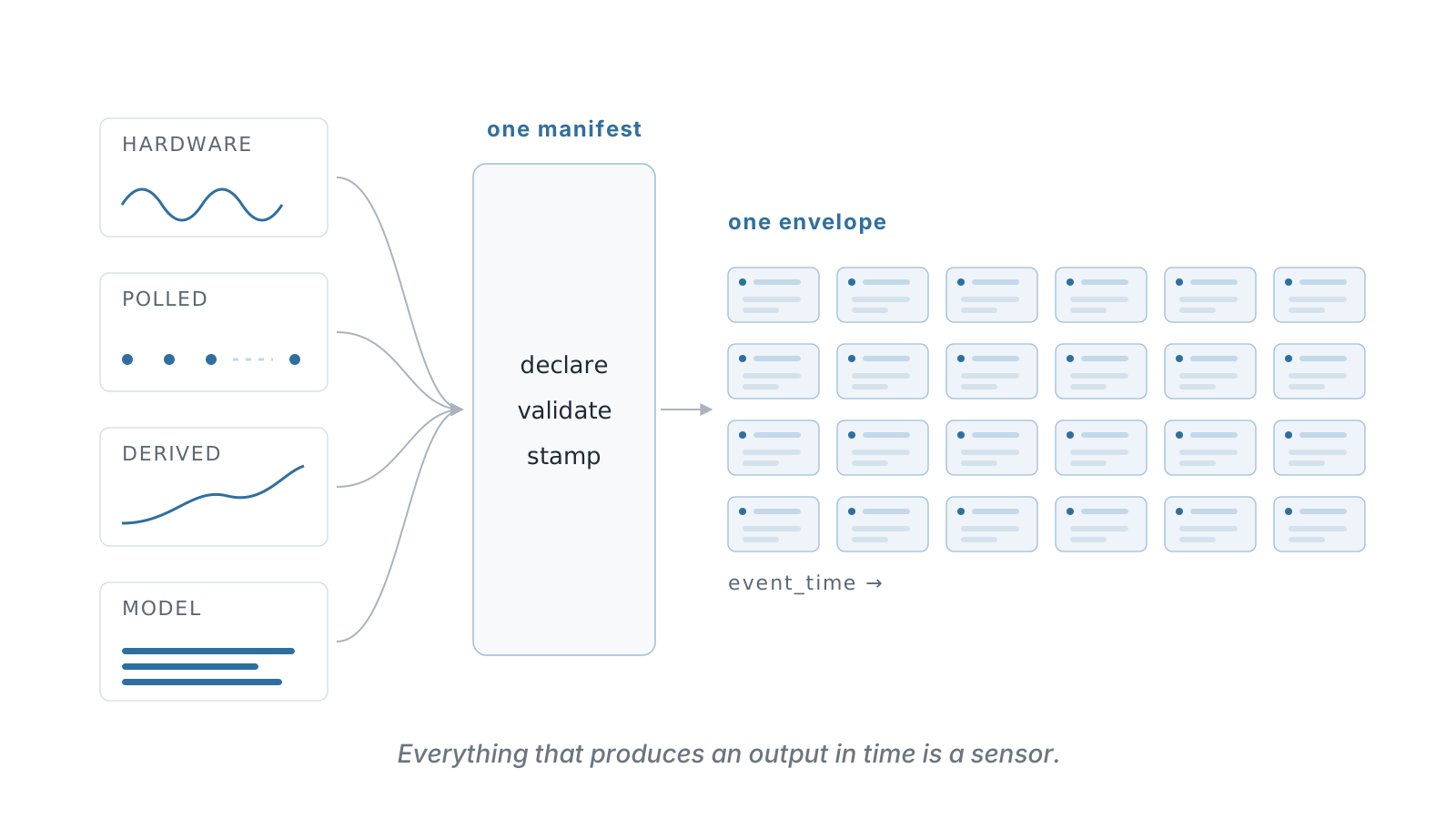
What happened when we made a physical transducer and a call to a language model the same kind of object - one manifest, one reading envelope, one store, and four guards that run at every boot.
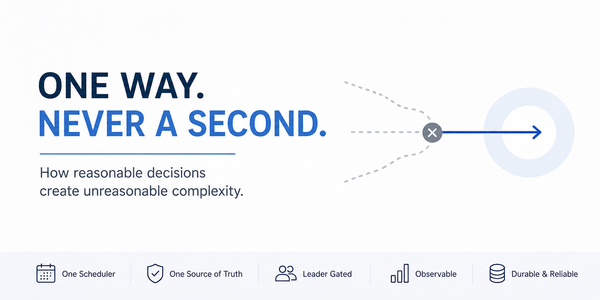
Somewhere in most mature codebases there are three ways to schedule a recurring job. Nobody chose that. There is no design document proposing three schedulers, no meeting where a team weighed the options and landed on "several." Look closely and each one had a good reason at the
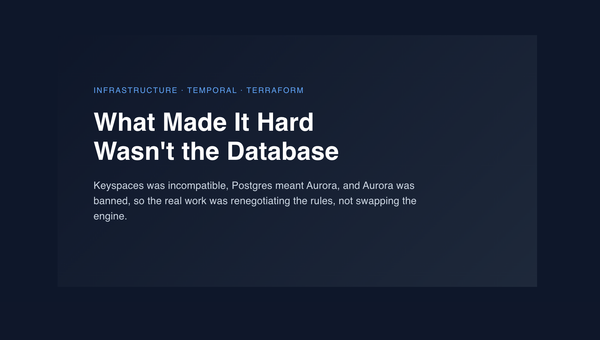
Keyspaces looked like the safe choice. Cassandra was already running in the stack, so letting Temporal reuse it meant no new engine and everything staying in-account. Then we hit the wall: Temporal's Cassandra schema depends on conditional batch writes, the lightweight-transaction mechanism behind shard-ownership fencing, and Keyspaces doesn&
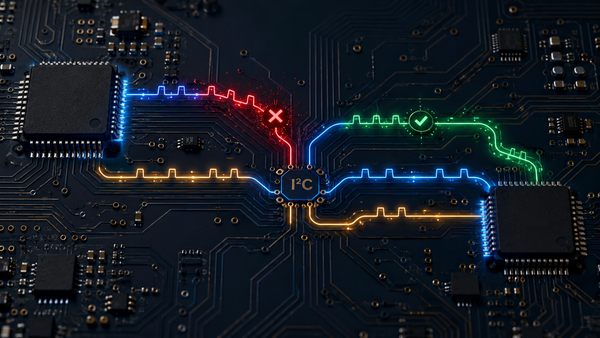
Two sensors share one I²C bus on our hub. One is an MLX90640 thermal imager sampling an 8×8 temperature grid twice a second. The other is a combination proximity-and-barometer that checks the room distance and ambient pressure at roughly the same cadence. Each sensor looks harmless in isolation.
A fleet of connected devices is a relentless text generator. Every device runs a dozen cooperating services, and each one narrates its life in log lines: startup banners, retries, sensor readings, stack traces. Across a hundred-plus devices that adds up to hundreds of thousands of lines a day, spiking into
There is a particular kind of failure that haunts always-on devices, and it almost never shows up in the lab. The firmware runs fine for a day, a week, a month, and then somewhere out in the field it quietly stops. No crash log, no stack trace, just a device
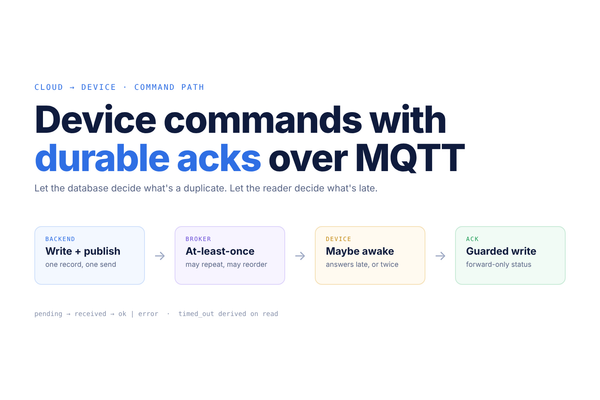
Modern device systems don't usually fail because one request is too large. They fail because many reasonable requests arrive at the wrong time, under the wrong retry behavior, with no shared contract between client and server. That pattern shows up most clearly during reconnects. Devices go offline for
The pipeline ran. Interrupts fired. DMA counters incremented. Every status register said the system was healthy. The buffers were empty. Three days of debugging, one register field.
Technology, Insights and Ideas.
Want to stop getting emails from Tech@Hoomanely?