Boosting Edge AI with Latent Audio Generation
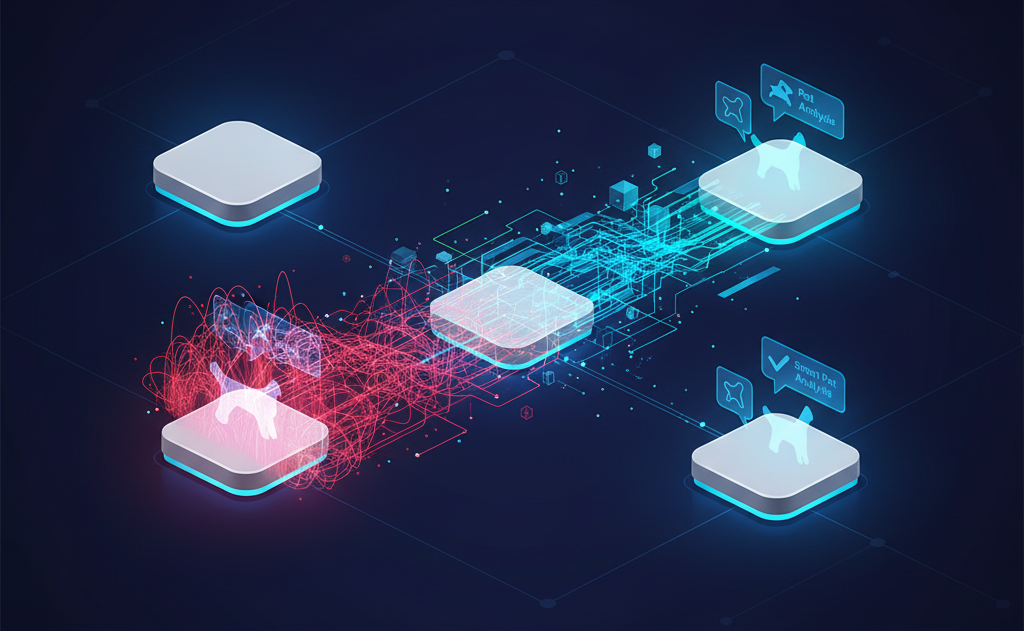
Edge AI is transforming how devices interact with the real world, from smart speakers to pet care devices. A critical challenge in deploying these models is robustness in varied acoustic environments. While collecting massive labeled datasets can help, real-world constraints often limit data availability, especially for specialised domains like pet sounds or rare events.
This is where audio augmentation becomes essential, it allows models to learn from synthetic variations of existing recordings, improving generalisation without expanding the physical dataset. However, unlike image augmentation, audio is temporal, multimodal, and highly sensitive to distortions, making augmentation a non-trivial task.
The challenge of audio augmentation
Audio data presents unique challenges for augmentation that images or text rarely encounter. Temporal dependencies mean sounds evolve over time, and minor shifts in rhythm or pitch can drastically alter meaning, a short bark versus a yip might differ only in microsecond timing. Frequency content means audio contains harmonics, overtones, and background subtleties that must be preserved, standard transformations like adding noise or pitch shifting can compromise these critical features. Sensitivity to denoising pipelines means many real-world systems include noise suppression or echo cancellation, so naive augmentations may be filtered out entirely. Limited labeled datasets mean domain-specific applications often have few recordings, making traditional data-hungry generative methods impractical.
The consequence: building a robust audio model isn't just about feeding more data, it's about generating synthetic samples that maintain semantic fidelity while introducing natural variation.
Generic approaches to audio augmentation
Signal-level transformations, time stretching, pitch shifting, volume scaling, noise injection, work well for speech datasets or environmental sounds, but are often incompatible with edge systems that include noise cancellation and can distort semantic features in sensitive domains like animal vocalisations.
Spectrogram-level augmentation, manipulating spectrograms using masking, frequency scaling, or warping, improves model invariance to frequency shifts, but transforms can produce unrealistic artifacts when inverted back to waveform, affecting downstream classification.
Generative audio models, GANs, VAEs, diffusion models trained on raw audio or spectrograms, can create entirely new audio samples, but require large datasets, compute, and careful training to avoid mode collapse or unnatural artifacts. Existing methods either compromise realism or require large data and compute, leaving a gap for small-scale, high-fidelity augmentation.
Why traditional approaches fall short for specialised dog sounds
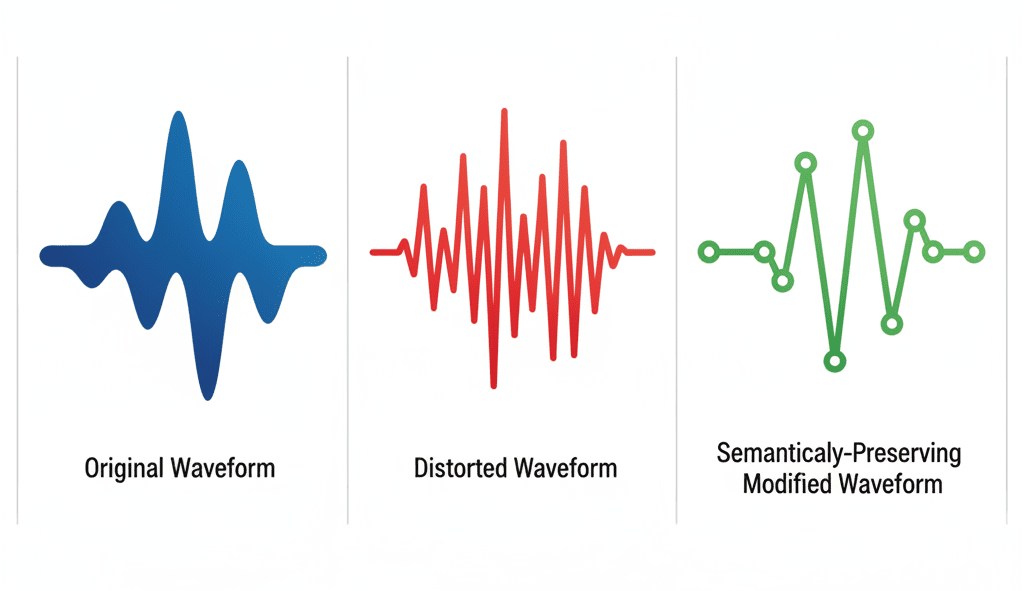
Traditional signal-level transformations are easy to implement but offer superficial variation. Adding Gaussian noise or slightly changing pitch may increase dataset size, but in our use case, such modifications risk destroying the semantic characteristics of distinct dog sounds like barks, yips, growls, or eating noises. Since edge systems often include denoising or noise suppression pipelines, these artificially modified clips could be filtered out or misrepresented, rendering them ineffective for training robust models.
Spectrogram-level manipulations provide more sophisticated transformations but are generally class-agnostic and don't guarantee preservation of subtle characteristics specific to animal sounds. Generative models like GANs, VAEs, or full-scale diffusion approaches have potential but come with practical limitations, they typically require large datasets to learn meaningful distributions, are computationally expensive, and often need class conditioning. In our context, with a small, unlabeled dataset, these methods risk producing outputs that don't align with the specific types of dog sounds we need, or are unstable and noisy for edge deployment.
Our approach, latent audio-to-audio diffusion using a pretrained codec, addresses these challenges. By operating in the latent space of a pretrained autoencoder, it generates synthetic audio that's semantically faithful to the original clips while introducing controlled, realistic variation. It doesn't rely on adding arbitrary noise, altering pitch, or class labels. Instead it creates new variations that maintain the specific identity of each sound type.
Positioning our approach
For edge deployments the goal is clear: generate synthetic audio that preserves semantic content, bark, yip, eating sound, growl; maintain compatibility with edge noise suppression; and operate effectively on limited datasets.
The adopted strategy is latent audio-to-audio augmentation via pretrained audio codecs and latent-space diffusion models. A pretrained audio autoencoder, or codec, maps waveform into a compact latent representation, preserving temporal and spectral structure while acting as a denoiser and dimensionality reducer. Latent-space diffusion introduces controlled variations in latent space, generating semantically similar but non-identical audio, avoiding direct waveform perturbation to ensure denoiser compatibility.
This method merges data efficiency with semantic fidelity, producing augmented audio that's ready for edge inference pipelines. The approach leverages pretrained neural audio codecs, frozen during augmentation, ensuring the system doesn't overfit or drift from real audio statistics. The audio is mapped into a latent representation capturing both frequency and temporal structures. A lightweight 1D UNet diffusion model operates in this latent space, learning to reconstruct clean latents from slightly perturbed ones. This method avoids large-scale GANs or raw waveform diffusion, making it trainable on small datasets.
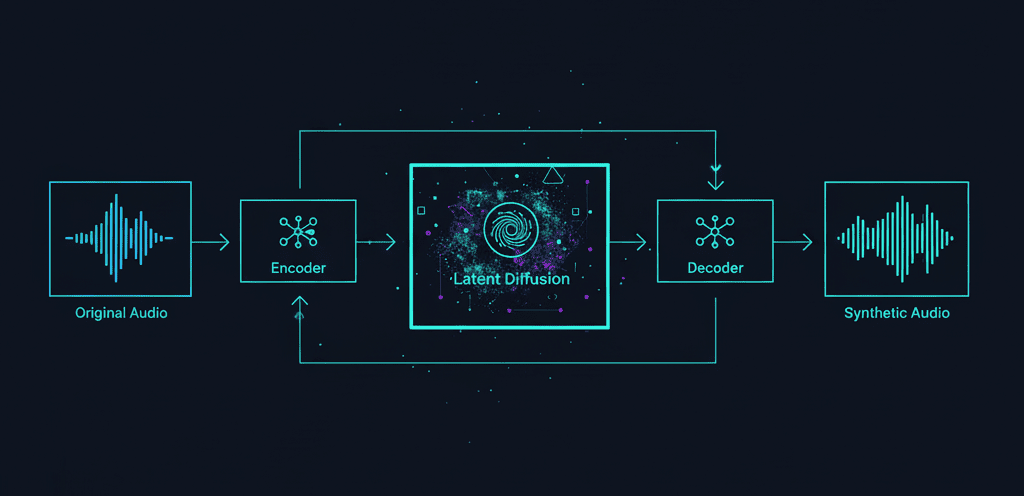
Key design principles: latent-space augmentation ensures variations are semantically consistent and survive noise-suppression pipelines. Audio-to-audio diffusion starts from an existing latent rather than pure noise, focusing on controlled variability rather than generative novelty. Segment-level training breaks audio into temporal windows, multiplying effective dataset size without introducing artificial artifacts. Inference strategy produces multiple synthetic variants per original clip, balancing dataset expansion with semantic fidelity.
Impact on edge models
By introducing realistic variations, the student model generalises better to new acoustic environments, avoids overfitting to limited training samples, and enhances prediction accuracy for rare or subtle events, like soft yips or eating noises.
Key takeaways
- Audio augmentation is critical for improving edge AI robustness.
- Traditional methods often fail in small datasets or denoised environments.
- Latent audio-to-audio diffusion provides a data-efficient, semantically faithful alternative.
- Pretrained audio codecs plus latent-space diffusion allow controlled variability without compromising signal quality.
- Edge AI systems benefit from improved generalization, reduced overfitting, and deployment-ready synthetic data.
- This approach demonstrates a pragmatic intersection of generative modeling and edge ML, bridging data scarcity and real-world robustness.