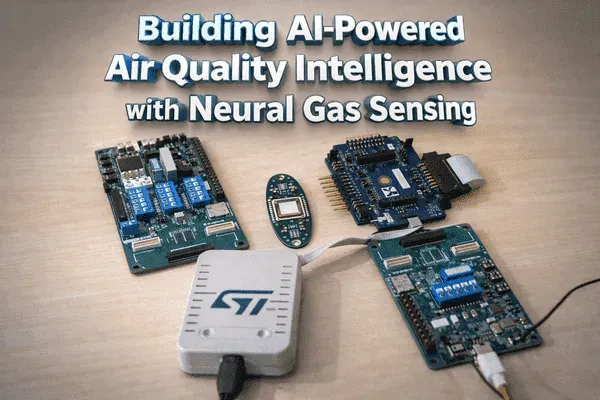
Building AI-Powered Air Quality Intelligence with Neural Gas Sensing
Indoor air quality monitoring has evolved from simple threshold detection to intelligent pattern recognition. While traditional sensors measure concentration levels, the latest AI-powered gas sensing technology can distinguish between different gas compositions, like differentiating cooking smoke from chemical vapors or detecting bacterial growth through volatile sulfur compounds.
This post walks through implementing an AI-driven indoor air quality monitoring system using neural gas sensing, multi-sensor fusion, and edge computing, examining how gas sensors with integrated machine learning can shift environmental monitoring from reactive detection to predictive intelligence. Traditional air quality sensors give limited context about gas sources, need frequent calibration, and can't adapt to specific environmental conditions without extensive manual tuning.
The neural gas sensing approach
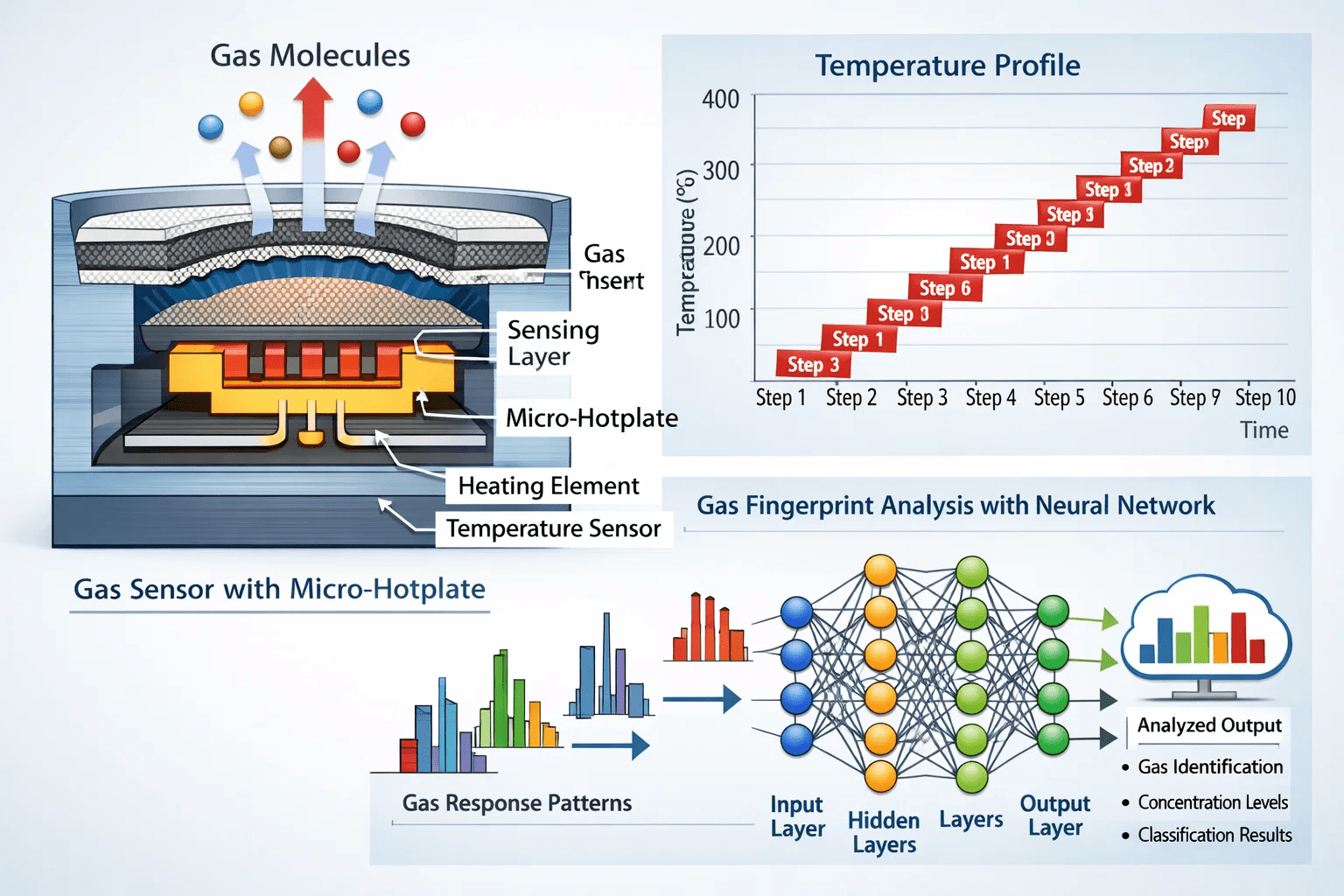
Modern AI-enhanced gas sensors create unique "fingerprints" for different gas compositions, rather than just measuring resistance changes the way conventional metal-oxide sensors do. The technology uses a micro-hotplate cycling through precisely controlled temperature profiles, up to 10 distinct temperature steps with 140-millisecond timing precision. Each step creates different surface chemistry conditions on the sensing element, generating unique electrical signatures for various gas mixtures:
Temperature Profile Example:
Step 1: 200°C (280ms) -> Measure volatile organics
Step 2: 300°C (420ms) -> Detect sulfur compounds
Step 3: 350°C (560ms) -> Analyze combustion gases
...continuing through 10 optimized steps
The AI training process follows a standard pattern: collect gas measurements across different environmental conditions, label them against known sources (cooking, cleaning, outdoor pollutants), train classification algorithms on the collected fingerprints, and export the trained models as configuration files for embedded deployment. The result is a sensor that can distinguish cooking vapors from chemical cleaning products, normal respiration CO2 from combustion gases, or early fire indicators from cigarette smoke.
Multi-sensor fusion architecture
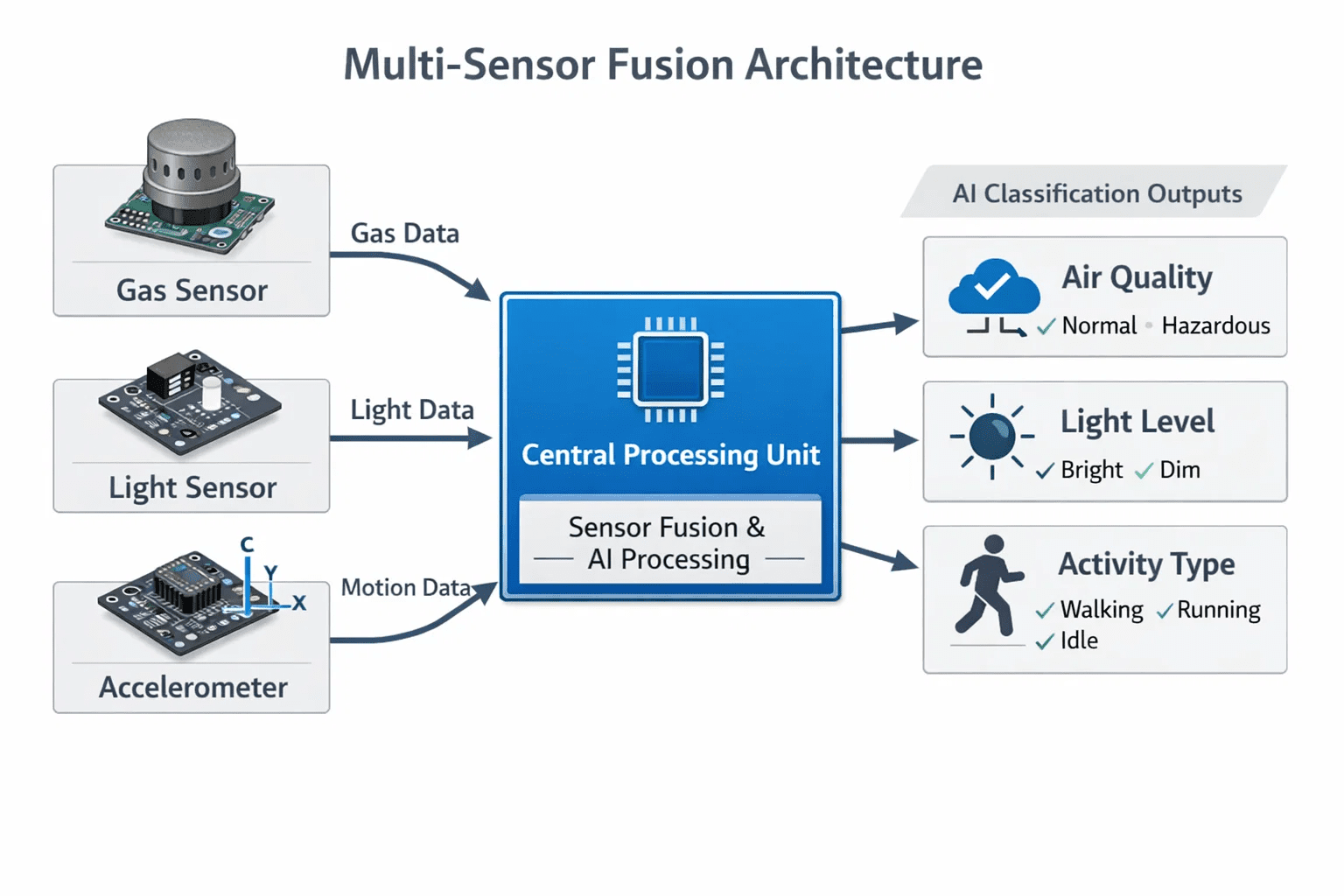
Single-sensor approaches miss important contextual information. A useful air quality system needs sensor fusion to understand occupancy patterns, environmental conditions, and behavioral context.
The core sensor integration combines a gas sensing module with PPB-level sensitivity for VOCs, VSCs, CO, and hydrogen, environmental compensation for temperature and humidity drift, and real-time baseline correction every 60 seconds; an ambient light sensor spanning 0.01 to 83,000 lux with automatic scaling, human eye spectral response matching around 550nm peak sensitivity, and interrupt-driven occupancy detection; and motion and vibration sensing through a three-axis accelerometer with selectable ranges, wake-up and free-fall detection, and FIFO buffering for pattern analysis without host intervention.
The fusion algorithm combines strategies: early fusion concatenates all sensor streams for comprehensive pattern recognition, feature-level fusion extracts temporal and spatial patterns from each sensor independently, and decision-level fusion combines individual sensor classifications through ensemble methods. Multi-sensor fusion approaches have been shown to meaningfully outperform single-sensor occupancy detection in published research.
typedef struct {
    float gas_resistance;
    uint32_t light_lux;
    int16_t accel_xyz[3];
    float temperature;
    float humidity;
} sensor_data_t;

// Fusion algorithm processing
fusion_result_t process_sensor_fusion(sensor_data_t* data) {
    // Environmental compensation
    float compensated_gas = apply_temp_humidity_correction(data);

    // Pattern recognition
    occupancy_state_t occupancy = analyze_movement_light_patterns(data);
    air_quality_class_t aq_class = classify_gas_fingerprint(compensated_gas);

    return combine_classifications(occupancy, aq_class);
}
Edge AI implementation
Running AI algorithms directly on embedded hardware removes cloud dependencies and enables real-time decisions. Modern ARM Cortex-M0+ microcontrollers can run neural network inference while keeping power consumption very low. Our implementation runs on a 48MHz Cortex-M0+ with 256KB flash for model storage, 36KB RAM for inference, dual I2C interfaces for multi-sensor communication, and an FDCAN controller for building automation integration.
Edge deployment needs aggressive model optimization: quantization converts 32-bit floating-point weights to 8-bit integers, pruning removes redundant neural connections, and knowledge distillation trains smaller student networks from larger teacher models. On this hardware, gas classification inference runs in the low single-digit milliseconds with a modest active current draw, and the memory footprint including the BSEC library stays under 400KB. A development workflow moves from gas fingerprint collection through model export, edge compilation, and MCU deployment, generating optimized C code that integrates directly with existing firmware.
Building automation integration
Modern building automation needs standardized communication protocols for interoperability. Our implementation uses FDCAN for high-speed, reliable communication with HVAC infrastructure, compatible with BACnet as the primary building automation protocol, Modbus for industrial sensor networks, and custom protocols for real-time air quality streams.
This enables occupancy-based ventilation:
typedef struct {
    uint8_t room_occupancy;     // Detected person count
    float co2_equivalent;       // Air quality metric
    uint8_t gas_class;         // Classified gas source
    uint32_t timestamp;        // Event timing
} hvac_command_t;

void send_hvac_update(hvac_command_t* cmd) {
    // Encode FDCAN message
    fdcan_message_t msg = {
        .id = HVAC_AIR_QUALITY_ID,
        .data = serialize_hvac_command(cmd),
        .length = sizeof(hvac_command_t)
    };

    fdcan_transmit(&hfdcan1, &msg);
}
Predictive HVAC control built on this foundation delivers meaningful energy savings through occupancy-aware ventilation and reduced HVAC runtime, along with faster air quality response. Smart building features built on top include preemptive air cleaning that catches pollution sources before occupants notice, zone-based control that adjusts ventilation per room based on actual usage, predictive maintenance that monitors air filter efficiency through particle detection, and emergency response for rapid gas leak or fire detection.
Real-world implementation challenges
Gas sensors face real deployment challenges. Metal-oxide sensors drift from temperature and humidity variation, sensor aging over months, and cross-sensitivity to interfering gases. We compensate through automatic baseline correction, continuous background monitoring during unoccupied periods, polynomial curve fitting for gradual drift, and environmental parameter compensation matrices; machine learning drift compensation, applying environmental corrections and Kalman-filtered baseline drift modeling on top; and cross-validation against certified reference gases with statistical process control for drift detection and automated recalibration scheduling.
# Pseudo-code for drift correction
def compensate_sensor_drift(raw_reading, environmental_data, time_series):
    temp_corrected = apply_temperature_correction(raw_reading, environmental_data.temperature)
    humidity_corrected = apply_humidity_correction(temp_corrected, environmental_data.humidity)

    baseline_drift = predict_drift_kalman_filter(time_series)

    return humidity_corrected - baseline_drift
Field deployment also needs a burn-in period for new installations, careful placement away from direct airflow, heat sources, and contamination, and quarterly performance validation with annual recalibration.
Results
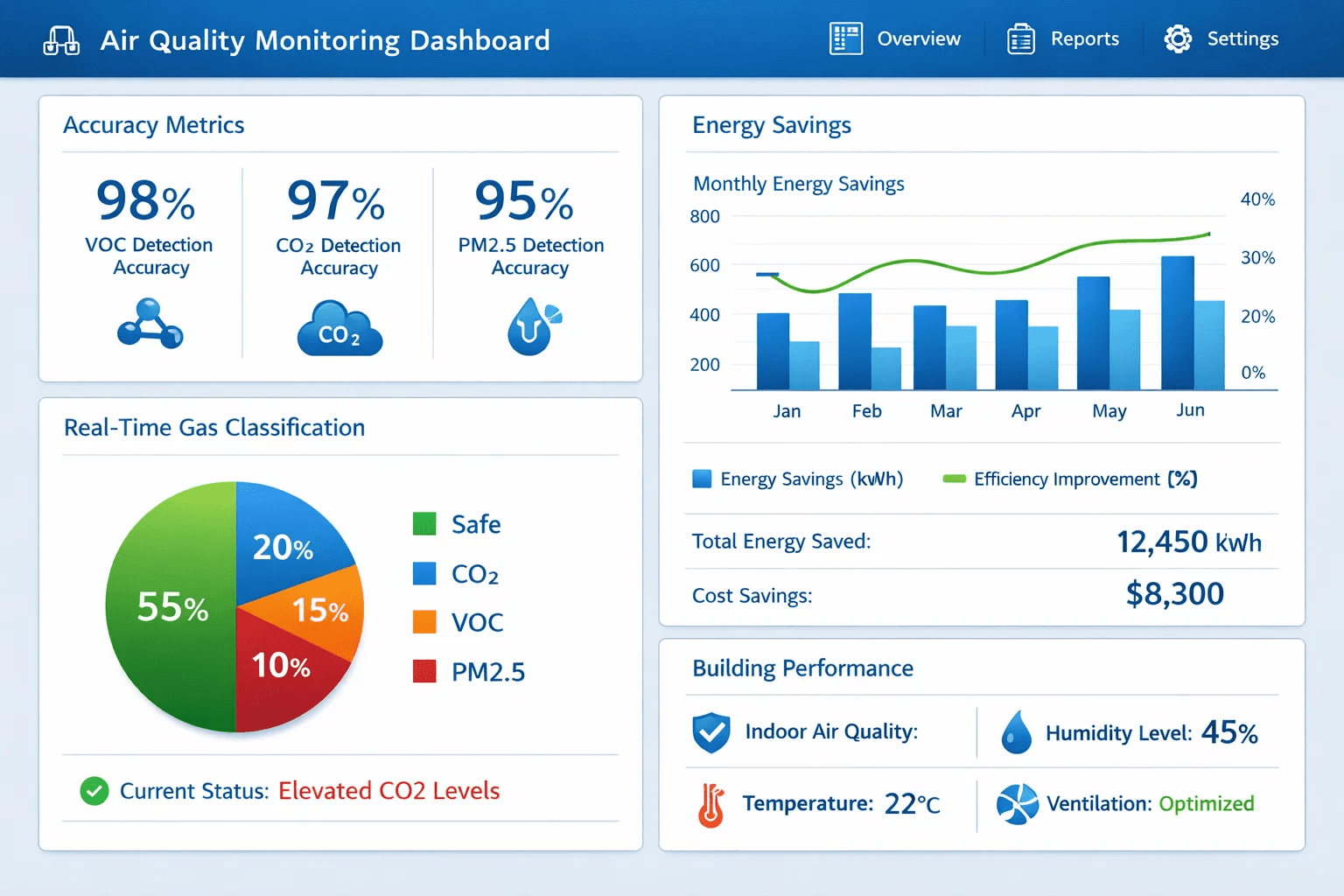
Gas source identification, occupancy detection, and air quality prediction all performed well against reference instrumentation across common indoor gas sources, and system performance held up with fast gas classification response, multi-day battery operation in low-power mode, and reliable FDCAN message delivery.
Why this connects to Hoomanely
This air quality work strengthens Hoomanely's mission of intelligent health monitoring through shared technology foundations. Edge AI plus sensor fusion is the same pattern whether you're processing air quality streams or physiological monitoring data, real-time processing of multiple sensor streams to extract meaningful patterns from complex environmental data. Predictive intelligence, the same machine learning approaches predicting HVAC needs from air quality patterns, can identify health trends from physiological data. And the physical intelligence ecosystem, the multi-device coordination proven in building automation, strengthens our interconnected smart device strategy for pet health.
Key takeaways
Neural gas sensing enables gas source classification beyond simple concentration measurement. Multi-sensor fusion meaningfully improves accuracy over single-sensor approaches. Edge AI deployment provides real-time intelligence without cloud dependencies. And FDCAN integration enables seamless building automation connectivity. Gas fingerprinting needs real training data per environmental condition, sensor drift compensation is critical for long-term deployment, and edge AI optimization can hit a small memory footprint with fast inference when done carefully.