Building Reliable USB-Powered IoT Devices: A Repeatable Method
At Hoomanely, USB isn't just a connector, it's a critical part of the power architecture. Almost every product we build uses USB for one or more purposes: powering the device, configuring firmware, transferring logs or data. But USB is more than a port, it defines an electrical relationship between two devices, who supplies power, who consumes it, and how much current is allowed.
With USB-C and USB Power Delivery, voltages can increase and current levels can scale dynamically. That means USB isn't just plug and play, it's negotiate, monitor, and protect. Across our products, from 5V at 500mA sensor nodes to 15V at 1A hubs and OTG devices, our approach stays the same: USB becomes universal when designed with clear intent and engineering discipline.
USB roles decide the electrical design
Every USB port has a clearly defined role dictating how power and data flow. A USB Host initiates communication and provides power to the peripheral. A USB Device responds but never initiates, receiving power from the host. USB OTG can switch roles dynamically. Our rule at Hoomanely: IoT sensors and low-power nodes are always USB Device, since they only need power and configuration from a PC. Gateways and hubs at medium power are USB Host or OTG, since they need to manage other devices like USB sticks or peripherals. We lock this decision before PCB layout, because changing later means redesigning schematic power paths, PD or role negotiation, and load switches and limits.
Power delivery and current limits
Most USB failures come from ignoring this. USB-PD can deliver up to 100W, but USB only gives you what you negotiate. We design devices to operate safely at USB device mode current of 500mA or less by default, and extended mode of 1A or more only when negotiation succeeds. Our initialization sequence starts below 100mA, the USB spec's pre-enumeration limit, then enumerates and declares required current, only then drawing 500mA, 1A, or PD power. At 500mA under USB 2.0, operation is always safe for basic function. At 1A under USB Host, OTG, or fast charge, we unlock performance mode when negotiated. Under USB-PD, when supported, we can draw up to 100W for high-load peripherals. The rule: never assume the port will behave, negotiate or downgrade gracefully.
Safety and protection
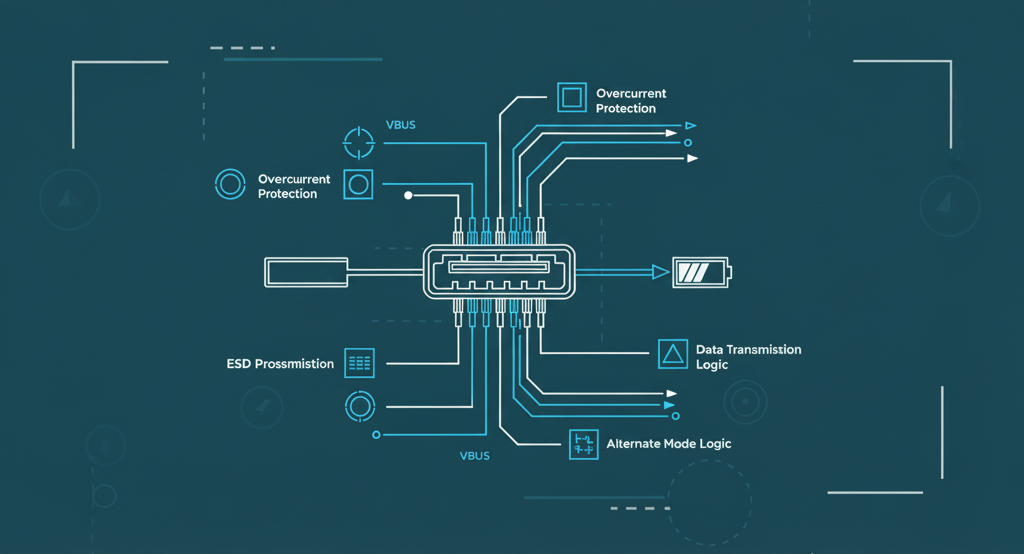
USB ports are exposed to real humans, not datasheets. They face ESD from human touch, bad chargers with overvoltage output, cable shorts causing overcurrent, and inrush spikes as capacitors charge on plug-in. Our USB protection stack is always the same: soft-start plus limited VBUS capacitance against inrush current resetting the port on plug-in; a load switch with current limit at 500mA or 1A against melted traces or damaged connectors from overcurrent; overvoltage lockout plus a Zener clamp plus a PD controller against cheap chargers outputting 9-12V; and low-capacitance TVS diodes within 5mm of the port against ESD events killing USB data lines. Since adopting this stack, we've had zero USB field failures.
Clear labeling prevents misuse
The number of hardware issues that are really user confusion is unbelievable, so every USB port on our PCB is labeled with its type and rated power, for example "USB-C (Device), 5V 500mA Max." Silkscreen prevents 90% of user-induced failures.
Validation: if it doesn't survive, it doesn't ship
Before production, we stress-test USB against bad chargers, cheap cables, hot-plug cycles exceeding 1000 insertions, ESD at plus-or-minus 8kV contact and plus-or-minus 15kV air, overvoltage by intentionally feeding 12V into a USB input, and overcurrent through a short-to-ground test. If USB survives every bad scenario in the lab, it will survive the customer.
Final takeaways
Decide the USB role early, host versus device defines everything downstream. Respect power negotiation, never draw more than 100mA before enumeration. Protect the port, TVS, current limit, OVLO, and soft-start are mandatory, not optional. Label the port, if a user can guess wrong, they will. And test for failure, not success, USB reliability is earned in validation. USB becomes universal only when the engineer makes it predictable.