
Circular Buffer Wrap-Around: Elegant Mathematical Mastery
When data flows faster than it can be processed, efficient buffering becomes the backbone of responsive embedded systems. At the core of high-performance IoT devices sits a simple but powerful idea: the circular buffer wrap-around technique, which turns a fixed block of linear memory into something that behaves like endless storage.
The mathematical foundation
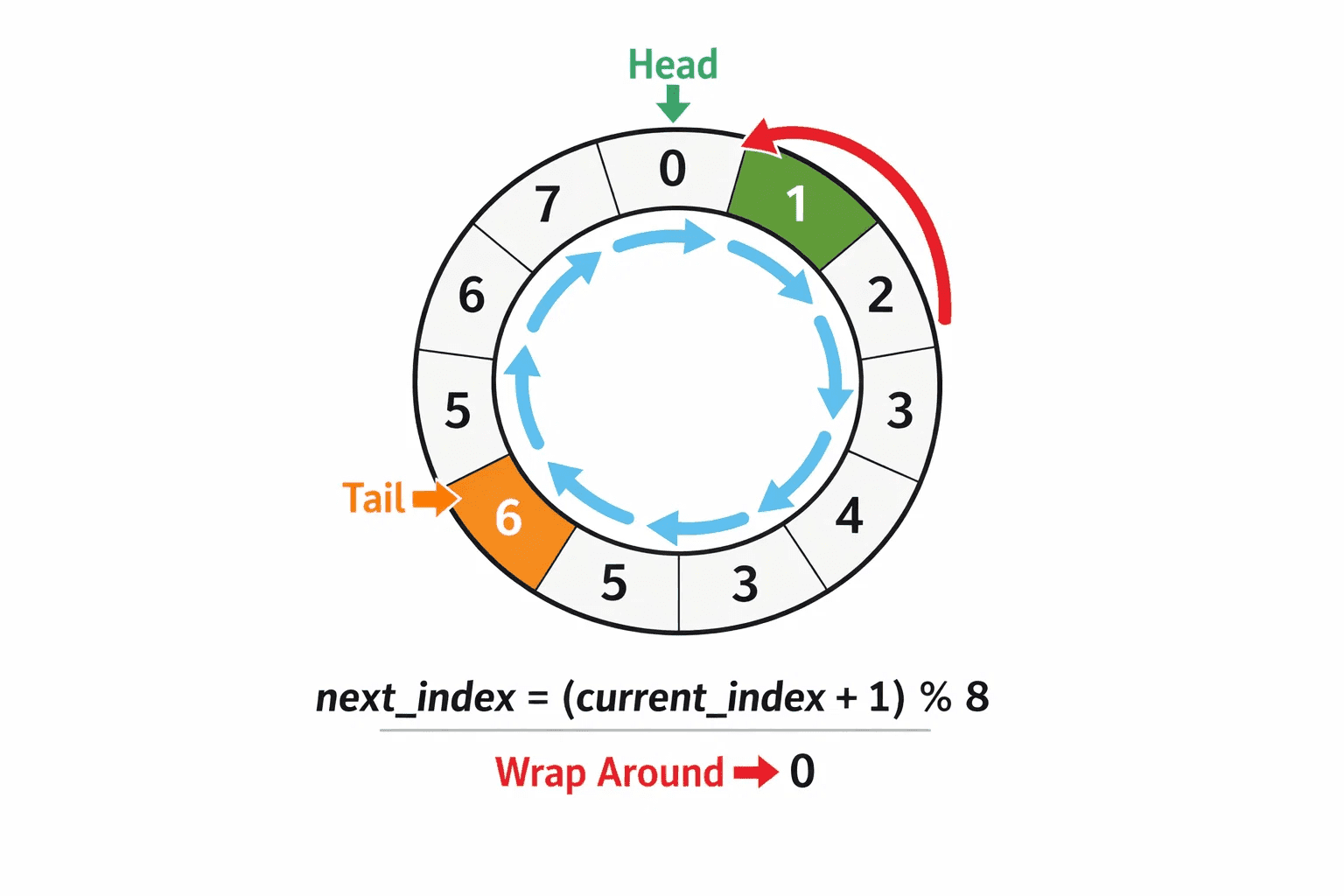
In embedded systems handling continuous data streams, from thermal sensors capturing temperature grids to high-speed camera interfaces processing frame buffers, the challenge isn't just storing data efficiently, it's managing memory boundaries with precision. The modulo operation (index + 1) % MAX_SIZE looks deceptively simple, yet it underlies some of the most reliable data management patterns in embedded firmware.
Real-world implementation: storage management
A thermal imaging system that must continuously capture, store, and transmit temperature data without losing information is a good example. The storage manager implements circular buffering at the entry level:
// Elegant index management with mathematical precision
if (storage_mgr.circular_buffer_active) {
    allocated_entry_index = storage_mgr.next_entry_index;
    storage_mgr.next_entry_index =
        (storage_mgr.next_entry_index + 1) % MAX_TABLE_ENTRIES;
}
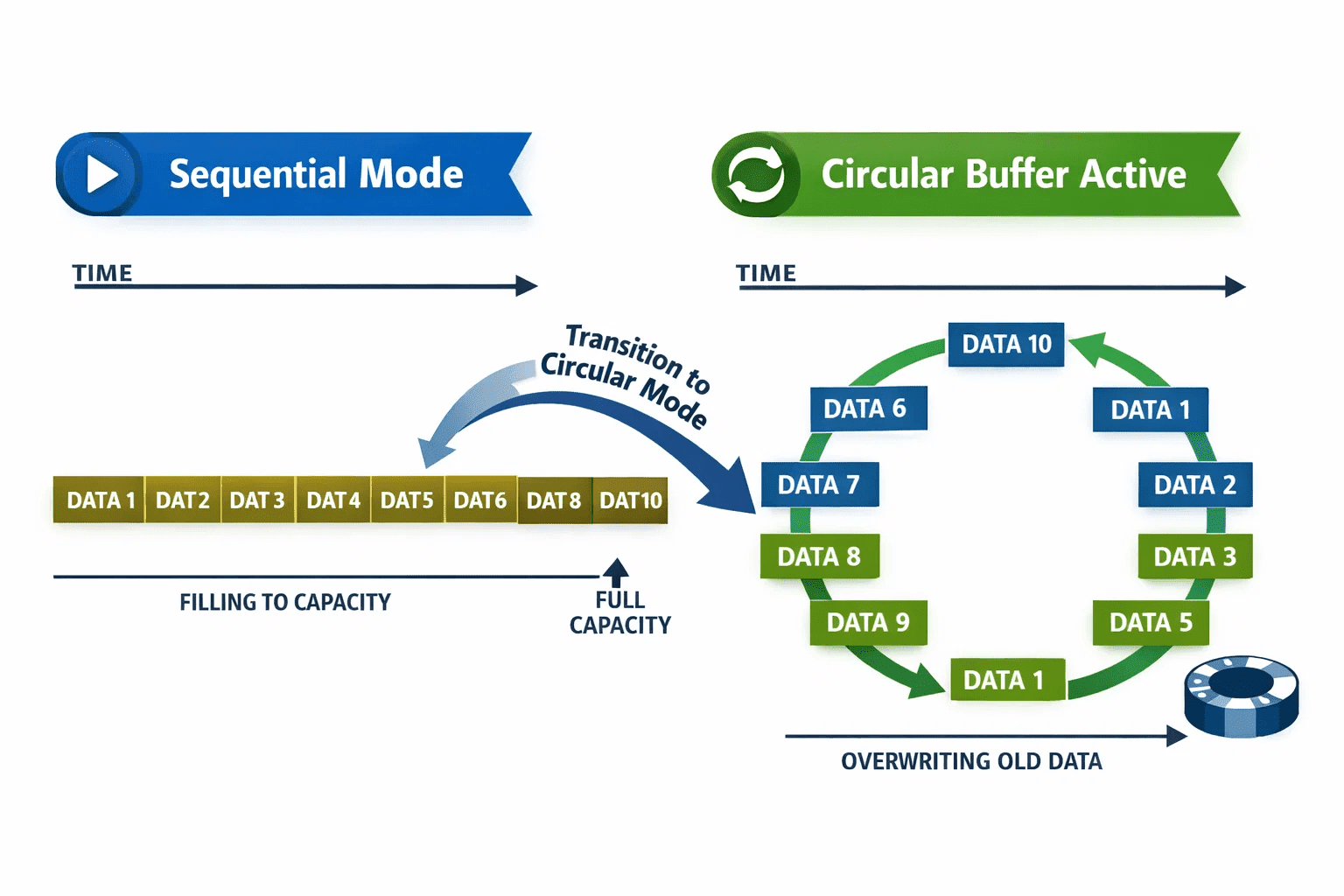
This is where 5,000 table entries become an effectively continuous stream through modulo arithmetic. When the buffer reaches entry 4,999, the next write wraps seamlessly to entry 0, with no memory reallocation or data copying involved. The system automatically transitions from sequential mode to circular mode once storage capacity is reached.
Hardware-level circular buffers: DMA
Beyond software, modern microcontroller architectures implement circular buffering at the hardware level through DMA. High-performance camera interfaces use linked-list DMA with circular configuration:
// Hardware circular buffer configuration
handle_GPDMA1_Channel7.InitLinkedList.LinkedListMode = DMA_LINKEDLIST_CIRCULAR;
HAL_DMAEx_List_SetCircularModeConfig(&DCMI_Queue, &DCMI_Node1);
This hardware-accelerated approach eliminates CPU intervention during buffer wrap-around, since the DMA controller handles pointer wrap-around using dedicated hardware circuits. The dual-buffer architecture creates a ping-pong mechanism where one buffer fills while the other processes, with circular linking ensuring seamless transitions, which is what real-time imaging needs when frame drops aren't acceptable.
Bit manipulation for power-of-two sizes
When buffer sizes are chosen as powers of two, division-based modulo operations can be replaced with bitwise AND:
// Mathematical optimization: buffer_size = 2^n allows bit masking
#define BUFFER_SIZE_MASK (BUFFER_SIZE - 1)
next_index = (current_index + 1) & BUFFER_SIZE_MASK;
This turns a comparatively expensive division into a single-cycle bitwise operation, which matters under strict timing constraints.
Multi-dimensional circular buffering
More complex systems often need multiple independent circular indices running side by side. Thermal sensor arrays demonstrate this through chunk-based packet management:
// Multi-stream circular buffer management
static uint32_t packet_bitmap[3] = {0, 0, 0};  // Per-chunk tracking
static bool chunk_complete[3] = {false, false, false};
Each chunk maintains its own circular state while contributing to a larger reconstruction process, which supports fault-tolerant assembly where packet loss or reordering doesn't break the whole. The bitmap approach also gives cheap duplicate detection, useful over unreliable communication channels where the same packet might arrive more than once.
Sizing for memory efficiency
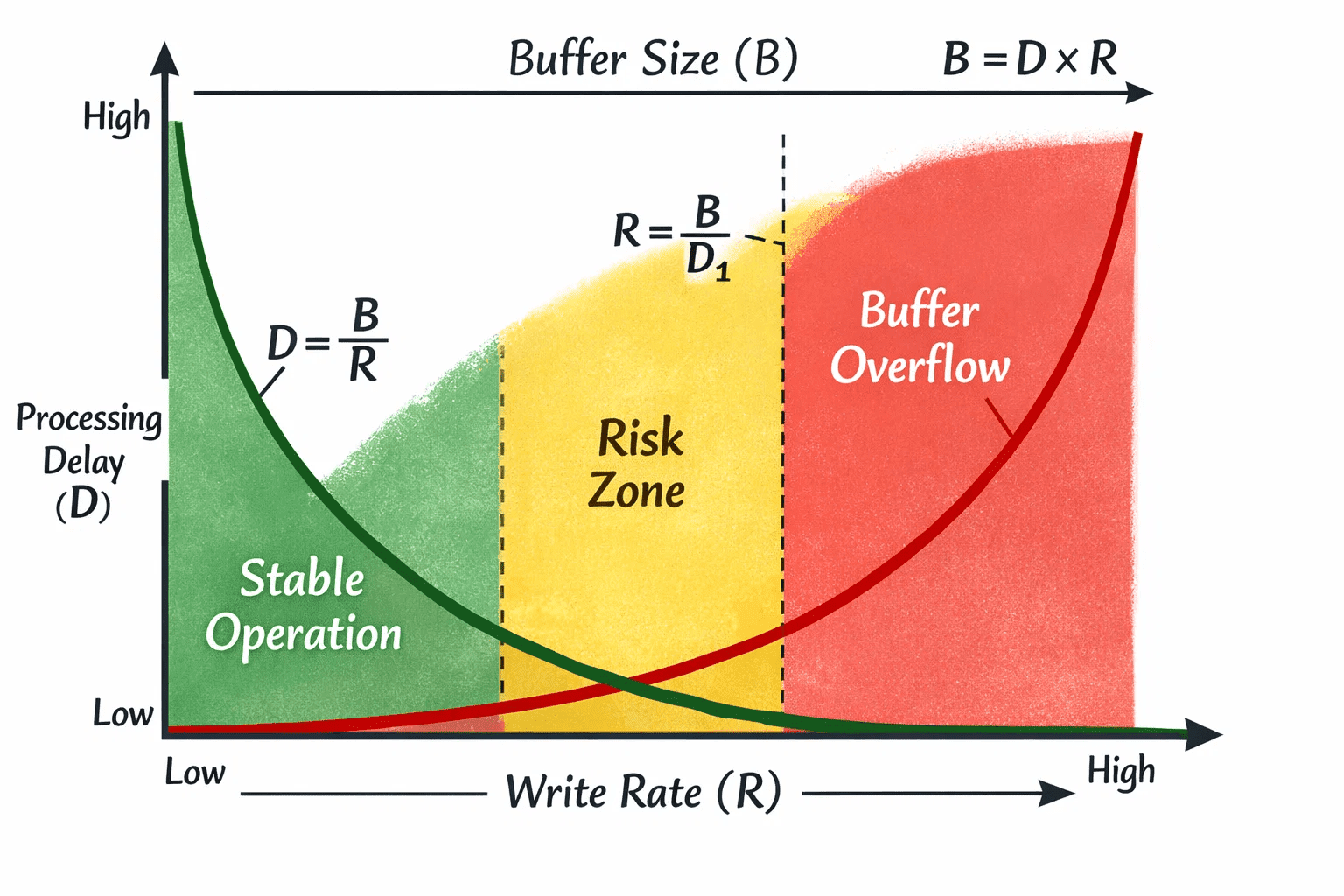
Circular buffers get their memory efficiency from a straightforward relationship between buffer size, write speed, and read speed: the buffer has to exceed the maximum difference between write and read positions during peak load. A reasonable rule of thumb is Buffer_Size >= (Write_Rate x Max_Processing_Delay) + Safety_Margin, which keeps the system stable while minimizing footprint in a resource-constrained environment.
Handling edge cases
Solid circular buffer implementations treat boundary conditions carefully: overflow protection through validated index math, underflow handling through empty-buffer detection based on pointer relationships, and state consistency through atomic index updates. A useful invariant is that (write_index - read_index) % buffer_size should always represent a valid data count, giving constant-time validation of buffer state.
Key takeaways
Circular buffer wrap-around is a small mathematical idea, the modulo operation, doing a lot of work under embedded constraints. Whether it's implemented in software for structured metadata, in hardware DMA controllers for zero-latency frame capture, or across multiple independent streams for fault-tolerant reconstruction, the underlying pattern stays the same: precise boundary math turns finite memory into something that behaves like continuous storage. At Hoomanely, these techniques run in production across our thermal imaging and IoT systems, where the elegance of the algorithm matters less than its reliability under real operating conditions.