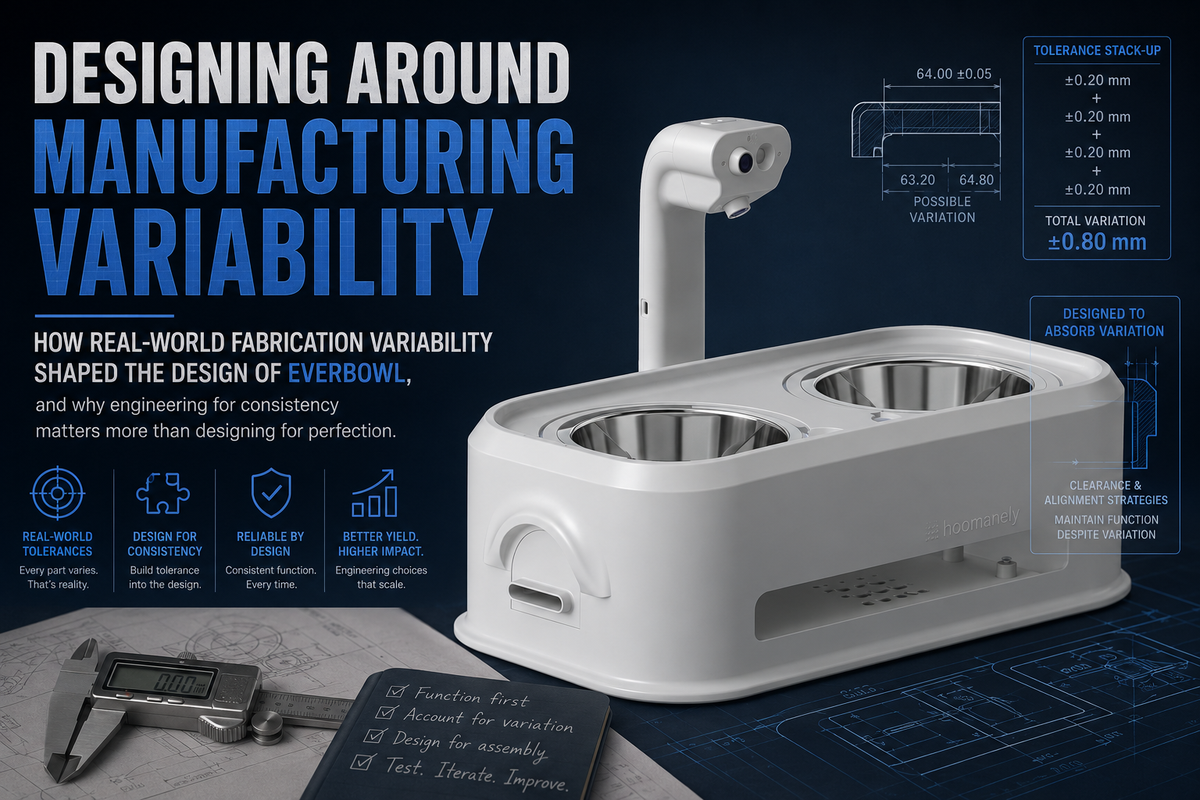
Designing Around Manufacturing Variability
How real-world fabrication variability shaped the design of Everbowl, and why engineering for consistency matters more than designing for perfection.
Introduction
Every CAD model starts out in a world of perfect geometry. Holes sit exactly where they're supposed to, surfaces are flat, and every dimension matches the drawing to the last decimal place. Manufacturing doesn't work that way.
Every fabrication process introduces variation. Vacuum-cast parts shrink slightly differently from mold to mold. FDM prints expand or contract depending on print orientation. Laser-cut sheet metal has kerf variation. Even painted surfaces add measurable thickness. None of that is a defect. It's just what manufacturing actually looks like.
Building 25 Everbowl units made it obvious pretty quickly that designing to nominal dimensions wasn't going to cut it. The challenge was never making one perfect unit. It was getting every unit to assemble, function, and perform consistently despite normal variation from part to part.
Trying to eliminate that variability isn't realistic. So instead we redesigned the product to tolerate it, which turned manufacturing from a source of uncertainty into something we could actually plan around.
Perfect parts don't exist
Manufacturing drawings specify nominal dimensions with allowable tolerances. Here's what that looked like on Everbowl:
| Feature | Nominal | Typical manufacturing variation |
|---|---|---|
| Vacuum-cast housing | 120.00 mm | ±0.30–0.50 mm |
| FDM printed bracket | 40.00 mm | ±0.20–0.40 mm |
| SLA component | 25.00 mm | ±0.05–0.10 mm |
| Laser-cut aluminum ring | 245.50 mm | ±0.10 mm |
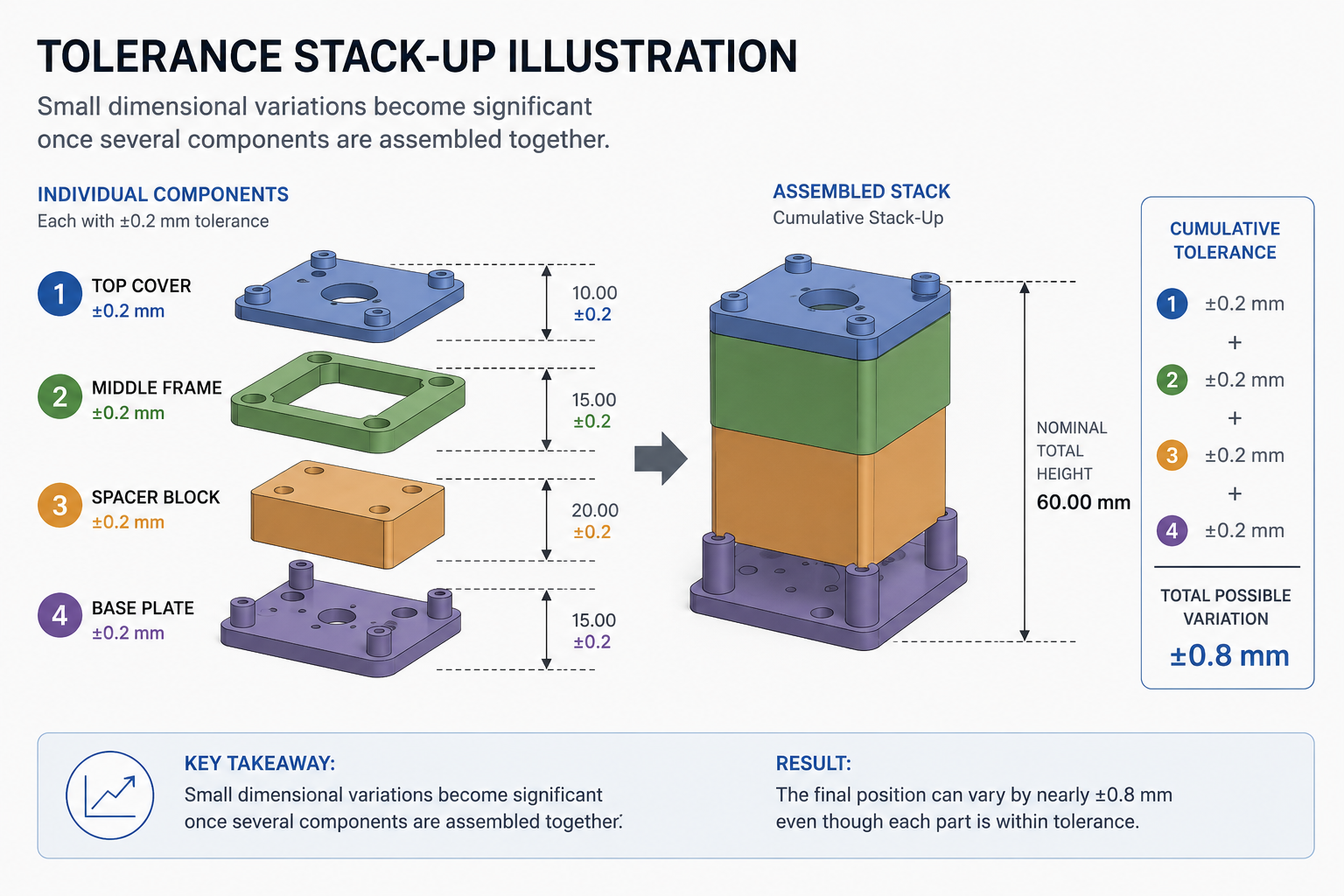
On their own, these numbers look small enough to ignore. But a product is an assembly, not a single part, and when several parts stack together their dimensional deviations add up. That's tolerance stack-up: a few tenths of a millimeter across several interfaces can turn into a full millimeter of misalignment, which is enough to throw off load cell positioning, fastener alignment, enclosure fit, sensor calibration, or just how clean the product looks.
For something like Everbowl, those small deviations weren't cosmetic footnotes. They fed directly into system performance.
Where we ran into manufacturing variability
Building one prototype hides a lot of variation that 25 units won't.
Vacuum-cast plastic components
Vacuum casting gave us good surface finish and repeatability, but we still saw dimensional drift caused by resin shrinkage, silicone mold aging, demolding stress, and cure conditions. Individual deviations stayed within spec, but parts from older molds noticeably took more effort to assemble than parts from a fresh mold.
Rather than chase tighter tolerances that weren't realistically achievable, we added a bit more clearance wherever alignment wasn't functionally critical, and kept precision reserved for the interfaces that actually needed it.
FDM printed parts
FDM stayed useful for fixtures, internal brackets, and design validation, but printed dimensions shifted with layer orientation, material choice (PLA vs. ABS), print temperature, and cooling. Holes tended to print undersized, and unsupported overhangs introduced small geometric distortion.
Instead of designing as if every print would come out exactly to spec, we designed mounting features around post-processing and sized holes based on what parts actually measured, not what the CAD file said.
Sheet metal laser cutting
The aluminum load-bearing rings needed tighter control than the printed parts. Laser cutting is repeatable, usually within ±0.1 mm, but kerf variation and thermal effects still nudged hole positioning, edge quality, and ring concentricity.
Since these rings carry load straight through the load cells, even a small geometric inconsistency here could shift sensor preload. So we referenced the critical interfaces from common datums instead of independent dimensions, which kept positional error from accumulating across the part.
Designing features that absorb variation
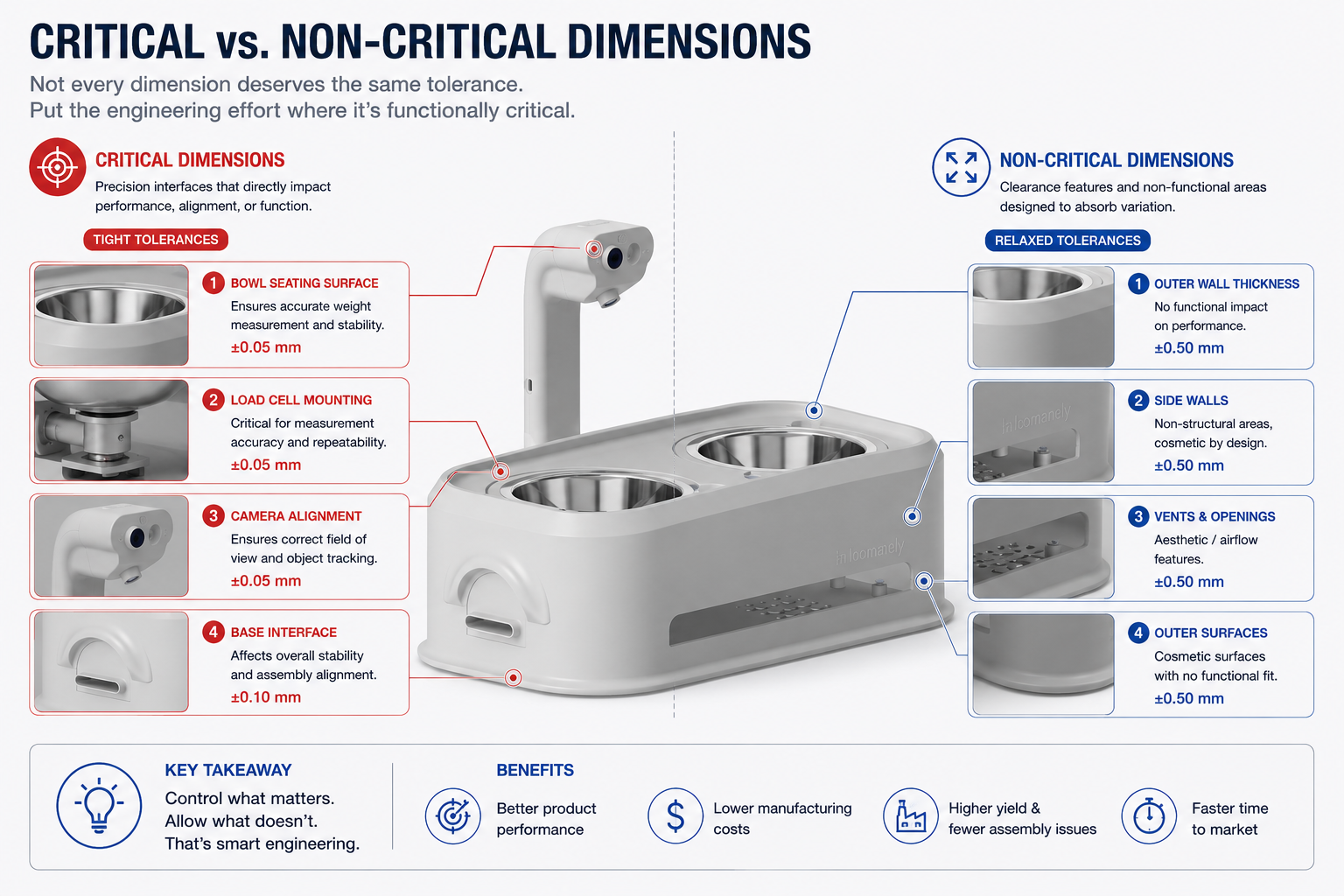
One of the bigger shifts between prototype and production wasn't better manufacturing. It was designing the product to accommodate the manufacturing we actually had. We split interfaces into two groups instead of treating every dimension the same.
Critical features directly affect performance: load cell mounting surfaces, aluminum ring interfaces, sensor reference planes, PCB locating bosses. These got the highest precision we could reasonably manufacture.
Non-critical features mostly affect assembly: cosmetic panel alignment, cable routing holes, internal ribs, cover clearances. Adding 0.3–0.5 mm of clearance here made assembly noticeably more consistent without touching function at all.
The result assembled reliably despite normal part-to-part variation, because it was designed to.
Designing for assembly, not just manufacturing
Dimensional variation rarely shows up as one obvious problem. It shows up as assembly getting harder in small ways: screw holes needing manual alignment, plastic parts needing extra force to seat, inserts sitting slightly proud, aluminum rings needing small positional nudges.
Each of those adds a few seconds. Multiply that by 25 units and it turns into hours of unnecessary effort.
Redesigning locating features and adding self-aligning geometry made a real difference here. The product stopped requiring perfect parts and started guiding imperfect parts into the right position on its own.
Yield improved through design, not inspection
The obvious response to manufacturing variation is to inspect parts more carefully. Inspection is good at catching defects. It doesn't reduce how often they happen.
What actually moved the needle was designing features that raised yield on their own. Here's what changed across our pilot build:
| Metric | Early builds | After design refinements |
|---|---|---|
| First-pass assembly success | ~78% | ~96% |
| Rework required | ~22% | ~4% |
| Assembly alignment issues | Frequent | Rare |
| Cosmetic rejection | Occasional | Minimal |
That improvement came from geometry changes, not tighter supplier specs. The product got easier to manufacture because it got easier to assemble correctly in the first place.
Manufacturing variability is a systems problem
The clearest lesson from this whole process: variability doesn't stay contained to one part. It propagates through the whole product.
A slightly oversized plastic housing feeds into load cell alignment, which feeds into sensor calibration, which feeds into assembly preload, which feeds into measurement accuracy, which is what the user actually experiences.
Once we started treating dimensional variation as a systems problem instead of a single manufacturing issue, we could go after the root cause instead of patching symptoms downstream.
How this shows up at Hoomanely
Building Everbowl taught us that manufacturing variability is inevitable, but an inconsistent product doesn't have to be. Understanding how fabrication choices ripple into mechanics, assembly, and sensing let us design hardware that stayed reliable even when individual parts landed within normal tolerance but not at nominal. We're not trying to squeeze impossible precision out of every process. We're trying to make the whole system resilient to the variation that's already there, and that's shaped how we approach scaling hardware beyond this one product.
Key takeaways
- Manufacturing variation is unavoidable. Design for it instead of fighting it.
- Tolerance stack-up gets worse as assemblies get more complex.
- Give tight tolerances to functionally critical interfaces, and let non-critical features absorb the slack.
- Self-aligning features cut down assembly time and rework.
- Better yield usually comes from design changes, not stricter inspection.
- Reliable products come from anticipating variability, not assuming parts will come out perfect.
Conclusion
The biggest mindset shift during Everbowl's development was realizing that manufacturing variability itself wasn't the problem. Unmanaged variability was. Every fabrication process introduces small dimensional differences, and those differences only get expensive when the design leaves no room for them.
Engineering assemblies that could tolerate realistic variation gave us a product that was easier to build, more consistent unit to unit, and more reliable in use. Robust product design was never about making perfect parts. It's about building a system that still performs the way it's supposed to when the parts going into it aren't.