Designing Fault Containment for Shared Modular Power Domains
Shared power makes modular hardware clean.
One carrier board can feed multiple sensor boards. One backplane rail can support several modules. One main supply can branch into compute, communication, sensing, audio, illumination, and auxiliary boards. The architecture looks efficient, serviceable, and scalable.
But shared power also creates shared failure paths.
A short on one module can collapse a rail used by other boards. A damaged connector can pull down the carrier supply. A failed sensor board can keep the main processor in reset. A peripheral rail can back-feed into an unpowered domain. A single fault can look like a total product failure even when most of the hardware is healthy.
That is the problem fault containment is meant to solve.
At Hoomanely, we do not treat modular power as only a distribution problem. We treat it as a containment problem. Every rail that crosses a board boundary should have a clear answer to one question:
If this module fails, how far does the failure travel?
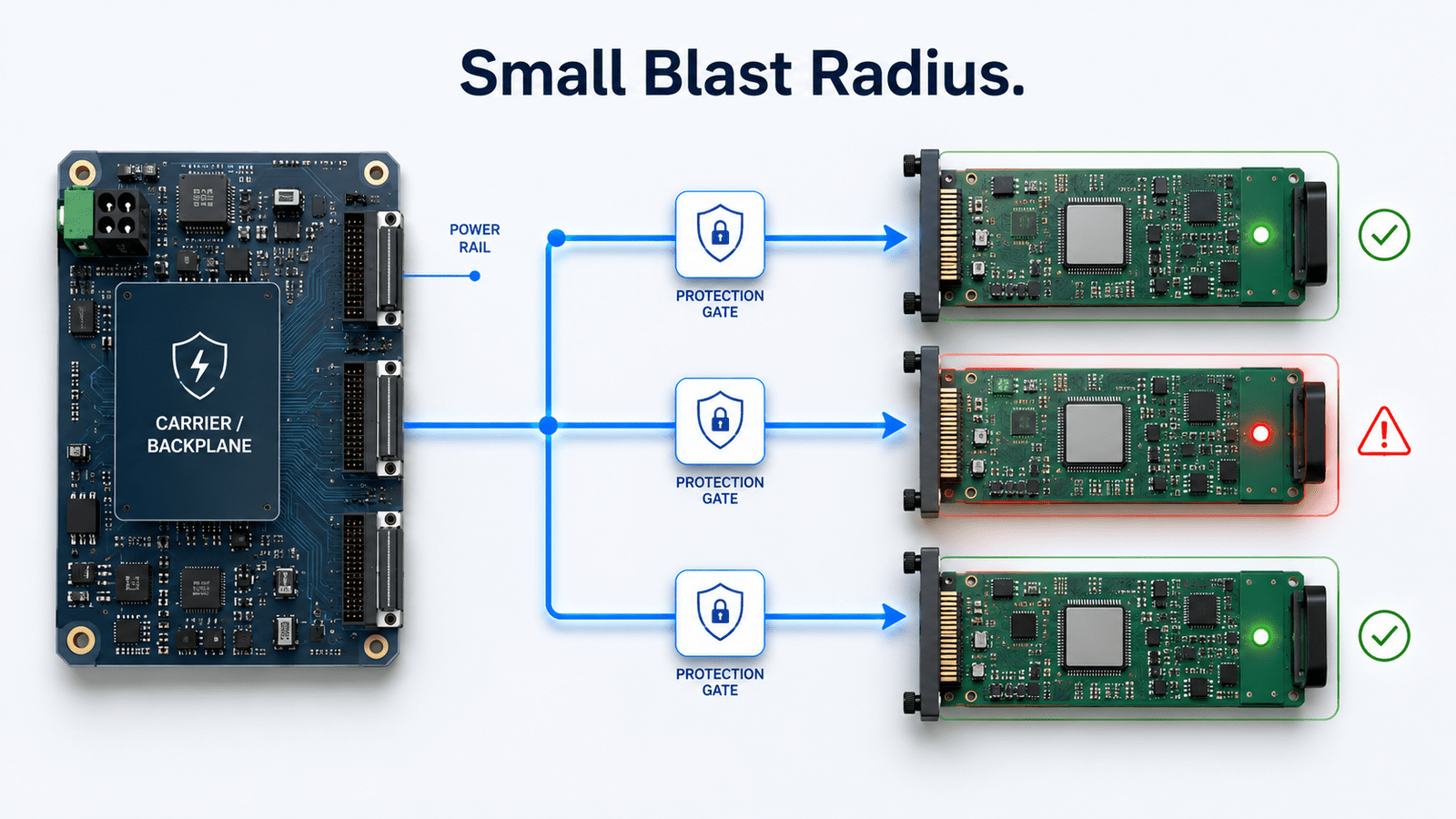
A good architecture keeps the blast radius small. A bad architecture lets one weak board take the whole product down.
Shared Rails Need Boundaries, Not Just Wider Copper
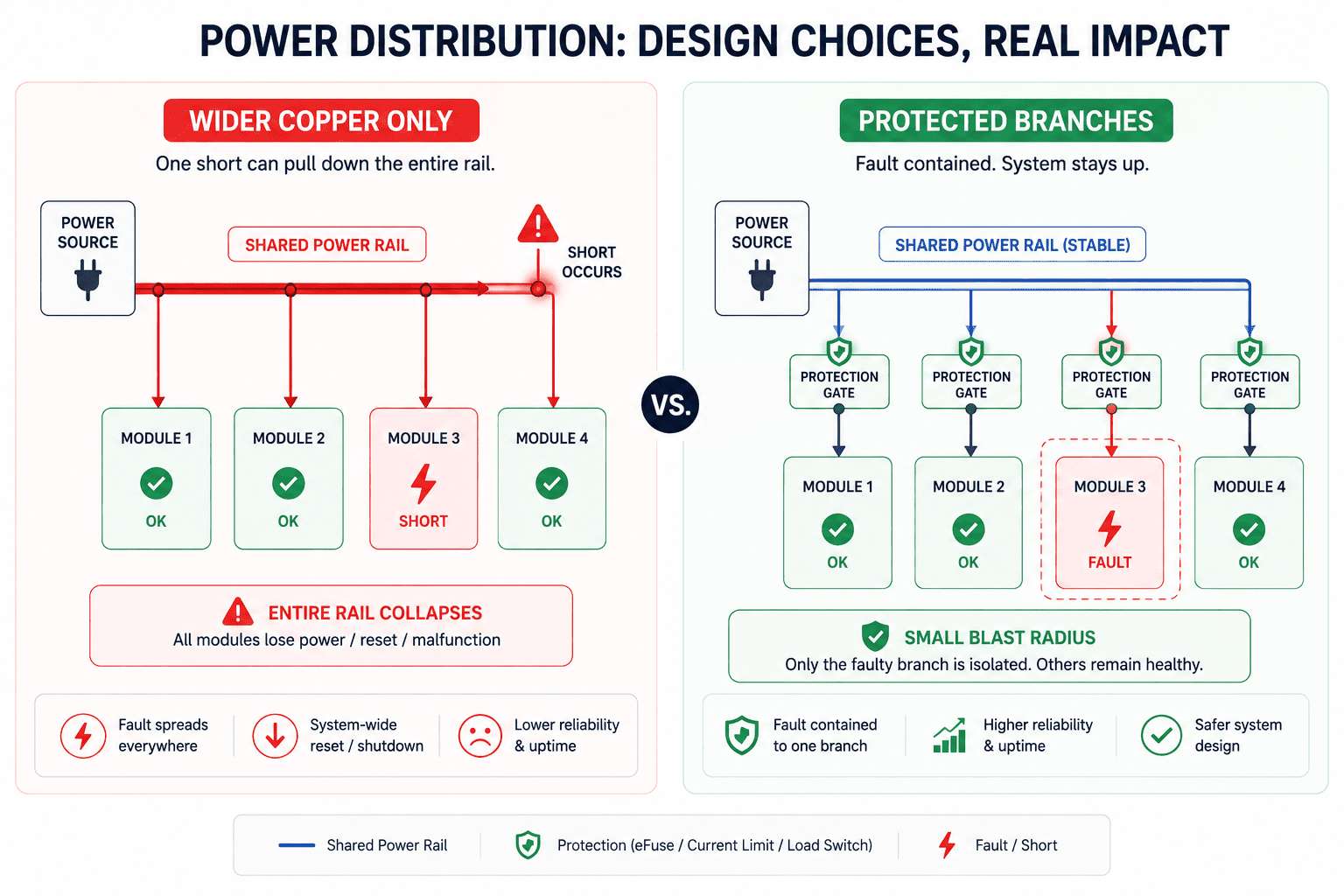
The first instinct in power design is often to make shared rails stronger.
Use wider traces. Add more copper. Increase connector current rating. Add more bulk capacitance. Choose a larger regulator. Reduce voltage drop.
Those choices matter, but they do not create fault containment by themselves.
A stronger shared rail can still be pulled down by a shorted module. A thicker power path can still deliver more fault current into a damaged board. A larger regulator can still heat, current-limit, or reset the entire system when one branch misbehaves.
Power strength and power containment are different design goals.
A shared rail should distribute power during normal operation, but it should not blindly feed unlimited energy into every connected load during abnormal operation. Each branch needs some form of boundary: current limiting, load switch control, eFuse behavior, series resistance, resettable protection, power-good feedback, or at minimum a measurable isolation point.
Without boundaries, a modular product is not truly modular electrically.
It is only physically modular.
Every Module Should Have a Defined Fault Budget
A module should not be allowed to fail in unlimited ways.
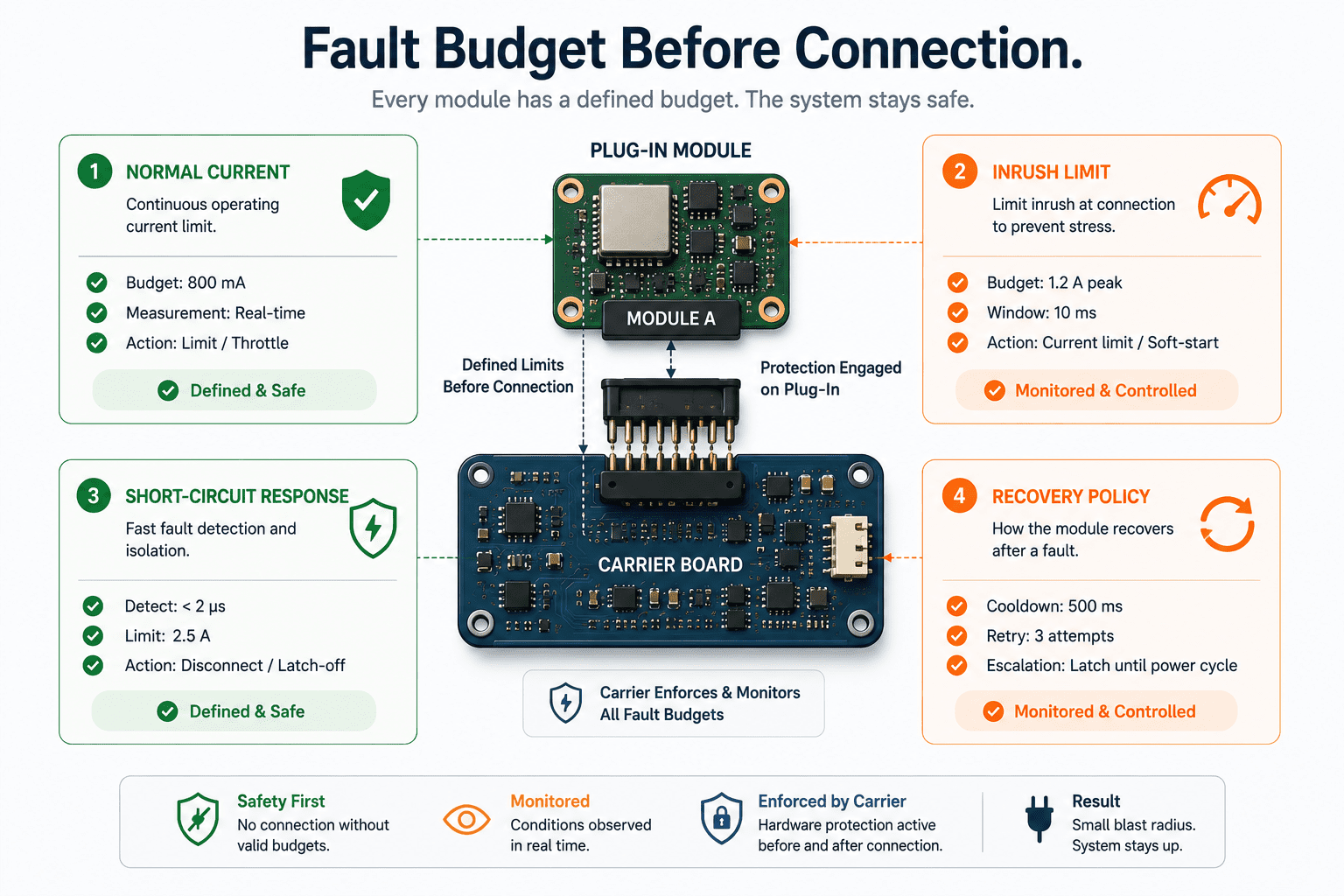
Before a board connects to a shared rail, the architecture should define its fault budget:
How much current may this module draw normally?
What is the maximum inrush allowed?
What happens if the module rail is shorted?
How long can the shared source tolerate the fault?
Does the fault latch off, retry, fold back, or stay current-limited?
Can the rest of the product continue operating without this module?
These questions sound simple, but they change the design.
A small sensor board may only need a limited current branch and a fault flag. A compute module may need staged power, soft-start, and aggressive fault reporting. A user-accessible connector may need stronger ESD, overcurrent, and reverse-current protection. A field-replaceable module may need presence detection and controlled re-enable.
The fault budget should be practical, not theoretical.
It should reflect the connector, cable, board copper, regulator capacity, enclosure thermal limits, service conditions, and the importance of that module to product operation.
At Hoomanely, we like to decide this before schematic routing begins. Once power rails are already shared everywhere, containment becomes much harder to add cleanly.
Branch Protection Is Better Than Global Panic
A common weak architecture protects only the main input.
There may be an input fuse, a TVS diode, a power switch, or a main regulator current limit. But after that, the rail branches directly to several modules.
This protects the product from some external faults, but it does not protect one module from another.
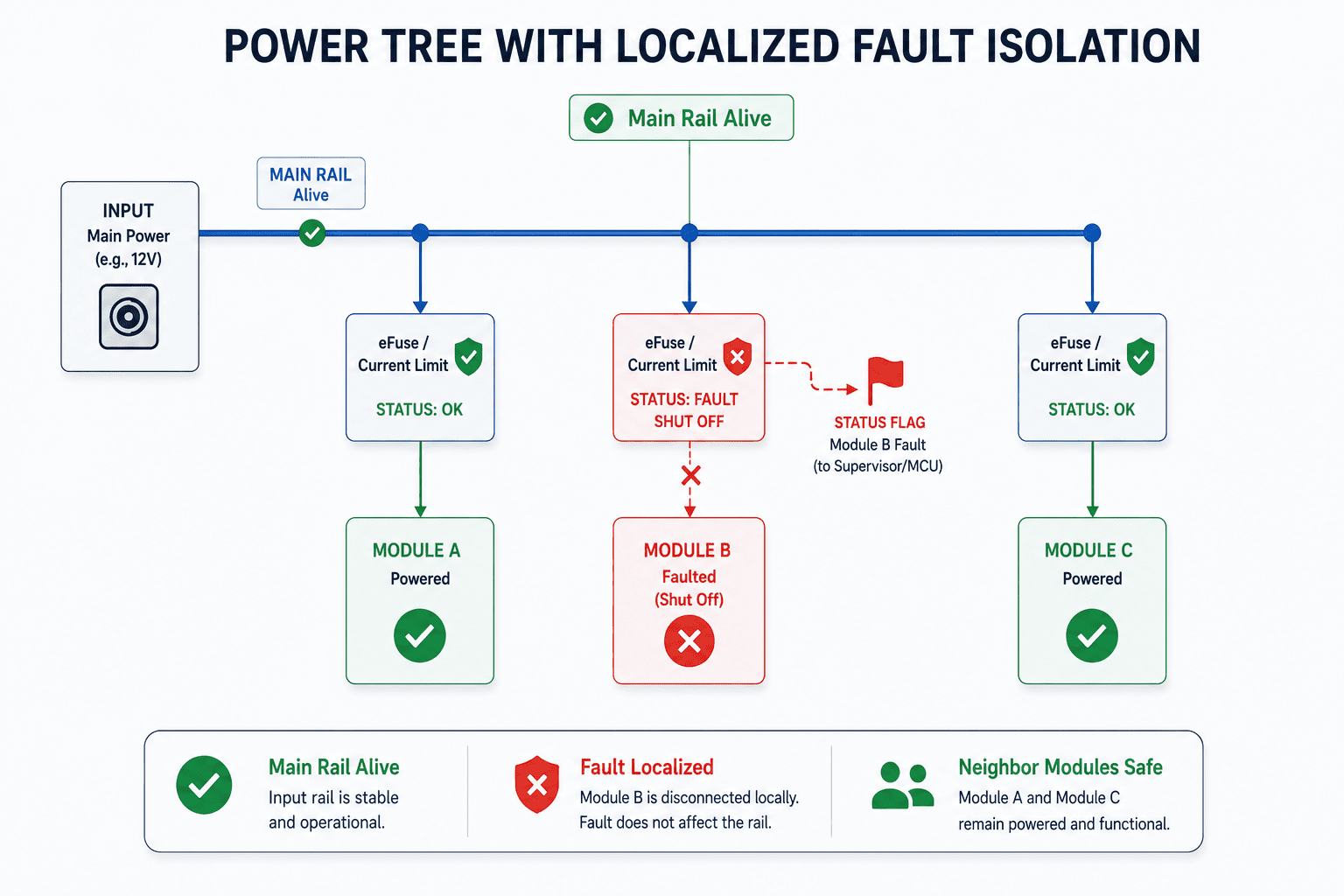
If module B shorts the shared 5 V rail, module A, module C, and the carrier board all experience the collapse. The main protection may respond eventually, but the entire product has already been disturbed.
A better architecture protects branches, not only the trunk.
Each important module branch should have a local protection behavior. That may be a current-limited load switch, eFuse, hot-swap controller, PTC, ideal diode, or controlled regulator enable. The goal is not to add unnecessary complexity to every net. The goal is to stop a local fault from becoming a global event.
Branch protection also improves diagnosis.
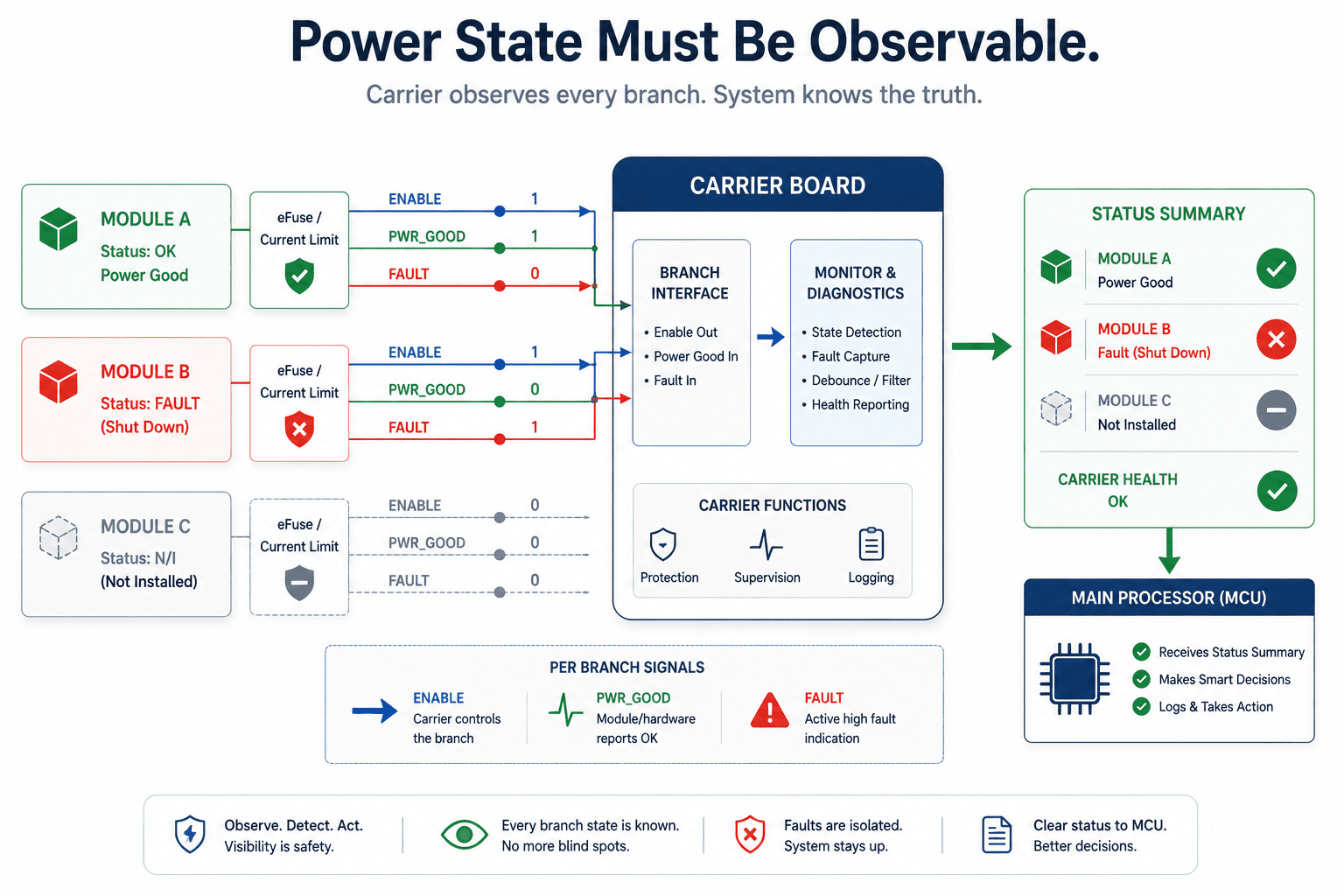
Instead of seeing “main power failed,” the system can see “module rail faulted.” That difference matters during bring-up, factory testing, and field service.
A system that can isolate the faulty branch can keep the rest of the product alive long enough to explain what happened.
Fault Containment Needs Power-Good Feedback
Protection without feedback is only half useful.
If a module branch current-limits or shuts down, the system should know it happened. Otherwise, the product may simply behave as if a board disappeared.
Power-good, fault, overcurrent, thermal warning, and enable-status signals are not luxuries in modular systems. They are observability paths.
A carrier board should be able to tell whether each downstream rail is valid. The main processor or supervisory controller should be able to distinguish between:
Module not installed.
Module installed but disabled.
Module enabled but rail not valid.
Module rail faulted.
Module powered but not responding.
These states should not all look the same.
At Hoomanely, we try to avoid “silent missing module” behavior. If a rail fails, the system should have enough hardware feedback to classify the failure before firmware starts guessing over I2C, SPI, UART, CAN, or GPIO.
Communication failure is often the symptom.
Power validity is often the reason.
Back-Feeding Breaks Containment Quietly
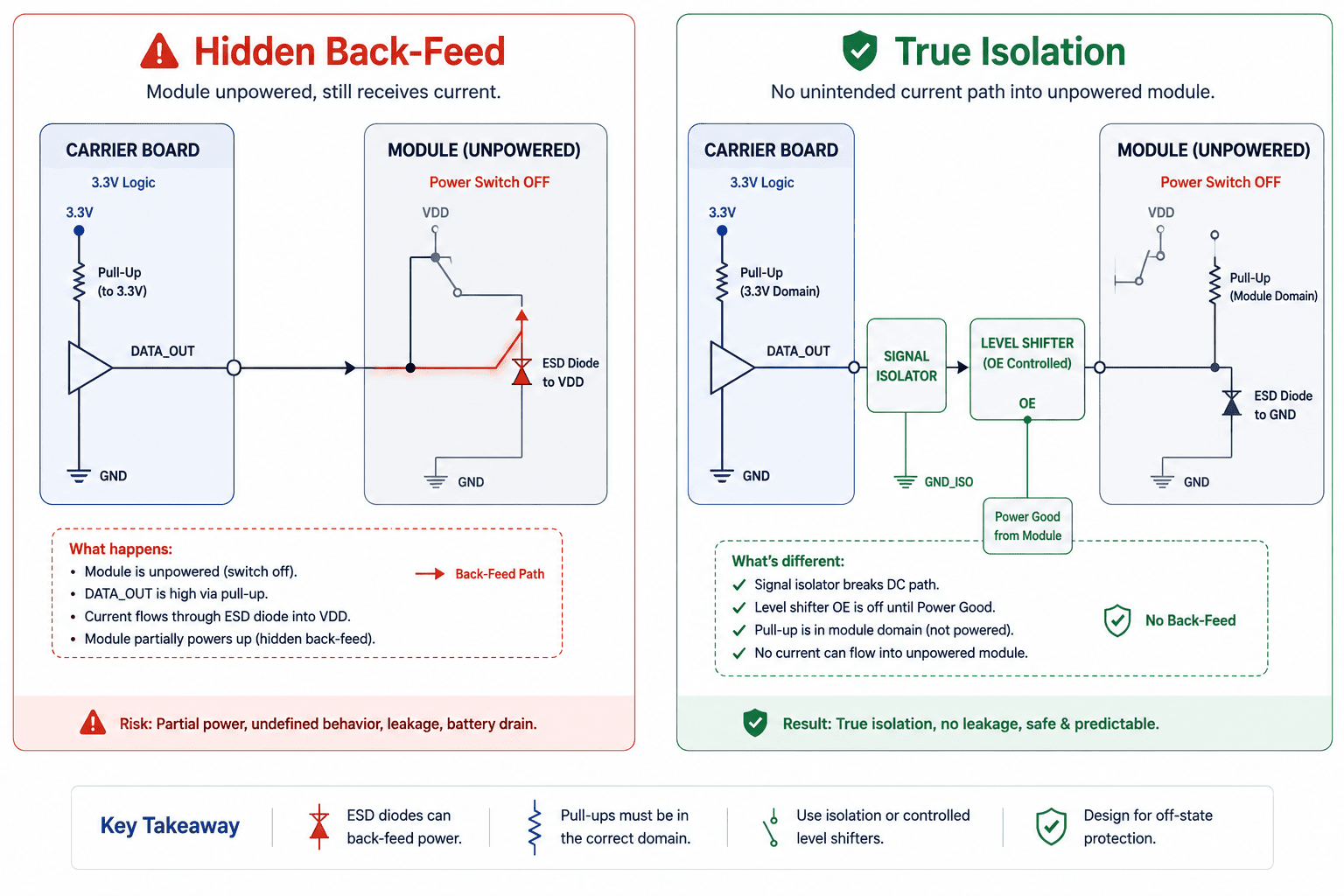
Back-feeding is one of the most common ways fault containment fails.
A module rail may be turned off, but signal lines, pull-ups, ESD diodes, level shifters, or debug connections may feed voltage into it. The module is not properly powered, but it is not fully off either.
This creates partial-power states.
The module may hold a bus low.
It may leak current into the shared rail.
It may fail to reset cleanly.
It may appear present when it should be isolated.
It may disturb a neighboring board through shared communication lines.
Back-feed paths often bypass the carefully designed power switch. That makes the power switch look correct on the schematic while the real board still leaks through IO structures.
Containment must therefore include signal isolation, not only power isolation.
If a module can be powered down independently, its data lines must be reviewed for off-state behavior. Pull-ups should belong to the correct domain. Level translators should have controlled OE pins. Series resistors may be needed on exposed lines. Bus switches may be appropriate when modules are removable or independently powered.
A rail is not isolated if its IO pins are still powering it.
Carrier Boards Should Not Become Fault Amplifiers
Carrier boards often sit at the center of modular products.
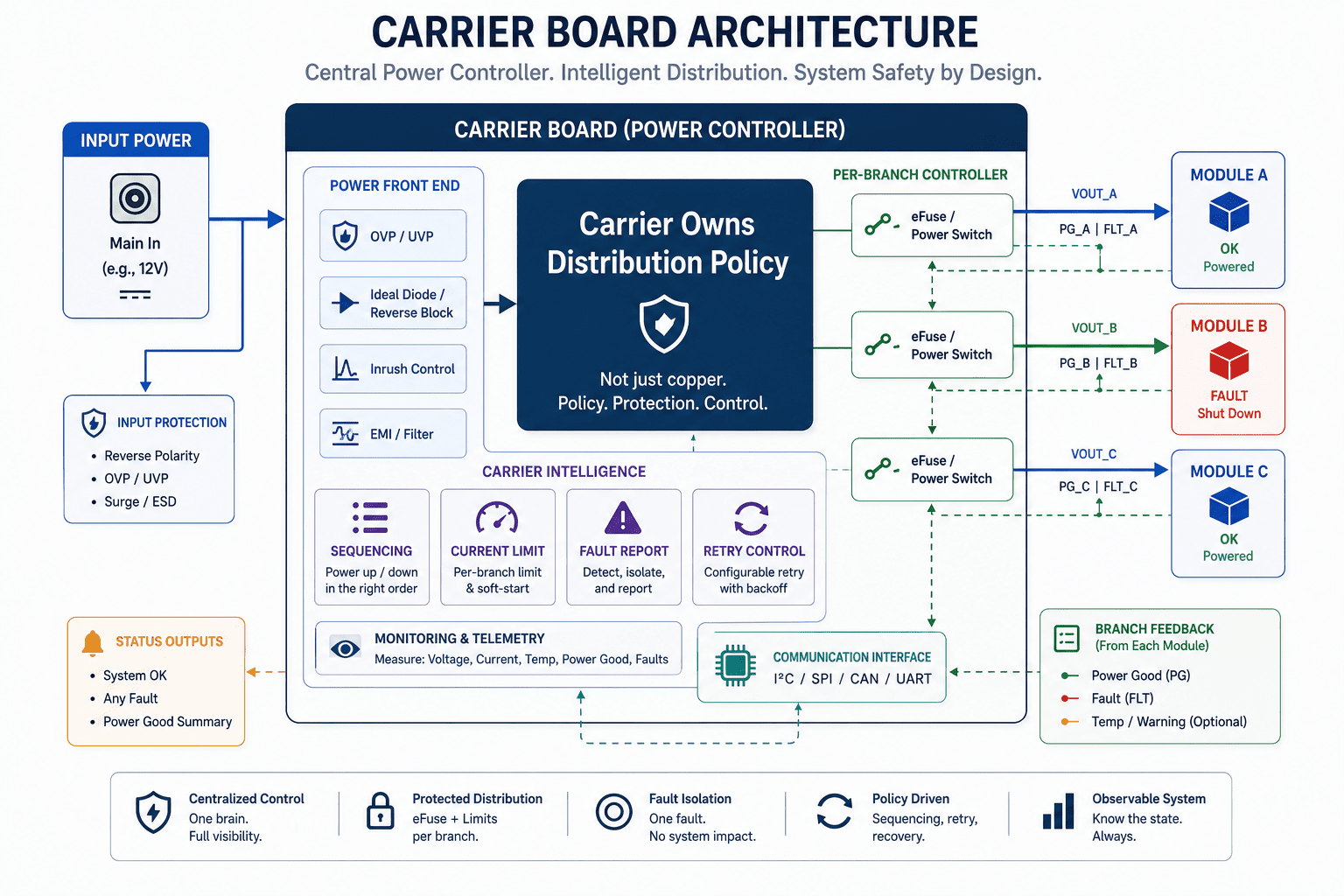
They distribute power, route communication, hold connectors, support regulators, and define system-level enable signals. Because of that, a carrier board can either contain faults or amplify them.
A weak carrier simply passes rails from one place to another.
A strong carrier owns distribution policy.
It decides which module gets power first, how much inrush is allowed, what happens when a branch faults, whether retries are permitted, how fault state is reported, and whether the system can continue in degraded mode.
This is especially important when multiple boards depend on the same input supply. If one branch fault causes the carrier’s main rail to dip, the carrier may reset, release enables unpredictably, or repeatedly restart the faulty module. That can create a reset loop across the whole product.
A good carrier avoids that.
It separates essential rails from optional rails. It keeps the supervisor or power-control logic alive long enough to make decisions. It does not allow optional module faults to disturb the minimum system required for diagnosis and recovery.
The carrier should behave like a traffic controller, not a copper splitter.
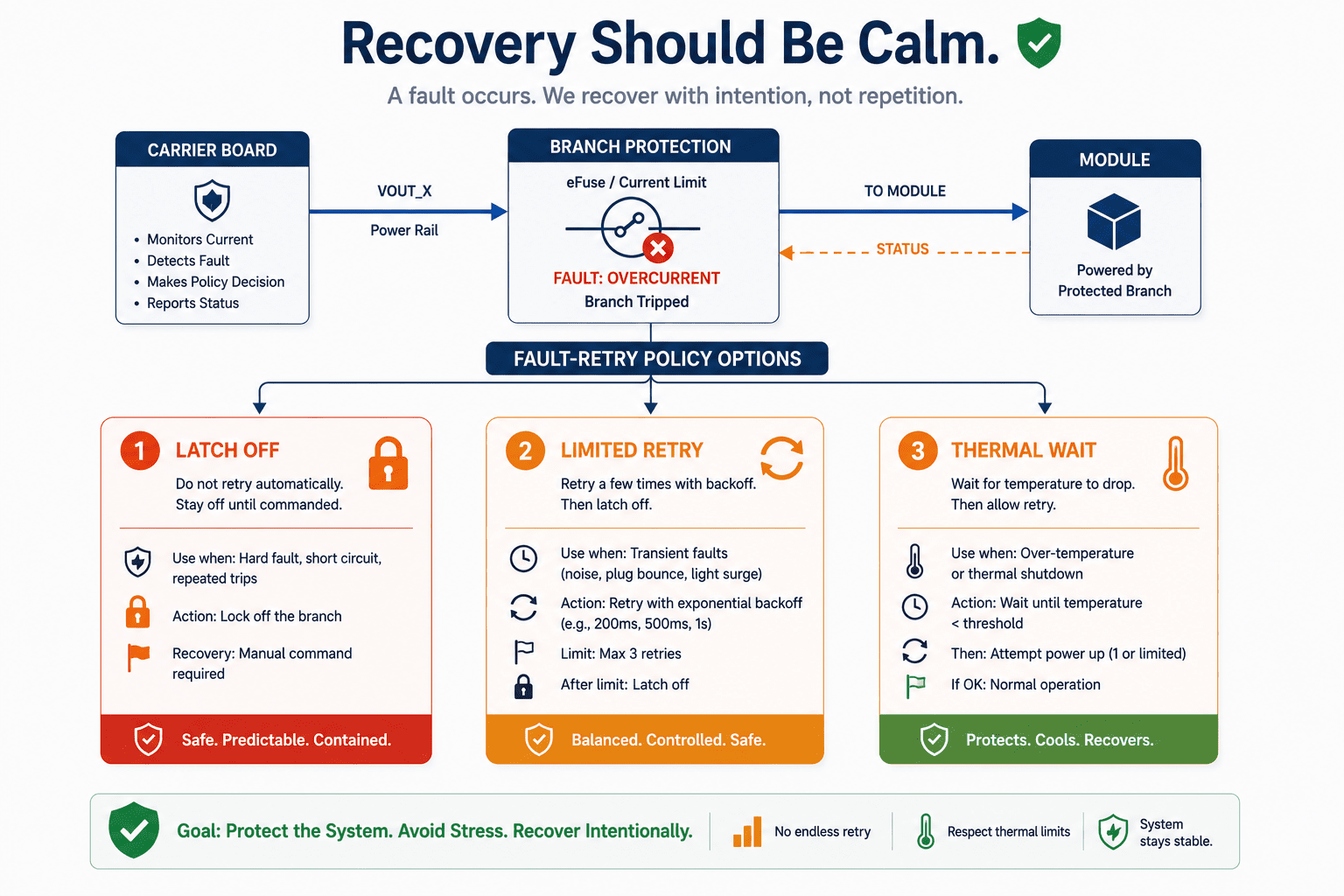
Faulted Modules Should Be Re-Enabled Carefully
Automatic retry sounds helpful.
A branch faults, turns off, waits, and tries again.
Sometimes that is correct. A temporary inrush event, cable insertion transient, or recoverable overload may clear after a retry.
But blind retry can be dangerous.
If the fault is a hard short, repeated retry injects heat into the damaged board. If the fault causes the main input to collapse, retry can create system-wide pulsing. If the fault appears during thermal stress, retry may keep the product near a dangerous condition.
Re-enable policy should be intentional.
Some branches may latch off until firmware or a user action clears them. Some may retry a limited number of times. Some may retry only after temperature drops. Some may remain disabled until the product power-cycles. Some may be allowed to run in reduced-current mode.
The correct answer depends on the module and the risk.
At Hoomanely, we prefer fault behavior that is calm. A fault should not make the product repeatedly slam power into a failing branch. It should move the system into a diagnosable, thermally safe, controlled state.
Recovery is useful only when it does not become a second failure.
Degraded Operation Must Be Designed, Not Assumed
Fault containment is not only about preventing damage.
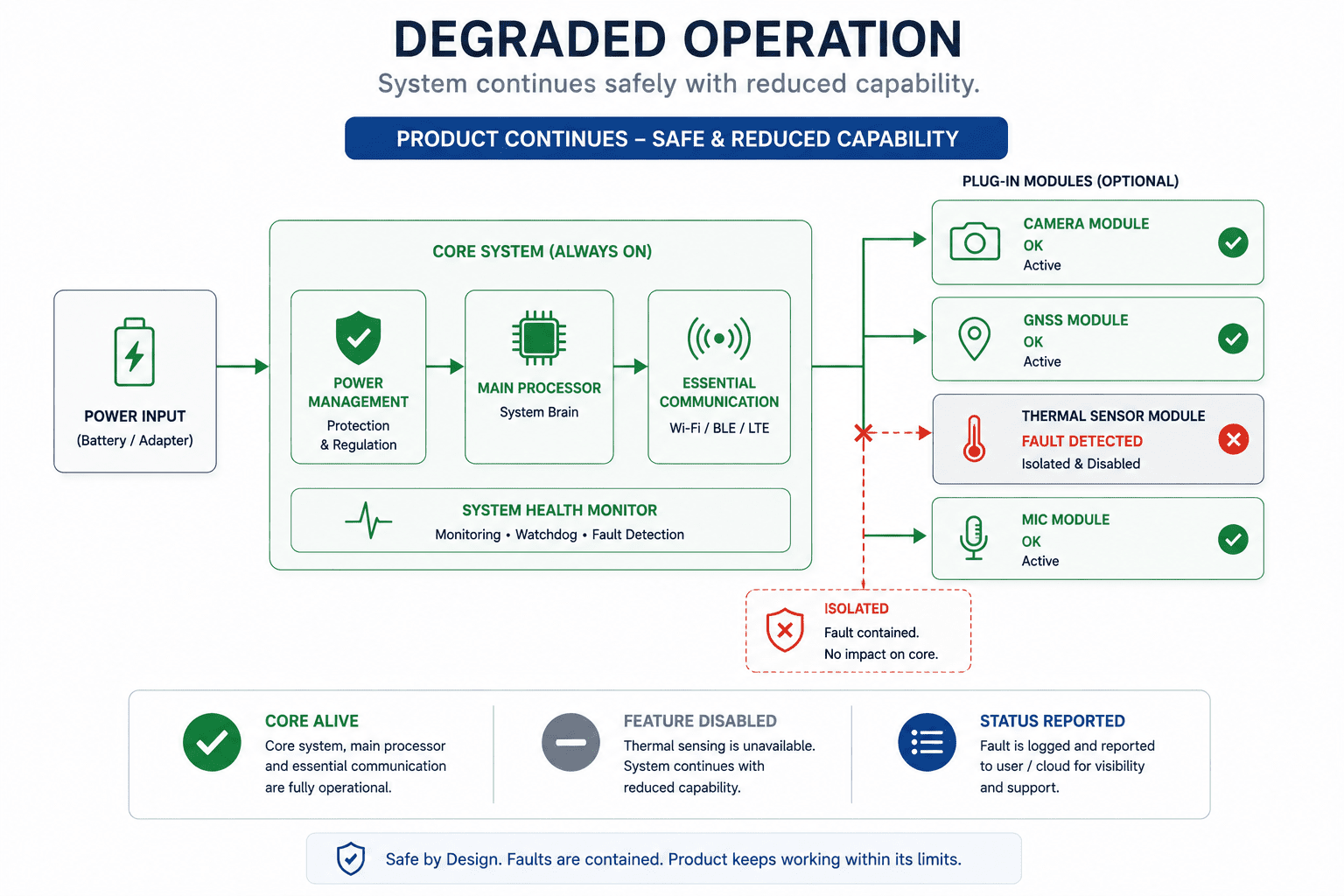
It is also about deciding what the product can still do when one module is unavailable.
If a secondary sensor board fails, can the main system still boot?
If an auxiliary rail faults, can core communication stay alive?
If a peripheral module is missing, can factory test still proceed?
If a noncritical feature is disabled, can the user still receive meaningful status?
A product cannot enter degraded operation unless the architecture supports it.
That means optional modules must have safe absence states. Shared buses must tolerate missing or unpowered nodes. Firmware must have hardware evidence to decide whether a module is unavailable or merely late. Power domains must be separable enough that one branch can stay off while others remain on.
Degraded operation is often discussed as a firmware feature, but it starts in hardware.
The board must allow one subsystem to be electrically absent without poisoning the rest of the product.
Test Fault Containment by Creating Faults
Fault containment should not be validated only by review.
It must be tested directly.
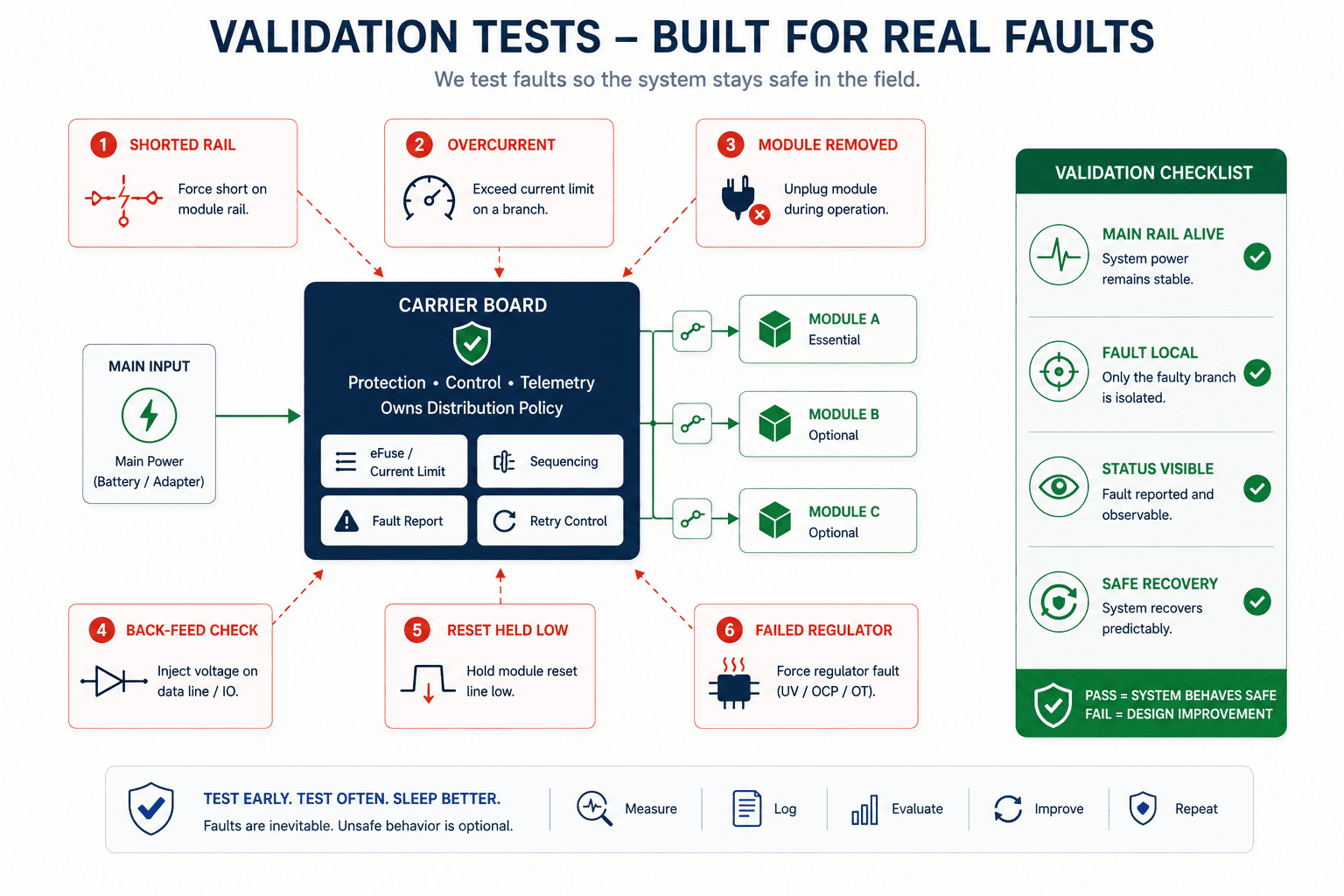
Short a protected module rail through a controlled current-limited setup. Disconnect a module while the carrier is powered, if the product could experience that during service. Force a branch overcurrent. Hold a module reset line low. Power one side while the other side is off. Simulate a failed regulator output. Check whether the neighboring boards continue operating.
The test is not only whether the protection trips.
The real questions are:
Does the shared rail stay alive?
Does the fault stay local?
Does the carrier report the right state?
Does the system avoid reset loops?
Does the faulted branch remain thermally safe?
Can the system recover in a defined way?
These tests reveal whether the architecture truly contains faults or only looks protected on paper.
A modular product deserves modular fault testing.
Hoomanely’s View: Modular Means Independently Survivable
At Hoomanely, we do not call a system modular only because boards are separable.
True modularity means a module can be connected, disconnected, powered, disabled, faulted, and serviced without turning every event into a whole-product crisis.
Shared power domains should make the product efficient, not fragile.
That requires boundaries. It requires current limits. It requires feedback. It requires back-feed control. It requires carrier-level policy. It requires degraded operation. It requires testing faults as first-class events.
The best modular systems do not assume every module behaves.
They assume one module will eventually misbehave and make sure the rest of the system remains understandable when it does.
That is the practical design standard.
Final Thoughts
Shared modular power domains are useful only when the fault boundaries are clear.
A single shorted board should not collapse every rail. A failed module should not make the carrier reset endlessly. A powered-down board should not back-feed through signal lines. A branch fault should not disappear into vague communication errors. Neighbouring subsystems should not suffer because one module lost control.
Designing fault containment means giving every shared rail a boundary, every module a fault budget, every branch a protection behaviour, and every failure a way to be seen.
The product becomes safer, easier to debug, easier to service, and more tolerant of real-world faults.
At Hoomanely, that is what modular architecture should mean.
Not just boards that plug together.
Boards that can fail separately.