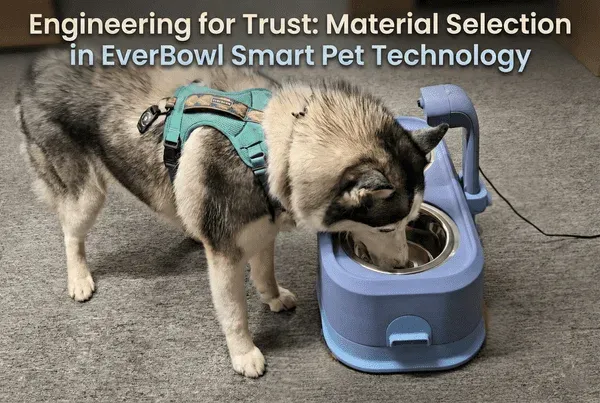
Engineering for Trust: Material Selection in EverBowl Smart Pet Technology
At Hoomanely, designing technology for pets presents unique engineering challenges that consumer electronics rarely encounter. Pets interact instinctively, through touch, taste, and repetition, without understanding operational boundaries or tolerating discomfort. When we developed EverBowl, every material decision was driven by a fundamental principle: the pet should never be aware of the technology.
This isn't marketing philosophy, it's engineering constraint. Materials must be biologically safe over years of exposure, stable under moisture and saliva, resistant to mechanical abuse, and support sophisticated sensing while remaining invisible to the animal.
Design philosophy: four critical questions
Every material candidate for EverBowl answered four validation questions. Biological safety:
- Is it safe under long-term exposure to pets
- Licking
- Rubbing
- Proximity? Environmental stability: does it remain stable under moisture
- Saliva
- Food acids
- Cleaning cycles? Mechanical durability: can it survive repeated impacts
- Dragging
- Drops without degrading into unsafe fragments? Functional transparency: does it support sensing and electronics without introducing thermal
- Acoustic
- Or visual disturbances? Only materials passing all four criteria advanced to production
Structural plastics: chemical inertness and mechanical predictability
Plastics form EverBowl's structural backbone, but selection prioritized chemical stability over cost. Any plastic with potential indirect exposure to food or water was verified as non-leaching and odor-neutral, no outgassing that pets could detect. Brittle plastics got eliminated early, materials that could chip into sharp fragments pose ingestion and injury risks. Materials were selected to tolerate warm water cleaning without warping or surface degradation, and internal structural plastics also serve vibration isolation, protecting sensor accuracy and preventing resonance pets might perceive as unsettling.
Balancing structural rigidity against impact resilience was a real trade-off. Matte finishes were preferred over glossy ones, reducing visual attraction, minimizing scratches that harbor bacteria, and dampening reflections that might distract pets. Pigments were selected for UV and moisture resistance, since discoloration over time signals material degradation that could compromise safety. The result:
- Structural plastics succeed through invisibility
- No odors
- No discoloration
- No reaction from pets
- No measurable degradation after thousands of cleaning cycles
Stainless steel bowls: hygiene through material properties
Direct food and water contact demanded materials with inherent hygiene advantages. Stainless steel's non-porous surface prevents bacterial absorption and biofilm formation, critical for daily feeding applications. Its chemical inertness resists acids from wet food, oils, and typical pet food additives without corrosion or leaching. Its scratch resistance maintains smooth surface integrity, since scratches create micro-environments where bacteria multiply. And its thermal neutrality avoids unexpected temperature sensations, pets are sensitive to thermal cues that affect feeding behavior.
Steel bowls were designed as removable, dishwasher-safe components, separating the hygiene surface from the embedded sensing system. Stainless steel's predictable density and stiffness enable consistent weight measurements, material uniformity directly supports sensor calibration and accuracy. The bowl positioning system was designed for repeatable placement without mechanical stress on sensing load cells, with tolerance stack-up analyzed to ensure roughly ±0.5mm positional accuracy.
IR illumination: seeing without disturbing
Infrared LEDs enable EverBowl's visual sensing without visible light intrusion, but introducing any optical emission into pet products requires careful engineering. We selected an 850nm IR wavelength, outside canine and feline visible spectrum, preventing distraction or stress. IR LEDs are operated at 60-70% rated maximum, prioritizing long-term stability over peak output. Junction temperature is maintained under 60°C through PCB copper spreading and current limiting, ensuring surface temperatures remain ambient. And the optical design includes baffles and controlled emission angles, so light is directed only toward target regions, preventing stray illumination.
Emission intensity was verified below IEC 62471 exempt group limits, no risk to pet or human eyes even during prolonged exposure. Infrared thermal imaging confirmed no hot spots more than 2°C above ambient on any surface accessible to pets. The result: EverBowl "sees" pet interaction through IR imaging without any perceptible disturbance to the animal.
Proximity sensors: non-contact interaction detection
Physical contact sensors introduce multiple problems in pet environments, mechanical wear from repeated actuation, debris accumulation in moving parts, hygiene concerns from exposed surfaces, and potential pinch points upon failure. Time-of-flight proximity sensors detect presence and distance without any physical contact requirement instead.
The sensor window needed optical transparency at the sensor wavelength (940nm typical), scratch resistance from pet claws and cleaning, saliva-safe materials for frequent licking, and anti-reflective properties to prevent internal reflections. The housing material needed predictable optical properties, black pigmentation to minimize stray light, and mechanical alignment stability through temperature and humidity cycling. The mounting system needed to survive cleaning vibration and impacts while maintaining sensor-to-target distance calibration and staying isolated from bowl movement to prevent false triggers.
Camera systems: observation without intrusion
Camera integration in pet products requires balancing functional requirements with animal comfort. The camera operates in IR spectrum only, no LED indicators, no visible light, no flash. Lens autofocus and sensor readout are engineered for silent operation, since mechanical noise can startle pets. Camera module thermal design limits surface temperature rise to under 1°C above ambient, preventing warm spots pets might investigate or avoid. And the lens window and surrounding materials use a matte finish, since glossy surfaces attract visual attention.
The lens window is optically clear polycarbonate with an AR coating, scratch-resistant, impact-resistant, and hydrophobic so water beads off, reducing cleaning frequency. Internal mounting is black ABS with ribbed geometry that suppresses internal reflections, dampens vibration from bowl impacts, and thermally isolates the camera from warm electronics. The camera bezel is matte black, recessed 1mm below surface, visually invisible from the pet's perspective, with a flush design that prevents debris accumulation. From the pet's perspective, nothing is "watching," the camera exists as a passive sensing instrument without any perceptible presence.
Environmental resistance: design for real pet environments
Pet products operate in conditions hostile to electronics, daily water spills, constant saliva exposure through licking, unpredictable cleaning routines, and physical impacts from bowls being tipped, dragged, or dropped. Our design philosophy assumes imperfect user behavior, occasional submersion, aggressive cleaning, and mechanical abuse are expected, not edge cases.
Gasket materials and compression sealing prevent capillary water ingress at all enclosure seams, validated through IP54 spray testing. Where metal exposure is unavoidable, stainless steel or zinc-plated hardware with conformal coating is used. Silicone gaskets are selected for chemical resistance, temperature stability from -20°C to +80°C, and compression set resistance that maintains seal over thousands of cycles. Enclosure plastics include anti-microbial additives, hydrophobic surface treatment, and UV stabilizers. Environmental protection is achieved without creating sealed, non-serviceable units, modular design allows disassembly for deep cleaning and component replacement.
Mechanical isolation: protecting sensors and pet comfort
High-precision sensors like load cells and accelerometers require stable mounting, but pets generate constant vibration through footsteps, bowl impacts, and floor-transmitted noise. Our multi-layer isolation strategy uses elastomer mounts to decouple the sensor assembly from the enclosure structure, attenuating vibration above 50Hz by more than 20dB. Internal sensor PCBs are mounted on compliant standoffs to prevent high-frequency resonance from floor vibration, and viscoelastic damping pads at structural joints dissipate vibrational energy without introducing compliance that affects measurements.
Mechanical isolation serves a dual purpose, sensor accuracy through eliminating false readings from environmental vibration, and pet comfort through preventing any tactile feedback that pets might find unsettling. Accelerometer testing confirmed no measurable vibration above 1g at frequencies under 200Hz transmitted to pet contact surfaces, below canine tactile sensitivity threshold.
Longevity and aging: safety over time
Materials safe on day one can become hazardous after months of use if they crack and create sharp edges, leach chemicals after UV or temperature exposure, loosen mechanically, or change surface properties. Our design approach prioritized long-term behavior over initial performance, validated through 1000 hours of xenon arc lamp UV exposure equivalent to two years of sunlight, 100 thermal cycles from -20°C to +60°C, 500 cleaning cycles with common detergents, and 10,000 simulated impacts from a 30cm bowl drop. Even at end-of-life, materials are designed to degrade gracefully, plastics may discolor but remain structurally sound, gaskets may lose compression but don't fragment, and electronics fail-safe rather than producing a hazardous output. EverBowl maintains its safety profile throughout an intended 5-year service life.
System integration: materials working together
EverBowl's safety and performance emerge from material system design, not individual component selection. Every material boundary is analyzed for thermal expansion mismatch, galvanic corrosion potential, chemical compatibility, and acoustic coupling. System-level testing confirms materials perform not just individually, but as an integrated assembly under real-world conditions.
Conclusion: invisible technology through material excellence
At Hoomanely, material selection for EverBowl wasn't driven by cost or convenience, it was guided by responsibility to pets who cannot voice discomfort or concerns. Every material was validated for safety, stability, durability, and invisibility. The result is a smart pet bowl where technology recedes completely. This is engineering for trust, where the highest achievement isn't features the user notices, but safety and comfort they never question. Materials are where that trust begins, and for products serving pets, there are no compromises.