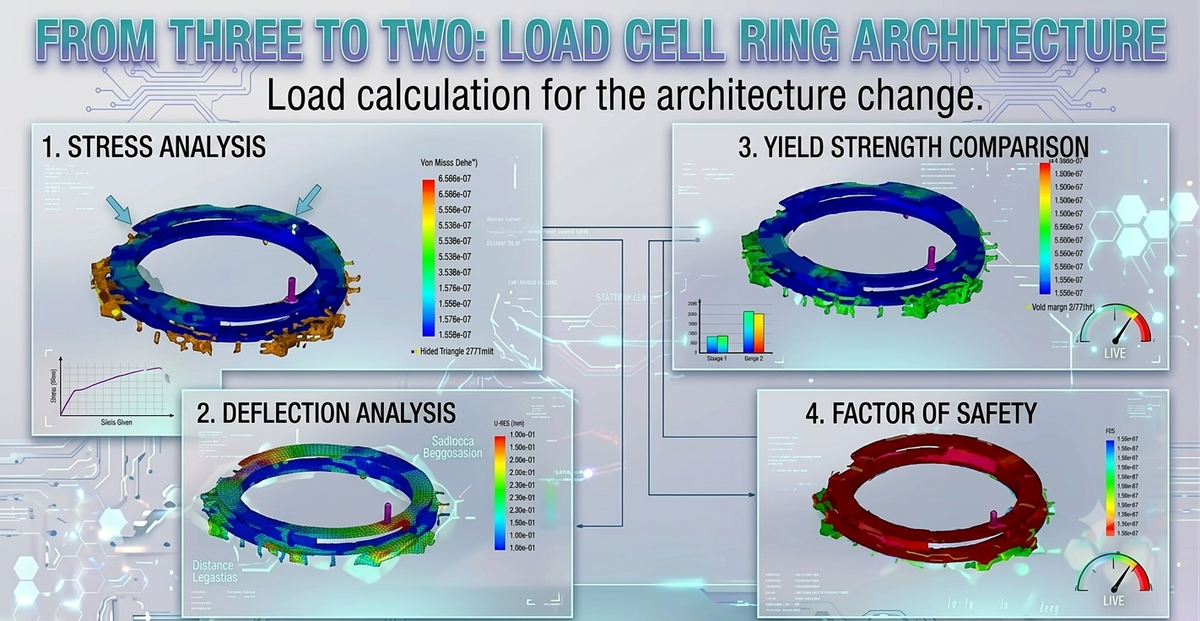
From Three to Two: Load calculation for the Load Cell Ring Architecture
Hardware redesigns rarely stay contained to one subsystem. A change in one place ripples outward, and what looks like a simple reduction in sensor count can cascade into new structural constraints, new joining challenges, and a fresh round of stress calculations. This is the story of moving our ring scale from three load cells to two: what drove the decision, what broke along the way, and what the engineering analysis revealed.
The original setup: three cells at 120°
The first version of the scale used two concentric aluminum rings, a top ring where the bowl sits (245.5 mm OD, 2.5 mm thick) and a bottom ring (256 mm OD, 2.0 mm thick), both 6061-T6 aluminum with a 198 mm central cutout. Three bar-type aluminum load cells sat between the rings at 120° spacing, each fixed with screws through a 3 mm bean-shaped spacer. That spacer created a deliberate cantilever: one end of the load cell was the fixed point, the other the load point, with a hole-to-hole moment arm of 64.45 mm.
The electronics ran on a two-board architecture: a load cell PCB carrying the sensors, connected to a separate carrier board housing the ADC, with each load cell signal running back over a cable harness to a centralized ADC. It worked. But the architecture carried more complexity than it needed to.
Why we moved to two load cells
The driving reason was electronics consolidation, not a mechanical preference. The goal was to move the ADC onto the load cell PCB itself, turning each sensor into a self-contained digital unit that talks directly to the carrier board over a digital bus. That eliminates the analogue cable runs, cuts noise susceptibility, and simplifies the carrier board considerably.
Moving to two load cells at 180° followed directly from that: two PCBs, two digital outputs, one carrier board reading both. A three-cell layout with onboard ADCs would have meant managing three independent digital channels and adding a third PCB to an already compact assembly. Two cells at 180° is the simpler, cleaner architecture, and there's a secondary benefit too: symmetric 180° placement reduces the weight calculation to a direct sum, R1 + R2 = W, with no angular correction factors needed.
The joining problem: why screws were out
Screws were the original fastening method and worked fine for three cells. Moving to two cells changed the load geometry enough that screws became a problem: fewer cells means more load concentrated per joint, and the 180° layout creates a stronger moment arm effect under off-axis loading than the 120° layout did.
The first replacement attempt was direct welding, and it failed immediately. The gap between the load cell bar and the ring is tight by design, since the 3 mm spacer exists specifically to create the cantilever gap, and that geometry makes clean weld access essentially impossible. The welds that did form cracked at the heat-affected zone because of the mismatch in stiffness between the thin spacer and the ring body.
The second attempt was JB Weld cold weld epoxy. It bonded and held, up to a point, then failed suddenly under heavier loads. Understanding why it failed drove the rest of the engineering analysis.
Why JB Weld fails under load: the peel problem
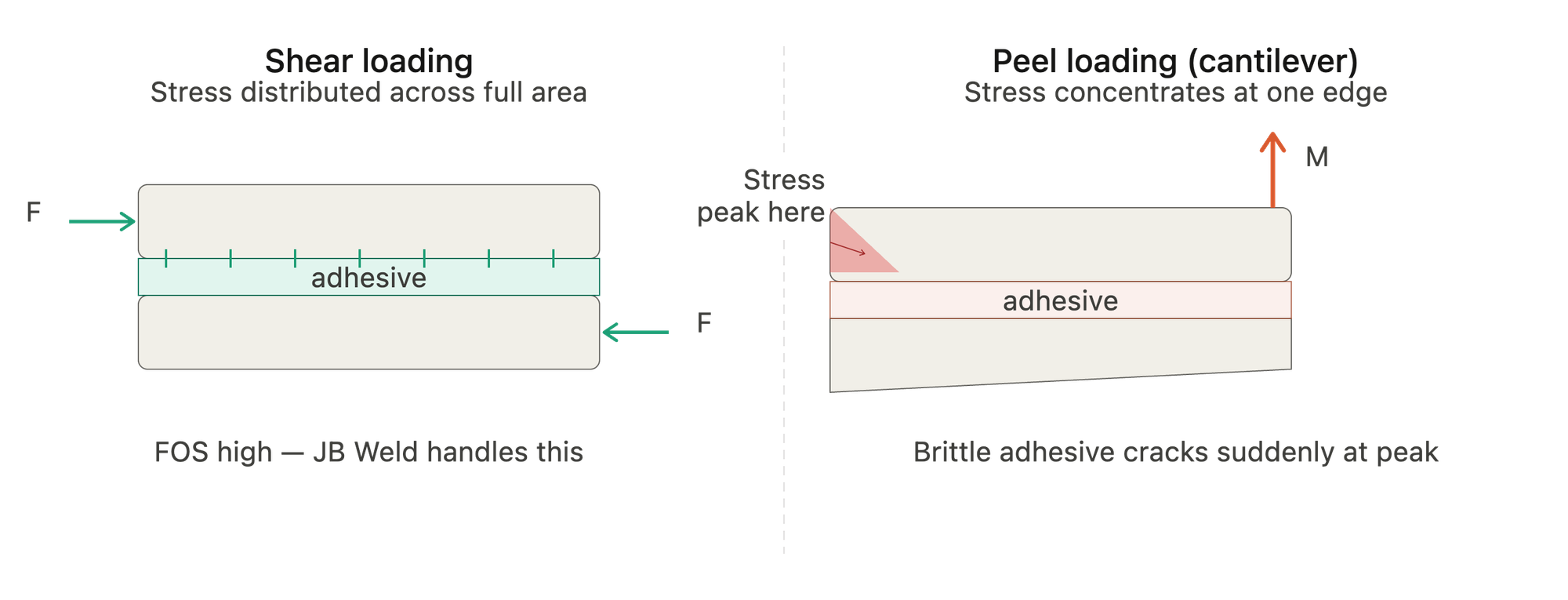
JB Weld is a cold weld epoxy that forms a dense, cross-linked polymer network, effectively metal-hard with essentially zero flexibility. Under pure shear, where force spreads across the full bond area, it performs well. The problem is the cantilever geometry: with the load cell acting as a cantilever, the fixed-end spacer joint sees not just shear but a bending moment, which generates peel stress, a force that lifts one edge of the bond while compressing the opposite edge.
Because JB Weld can't deform, all of that peel force concentrates at a single edge. Once the stress there reaches the adhesive's lap shear limit, the crack propagates instantly across the whole bond, causing sudden, total joint failure, exactly what we saw.
The replacement was Loctite EA 9466, a two-part flexible epoxy. Its lap shear strength is comparable to JB Weld's (7.2 MPa), but it retains enough elongation to spread peel stress across the bond instead of concentrating it at one edge. At the load cell interface specifically, where contact area is small and peel risk is highest, this material difference raised the factor of safety from 2.49 to 8.3 with no change in geometry at all.
The calculations: what the transition demanded
Once the joining method was settled, the structural analysis quantified exactly what the two-cell layout requires at each load case.
Force distribution: at 5 kg total load, each cell carries 24.53 N and generates a bending moment of 1.581 Nm at the fixed-end spacer.
Spacer stress at 5 kg: with the original bean-shaped spacer (52.63 mm x 5 mm), combined shear and bending stress at 5 kg comes to 0.863 MPa, well within JB Weld's limit, for a factor of safety of 9.3. The original spacer geometry was fine for the original load range.
The key insight from the calculation is that bending stress is governed by the spacer's moment of inertia, I = w x L³ / 12. Length is cubed in that term, so doubling the spacer length cuts bending stress by 8x, making length the single most powerful design variable. The spacer needed for 50 kg at a factor of safety of at least 3 is 120 mm x 8 mm, with a 4 mm concave fillet bead at all edges.
The two bond interfaces: the spacer has two bond faces, one to the ring (Interface 1, 960 mm² contact area) and one to the load cell body (Interface 2, 240 mm² contact area). Interface 1 achieves a factor of safety of 6.68 with JB Weld at 50 kg, which is safe. Interface 2, with its shorter contact length and much lower moment of inertia (8,433 mm⁴ versus 1,152,000 mm⁴), only reaches 2.49, which is marginal. The fix there is the adhesive upgrade to EA 9466 plus extending contact length to 28 mm wherever the geometry allows.
What the analysis exposed that the three-cell setup hid
Three cells at 120° distribute load more evenly and create shorter individual moment arms under off-axis loading. The 180° two-cell layout is mechanically simpler to analyze but more sensitive to moment concentration, since both cells carry higher individual loads and the fixed-end joint takes the full bending moment without the triangulated support that three points provide.
That doesn't make two cells the wrong call, the electronics simplification is real and significant, but it means the joint engineering has to be done properly. The three-cell version with screws could tolerate more geometric imprecision because mechanical fasteners spread load across thread engagement length. Adhesive joints are far less forgiving of peel stress than screws are.
Final design state
About Hoomanely
This load cell redesign reflects the kind of first-principles hardware work behind Hoomanely's sensing technology. Moving from three cells to two wasn't just a parts reduction, it was a deliberate architecture decision touching electronics integration, structural mechanics, and materials selection all at once. Our approach to sensing hardware is to understand every failure mode analytically before it shows up in the field, and to make design changes that are backed by calculation rather than intuition.
Key takeaways
- The move from 3 to 2 load cells was driven by electronics consolidation: placing the ADC on each load cell PCB eliminates analogue cable runs and simplifies the carrier board.
- Direct welding failed due to geometric constraints; JB Weld failed under the cantilever's peel stress. Both failures had structural, not process, root causes.
- Bending stress at the spacer joint is controlled by spacer length cubed; doubling length cuts bending stress by 8x.
- Interface 2 (spacer to load cell) is the governing joint. EA 9466 raises its factor of safety from 2.49 to 8.3 with no geometry change.
- The 180° two-cell layout is more moment-sensitive than the 120° three-cell layout; proper joint engineering isn't optional here.