Making Status LEDs Tell the Truth About System State
Status LEDs are often treated as cosmetic elements, an afterthought once the core system works. In practice, they're one of the most powerful diagnostic tools in a product. When LEDs reflect real system state accurately and deterministically, they reduce debug time, prevent false fault assumptions, eliminate unnecessary resets, improve manufacturing efficiency, reduce support overhead, and improve system-level performance under stress. When they don't, they create confusion that directly degrades operational performance.
The typical failure: LEDs driven by assumption
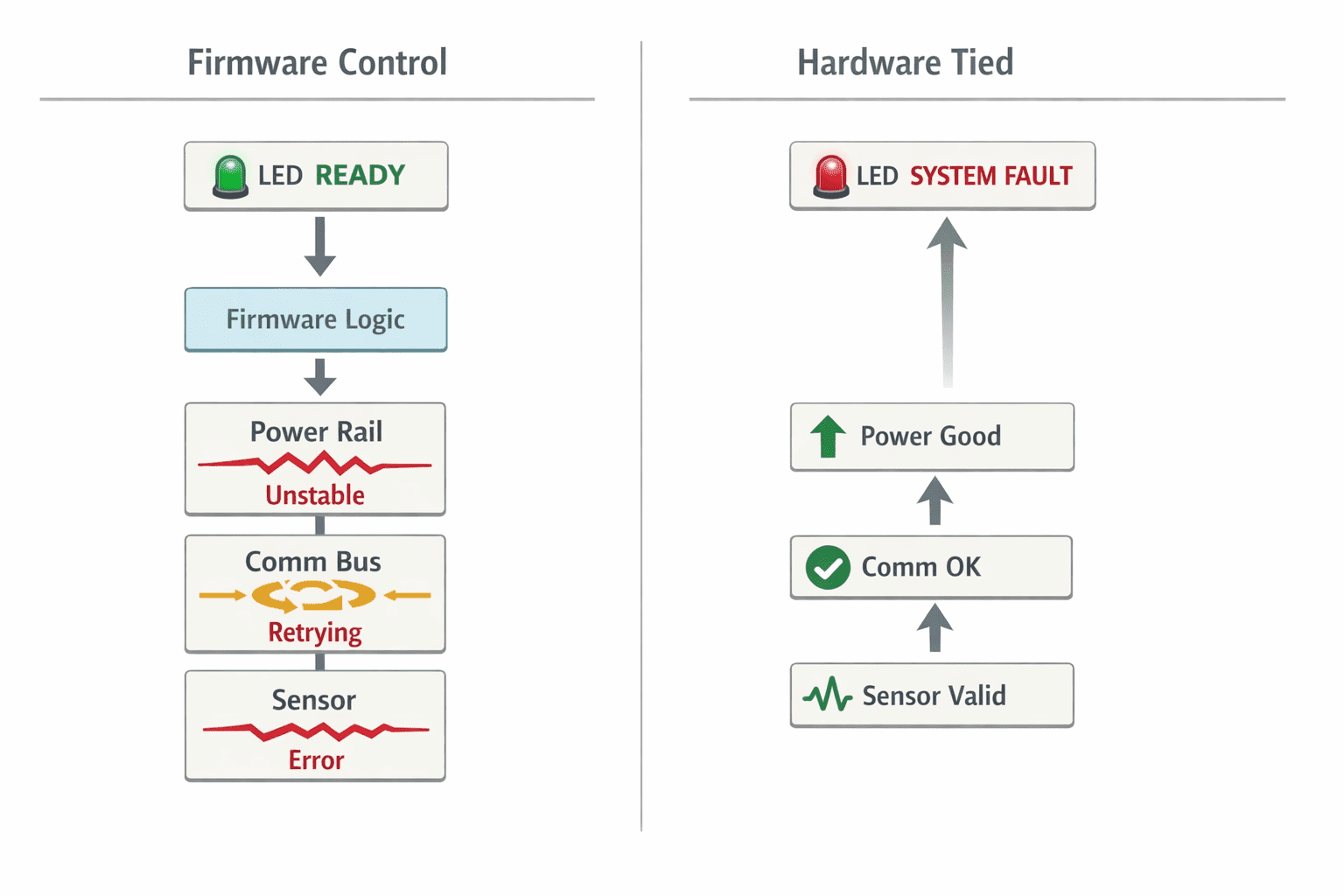
In many current-state products, LEDs are toggled by firmware flags, reflecting "expected" state, not actual hardware state. They update after events, not during them, and they lag real conditions. An LED may indicate "connected" while the bus is retrying, show "powered" while rails are unstable, or show "idle" while a subsystem is hung.
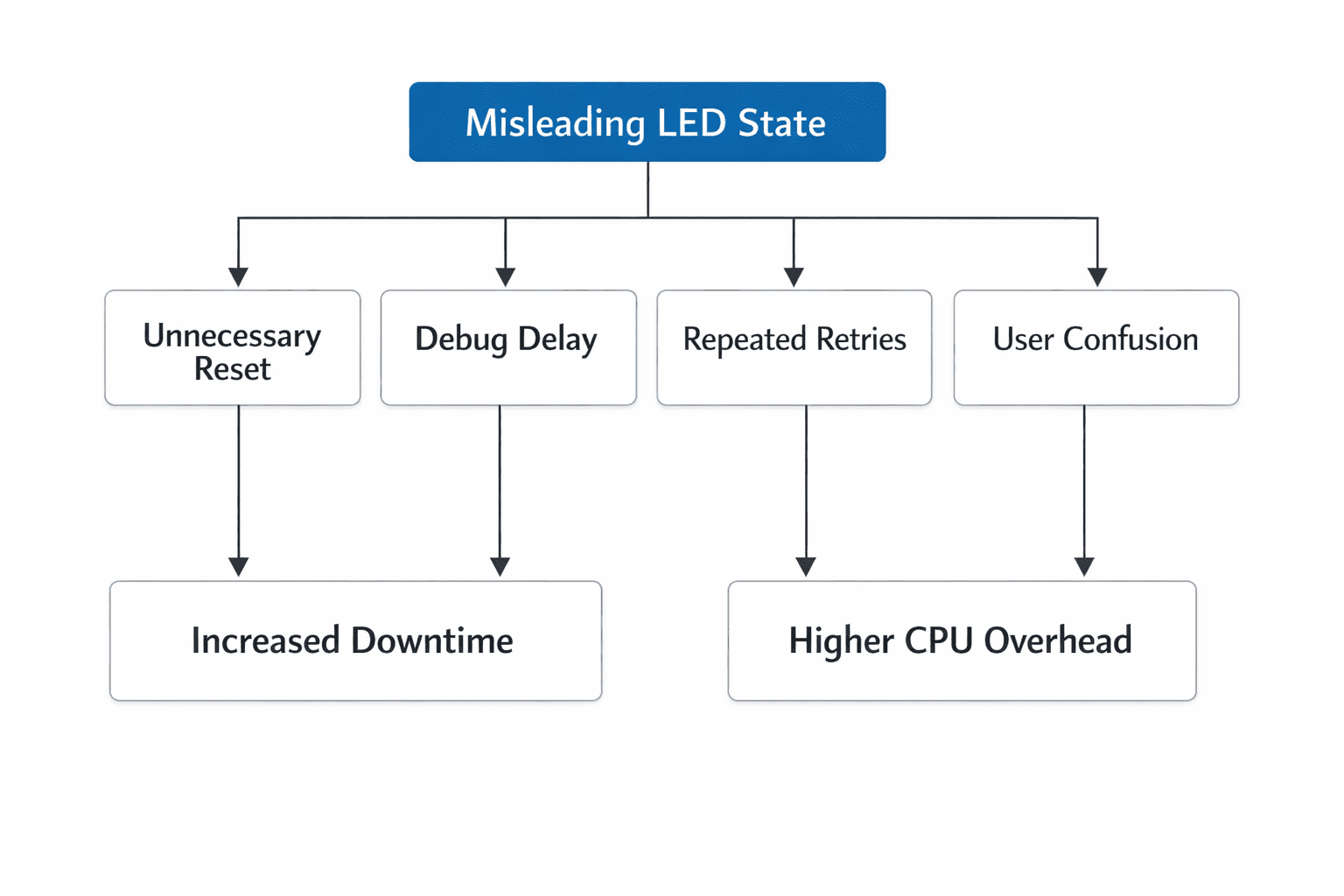
This causes engineers to chase phantom bugs, manufacturing to misclassify boards, field technicians to misinterpret failures, and users to power-cycle unnecessarily. Each of these costs time and performance.
Why misleading LEDs hurt performance
If an LED reflects actual rail validity instead of firmware assumption, engineers can localize power faults meaningfully faster, spend less time attaching probes, and trigger fewer unnecessary resets. When LED feedback is unreliable, users power-cycle prematurely, technicians restart systems unnecessarily, and watchdogs get blamed incorrectly. Reducing unnecessary resets improves system uptime, data continuity, and recovery latency, and in deployed systems, that meaningfully improves perceived reliability.
LEDs should reflect hardware, not hopes
The practical rule: if the LED says "OK," the hardware must actually be OK. This means LEDs should be tied to real power-good signals, actual communication activity, verified initialization completion, and hardware-valid states, not boolean variables in firmware, state-machine assumptions, or unverified internal flags. When LEDs reflect hardware truth, misleading states get eliminated, debug ambiguity drops, and fault detection becomes immediate.
Power LEDs must represent valid power
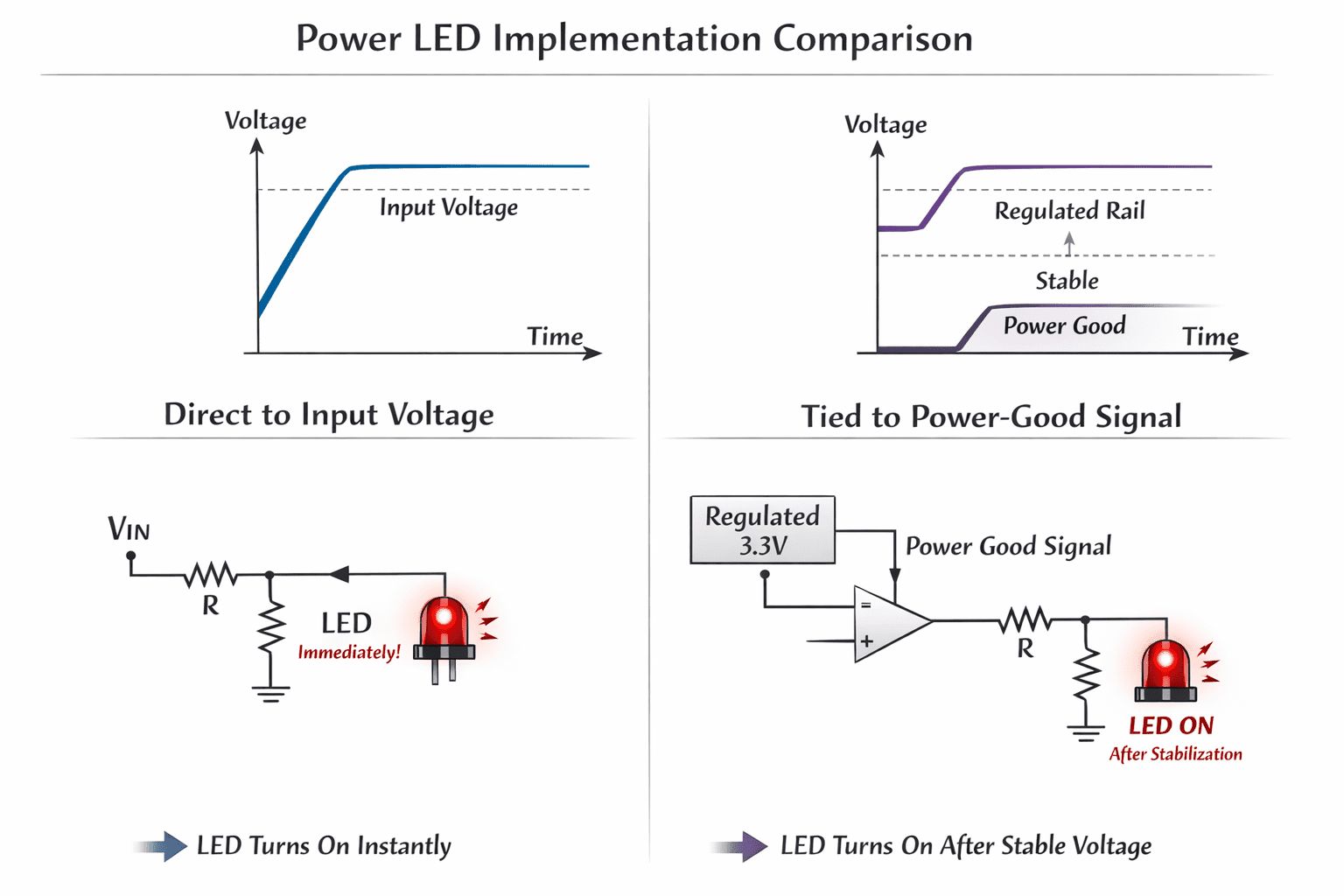
A common mistake is tying the power LED directly to input voltage, meaning the LED turns on before rails stabilize, remains on during brownout, and masks transient instability. A truthful power LED reflects a valid regulated rail, not just presence of input. The measurable effect is faster brownout diagnosis, reduced misclassification of field returns, and a clear separation between an input issue and a regulator issue, which reduces troubleshooting time significantly in manufacturing and support environments.
Activity LEDs should reflect actual activity
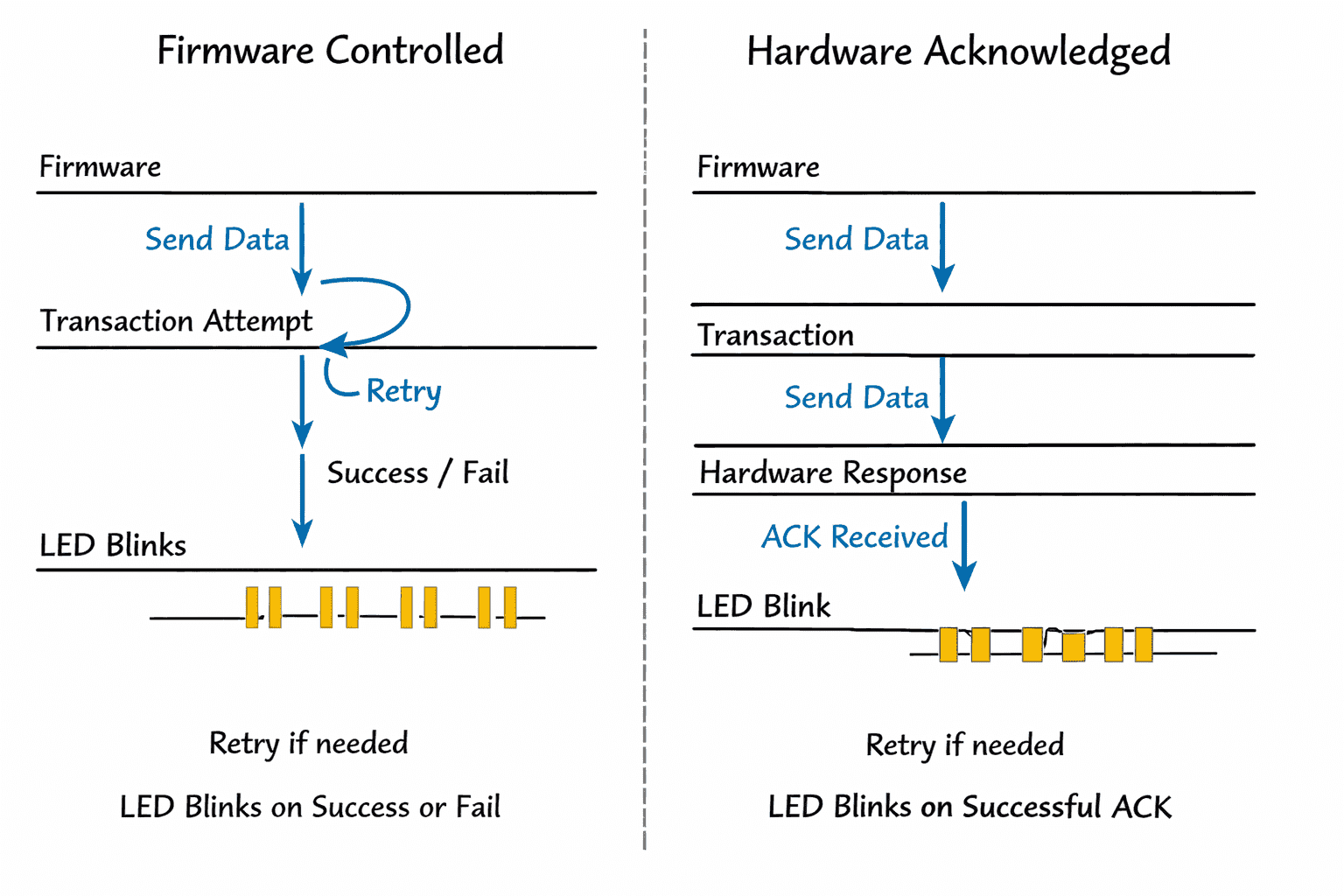
Many products blink LEDs on "data send attempt." The correct approach blinks LEDs on confirmed transaction, verified interrupt, or hardware-acknowledged activity. In a typical design, the LED blinks but the transaction failed, and the user assumes the operation succeeded. In a hardware-linked design, the LED reflects real bus traffic. The impact is a meaningful reduction in misdiagnosed communication faults, faster isolation of cable versus firmware issues, and clearer performance feedback under load.
Fault LEDs must be latched and meaningful
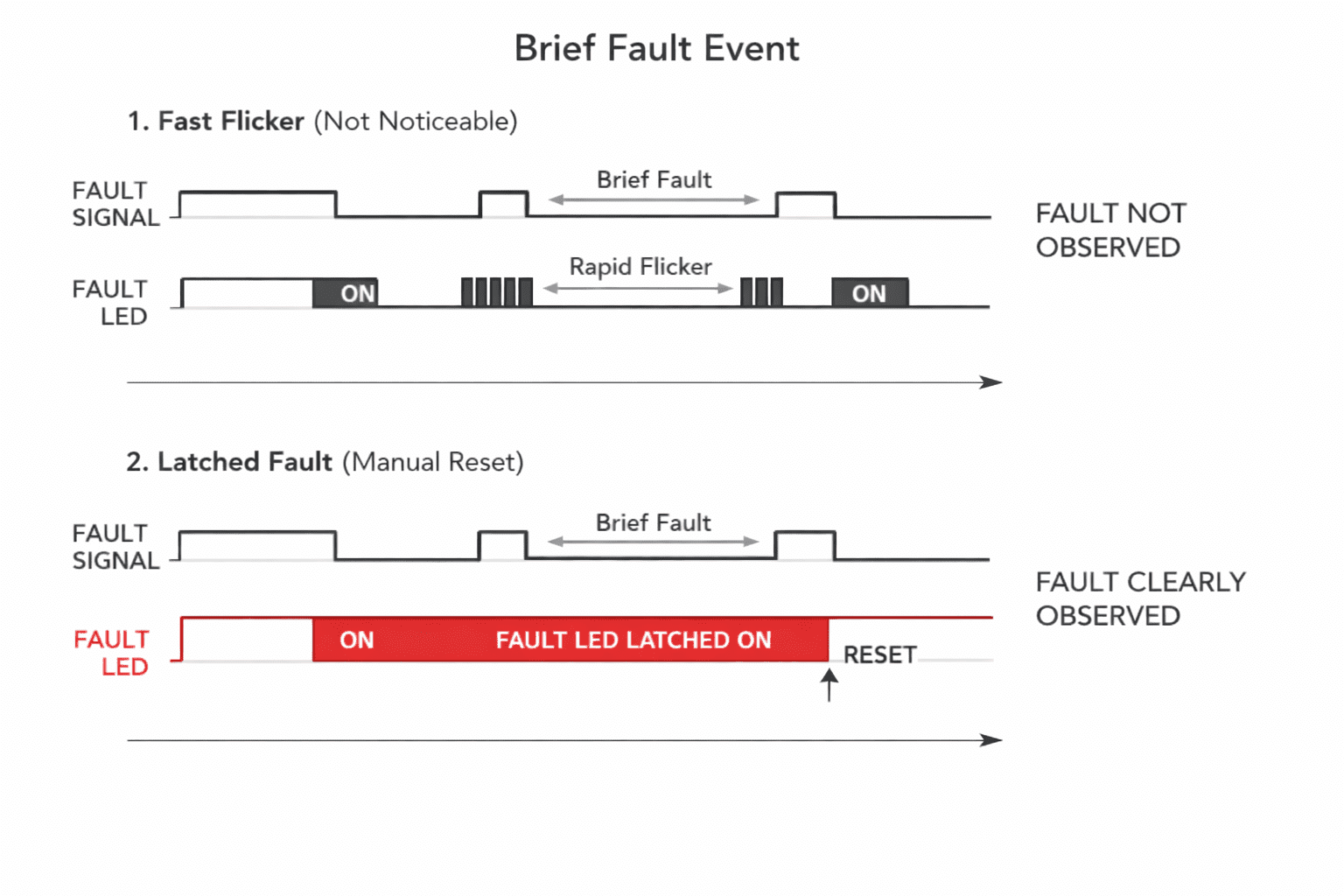
A fault LED that flickers briefly is useless. A practical design ensures fault states latch visibly, transient faults are distinguishable from persistent faults, and reset cause is encoded in the LED pattern if possible. This eliminates the need for immediate serial logs and guesswork during post-failure inspection. In manufacturing, this can meaningfully reduce diagnostic time per failed unit, improve yield classification accuracy, and decrease retest cycles.
LED timing must be deterministic
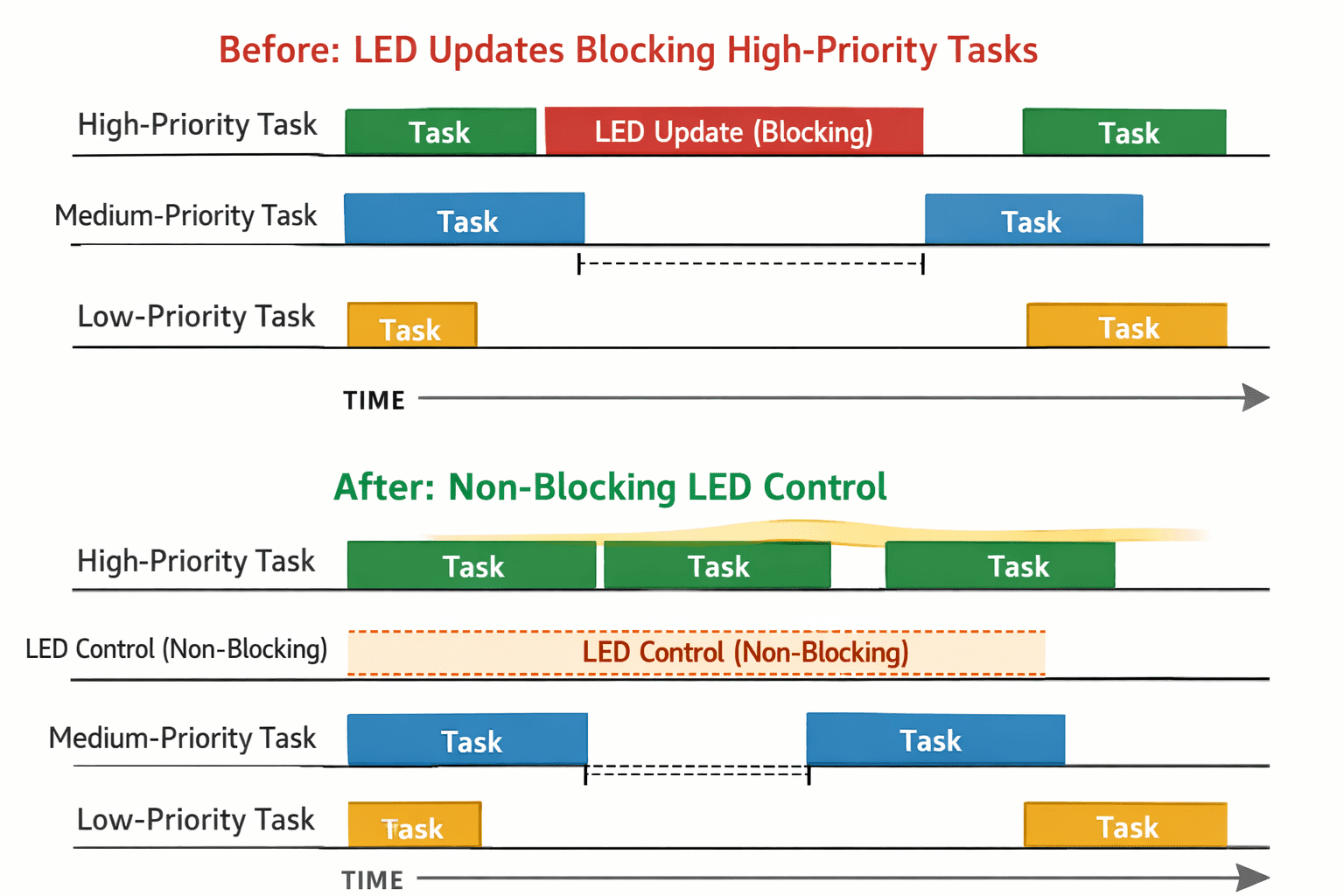
Poor LED design can introduce performance jitter if LED updates occur in critical code paths, high-frequency blinking shares timing resources, or software delays get inserted for visual effect. LED control should be non-blocking, avoid high-priority interrupts, and avoid polling loops. When implemented correctly, there's no measurable CPU overhead, no timing jitter, and no interference with sensor sampling or bus arbitration. Performance stays intact.
LEDs as bring-up accelerators
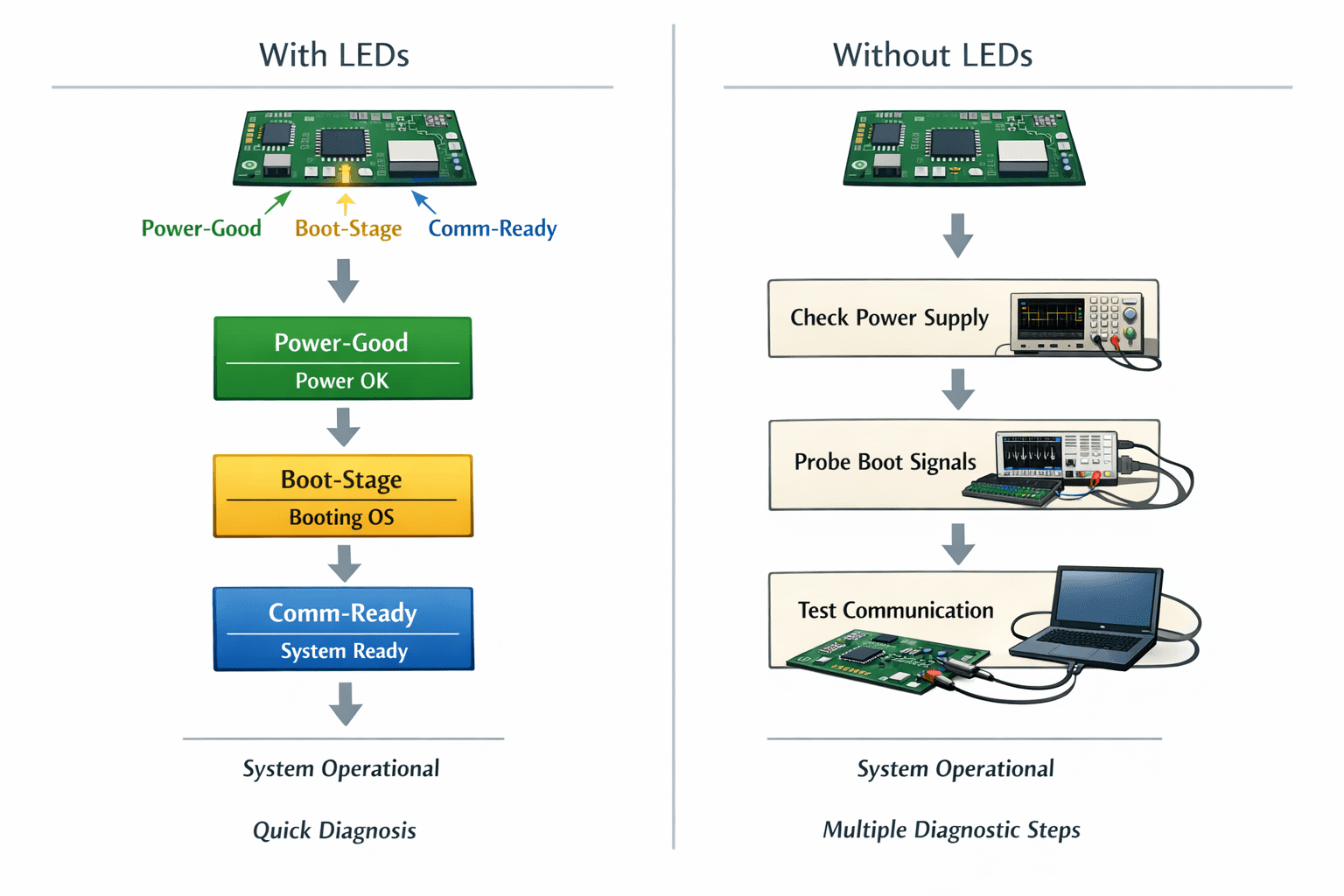
In early bring-up, LEDs can eliminate entire categories of ambiguity. A rail-good LED confirms regulator behavior without a scope. A boot-stage LED confirms code execution stage. A communication LED confirms bus arbitration success. When implemented cleanly, bring-up time can drop meaningfully, probe attachment becomes selective rather than exploratory, and first-signal time improves significantly. That's a direct engineering velocity gain.
LEDs should never mask instability
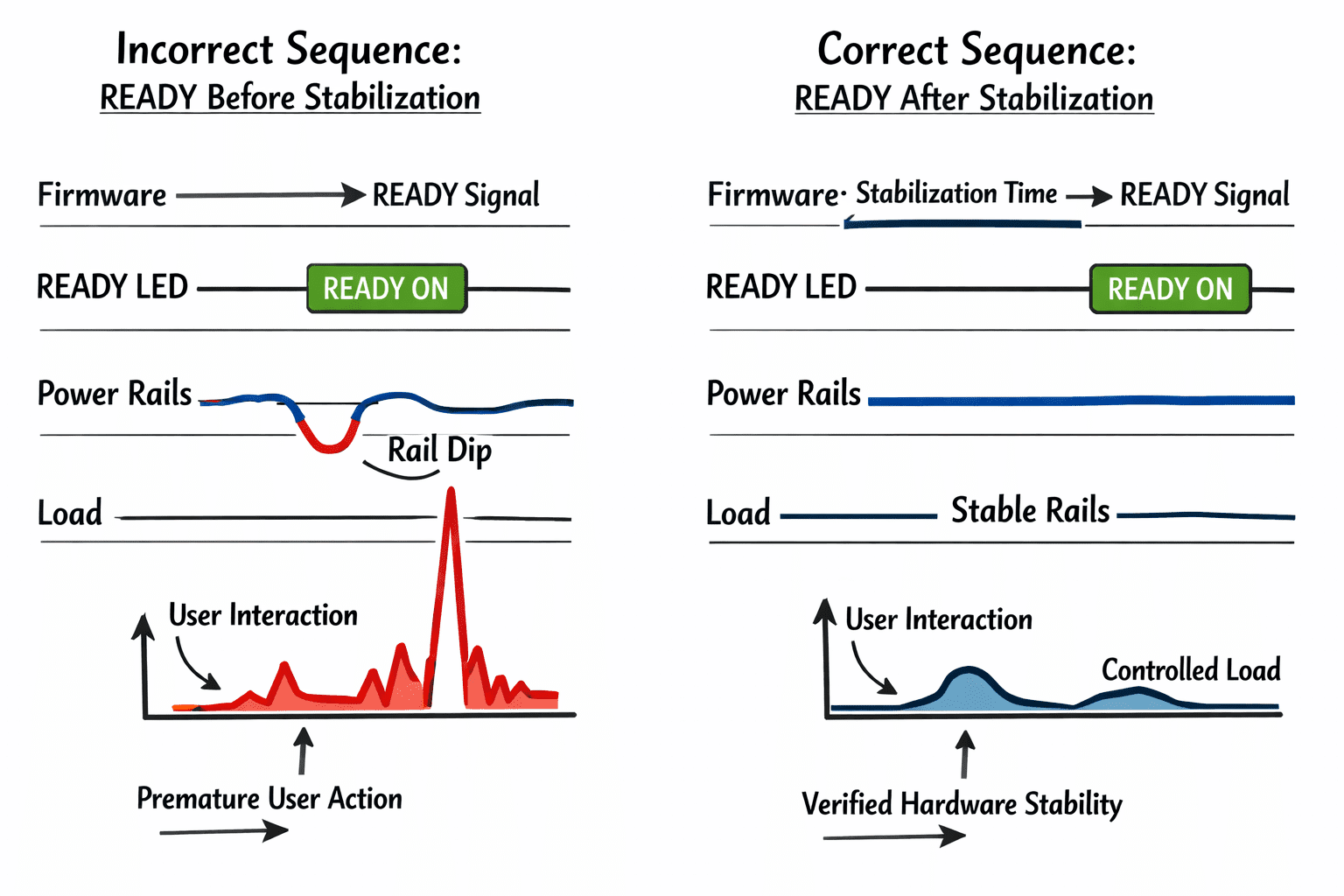
One of the worst patterns is an LED tied to a firmware state machine that assumes success, for example firmware setting the LED "ready" before hardware actually stabilizes. This causes early user interaction, premature feature activation, load spikes during unstable periods, and increased brownout risk. The correct implementation ensures "ready" means hardware ready, not just firmware progressed. This protects performance during dynamic transitions.
Manufacturing impact
On the factory floor, truthful LEDs enable quick visual inspection, reduce the need for external testers in early stages, and improve operator confidence. Measured impacts include faster failure isolation, reduced manual logging, and lower retest rates. Even a few seconds saved per board scales significantly in production.
Field diagnostics without opening the device
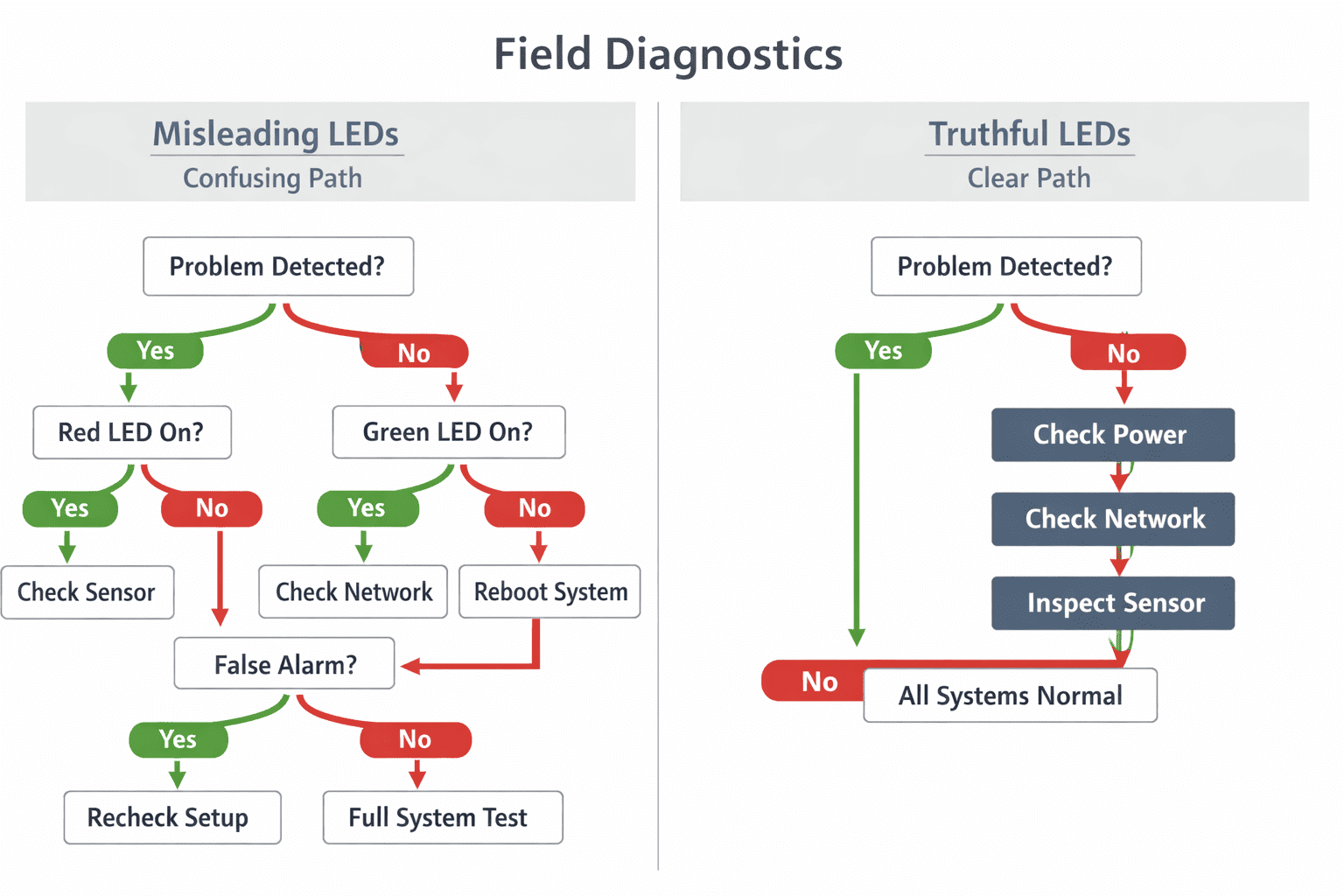
A truthful LED system allows technicians to diagnose remotely, enables phone-based troubleshooting, and reduces unnecessary RMAs. When LEDs reflect actual hardware states, support scripts become deterministic, fault trees simplify, and mean time to resolution drops. That's performance at the system lifecycle level.
Minimal hardware, maximum clarity
The goal isn't to add more LEDs. It's to encode power validity, activity integrity, fault state, and system readiness with clarity and determinism. When done correctly, you gain faster hardware fault isolation, reduced unnecessary resets, lower CPU overhead from LED handling, clearer operational state during stress, and improved uptime consistency.
LEDs are low-cost performance tools
Status LEDs are among the cheapest components on a board. Yet when designed correctly, they improve engineering velocity, reduce downtime, increase reliability perception, lower support cost, and preserve performance during real-world use. At Hoomanely, we treat LEDs as part of the system architecture, not decoration. When LEDs tell the truth, the product behaves more predictably. And predictable systems are fast systems.