Manufacturing Files Without Surprises
In hardware, the real deadline is not when the firmware compiles or the prototype boots. The real deadline is when your manufacturer loads your files into their pick-and-place line, because that's when surprises cost money.
At Hoomanely, we build connected pet hardware, weight-sensing bowls, pet trackers, BLE sensor nodes, and compute modules. Our product family shares a modular hardware ecosystem, and our priority is reducing time-to-market without sacrificing engineering rigor. In our early builds, manufacturing surprises were our biggest source of delays:
- Missing or mismatched footprints on the CPL file
- A contract manufacturer asking for fiducials and tooling rails after file hand-off
- DFM feedback requiring footprint or silk changes that triggered a re-spin
The fix wasn't more documentation, it was creating a repeatable manufacturing file workflow.
Step 1: CPL accuracy, designing for machines, not humans
Most engineers think a Gerber export is enough. In manufacturing, CPL kills more projects than Gerbers. A Component Placement List tells the factory exactly where every component goes, X/Y location, rotation, and reference designator. Before optimization, our revisions suffered from rotation mismatches on QFNs and LEDs causing wrong orientation and manual rework, parts missing from the CPL causing line stoppages and "please resend" emails, and wrong center offset for odd-shape components causing mis-pick errors on feeders.
What we implemented: per-footprint origin and rotation rules inside our component library, so rotation wasn't fixed after export, it was fixed at the library level, eliminating recurring mistakes. LEDs get their origin at the optical center with rotation zero facing cathode left, QFNs get origin at the exposed pad center with rotation zero pin-1 heading up. We also attach JSON-based metadata to every footprint, manufacturer part number, mount type, rotation, and center reference, that the CPL exporter reads automatically, no manual editing of spreadsheets. The result: CPL rework requests from manufacturers dropped to zero.

Step 2: panelization, designing with the assembly line in mind
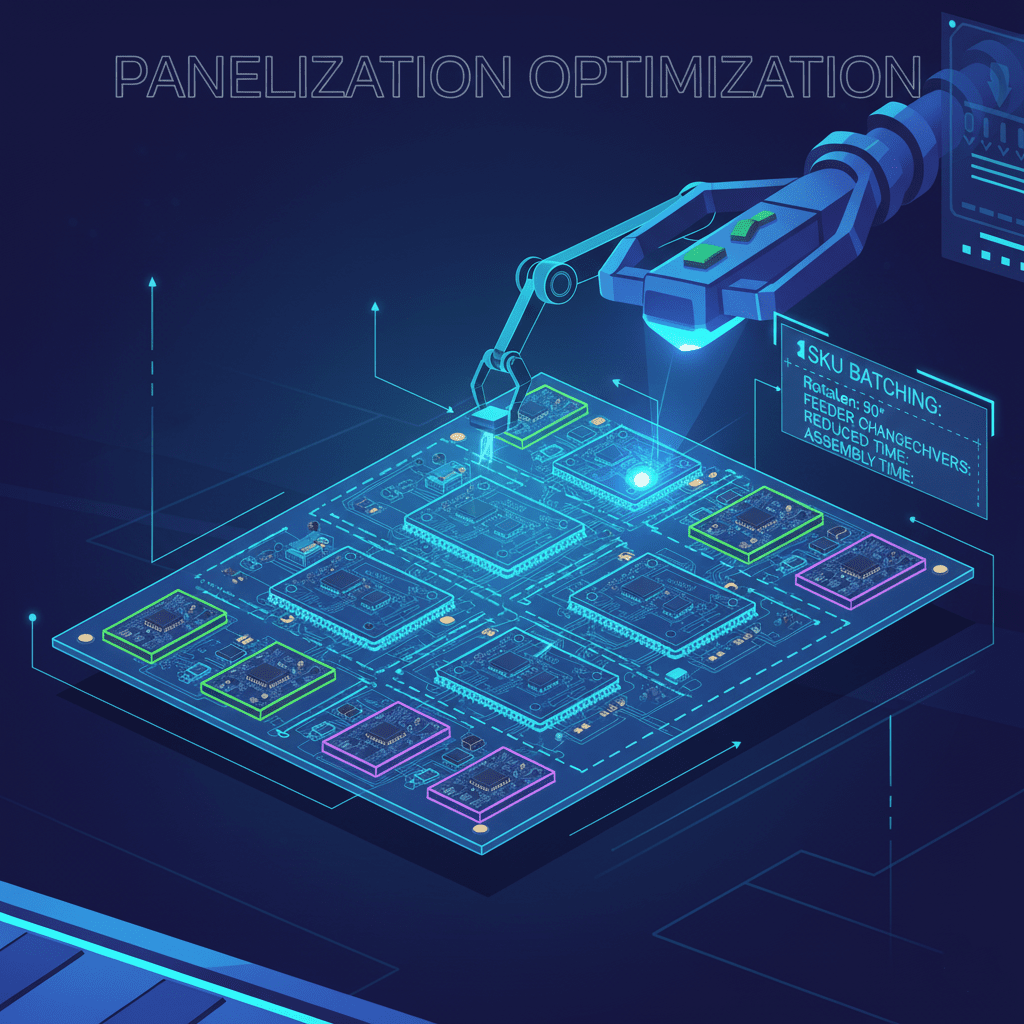
Panelization isn't just putting multiple PCBs on one sheet, done right it's a manufacturing optimization multiplier. At Hoomanely, we have multiple product SKUs reusing the same motherboard but different daughterboards and sensor modules. Our strategy uses a 3x2 test panel for fast prototype trial builds, shared edge rails with global fiducials for maximum pick-and-place efficiency, and a mixed panel of two SKUs on a single panel, only possible because of identical fiducials and datum points, enabling modular product builds. This reduces feeder changeovers, speeds up assembly quoting since the CM sees a consistent panel format, and allows cost-optimized batching across SKUs. The assembly house should never panelize for you, if they do, you inherit their constraints, not your optimization.
Step 3: fab feedback loop, no more "file final final v8"
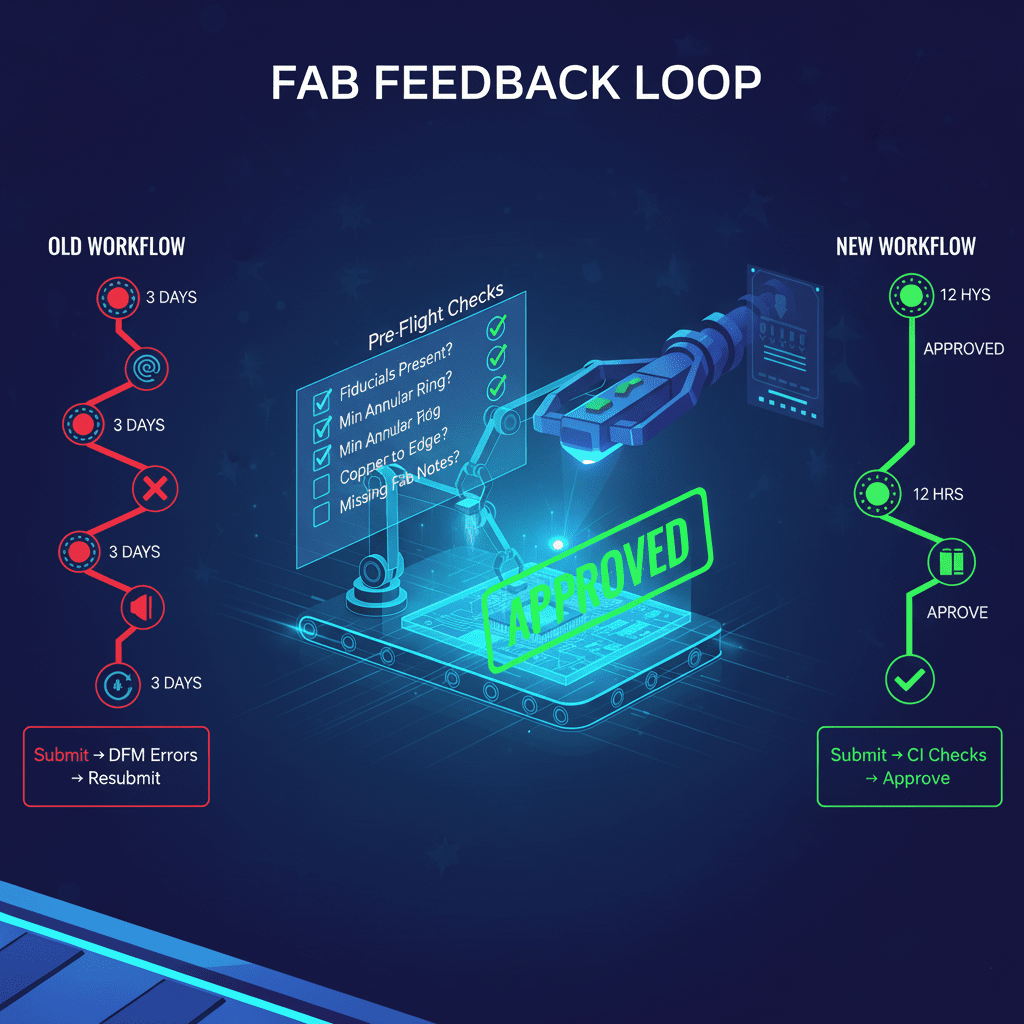
Before this process, every manufacturing cycle looked like submit, wait three days, get DFM errors, re-export, re-submit, repeat. We changed it to submit, get feedback within 12 hours, one-click regenerate, approved. How: a single source of truth document covering board spec, stack-up, via rules, and impedance targets; pre-flight checks integrated into CI checking for missing fab notes, fiducial presence, copper-to-edge spacing, and minimum annular ring; and manufacturer feedback codified back into templates and library permanently. When a fab said fiducials were too close to copper pour, we added a keepout rule of 2.5mm copper clearance around fiducials permanently. When a fab said side connectors needed a mechanical support pad, we added an auto-support-pad rule to relevant footprints permanently. Every fabrication learning becomes a design rule, not a one-off fix.
Results
First-pass manufacturing success went from roughly 70% to 100% on our last five builds. Time from design freeze to CM approval dropped from 7-10 days to 48 hours. Manual CPL edits per build dropped from 20-40 minutes to zero, fully automated. CM back-and-forth email threads dropped from 6-10 to just one, the file received confirmation. We now go from design freeze to production approval in two days, no surprises, no re-spins caused by missing data, no manual spreadsheet edits.
Final thoughts
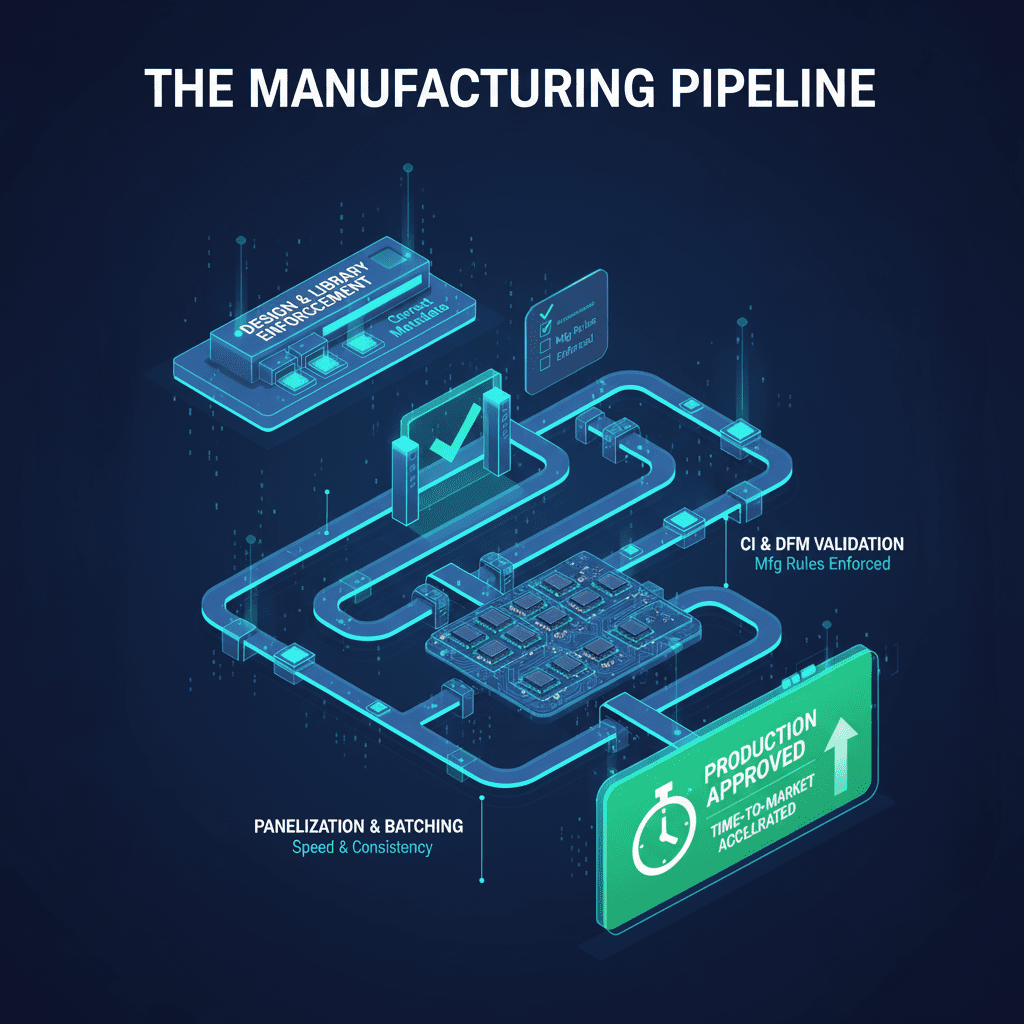
Engineering excellence isn't the absence of mistakes, it's the presence of systems that prevent repeat mistakes. At Hoomanely, manufacturing is now treated as a software pipeline, not an afterthought, libraries enforce correct metadata, CI enforces correct manufacturing rules, panelization enforces speed and consistency. Hardware moves at the speed of how quickly you can learn from the last build. By engineering the manufacturing workflow, not just the PCB, we removed chaos from the build process and accelerated time-to-market.