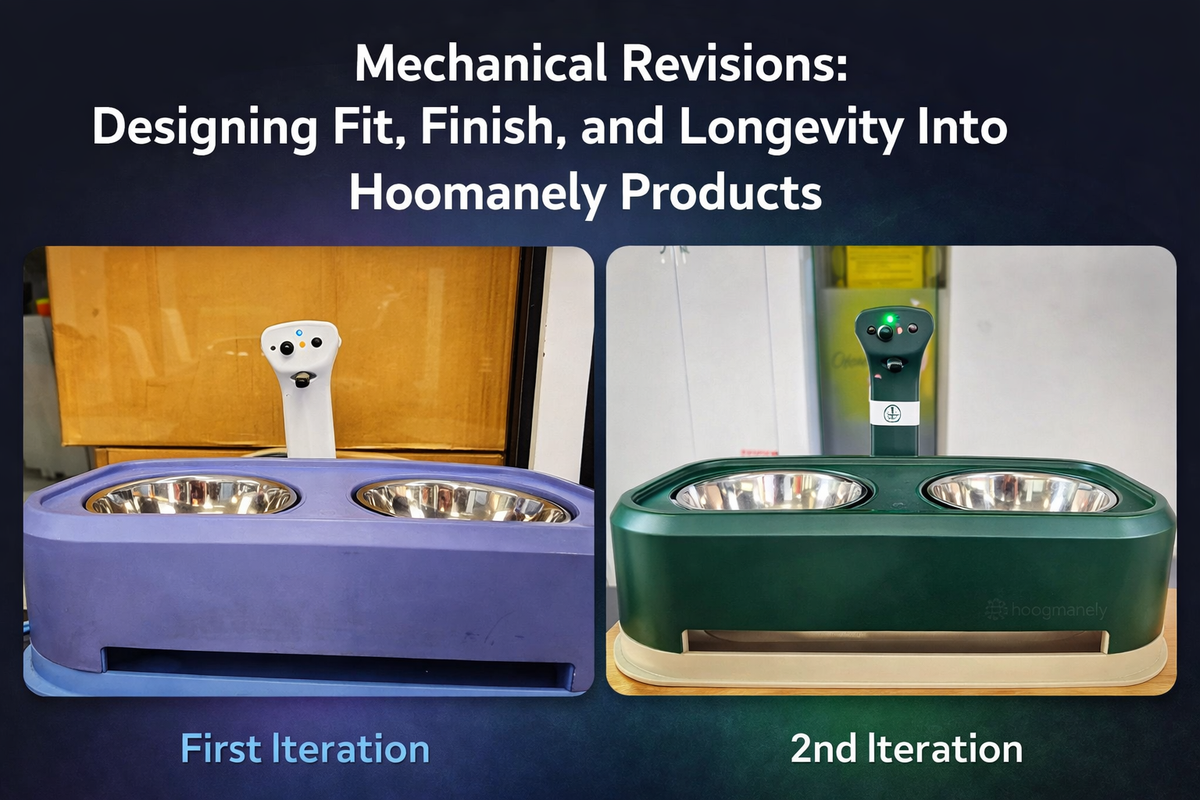
Mechanical Revisions: Designing Fit, Finish, and Longevity Into Hoomanely Products
Long before a processor boots or a sensor streams data, a user forms an opinion. That opinion is shaped not by firmware or electrical architecture, but by what they see, hold, and feel. In product engineering, the enclosure is the first interface, and often the most unforgiving one. At Hoomanely, we treat mechanical design not as a protective shell for electronics, but as a fully engineered system that defines experience, durability, and trust.
Fit: precision as a user experience
Fit is often described in visual terms, gaps, flushness, alignment, but its impact runs deeper. Poor fit introduces subconscious discomfort, even non-technical users can sense when something feels off. At a mechanical level, fit is the result of cumulative precision, PCB outline accuracy, standoff heights and tolerances, connector positioning, fastener alignment, material shrinkage and warpage, and assembly stack-ups. In vBus-based products, where multiple modules interface mechanically as well as electrically, fit becomes even more critical, a misalignment of fractions of a millimeter can create stress, uneven loading, or visible inconsistency across units.
No manufactured part is exact, so mechanical revisions focus on controlling how tolerances accumulate, not eliminating them. Our enclosure designs intentionally define datum references between PCB, enclosure, and fasteners, anchor critical alignment features to fixed mechanical references, allow non-critical surfaces to float visually without exposing gaps, and avoid tolerance stacking across unrelated features. Revisions often shift where tolerances are absorbed, a mounting post may move by a millimeter, not to fix a flaw, but to improve how dimensional variation distributes across the assembly. The result is consistency, every unit feels the same, not just the best one.
Internal fit: electronics and mechanics as one system
An enclosure is only as good as how well it respects the electronics it houses, so mechanical revisions always evolve alongside internal layouts. Key considerations include PCB-to-wall clearances preventing contact under vibration or thermal expansion, connector alignment avoiding side-loading during cable insertion, thermal interfaces maintaining pressure without inducing board stress, and cable routing paths preserving bend radius and strain relief. As products evolve, even minor PCB revisions can prompt mechanical updates, a connector shifts, a component height changes, a thermal path improves, and the enclosure must adapt precisely. Mechanical revisions ensure internal changes never degrade external experience.
Finish: the tactile contract with the user
Finish is the first physical signal of quality. Texture, color consistency, surface hardness, and edge treatment all contribute to how a product is judged, often within seconds. We design finishes not just for appearance, but for long-term handling, resistance to scratches and wear, color stability over time, and ease of cleaning and maintenance. A visually perfect surface that degrades quickly is not a premium finish, it's a liability.
Finish quality is determined as much by process as by material. Across revisions, we evaluate plastic resin selection for durability and color retention, surface texture depth to balance grip and cleanability, mold tooling adjustments reducing flow marks or gloss variation, and coatings or additives improving scratch resistance. These changes are subtle but cumulative, a slightly altered texture or revised wall thickness can dramatically improve how a product ages in real environments. Finish revisions are rarely dramatic, but they're always intentional.
Mechanical revisions as a maturity curve
Mechanical systems exist in the physical world, where users interact in ways no CAD model fully predicts, grip patterns vary, assembly forces differ, environmental exposure accumulates over time. Rather than aiming for a perfect first enclosure, we design for controlled evolution, early revisions validate geometry and integration, subsequent revisions refine ergonomics and tactile feel, and later revisions optimize durability and manufacturing repeatability. This progression is not a correction cycle, it's a maturation process, each revision incorporating broader understanding of how users handle the product, how it's serviced, how it ages, and how it performs across thousands of units.
Assembly fit: designing for repeatability
A design that assembles well once but inconsistently in production is not complete, so mechanical revisions focus heavily on assembly repeatability. This includes clear mechanical constraints that guide assembly automatically, features that self-align without forcing, fastener access that avoids tool interference, and elimination of ambiguous orientations. Mechanical changes often simplify assembly rather than complicate it, chamfers appear, bosses move, snap features gain lead-ins, not to change appearance, but to reduce variability. A well-revised enclosure assembles the same way every time, regardless of operator or location.
Longevity: designing for time, not just day one
Products are touched, cleaned, transported, and exposed to their environment. Mechanical revisions consider how materials behave over years, not weeks, evaluating surface wear patterns in high-contact areas, color stability under light and cleaning agents, fatigue in snap features or fasteners, and stress relaxation in plastic under constant load. Revisions may subtly thicken ribs, adjust snap geometry, or reinforce mounting points, not because something broke, but because long-term behavior deserves margin. Longevity is engineered quietly, the best revisions are the ones users never notice.
Aesthetics through engineering discipline
Aesthetic clarity is often mistaken for stylistic flair. In reality, it's usually the result of disciplined constraint. Mechanical revisions refine consistent radii across surfaces, balanced proportions between enclosure halves, seam lines that align with natural visual breaks, and hidden fasteners minimizing visual noise. As internal layouts stabilize, external forms simplify, visual calm emerges not from decoration, but from resolution. A refined enclosure looks intentional because it is.
Integrating feedback without chasing noise
User feedback is invaluable, but not all feedback should drive change. Mechanical revisions focus on structural patterns, not isolated preferences, looking for signals related to comfort and handling consistency, perceived solidity, visual alignment and finish durability, and ease of service and reassembly. Revisions address underlying mechanical causes rather than surface symptoms, a complaint about "feel" might lead to changes in wall thickness, rib placement, or internal load paths, not cosmetic tweaks. This keeps revisions grounded in engineering, not reaction.
Mechanical revision control as a system
Mechanical revisions are tracked with the same rigor as electrical and firmware changes, clear revision identifiers, defined compatibility boundaries, documented dimensional changes, and controlled interaction with internal modules. This ensures improvements compound without fragmenting the product ecosystem, each revision strengthens, rather than resets, the design.
Conclusion: refinement is the product
Mechanical design excellence is not achieved through a single inspired CAD model. It is achieved through iteration, discipline, and respect for how products are actually used. At Hoomanely, mechanical revisions are where intention becomes reality. Fit evolves into confidence. Finish matures into trust. Enclosures stop feeling like containers and start feeling like resolved products. The enclosure is not separate from the electronics, it is the physical expression of everything inside. When fit and finish are engineered with care, the product communicates quality before it ever powers on. That is the goal of mechanical revisions: not to change what works, but to refine it until nothing feels accidental.