Migrating from DCMI to MIPI CSI-2: Embedded Camera Interfaces for the Next Generation
Real-world lessons from transitioning parallel to serial camera architectures in production embedded systems
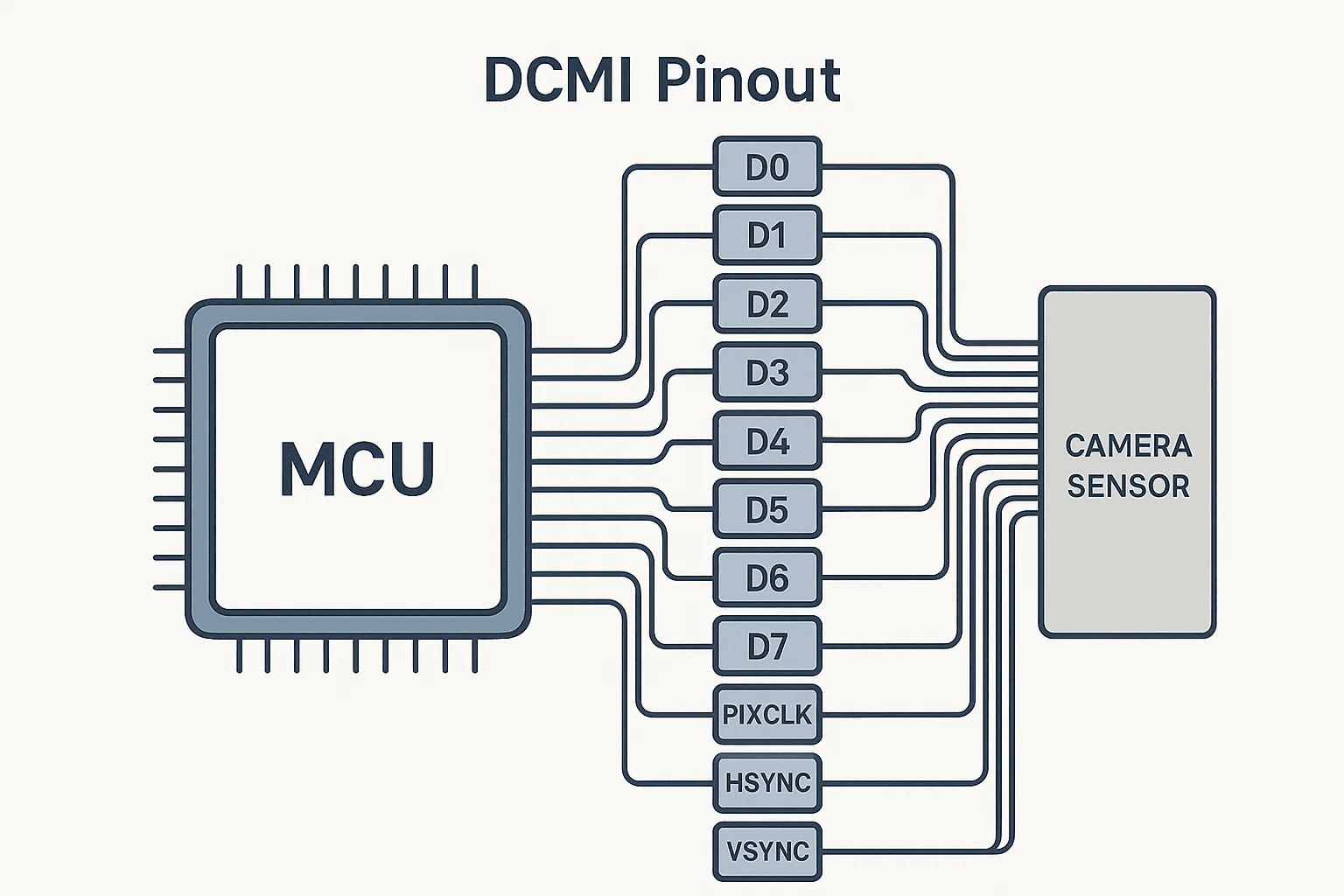
Imagine an industrial vision system built around a high-performance MCU and a 1 MP camera using the traditional parallel interface, DCMI. It worked, until thermal sensors, proximity modules, and wireless connectivity landed on the same board. Suddenly the 17 GPIO pins DCMI needs (14 data lines plus HSYNC, VSYNC, and PIXCLK) became a show-stopper. Pin conflicts forced components farther apart, high-speed parallel traces radiated EMI, and the compact form factor blew out.
That exact scenario forced us at Hoomanely to explore migrating from DCMI to the high-speed serial interface MIPI CSI-2. As embedded systems move toward higher resolution, denser sensors, and stricter power and EMI budgets, this migration is foundational, not cosmetic.
The problem: why DCMI no longer cuts it
DCMI has been a workhorse in embedded camera systems, a straightforward parallel bus with direct DMA access. But several limitations emerge in modern embedded vision. High pin count: a 12-bit data bus with HSYNC, VSYNC, PCLK, and control lines easily eats 15 to 17 GPIOs, a lot on tightly constrained boards. EMI and signal integrity: multiple parallel single-ended lines toggling at tens of MHz create switching noise, crosstalk, and routing headaches around ground-return paths and length matching. Limited bandwidth: even with an 80 MHz pixel clock and 12-bit data, you hit roughly 960 Mb/s theoretical, and practical sustained rates fall well short due to routing and memory bottlenecks. And a lack of hardware pipeline: many sensors designed for parallel output need CPU and firmware intervention for format conversion and DMA ring management, eating cycles and limiting scalability.
On our industrial monitoring platform, these limitations meant pin-availability constraints blocking additional sensors or connectivity, EMI compliance issues during certification, and serious headroom restrictions for future upgrades. DCMI was the bottleneck.
The approach: why MIPI CSI-2
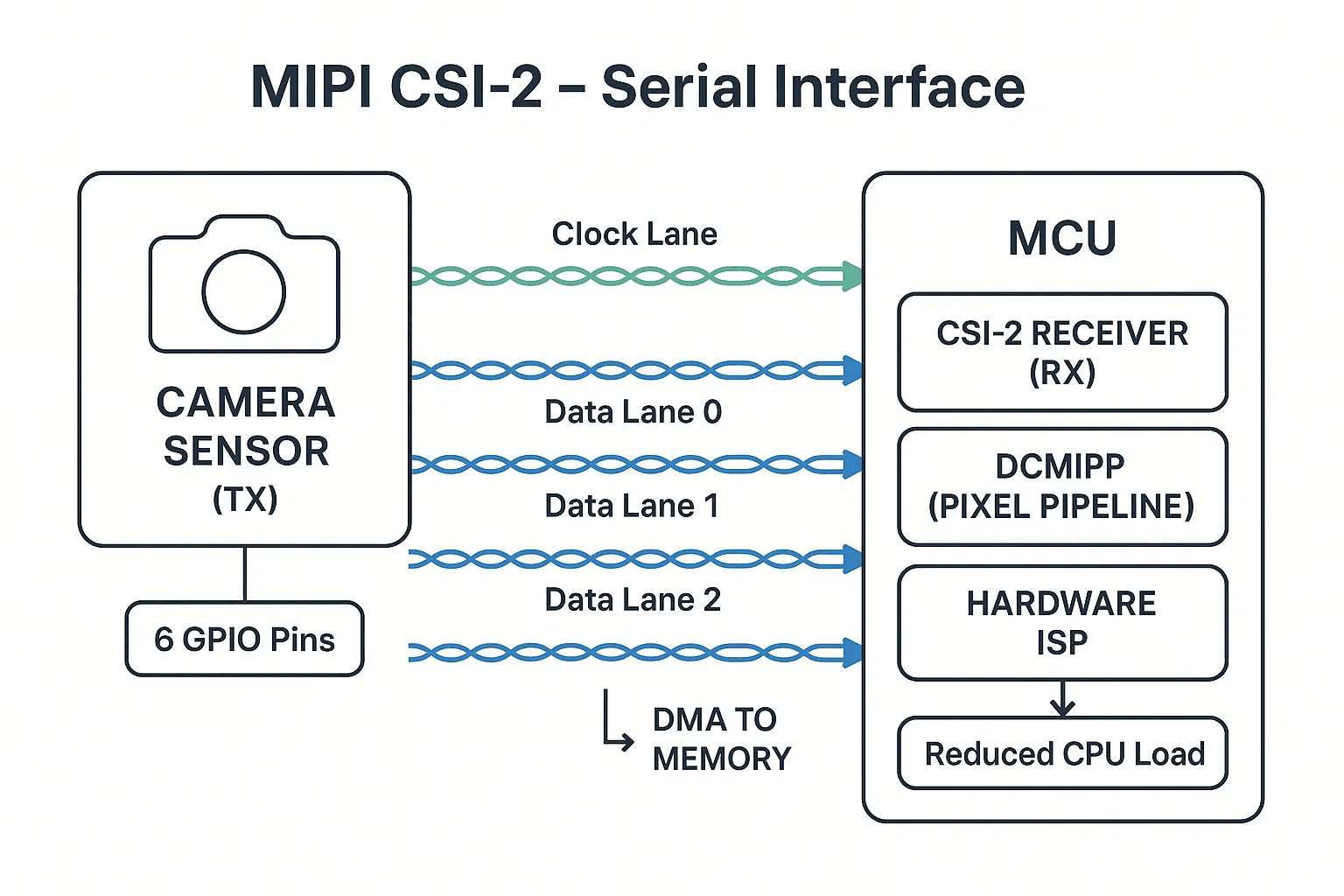
The MIPI Alliance's CSI-2 is a well-established standard for high-speed image sensor to host connections. A 4-lane CSI-2 interface uses 4 data lanes plus 1 clock lane, roughly 6 GPIOs against DCMI's 17. Each lane can deliver 2.5 Gbps or more, so a 4-lane link reaches roughly 10 Gbps theoretical. Low-power differential signaling gives better EMI immunity and simpler routing with less switching noise. Many modern SoCs include dedicated CSI-2 capture IP with DMA, ISP, and format conversion offload built in, reducing firmware burden. And virtually every modern sensor supports CSI-2 across mobile, automotive, and industrial vision, so fewer pins mean simpler routing, a smaller footprint, and more room for other sensors and interfaces.
DCMI vs. MIPI CSI-2
Our previous DCMI implementation used a 12-bit parallel bus with roughly 17 GPIOs, a max practical pixel clock around 80 MHz, heavy firmware-managed DMA capture, interrupt-driven frame-ready notification, and moderate power with high switching noise. The CSI-2 replacement uses roughly 6 GPIOs (4 lanes plus clock), up to 10 Gbps theoretical bandwidth (4 lanes at 2.5 Gbps each), differential pairs for fewer layout constraints and better EMI, hardware pixel pipelines that cut CPU overhead, and better power efficiency with headroom for future sensors.
Hardware and software migration
Board design changes. DCMI's 17 single-ended signals need length matching and skew control, with high-toggling lines causing EMI and ground-bounce, often forcing large BGA packages or dense routing. CSI-2 needs 6 differential signals (3 pairs) at 100 ohm differential impedance, trace lengths under about 30cm recommended for a reliable link on a typical board, standardized differential-pair layout with simpler ground return, and simplified EMI management from fewer switching nodes.
Software architecture evolution. The DCMI model relied on interrupt-driven, CPU-managed capture: the ISR stashed the frame buffer pointer and notified a processing task. The CSI-2 model configures a pixel pipeline directly, specifying input format (RAW12), output format (RGB565), and frame rate, letting the hardware pipeline handle conversion that used to run in software.
Lessons learned
Successful highlights included simplified board layout with fewer high-speed parallel traces for easier routing and better EMI, hardware offload freeing CPU cycles for higher-level processing like ML and edge analytics, and a future-proof design opening the path to higher resolution, multi-camera, and stereo vision systems.
Critical gotchas are worth flagging too. Timing sensitivity is real, CSI-2 needs precise parameter tuning (T-HS-SETTLE, T-LPX, T-CLK-SETTLE), and faulty values cause pixel drop or link reset, the fix is starting with sensor-max values and iterating downward until stable. Driver maturity varies, some MCUs with CSI-2 support have immature driver stacks, expect patching. Sensor ecosystem and legacy support matter, if your existing sensors only output parallel, migration may force board redesign or a bridge chip. And debug complexity goes up, differential high-speed lanes are harder to probe, you'll need oscilloscopes supporting over 2.5 Gbps and BERT equipment.
Migration decision framework
Migrate to CSI-2 when GPIO pin count constrains system design, you're planning 4K or higher resolution, EMI compliance is a struggle with parallel interfaces, you're working in space-constrained applications, or your sensor roadmap requires MIPI compatibility. Stick with DCMI when using legacy sensors without MIPI support, cost sensitivity prohibits board redesign, applications are low-resolution (under 1MP) with relaxed timing, or your existing design already meets all requirements.
Before migrating: verify sensor MIPI CSI-2 support and lane requirements, obtain complete sensor timing specs, review the PCB design for differential pair routing and impedance control, and account for CSI PHY power in your budget. During migration: generate a base configuration and expect manual tuning, start with conservative timing parameters and optimize later, test incrementally starting with the lowest resolution and frame rate, and validate signal integrity with an oscilloscope checking eye diagrams.
Timing parameter optimization
A systematic binary-search approach works well for settling time calibration:
// Systematic approach to timing optimization
typedef struct {
    uint32_t t_hs_settle_min;
    uint32_t t_hs_settle_max;
    uint32_t optimal_value;
} TimingCalibration;

HAL_StatusTypeDef CSI_CalibrateTimings(CSI_CameraHandle *camera) {
    TimingCalibration settle_cal = {
        .t_hs_settle_min = 85,  // ns - typical minimum
        .t_hs_settle_max = 145, // ns - typical maximum
    };

    for (uint32_t test_value = settle_cal.t_hs_settle_min;
         test_value <= settle_cal.t_hs_settle_max;
         test_value += 5) {

        camera->hcsi->timing.t_hs_settle_ns = test_value;

        if (CSI_TestFrameCapture(camera) == HAL_OK) {
            settle_cal.optimal_value = test_value;
            break;
        }
    }

    return HAL_OK;
}
Why it matters at Hoomanely
This migration directly advances our ambient intelligence systems that need to understand behavior and environmental context with minimal latency. The bandwidth improvement and integrated hardware acceleration enable real-time analysis of higher-resolution imagery, while the dramatic reduction in GPIO usage lets us integrate more sensors and connectivity within the same physical constraints, crucial for unobtrusive monitoring solutions that blend into a pet's home environment. As we expand into AI-powered edge devices, the MIPI ecosystem gives us access to the latest sensor technologies and processing capabilities for next-generation computer vision.
Key takeaways
Plan for the ecosystem transition, MIPI CSI-2 adoption is accelerating across sensor manufacturers, and early migration provides a real competitive advantage. Factor in timing complexity, MIPI timing parameters need more precision than parallel interfaces, budget development time for sensor-specific tuning. Embrace hardware acceleration, modern MCUs with integrated pixel pipelines transform camera systems from CPU-intensive to hardware-accelerated. Validate before committing, confirm your target sensors actually support CSI-2 before starting migration. And invest in debug infrastructure, MIPI debugging needs different tools and techniques than parallel interfaces, plan for that learning curve.