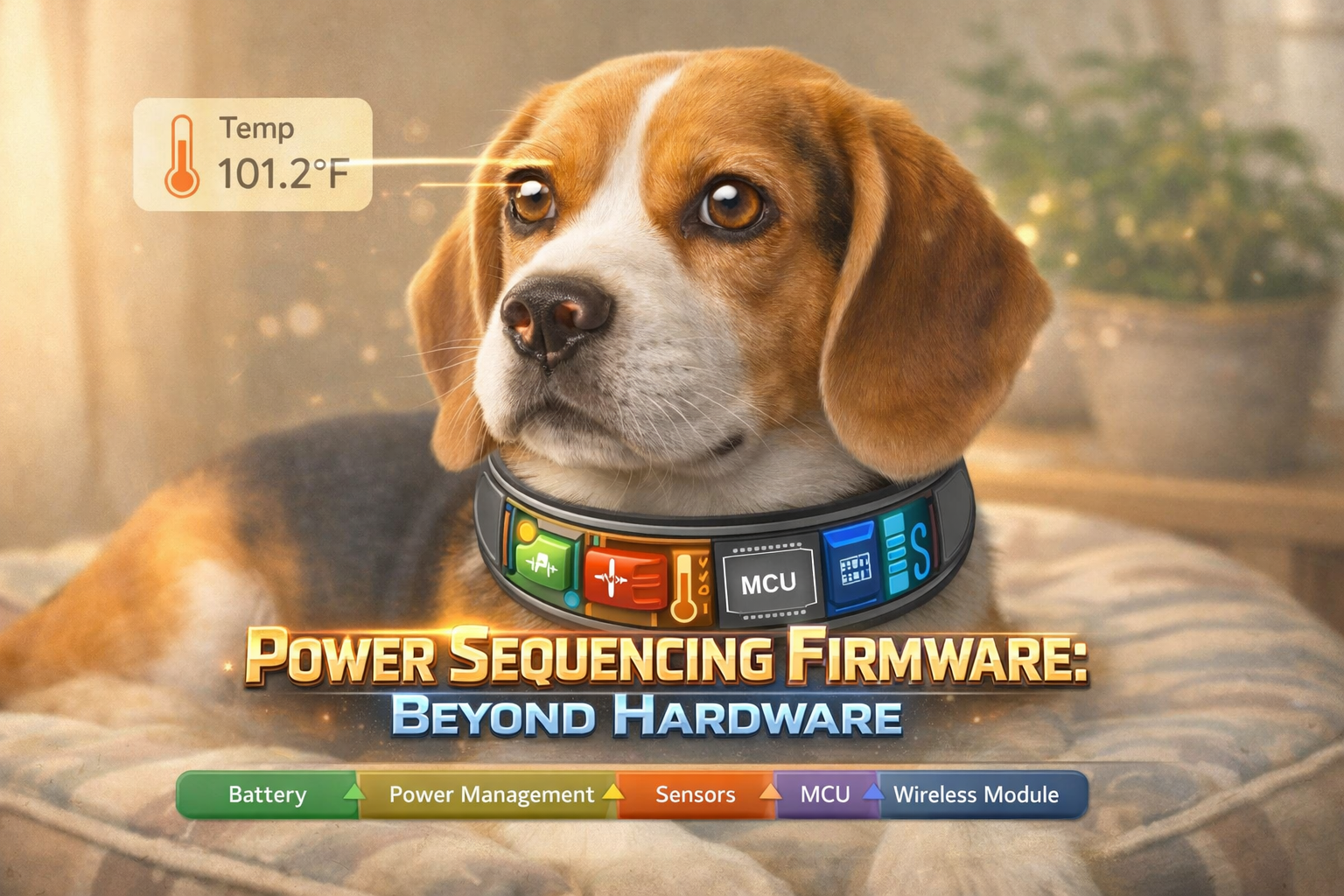
Power Sequencing Firmware: Beyond Hardware - Software-Controlled Startup
How intelligent firmware orchestrates complex device initialization for reliable embedded systems
In embedded systems, the moment you press power is just the beginning of an intricate dance. Hardware designers focus on voltage rails and capacitors, but firmware engineers face an equally critical challenge: making sure every component powers up in the right sequence, at the right time, with proper fault handling. This software-controlled approach to power management has become essential in modern IoT devices, edge computing systems, and monitoring equipment where reliability isn't optional.
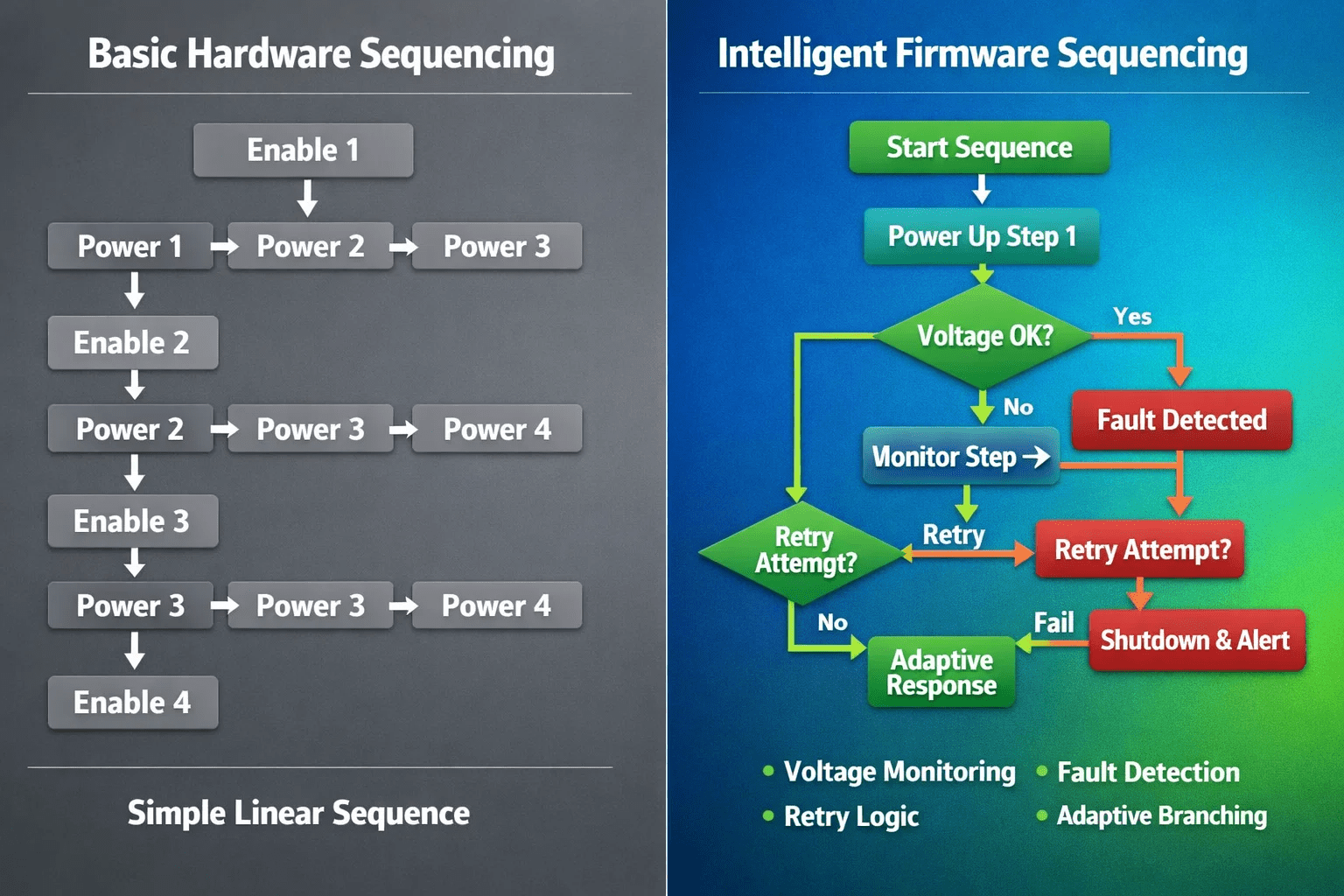
Power sequencing firmware turns what could be chaotic hardware startup into a predictable, monitored, recoverable process. Rather than relying solely on hardware power management ICs, sophisticated firmware state machines give you granular control, intelligent fault detection, and adaptive recovery that hardware alone can't achieve.
Why software-controlled power sequencing matters
Hardware-only sequencing works for simple systems, but modern embedded devices demand more intelligence. A multi-sensor edge computing device with camera modules, wireless transceivers, AI processing units, and external storage has specific power-up timing requirements, voltage dependencies, and failure modes for every component that need intelligent handling.
Complex dependencies show up constantly: a camera sensor might need its analog supply stable for 10ms before digital logic can enable, while wireless modules may need crystal oscillators to settle before radio initialization. Hardware-only solutions also give limited fault visibility. When something goes wrong during startup, you need firmware that can detect the specific failure point, log diagnostic information, and implement an appropriate recovery strategy, retry, skip a non-critical component, or drop into a safe diagnostic mode. Advanced applications also need runtime power state changes, a pet monitoring device might dynamically enable or disable sensor modules based on activity detection or battery level, which needs real state machine management beyond static hardware sequencing. And professional-grade systems need detailed startup telemetry, precise timing, voltage monitoring, failure analytics, for both immediate recovery decisions and long-term reliability improvements.
Architecture: robust power sequencing state machines
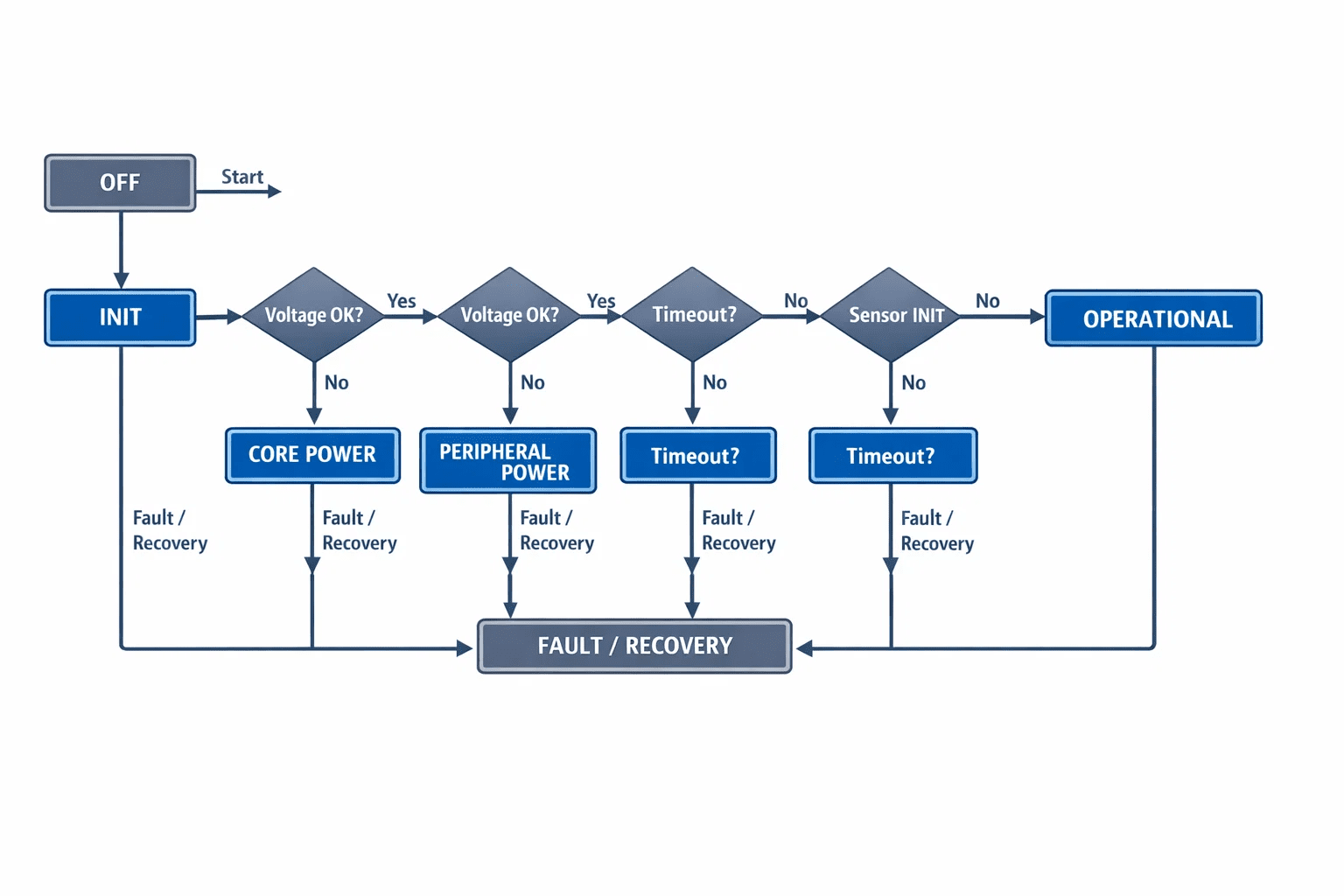
Effective power sequencing firmware centers on well-designed state machines modeling the power-up process as discrete states with defined transitions, timeouts, and error handling:
typedef enum {
    POWER_STATE_OFF,
    POWER_STATE_INIT,
    POWER_STATE_CORE_POWER,
    POWER_STATE_PERIPHERAL_POWER,
    POWER_STATE_SENSOR_INIT,
    POWER_STATE_COMMS_INIT,
    POWER_STATE_OPERATIONAL,
    POWER_STATE_FAULT,
    POWER_STATE_RECOVERY
} power_state_t;

typedef struct {
    power_state_t current_state;
    uint32_t state_entry_time;
    uint32_t timeout_ms;
    uint8_t retry_count;
    fault_code_t last_fault;
} power_sequencer_t;
This gives clear state visibility for debugging, timeout protection against hanging in any single state, retry logic for transient failures, and fault isolation that makes it easy to identify exactly where problems occur in the sequence.
GPIO control gets organized into logical groups with proper timing relationships:
typedef struct {
    GPIO_TypeDef* port;
    uint16_t pin;
    uint32_t delay_after_ms;
    bool active_high;
} power_control_t;

// Power sequence configuration
static const power_control_t core_power_seq[] = {
    {GPIOA, GPIO_PIN_0, 5,   true},  // Primary regulator enable
    {GPIOA, GPIO_PIN_1, 10,  true},  // Secondary regulator enable
    {GPIOB, GPIO_PIN_2, 15,  false}, // Reset release (active low)
};
This structured approach keeps timing consistent, makes sequences easy to reconfigure, and gives a clear framework for adding new power domains as systems evolve.
Voltage monitoring and fault detection
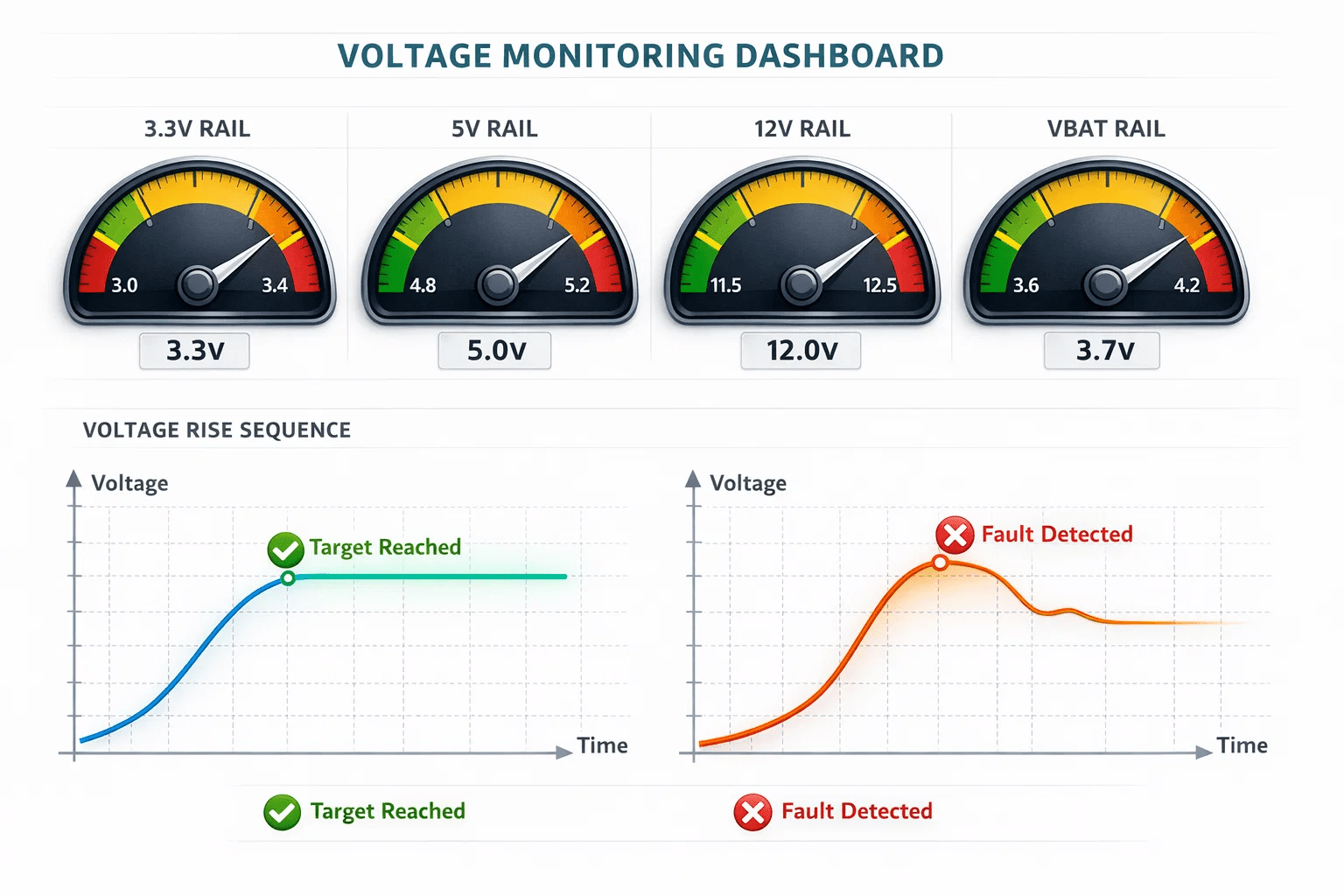
Reliable sequencing needs continuous monitoring of system voltages, with the ADC serving as a critical sensor for the power management system:
typedef struct {
    uint16_t nominal_mv;
    uint16_t tolerance_percent;
    uint16_t settling_time_ms;
    uint8_t adc_channel;
} voltage_monitor_t;

bool check_voltage_rail(const voltage_monitor_t* monitor) {
    uint16_t measured_mv = read_adc_voltage(monitor->adc_channel);
    uint16_t tolerance = (monitor->nominal_mv * monitor->tolerance_percent) / 100;

    return (measured_mv >= (monitor->nominal_mv - tolerance)) &&
           (measured_mv <= (monitor->nominal_mv + tolerance));
}
The firmware continuously samples critical voltage rails during sequencing, comparing measured values against expected ranges to catch brown-outs, regulator failures, or excessive ripple before they damage downstream components.
Beyond simple range checking, sophisticated fault detection looks for patterns. Voltage settling analysis, watching how quickly rails reach target values, can detect weak regulators or excessive load before they cause real failures. Startup current monitoring helps identify components that aren't initializing properly or are drawing excessive power due to a fault. Temperature correlation helps distinguish environmental startup issues from actual component failures.
When faults occur, the recovery strategy depends on fault type and criticality:
void handle_power_fault(fault_code_t fault_code) {
    switch(fault_code) {
        case FAULT_VOLTAGE_LOW:
            if(retry_count < MAX_RETRIES) {
                delay_ms(RETRY_DELAY);
                restart_power_sequence();
            } else {
                enter_safe_mode();
            }
            break;

        case FAULT_TIMEOUT:
            log_detailed_diagnostics();
            skip_non_critical_components();
            continue_sequence();
            break;

        case FAULT_OVERCURRENT:
            immediate_shutdown();
            log_critical_fault();
            break;
    }
}
This tiered approach lets systems gracefully degrade functionality while keeping core operations running, which matters a lot where complete system failure just isn't acceptable.
Handling edge cases
Real-world power sequencing runs into edge cases simple state machines can't handle well. Dynamic sequencing adapts power-up behavior based on the previous shutdown reason, available power source, and detected hardware configuration, using a minimal power sequence for faster recovery after a watchdog reset, or a low-power sequence when starting on a low battery, and the full sequence otherwise.
Power state persistence in non-volatile memory enables intelligent resume: checkpointing critical power state before shutdown lets startup skip components that were already properly initialized, component health tracking helps predict potential failures and adjust timeouts dynamically, and energy budget tracking helps optimize sequences for battery life.
Environmental compensation matters too, cold temperatures increase settling time while high temperatures may settle faster, so settling time calculations adjust for measured system temperature to stay reliable across the full operating range.
Real-world application: power management in edge AI
A comprehensive monitoring system typically integrates a core processing unit needing stable power before peripheral initialization, AI acceleration hardware needing precise voltage sequencing and thermal management, a sensor array with varying power-up times, communication modules needing crystal stabilization and RF calibration, and storage systems with specific write voltage sequences. Power sequencing firmware has to orchestrate all of it under real-time constraints, power budget limits, and fault tolerance requirements.
Smart recovery and graceful degradation matter here too. If a sensor fails to initialize, the system logs the failure, checks whether it's critical, and either enters a diagnostic mode or continues with reduced functionality by disabling features that depend on that sensor, maximizing system availability even when individual components fail.
Debugging and optimization
Effective power sequencing firmware includes comprehensive debugging: detailed logging of timestamp, state, voltage readings, current consumption, temperature, and fault status gives insight into sequencing behavior, helping optimize timeout values, spot marginal components, and predict potential failures before they affect operation. Parallel initialization of independent components where hardware allows reduces overall startup time, predictive timeouts based on historical timing data improve reliability while minimizing unnecessary delay, and monitoring actual power consumption during sequencing helps optimize for battery life and thermal management.
Why it matters at Hoomanely
Pet health events can occur at any time, making device downtime unacceptable. Our power sequencing firmware makes sure improvements to our monitoring algorithms never compromise device availability. The dual-bank approach lets us deploy sophisticated health monitoring algorithms and ML models while keeping the safety net of proven firmware, particularly valuable for edge AI, where new models have to deploy safely without risking device functionality. Physical intelligence devices with sensor fusion need precise power management to make sure every sensor initializes correctly and stays synchronized for accurate health data. Continuous monitoring can't afford unexpected downtime from a power sequencing failure, so fault detection and recovery here directly protects system availability.
Key takeaways
Well-designed state machines give predictable behavior while staying flexible for complex scenarios and edge cases. Real-time voltage and current monitoring combined with intelligent fault detection enables proactive problem identification. Tiered fault handling lets systems gracefully degrade rather than fail outright. Environmental awareness, adjusting for temperature, power source, and system history, optimizes performance across diverse operating conditions. And comprehensive logging and telemetry are essential for both development optimization and field troubleshooting.