Queue vs. Direct Task Notify Performance Trade-offs in FreeRTOS ITC
FreeRTOS queue vs direct task notification is a fundamental inter-task communication trade-off with real performance implications for real-time embedded systems. On ARM Cortex-M33 at 250MHz, FreeRTOS queues average 15 to 25 microseconds of latency including copy operations and context switch overhead, while direct task notifications deliver 2 to 5 microseconds through zero-copy atomic operations with zero additional memory footprint. That roughly 5x improvement recovers several milliseconds per frame in interrupt-driven sensor pipelines. Direct task notifications suit high-frequency ISR signaling; queues suit complex multi-producer consumer data flows; sophisticated systems combine both.
Modern embedded systems demand efficient inter-task communication (ITC) mechanisms that balance performance with reliability. When building high-performance sensor systems, every microsecond counts, especially in real-time applications where hardware interrupts must trigger rapid processing pipelines. This post examines two fundamental FreeRTOS ITC approaches, traditional queues versus direct task notifications, and where each one wins.
The challenge: when hardware speed meets software reality
In precision sensor systems, the gap between hardware capability and software overhead becomes obvious fast. Consider a thermal imaging sensor generating frames at 30 FPS, each frame must be captured, processed, and stored within a 33.3ms window. Traditional ITC mechanisms often introduce latencies that accumulate across the processing pipeline, constraining overall system throughput.
Understanding the fundamentals
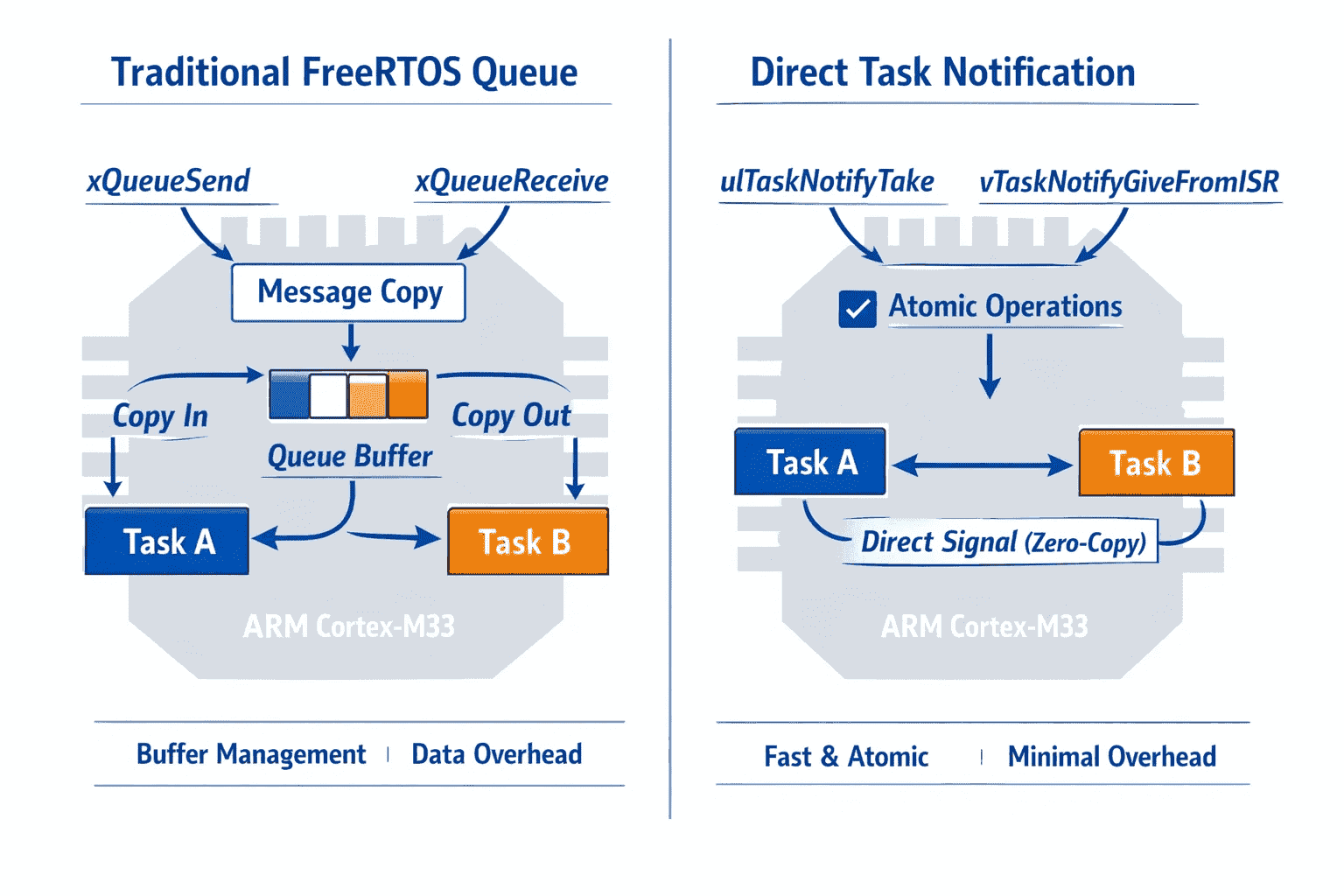
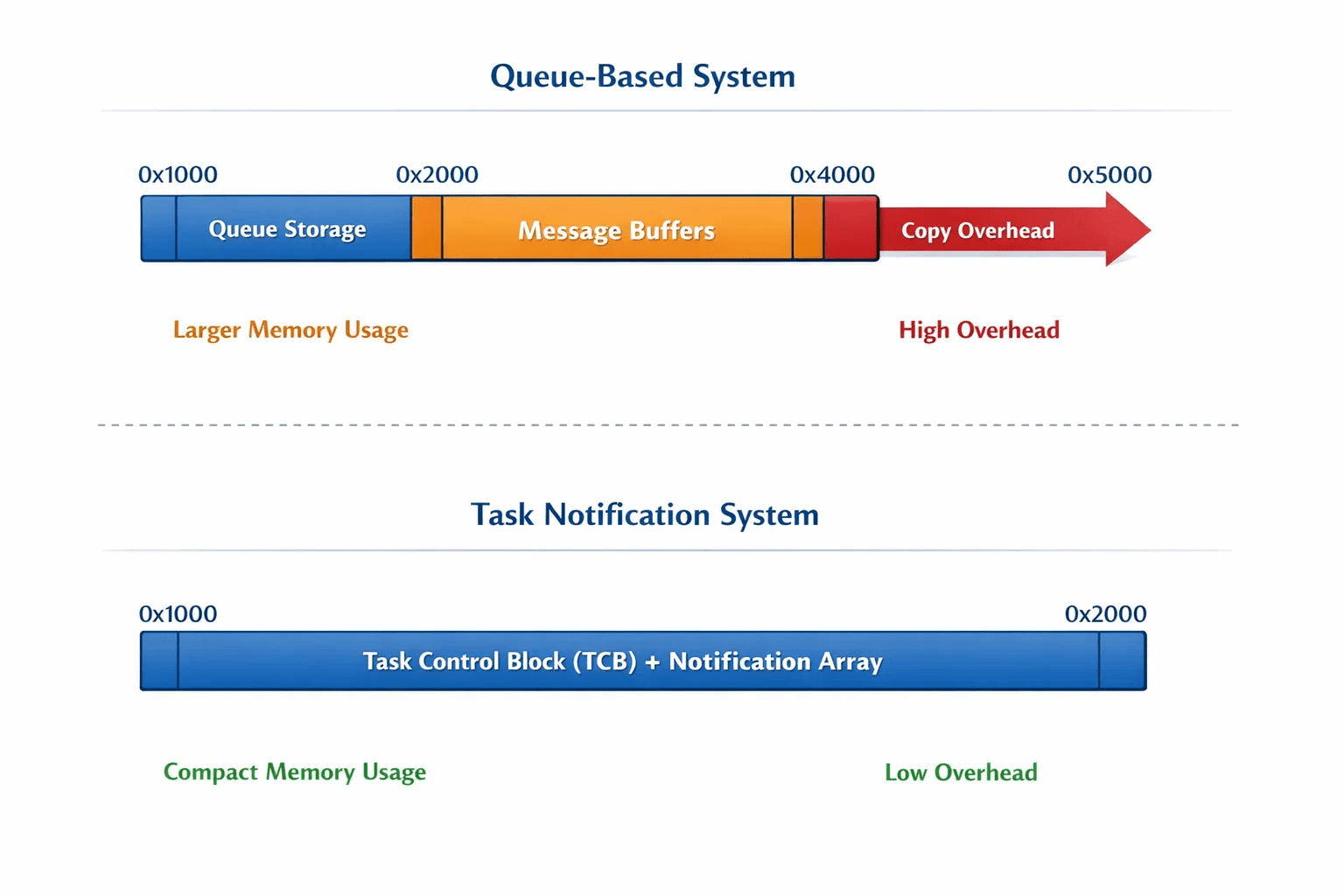
FreeRTOS queues are the traditional approach to inter-task communication: a robust, feature-rich solution for passing data between tasks with built-in synchronization and buffering. Queues maintain internal buffers to store message copies, copy messages into and out of storage, support multiple producers and consumers, allow blocking operations while tasks wait for space or messages, and require dedicated memory for message buffers.
Direct task notifications, introduced in FreeRTOS v8.2.0, are a lightweight alternative for simple signaling. They leverage the task control block's built-in notification array, eliminating separate queue objects entirely: zero copy, no message copying, only notification values; minimal memory, using existing task control block storage; single target, one-to-one communication only; atomic operations with hardware-optimized primitives; and faster context switches from reduced scheduler overhead.
Performance analysis: real-world impact
These measurements come from ARM Cortex-M33 implementations running at 250MHz, representative of typical industrial IoT processing.
Memory footprint. A traditional queue:
// Traditional queue approach - storage overhead
QueueHandle_t transmission_queue;
transmission_queue = xQueueCreate(8, sizeof(transmission_msg_t));
// Memory usage: ~160 bytes (queue + 8 x 20-byte messages)
A direct task notification:
// Zero additional memory required
ulTaskNotifyTake(pdTRUE, portMAX_DELAY);
// Memory usage: 0 bytes (uses existing TCB)
The memory savings add up in systems with multiple communication channels. A typical sensor processing pipeline might need 10 to 15 communication paths, where queues consume around 1.6KB while notifications use zero additional memory.
Latency. Queue operations average 15 to 25μs, including copy operations, while direct notifications average 2 to 5μs of atomic-operation-only latency. That roughly 5x improvement matters in time-sensitive applications: for a 30 FPS camera system, cutting ITC latency from 25μs to 5μs per operation can recover several milliseconds per frame, enough headroom for additional processing or higher frame rates.
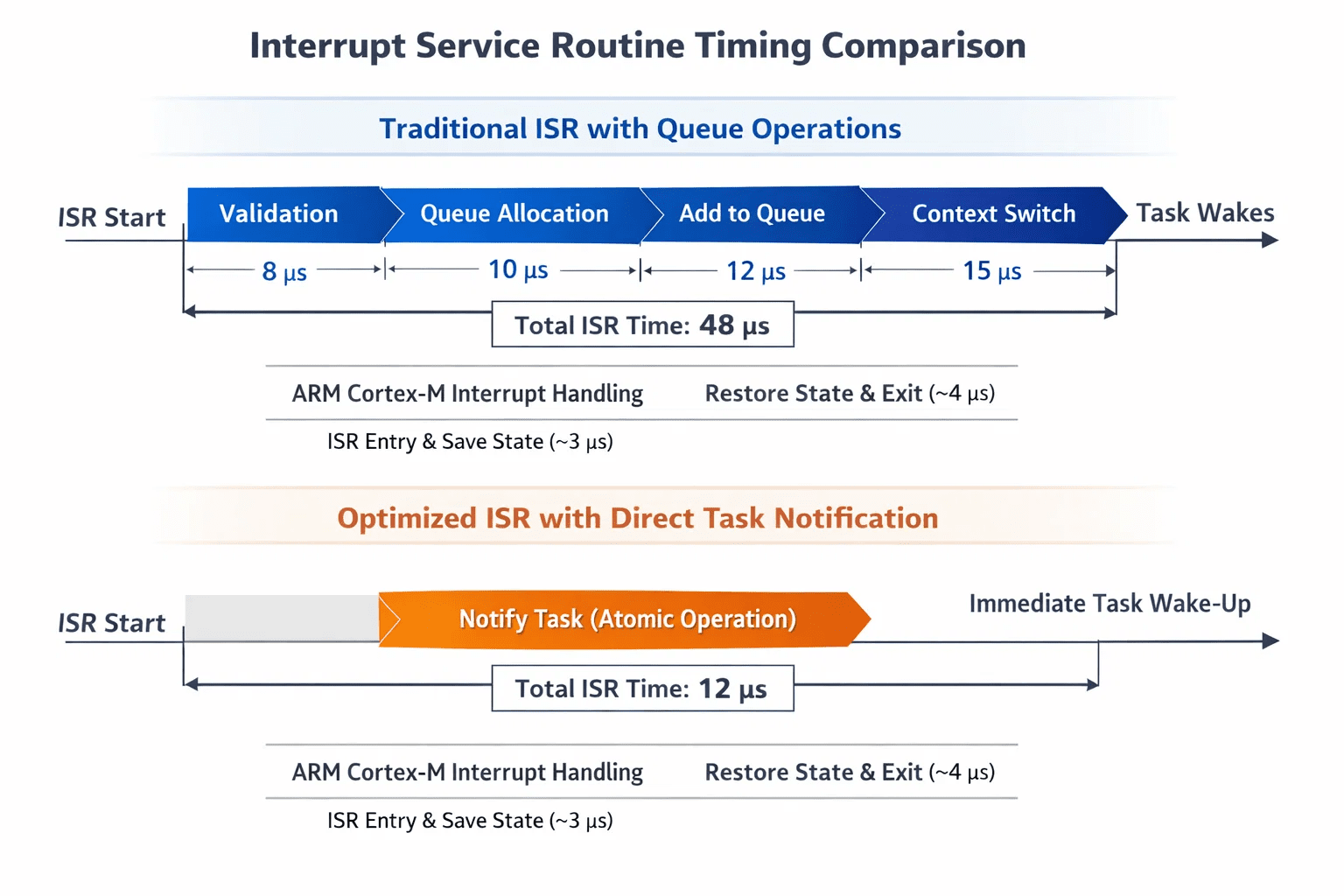
Context switch overhead. Task notifications shine in interrupt-driven scenarios. Traditional queue operations from ISR context need additional validation and can trigger longer context switches:
// Queue from ISR - multiple validation steps
BaseType_t xHigherPriorityTaskWoken = pdFALSE;
xQueueSendFromISR(queue, &message, &xHigherPriorityTaskWoken);
portYIELD_FROM_ISR(xHigherPriorityTaskWoken);

// Direct notification - single atomic operation
BaseType_t xHigherPriorityTaskWoken = pdFALSE;
vTaskNotifyGiveFromISR(task_handle, &xHigherPriorityTaskWoken);
portYIELD_FROM_ISR(xHigherPriorityTaskWoken);
Architectural trade-offs
Direct task notifications work best for: simple signaling like boolean events, counters, or completion flags; high-frequency, interrupt-driven processing pipelines; memory-constrained systems where every byte matters; and one-to-one producer-consumer relationships.
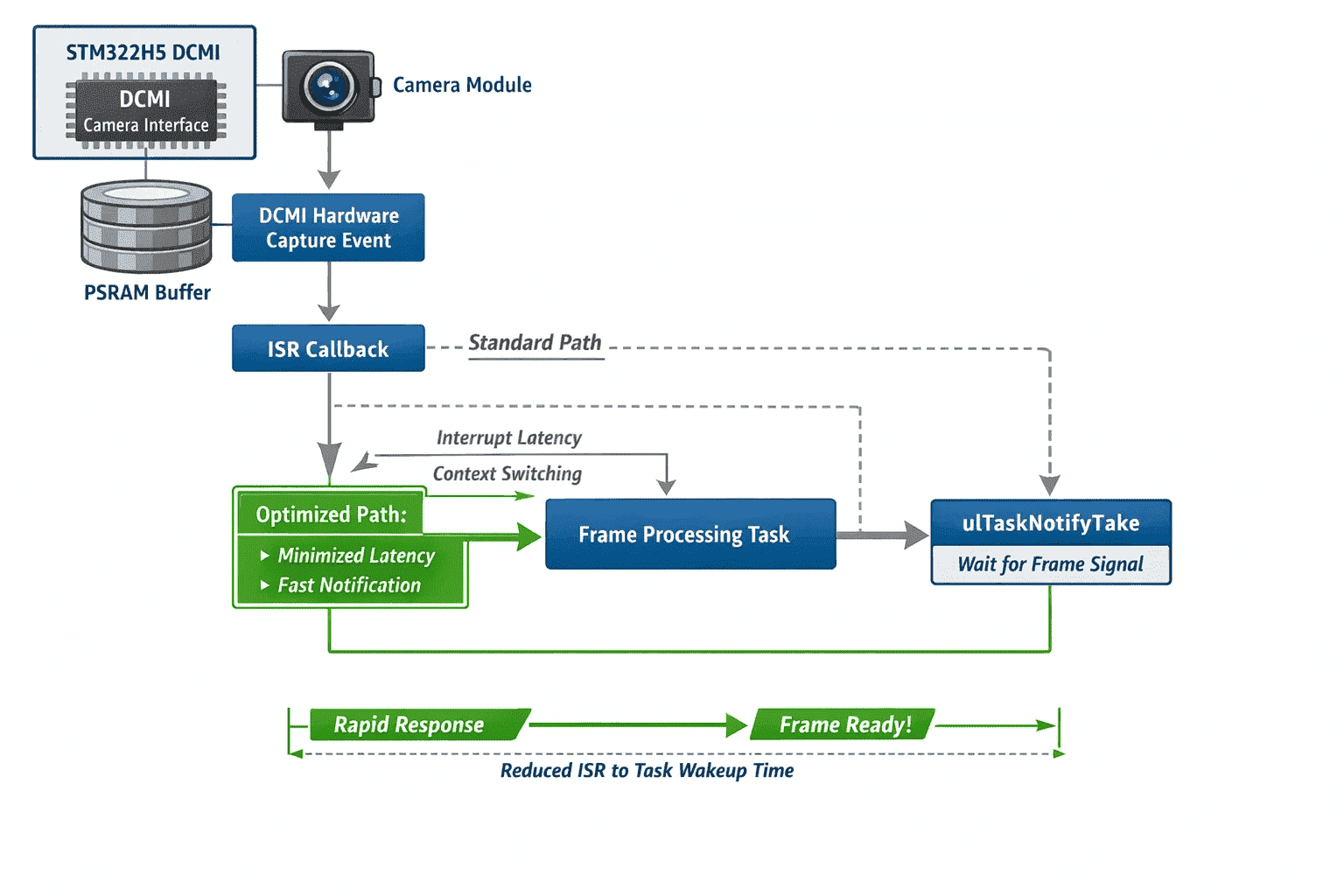
In our camera system, frame capture completion uses direct notifications to minimize ISR latency:
// Frame processing task waits for notification
void frame_processing_task(void *pvParameters) {
    for (;;) {
        ulTaskNotifyTake(pdTRUE, portMAX_DELAY);
        // Process frame immediately
    }
}

// ISR notifies completion with minimal overhead
void HAL_DCMI_FrameEventCallback(DCMI_HandleTypeDef *hdcmi) {
    BaseType_t xHigherPriorityTaskWoken = pdFALSE;
    vTaskNotifyGiveFromISR(frame_processing_task_handle,
                           &xHigherPriorityTaskWoken);
    portYIELD_FROM_ISR(xHigherPriorityTaskWoken);
}
Queues remain essential when: you have complex data structures, multi-field messages, or variable-length data; you need buffering for burst traffic or producer-consumer rate mismatches; multiple producers contribute to the same processing pipeline; or you need FIFO message ordering guarantees.
Storage systems benefit from queues when multiple sensors generate data asynchronously:
typedef struct {
    uint32_t sensor_id;
    uint32_t timestamp;
    uint8_t *data_buffer;
    size_t data_length;
} sensor_data_t;

QueueHandle_t storage_queue = xQueueCreate(16, sizeof(sensor_data_t));
Optimization strategies
Hybrid approaches. Sophisticated systems often combine both mechanisms: fast notification paths for time-critical signaling, queues for complex data flows.
// Fast path: immediate processing notification
vTaskNotifyGiveFromISR(urgent_task_handle, &yield);

// Slow path: detailed processing through queue
xQueueSendFromISR(processing_queue, &complex_message, &yield);
Performance tuning guidelines: profile before optimizing, since actual latencies vary by target hardware; consider system load, since performance characteristics shift under different CPU utilization; weigh memory versus speed trade-offs, since direct notifications save memory but limit functionality; and plan for scalability in how communication patterns will grow.
Why it matters at Hoomanely
These performance optimizations directly support continuous pet health monitoring. Rapid response to physiological changes can be life-critical, and optimized ITC patterns let sensor systems achieve sub-millisecond response times for emergency detection while maintaining energy efficiency for 24/7 operation. The combination of direct task notifications for critical signaling and selective queue usage for complex data processing lets our Biosense AI engine process multiple sensor streams simultaneously without compromising response times.
Key takeaways
Direct task notifications provide roughly 5x latency reduction for simple signaling, with meaningful memory savings per communication channel and optimized ISR performance for interrupt-driven systems. Choose notifications for simple, high-frequency signaling; reserve queues for complex data structures and multi-producer scenarios; and consider hybrid approaches for comprehensive system optimization. Profile actual performance in target hardware conditions, and design communication patterns to match data complexity requirements rather than defaulting to one mechanism everywhere.