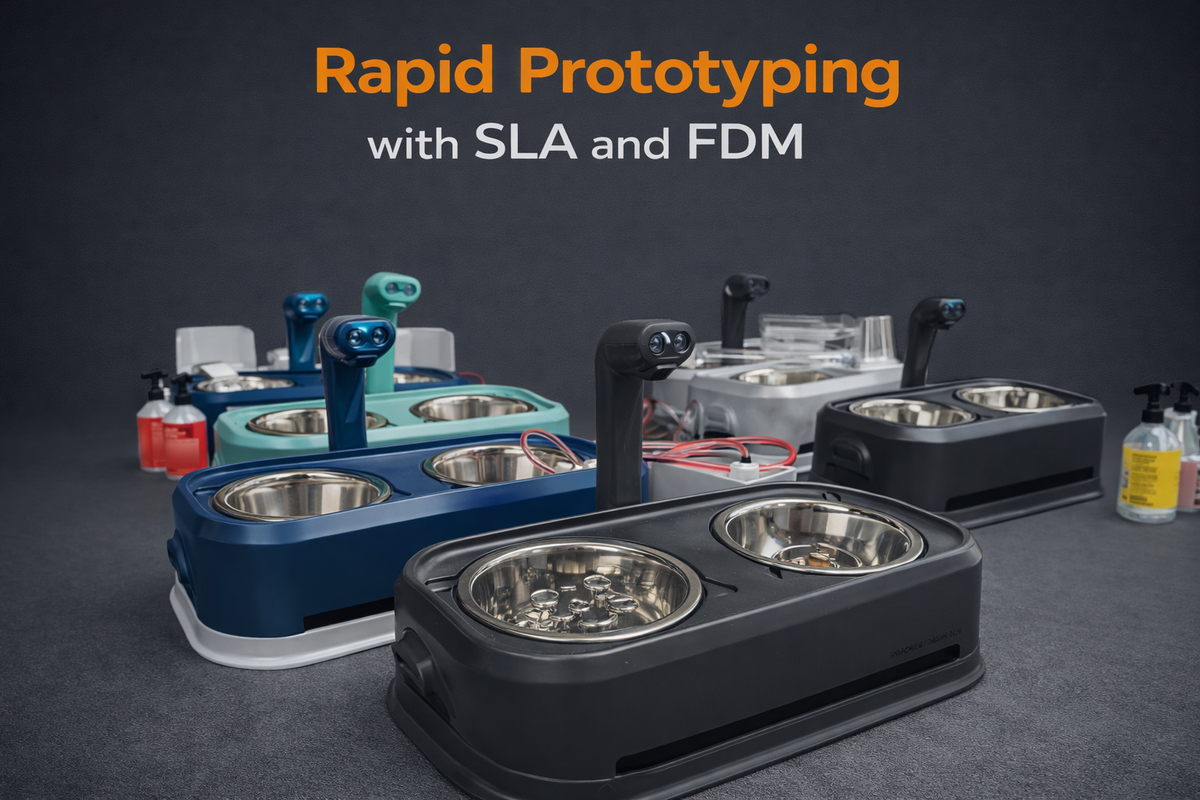
Rapid Prototyping with SLA and FDM
Choosing the right path from geometry to user reality
Speed matters, but only when it's paired with intent. At Hoomanely, getting a product into users' hands early is not a race against time, it's a strategy to surface real-world constraints that no simulation or review can fully predict. Enclosure feel, grip comfort, visual proportion, connector accessibility, structural robustness, these are qualities that only emerge when a product is physically experienced. Rapid prototyping enables that experience, but the real leverage comes from how we prototype.
SLA and FDM are not interchangeable tools in our workflow. They represent two distinct prototyping philosophies, each optimized for different questions we want to answer at different stages of product evolution. By choosing between them deliberately, and often using both in parallel, we compress iteration cycles without compromising mechanical integrity, precision, or long-term design intent.
Prototyping as a design instrument, not a shortcut
Rapid prototyping is often misunderstood as a way to "print something fast." In practice, it's a way to validate assumptions early, before design decisions harden into tooling, supply chains, and production commitments. Our products involve complex geometries, curved enclosures, organic surfaces, internal ribs, tight clearances around electronics, and structural load paths that must survive daily use. These characteristics make it impossible to rely on a single prototyping method.
Instead, we treat prototyping as a staged instrument:
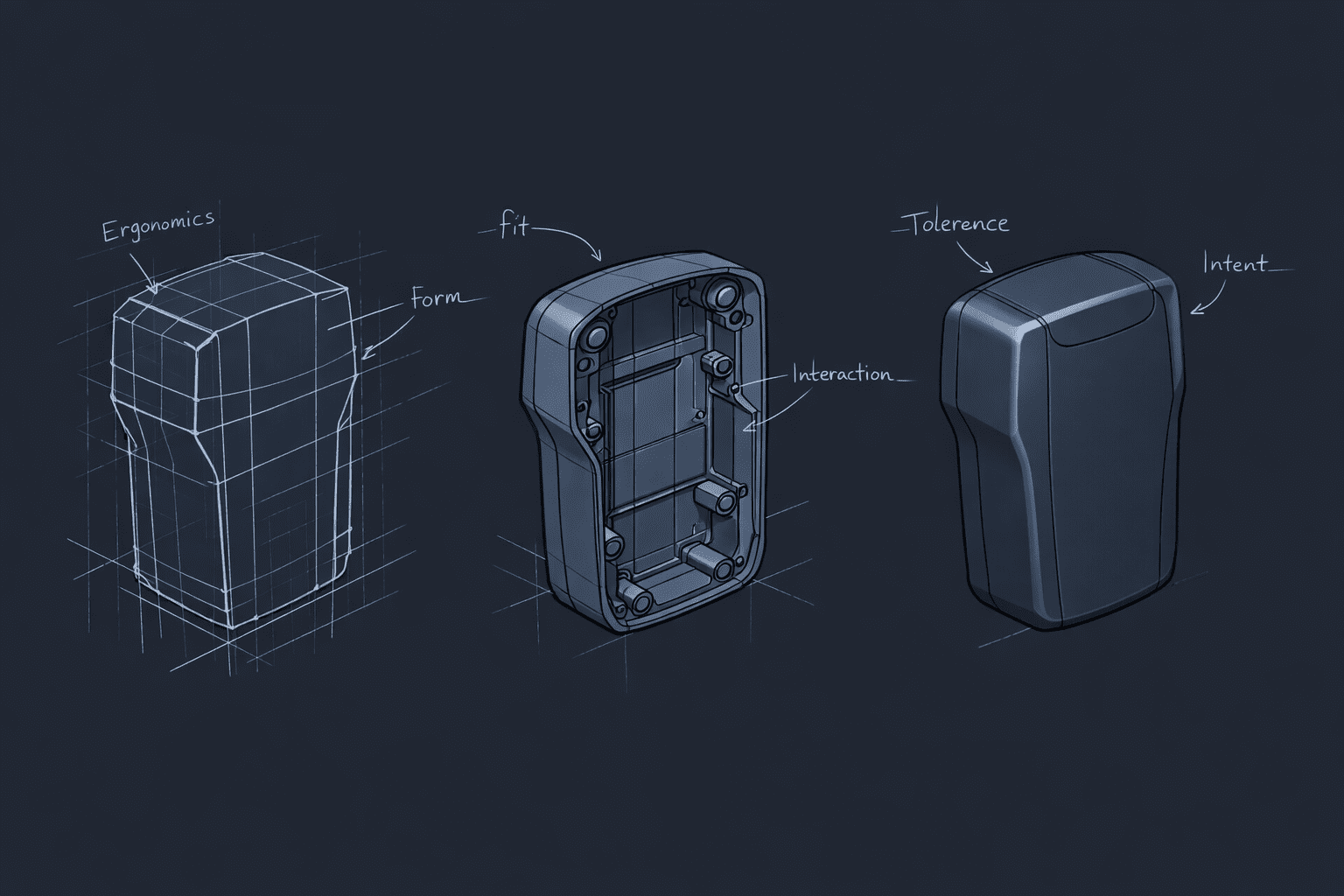
- Early-stage geometry and ergonomics
- Mid-stage fit
- Assembly
- Interaction
- Late-stage tolerance confidence and visual intent
SLA and FDM each excel at different layers of this validation stack.
FDM: structural intent and mechanical confidence
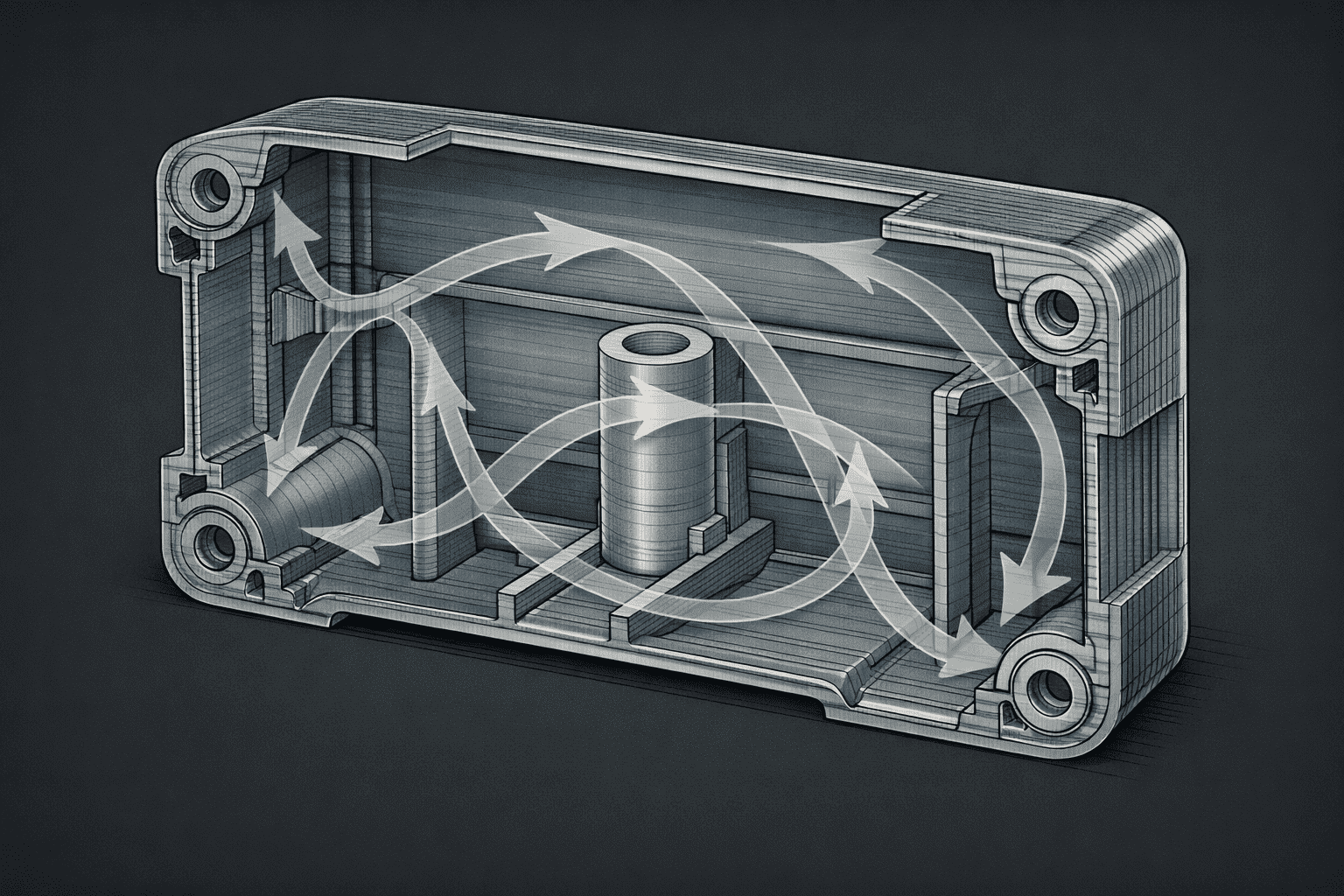
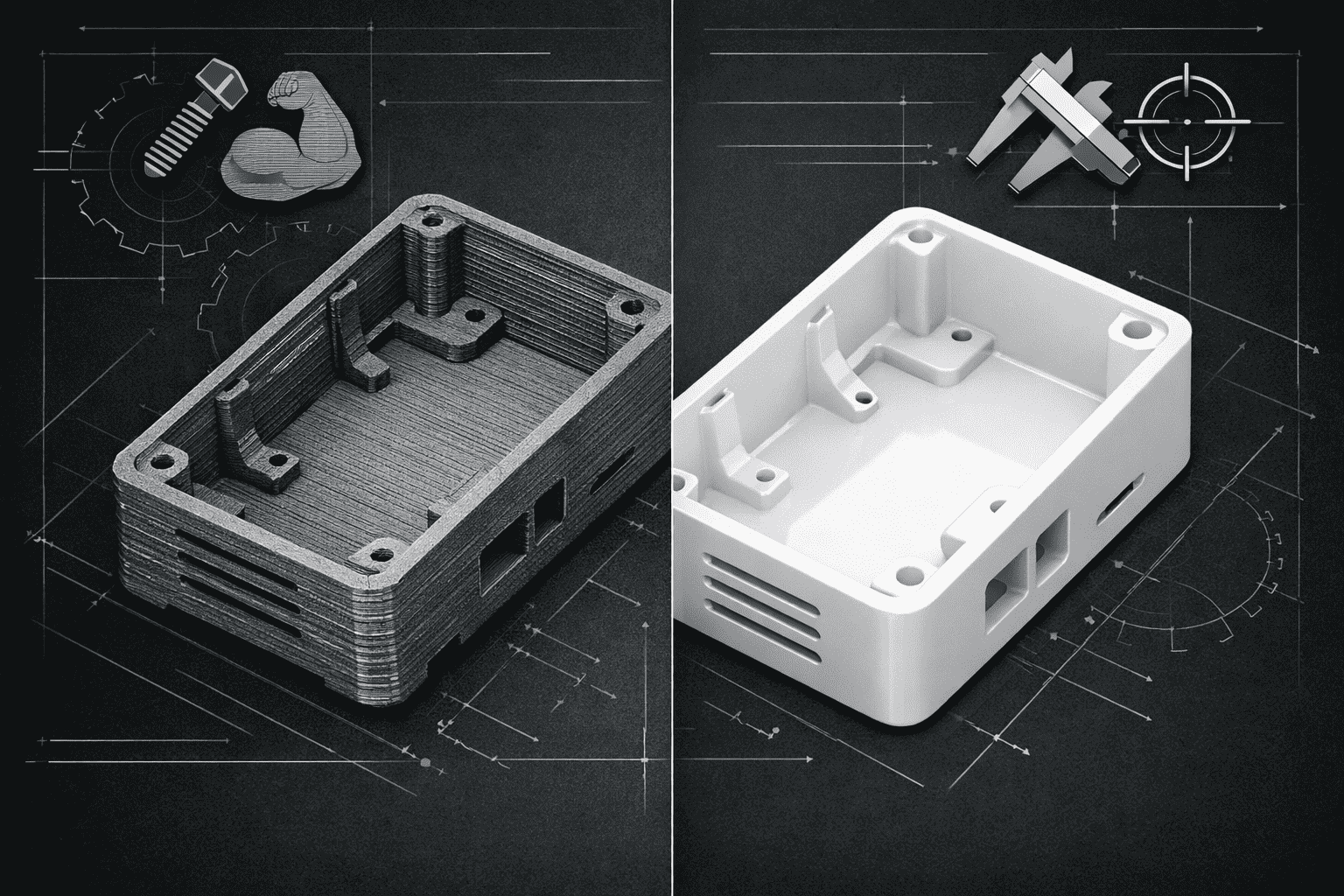
FDM is our workhorse when the question is "will this survive real use?" FDM prints allow us to explore mechanical behavior early, wall thickness decisions, rib placement, snap strength, and overall enclosure rigidity. The layered nature of FDM, often seen as a drawback, actually provides valuable signal: if a design survives FDM stresses, it's directionally sound for injection-molded plastics with superior material properties.
For Hoomanely products, FDM is especially valuable when evaluating structural durability of curved or cantilevered sections, testing mounting interfaces between enclosures and internal frames, validating assembly forces for press-fits, clips, and screw bosses, and checking drop and torsion resilience in handheld or floor-mounted devices.
We don't treat filament choice casually. PETG, ABS, and reinforced filaments are selected based on what behavior we want to approximate, impact absorption, flex tolerance, or stiffness. This lets FDM prototypes serve as mechanical surrogates, not just visual stand-ins. FDM answers questions like: does this enclosure flex too much under grip pressure? Will this boss crack under repeated torque? Is this rib actually contributing to stiffness, or just adding complexity? If the answer is "no" at this stage, the design is reshaped immediately, long before any cosmetic considerations enter the picture.
SLA: precision, fit, and visual truth
Where FDM validates strength, SLA validates truth. SLA printing gives us access to fine detail, sharp edges, smooth surfaces, and tight dimensional accuracy, qualities essential for understanding how a product will feel and assemble in its final form.
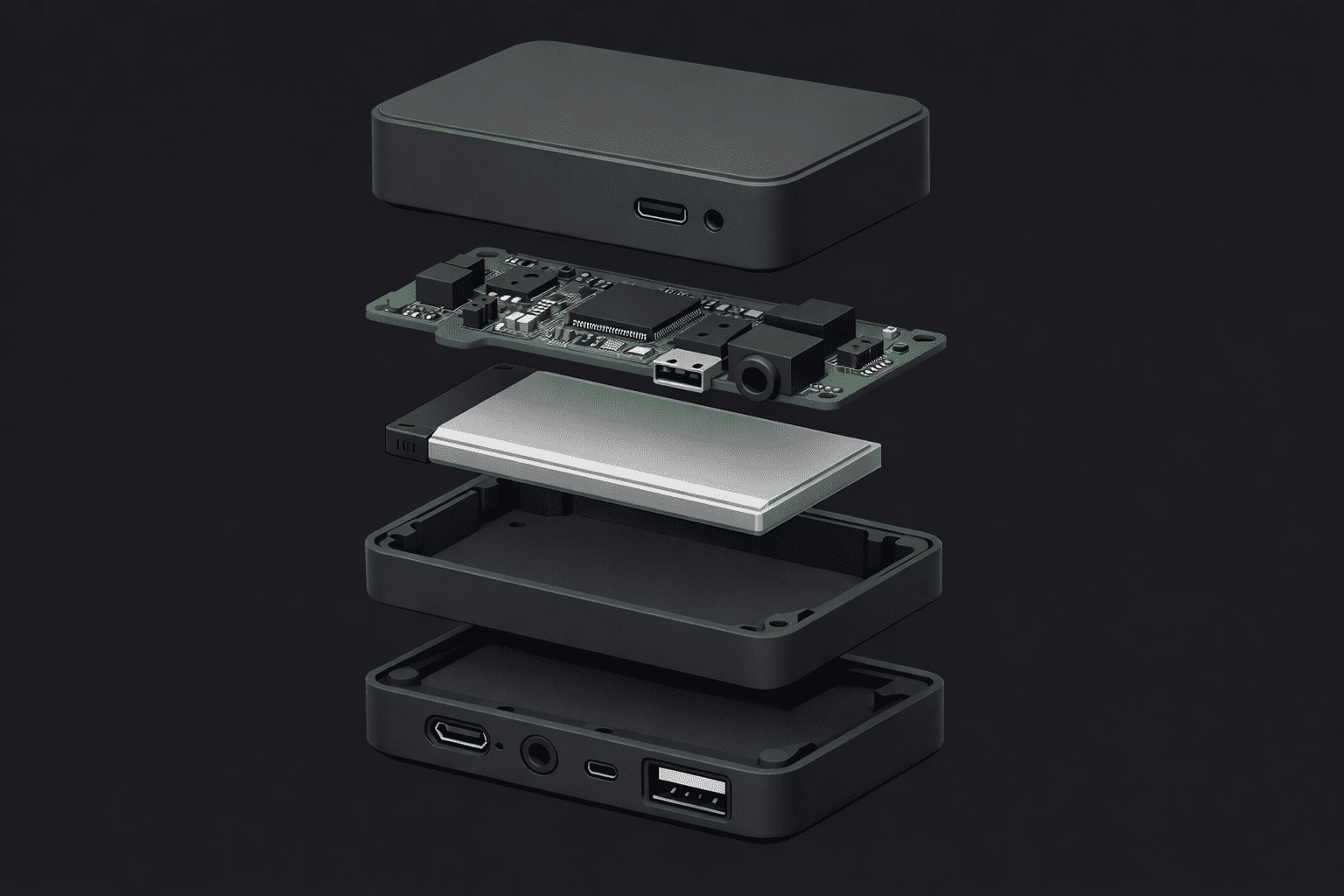
SLA is chosen when we need confidence in connector alignment and port cutouts, tight internal clearances between PCB, battery, and enclosure walls, optical elements, light guides, and indicator windows, and user-facing surfaces, seams, and parting lines. For products with curved ABS enclosures, SLA lets us evaluate how those curves visually resolve in the hand, something CAD alone cannot convey. Small radius transitions, edge breaks, and surface continuity become immediately apparent.
SLA prototypes often answer: does this enclosure look and feel "finished"? Are seams visually distracting? Do tolerances stack cleanly during assembly? This is where industrial design intent meets mechanical reality.
DFM thinking during prototyping
A key principle in our workflow is that rapid prototyping is not separate from design-for-manufacturing, it feeds it. FDM helps us identify features that will be difficult or unnecessary in molding, overly aggressive ribs, deep unsupported cavities, and snap geometries that rely on unrealistic flexibility. By simplifying or strengthening these features early, we reduce risk in later tooling decisions.
SLA lets us validate draft feasibility without visually compromising surfaces, wall thickness consistency across curved forms, and whether the tolerance requirements are realistic for mass production. Even though SLA can exceed production-level precision, it helps us set upper bounds on what the design expects, ensuring we don't unknowingly depend on impossible manufacturing accuracy.
Choosing between SLA and FDM: a deliberate trade-off
At Hoomanely, the decision isn't "SLA or FDM?", it's "what question are we trying to answer today?" Structural durability and assembly force testing point to FDM. Ergonomics and grip start with FDM early and get refined with SLA. Tight fit, alignment, surface quality, seams, and internal clearance validation point to SLA. Early form exploration favors FDM, while late-stage enclosure confidence favors SLA. Often, the same enclosure exists in both forms simultaneously, each revealing different truths about the same geometry.
Complex geometry, curves, and stress paths
Our products rarely rely on simple rectangular forms. Curves are structural, not decorative. They distribute stress, guide user interaction, and integrate electronics naturally. Rapid prototyping lets us observe how stress flows through curved shells, identify thin regions prone to cracking, adjust internal ribbing without altering external form, and ensure curved enclosures don't introduce unintended assembly stress. FDM exposes weaknesses in load paths. SLA reveals where precision is critical. Together, they let us shape enclosures that are both elegant and durable.
Accelerating user feedback without locking design
One of the most valuable outcomes of rapid prototyping is early user exposure, not for validation, but for discovery. By using FDM for early field units and SLA for refined evaluation models, we gather feedback on how products are handled, where wear naturally occurs, which surfaces users touch most, and how intuitive assembly and servicing feels. Crucially, this happens while designs are still fluid. No tooling constraints. No sunk-cost pressure. Just informed iteration.
Prototyping as a cultural discipline
The real advantage isn't the printers, it's the mindset. Rapid prototyping at Hoomanely is intentional, not reactive, structured, not ad-hoc, and integrated with mechanical, electrical, and industrial design. Every prototype answers a question. Every iteration closes uncertainty. SLA and FDM are tools, but the discipline is in knowing when and why to use them.
Conclusion: speed with direction
Rapid prototyping is often framed as speed versus quality. In reality, when practiced deliberately, it's speed through quality. By leveraging FDM for mechanical confidence and SLA for precision and visual truth, we ensure our products mature quickly without accumulating hidden debt. Complex geometries become predictable. Curved enclosures become reliable. Early user feedback becomes actionable.
This is how Hoomanely moves fast, without breaking trust, structure, or intent. Rapid prototyping isn't about printing parts. It's about printing certainty.