Real-Time Image Compression in Embedded Systems: Performance Optimization for Edge AI Applications
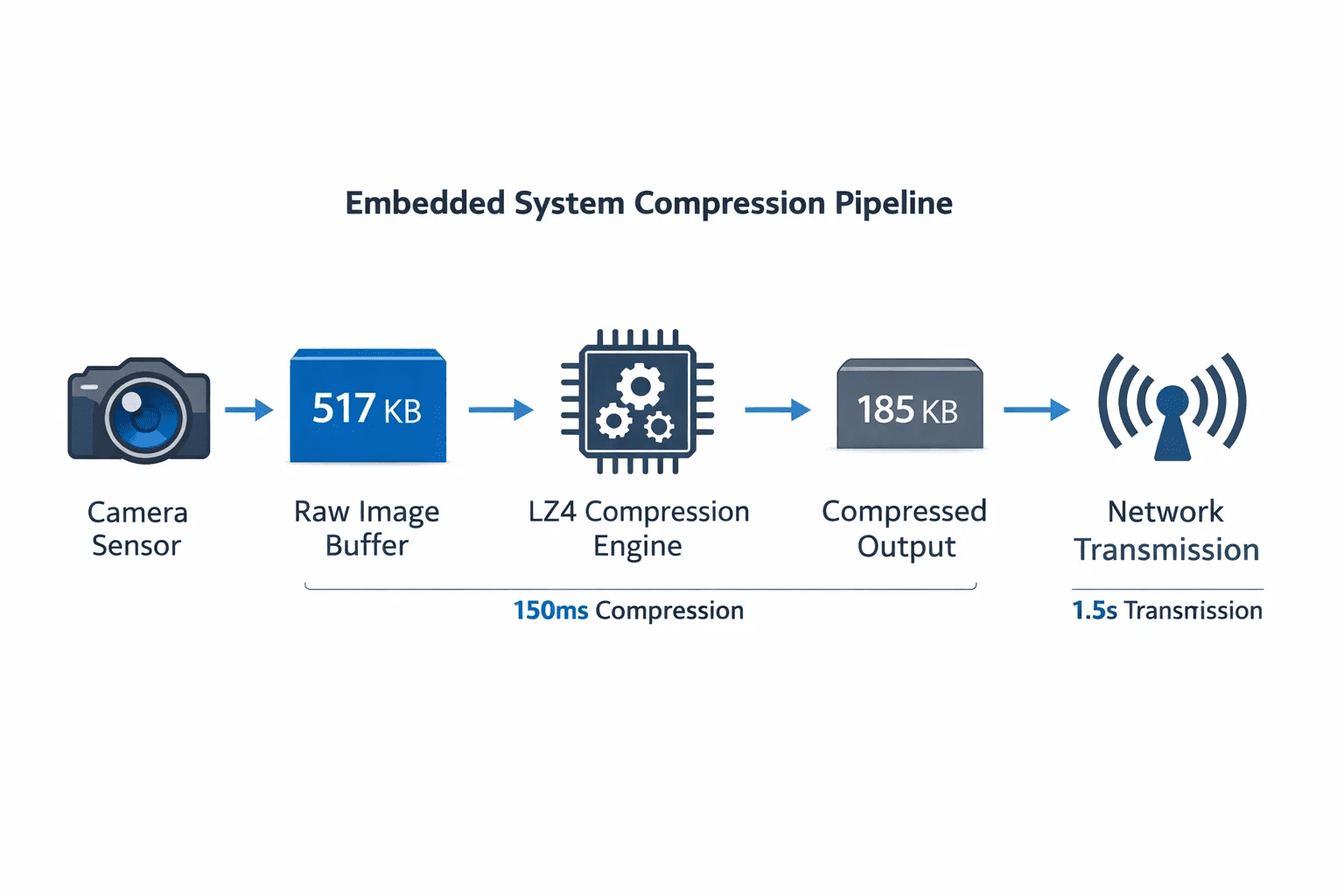
Modern edge AI systems face a genuinely complex challenge: how do you efficiently transmit large amounts of high-resolution sensor data in real time while operating under severe resource constraints? When your embedded system captures 500KB+ images every few seconds and needs to transmit them over limited bandwidth, transmitting raw data quickly hits a wall. The answer lies in compression algorithms optimized for embedded environments, and LZ4 has proven itself as the clear winner for speed-critical applications.
The compression challenge in edge computing
Edge devices live in a fundamentally different environment than servers. Consider a real-world case: a high-resolution camera sensor generating 517KB images that need to reach the cloud in near real time over a constrained connection. Sending raw image data immediately reveals its limits. A 517KB image over a 1Mbps connection takes roughly 4.1 seconds just for the transfer, and once you add network overhead you're looking at 5-plus seconds per image, unacceptable for applications needing continuous monitoring or rapid response.
Resource constraints compound the challenge: limited CPU cycles (often under 200 MHz ARM Cortex processors), constrained memory (512KB to 8MB total RAM), power budgets measured in milliwatts, and real-time OS requirements. Traditional compression algorithms like GZIP or DEFLATE optimize for compression ratio, often hitting 10:1 reductions but needing seconds of processing time. In embedded systems, that CPU-intensive approach cascades into bigger problems: longer compression times need larger memory buffers, higher power draw, and potential instability.
LZ4: the speed-optimized solution
LZ4 represents a real shift in compression philosophy, prioritizing speed over maximum ratio. Created by Yann Collet, it's built around the idea that fast compression is often more valuable than maximum compression. The algorithm uses a relatively simple dictionary-based scheme: a 64KB sliding window, hash-table-based matching with a 4-byte minimum match length, literal runs plus length-distance pairs, and linear O(n) time complexity. Unlike more sophisticated algorithms using multiple passes or complex entropy encoding, LZ4 makes compression decisions in a single forward pass.
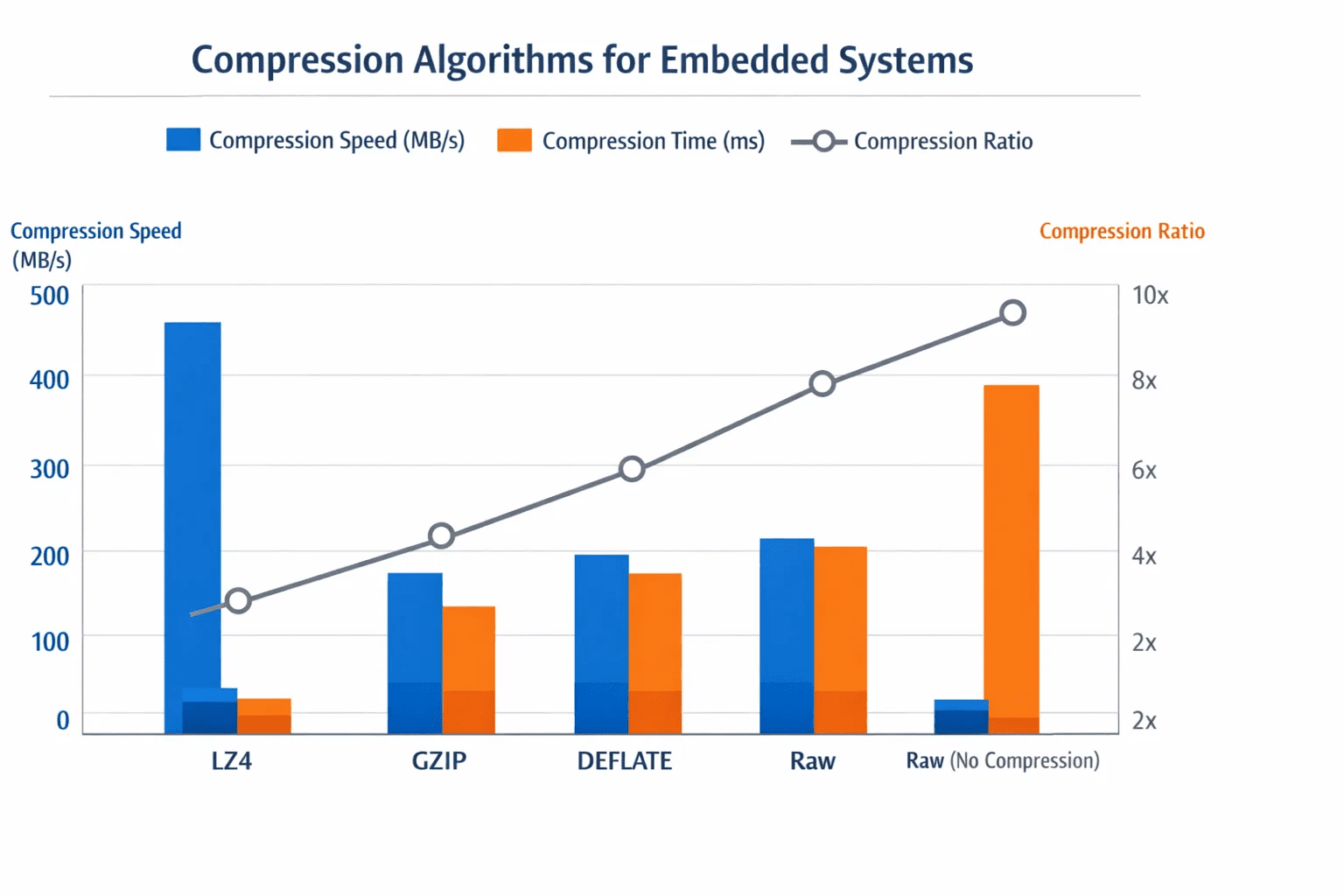
While LZ4 typically achieves 2 to 3x compression ratios, compared to 5 to 10x for GZIP, its speed advantage is dramatic: compression above 500 MB/s per core, decompression above 2000 MB/s per core, under 64KB of working memory, and under 5% CPU overhead for typical workloads. That profile lines up almost perfectly with embedded constraints: predictable single-pass timing, a small dictionary that fits comfortably in most systems, a simple implementation around 500 lines of C with no dependencies, and operations that map well to ARM instruction sets.
Implementation architecture
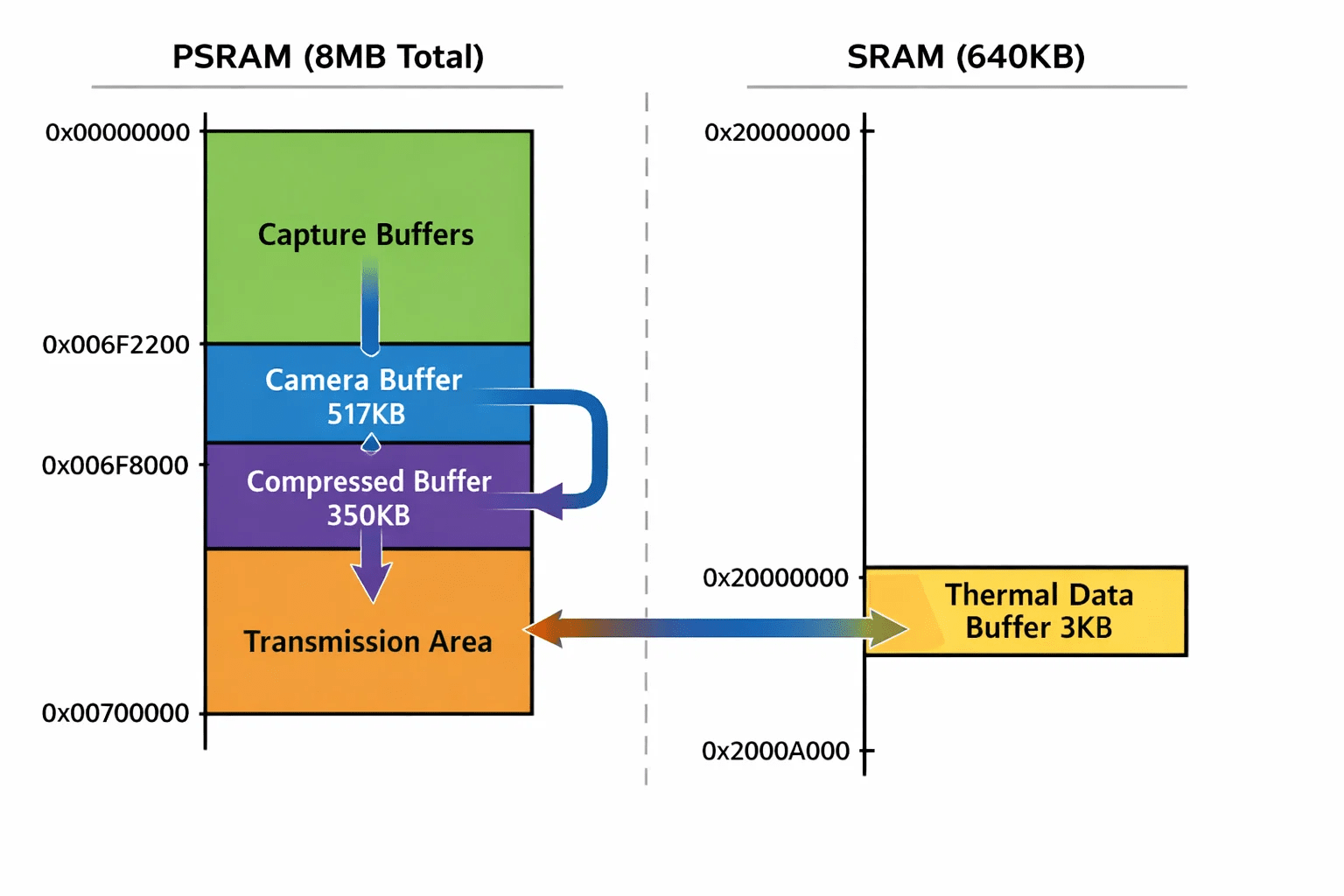
Implementing LZ4 in a resource-constrained embedded system takes careful architectural decisions. Our camera image pipeline uses a hybrid memory allocation strategy:
// Camera buffer: 517KB raw image
uint8_t *camera_buffer = (uint8_t *)PSRAM_TX_ADDR;

// Compressed buffer: Max ~350KB (worst case bound)
uint8_t *compressed_buffer = camera_buffer + CAMERA_IMAGE_SIZE;

// Thermal data: Use SRAM to avoid PSRAM corruption issues
static float thermal_tx_buffer_sram[768] __attribute__((section(".sram")));
Camera and compression buffers live in external PSRAM (8MB total), while thermal sensor data uses internal SRAM to sidestep hardware-specific corruption issues. Compression happens in-place when possible to minimize memory use, and transmission buffers get allocated at the PSRAM's end to avoid conflicts with capture operations.
The compression system integrates tightly with capture:
int camera_compress_image(const uint8_t *src, size_t src_size,
                         uint8_t *dst, size_t dst_capacity) {
    TickType_t compress_start = xTaskGetTickCount();

    int compressed_size = LZ4_compress_default((const char *)src, (char *)dst,
                                              (int)src_size, (int)dst_capacity);

    TickType_t compress_end = xTaskGetTickCount();
    uint32_t compress_time = (compress_end - compress_start) * portTICK_PERIOD_MS;

    float ratio = (float)src_size / compressed_size;
    LOG_INFO_TAG(TAG, "Compressed %lu -> %d bytes (%.2fx ratio, %lu ms)",
                 src_size, compressed_size, ratio, compress_time);

    return compressed_size;
}
Robust error handling matters a lot here: comprehensive parameter validation before compression, LZ4_compressBound() to guarantee destination buffer adequacy, checking for negative return values indicating algorithm failure, LZ4_decompress_safe() to prevent buffer overruns, and continuous timing measurement for system health.
Real-world performance
Our embedded implementation delivers solid numbers across several dimensions. Compression typically runs at a 2.1 to 2.8x ratio for camera sensor data, taking 50 to 200ms for 517KB images on an ARM Cortex-M33 at 250MHz, with under 100KB of memory overhead including the worst-case output buffer and under 2% additional system power draw.
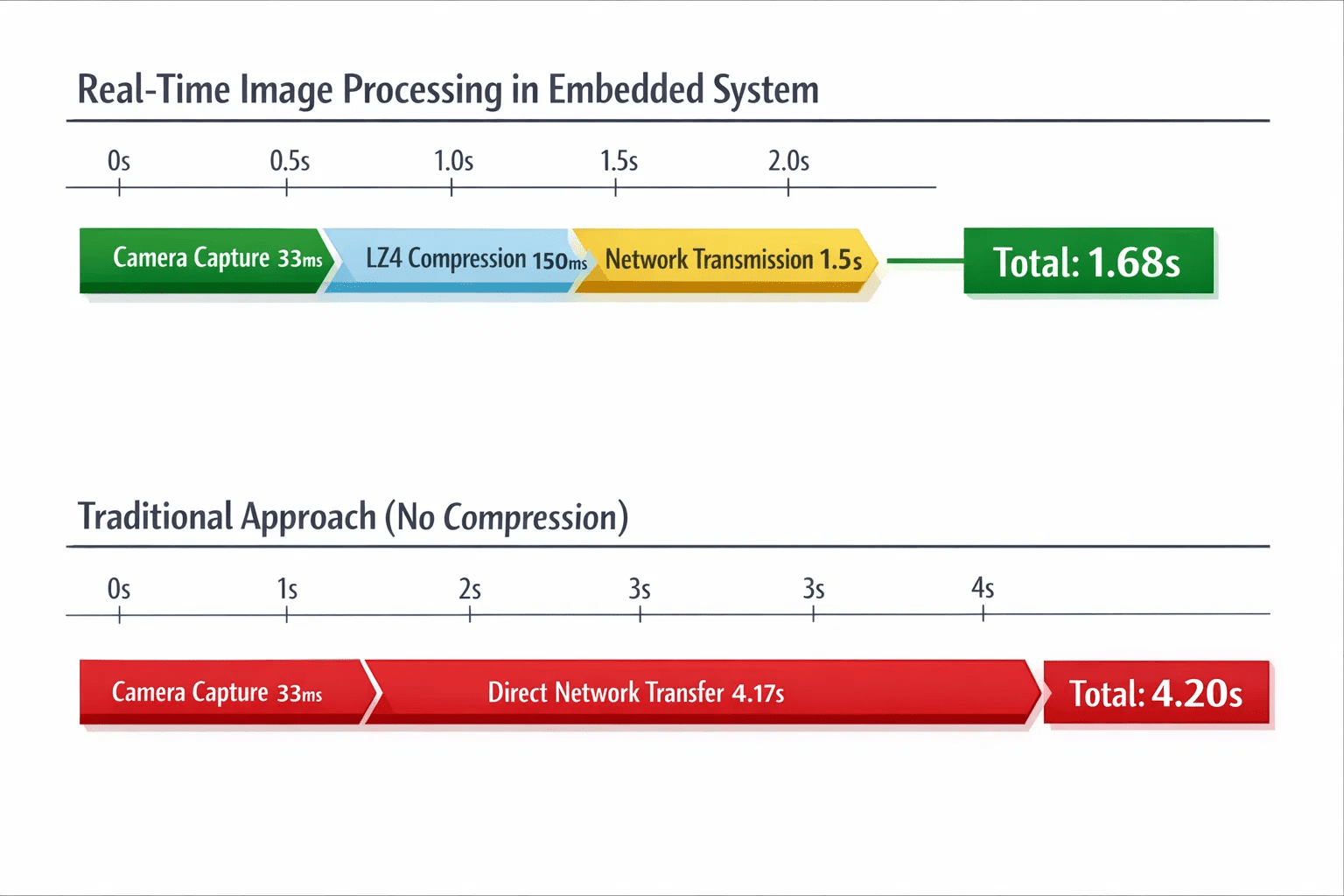
For a complete transmission cycle: camera capture takes about 33ms (30 FPS sensor), LZ4 compression averages around 150ms, network transmission drops from roughly 4.1s raw to about 1.8s compressed, bringing the total pipeline from about 4.2s down to about 2.0s, a meaningful improvement. The hybrid memory allocation stays efficient too: transmission buffers use around 880KB of PSRAM (about 11% of 8MB), thermal data uses about 3KB of SRAM, and fragmentation stays minimal thanks to predictable allocation patterns. On the bandwidth side, a typical 517KB image compresses to roughly 185KB, cutting transmission time by over 60% and improving battery life meaningfully in wireless transmission scenarios.
Why this matters at Hoomanely
This compression technology directly enables our push toward continuous, precision pet health monitoring. Our biosense AI engine needs continuous streams of visual and sensor data to build personalized health baselines for each pet. LZ4 compression supports real-time transmission without overwhelming network infrastructure, efficient aggregation of camera, thermal, and proximity data, local processing that reduces cloud dependency, and a system architecture that scales across multiple pets and devices. Moving toward clinical-grade intelligence at home means the ability to process and transmit large volumes of sensor data in real time is genuinely critical infrastructure, not a nice-to-have.
Key takeaways
Choose LZ4 for real-time applications where speed matters more than maximum compression, resource-constrained environments with limited CPU and memory, and applications needing frequent compression and decompression cycles. Profile early with your actual data, plan memory around worst-case buffer sizes via LZ4_compressBound, implement comprehensive validation for embedded robustness, and keep measuring performance continuously. Reach for GZIP or DEFLATE instead when compression ratio matters more than speed, and consider hardware acceleration for very high-throughput applications.