Rethinking Hardware Prototyping: How We Build Faster Without Cutting Corners
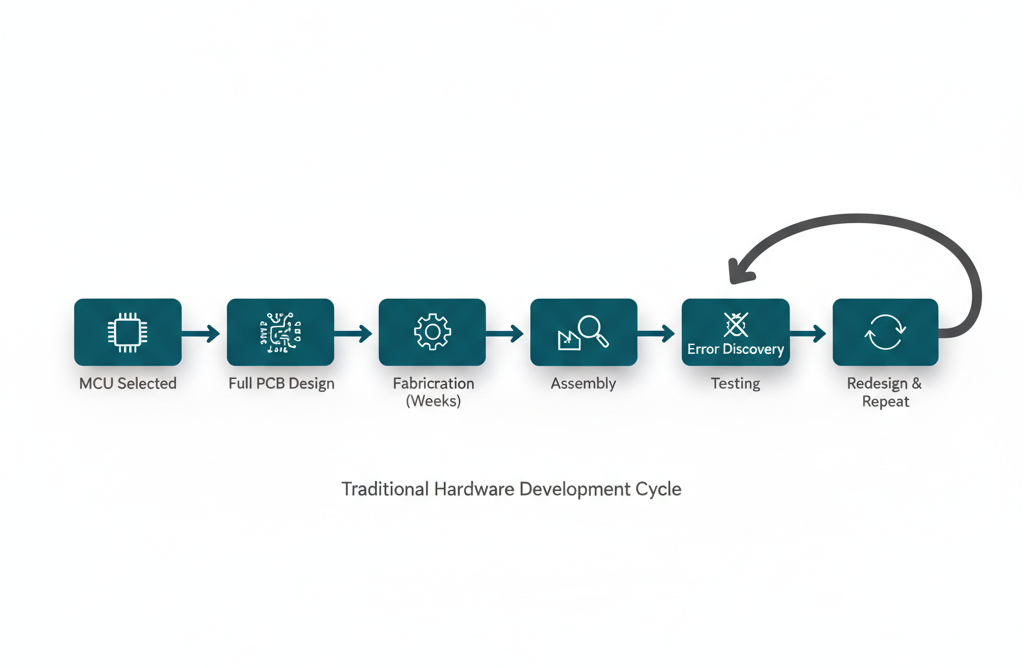
There's a peculiar rhythm to hardware development that anyone in the field knows well. You design a circuit, order boards, and then you wait. Weeks pass. The boards arrive. You test them, discover issues, make fixes, and the cycle begins again. Each iteration feels like watching paint dry, except the paint costs thousands of dollars and your launch timeline keeps slipping.
For startups like Hoomanely, this traditional approach isn't just slow, it's existential. We don't have the luxury of six-month development cycles. But we also refuse to compromise on quality or skip the fundamentals of good engineering. So we asked ourselves: what if hardware development didn't have to be a waiting game?
The traditional trap
The conventional hardware development process is deeply sequential. You pick a microcontroller, design your entire system around it, order PCBs, wait for manufacturing, assemble them, and finally start testing. If that MCU doesn't work out, if the documentation was incomplete or the SDK has bugs, you're back to square one. This linear approach made sense when PCB manufacturing took months and component choices were limited. But with rapid prototyping services and an explosion of new silicon, this old methodology has become the bottleneck. For a startup, every week spent waiting is a week not spent learning, and in hardware, learning only happens when you have physical boards in hand.
Our philosophy: parallel progress over sequential waiting
We still follow the same fundamental engineering roadmap everyone does, proof of concept, prototype, validation, production. We haven't invented a magical shortcut that skips testing. Instead, we've rearchitected how those steps happen. Our core insight: why should one decision block all the others?
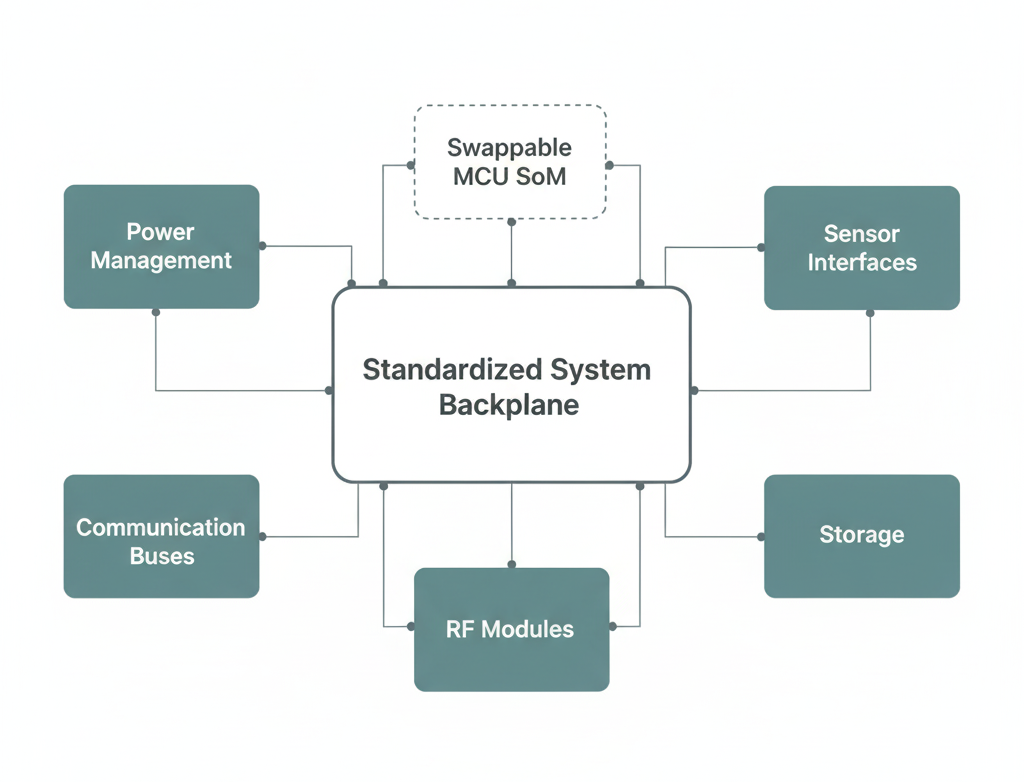
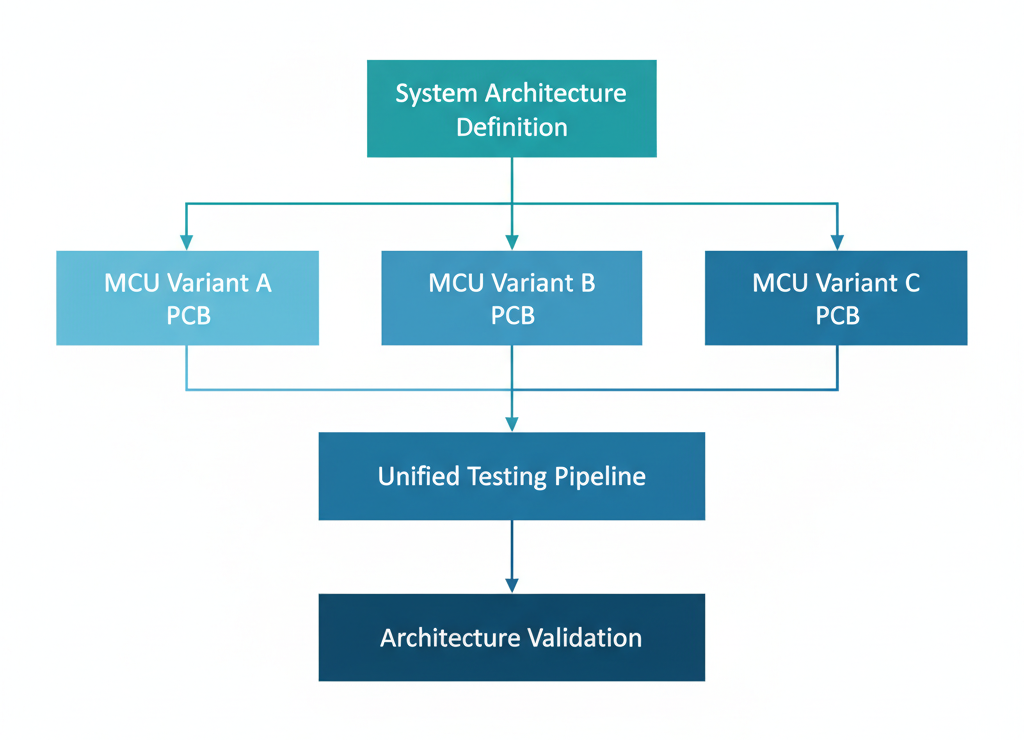
Building a hardware "platform" instead of projects. Every time you start a new project with a different microcontroller, you typically rebuild everything from scratch, new schematics, new pin mappings, new power trees, new bring-up procedures. We created what we call Virtual Interface PCB Architecture, designing the "motherboard" once and treating the microcontroller as a swappable module. We designed a standardized system architecture with consistent pinouts for power management, sensors, radios, storage, and communication buses, connecting through standardized headers following the same routing rules across projects. When we need to work with a different MCU family, only the SoM section changes, everything else stays identical. Instead of spending three weeks redesigning an entire board for a new processor, we spend three days adapting the interface layer, and every iteration benefits from accumulated learnings about signal integrity, grounding strategy, and thermal management.
Testing multiple futures simultaneously. A familiar nightmare:
- You commit to a cutting-edge microcontroller
- The specs look perfect
- You design your entire product around it
- Then you discover the SDK is buggy
- The documentation has gaps
- Vendor support is minimal
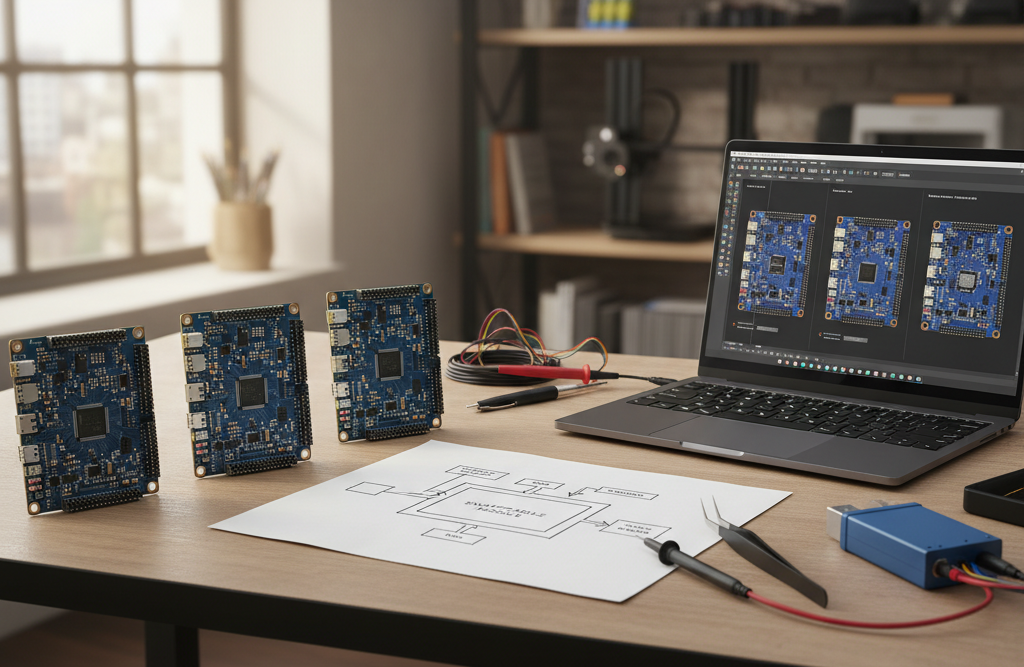
Our solution is not committing to just one future. For each new design, we create multiple PCB variants using different MCU families, perhaps one with STM32, another with ESP32, a third with nRF52. Only the MCU and its immediate support circuitry differ, all sensors, radios, power supplies, and connectors remain identical across variants. This gives our firmware team real hardware to work with immediately, even if one MCU hits a roadblock, lets our testing team compare power consumption and communication reliability across platforms under identical conditions, and keeps hardware engineers unblocked waiting for one specific chip to work. Risk becomes redundancy. By the time we determine which MCU is optimal, we've already validated the entire system architecture.
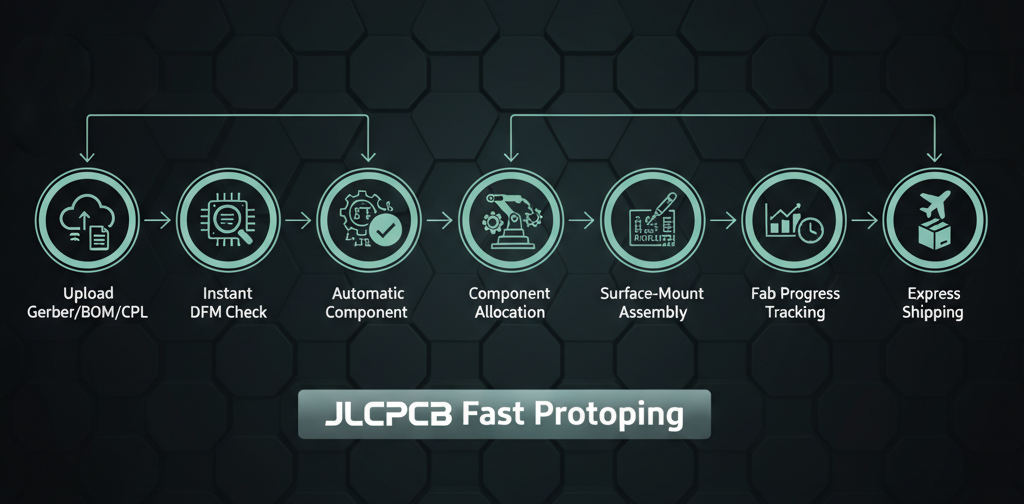
Manufacturing as a sprint, not a marathon. Even the best architecture doesn't help if manufacturing takes forever, so choosing the right partners becomes critical. We work extensively with manufacturers optimized for exactly what startups need: speed, flexibility, low barriers to entry. Low minimum quantities let us order just a handful of boards per revision, perfect for R&D without burning capital on inventory we might not need. Integrated component sourcing means parts are ordered and stored long-term, reused across batches, no scrambling to reorder for each revision. End-to-end assembly means we upload design files and receive fully assembled boards, no coordinating between three vendors. Transparent tracking gives real-time visibility into fabrication, assembly, and shipping. The speed difference is dramatic, a traditional flow of design-to-order taking 3-5 days plus manual quoting, manufacturing taking 3-4 weeks, and testing only after all boards arrive adds up to roughly 8-12 weeks total, versus our flow with instant quotes, 5-10 day assembled manufacturing, and parallel testing across MCU variants, roughly 3 weeks end-to-end. By the time traditional development teams receive their first prototypes, we're testing our second revision.
Why this matters for startups
Speed isn't about ego or bragging rights, for a startup, velocity is survival. The faster we iterate, the faster we learn what works, and reaching product-market fit before running out of runway is the only game that matters. But here's what we don't do: we don't skip validation, we don't test on breadboards and hope it works in production, we don't cut corners on EMI testing or thermal analysis. Our approach gets us to real-world testing early, on production-grade PCBs with accurate thermal behavior, genuine EMI performance, and reliable mechanical fit, long before mass production. We're not moving fast by skipping steps, we're moving fast by doing multiple steps simultaneously.
The bigger picture
Traditional hardware design moves like a train on a single track, one MCU, one prototype, one revision at a time, each station completed before the train moves forward. At Hoomanely, we move like water finding multiple paths down a mountain, testing architectures, evaluating MCUs, and refining manufacturing processes simultaneously. Some paths hit obstacles, others flow freely, but we're always moving.
Virtual Interface PCB architecture, parallel MCU development, and rapid prototyping services aren't revolutionary concepts individually. Plenty of teams use modular design, many companies order from fast-turn manufacturers. The innovation is in combining these approaches into a coherent philosophy: minimize dependencies, maximize parallel progress, keep the team learning continuously. This represents something fundamental about how we think: the best way to reduce risk isn't to plan more carefully, it's to test more frequently.