Roadmap to Linux Device Drivers
Linux powers everything from routers and EV chargers to drones, cameras, industrial machines, and the modern edge AI stack. But behind every peripheral that just works lies a device driver, the thin layer of software that lets hardware talk to the Linux kernel.
For new embedded engineers, Linux device drivers often feel intimidating: kernel space, memory barriers, concurrency, interrupts, where do you even start? This roadmap breaks the journey into clear, logical steps, from learning the basics of kernel space to writing your first character driver, adding interrupt handling, integrating with device trees, and eventually building production-grade drivers that power real hardware.
1. Understand the foundations
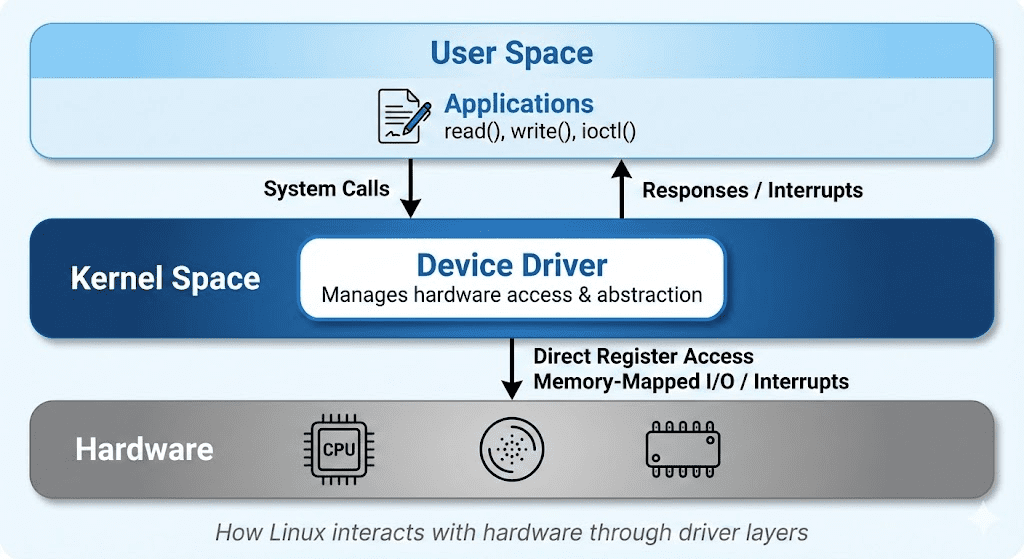
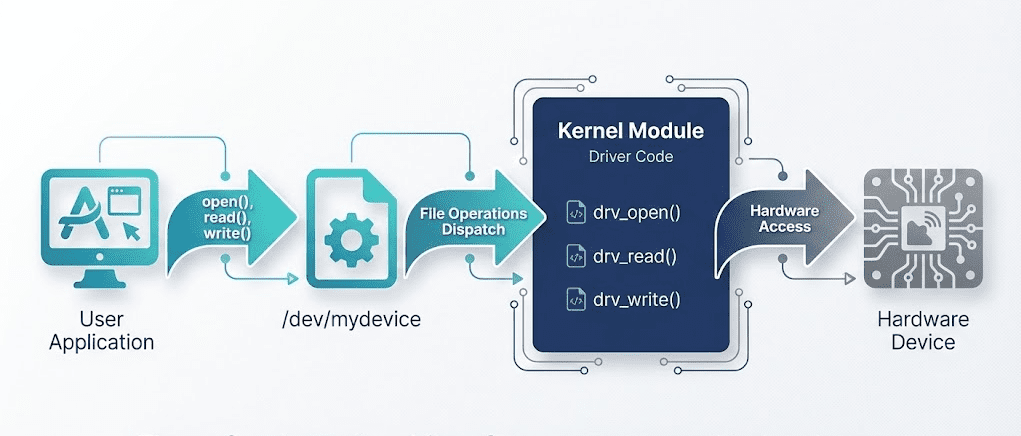
Before writing any driver, you need a firm grasp of how the kernel interacts with hardware. Drivers live in kernel space with direct hardware access, while applications run in user space with restricted privileges, that separation is fundamental to Linux's stability and security model. System calls bridge the gap: when applications call read(), write(), or ioctl(), these requests flow through system calls to your driver's implementation. Loadable kernel modules can be dynamically loaded with insmod and removed with rmmod, without a full reboot, which accelerates development a lot. And drivers expose their APIs through device files like /dev/i2c-1 or /dev/my_driver, making hardware accessible through familiar file operations.
2. Start with loadable kernel modules
The easiest entry point is building and loading a basic kernel module that logs messages on load and unload. Install kernel headers, write a .c file implementing module_init() and module_exit(), build with a Makefile referencing KDIR=/lib/modules/$(uname -r)/build, load with insmod, and verify with dmesg. That first "Hello from kernel space" message is a rite of passage. This step teaches the module lifecycle, Makefiles for kernel code, and effective kernel logging.
3. Write a character device driver
Most beginners start with character drivers for custom sensors, motors, GPIO expanders, and similar peripherals. You'll learn to allocate device numbers with alloc_chrdev_region, create /dev/<device> entries applications can open, and implement open(), read(), write(), and release(). You'll work with kernel buffers, understand the difference between copy_to_user() and copy_from_user(), and tackle your first concurrency questions, spinlocks or mutexes, depending on the use case. Character drivers are the foundation for UART drivers, SPI/I2C custom drivers, virtual drivers, and sensors or actuators in robotics.
4. Master interrupt handling
Polling hardware wastes CPU cycles and increases latency. Interrupts (IRQs) let you react instantly to hardware events instead. You'll register handlers with request_irq(), understand the distinction between top-half and bottom-half processing, and use workqueues, tasklets, or threaded IRQs appropriately. The process: configure the interrupt line, register it, implement a handler that stays short and fast, then offload heavier work to bottom-half processing. This is essential for sensors, CAN controllers, touchscreens, and network devices, without it, real-time or event-driven hardware becomes a struggle.
5. Learn the device tree for ARM boards
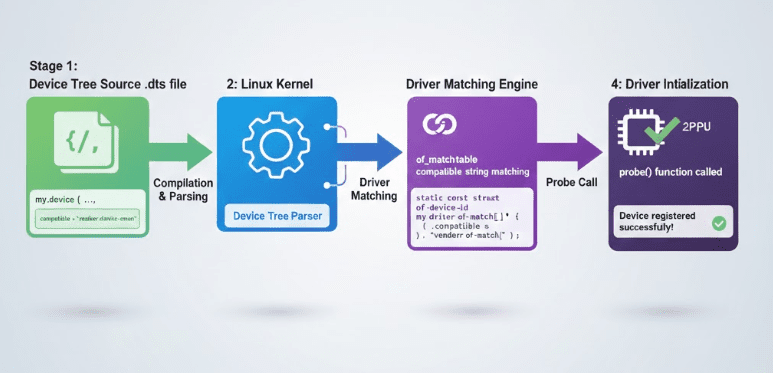
Embedded Linux relies heavily on the device tree to describe hardware configuration without hardcoding it into the kernel. You'll write .dts overlays, bind drivers through compatible strings, add custom hardware blocks, and expose GPIOs, I2C/SPI buses, and interrupts, with of_match_table bridging hardware description and driver code. Without this, drivers won't load automatically on target hardware, non-negotiable for custom HATs, SOM boards like STM32MP1 or i.MX, industrial controllers, and camera/motor/sensor boards. The device tree is what makes code portable across board variants.
6. SPI, I2C, GPIO, and platform drivers
Once fundamentals are solid, expand into the driver types covering most embedded use cases. SPI drivers handle high-speed serial peripherals using spi_driver, spi_device, and spi_transfer structures, registering callbacks in probe() and managing full-duplex transfers, for DACs, ADCs, IMUs, displays, and radio modules. I2C drivers manage lower-speed peripherals through the i2c_driver framework, using regmap and helper functions for SMBus-based devices like temperature sensors, EEPROMs, and power management ICs. GPIO drivers export or control pins, handle interrupts via irqdomain, and provide custom logic for I/O expanders. Platform drivers handle memory-mapped hardware using ioremap() to read and write registers directly, managing clocks, resets, and regulators, and they're the backbone of industrial embedded systems from custom peripherals to FPGA interfaces.
7. Memory-mapped I/O and register access
Eventually you'll interact directly with hardware registers using ioread32() and iowrite32(), understanding memory barriers for correct ordering, and managing DMA for high-throughput devices. Without this, you can't write drivers for CAN controllers, Ethernet PHYs, graphics devices, high-speed peripherals, or custom FPGA IP cores, this is where embedded Linux meets real hardware engineering, including cache coherency issues and performance-critical data transfer optimization.
8. Debugging and testing workflow
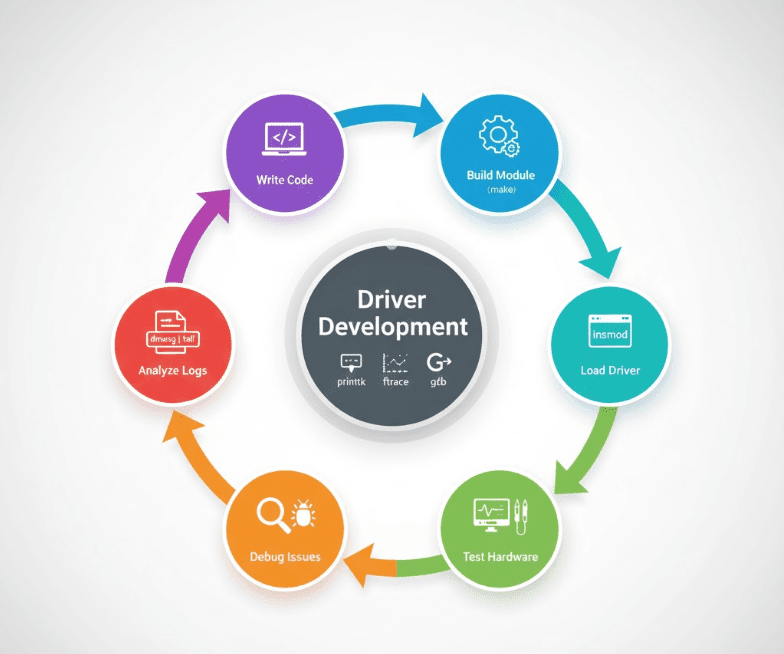
The kernel provides powerful debugging tools: dmesg for logs, ftrace and trace-cmd for timing analysis, printk() for quick debugging, debugfs for user-accessible hooks, and gdb with KGDB for live kernel debugging. The workflow: add debug prints at critical points, trace interrupt latency to find bottlenecks, verify device tree bindings via of_node properties, use udevadm to inspect device creation, and write small test applications to validate functionality against /dev/mydevice. This lets you isolate issues quickly, from probe failures to IRQ storms, and understand exactly what your driver is doing at any moment.
9. Production-grade drivers
Functional drivers are just the beginning. Production quality needs power management with suspend and resume hooks, sysfs attributes for runtime configuration, proper error paths in probe() and remove(), appropriate locking strategies, no memory leaks, and graceful hotplug handling. A production driver has to be robust under edge cases, crash-proof under unexpected conditions, efficient with resources, well-documented, and configurable via device tree or sysfs, the bar required for automotive, IoT, industrial, and consumer products.
Why this roadmap matters for advanced embedded platforms
Modern embedded platforms combine Linux, microcontrollers, industrial networking, and intelligent automation, and device drivers are the invisible backbone enabling that integration. Mastering them unlocks better integration between microcontrollers and application processors, reliable sensor and camera pipelines, custom high-performance interfaces, more robust OTA and networking subsystems, and faster product iteration with greater platform stability. At Hoomanely, these driver development principles power the advanced embedded platforms behind our intelligent automation and hardware-software integration.
Key takeaways
Linux device drivers bridge the gap between hardware and kernel space, making complex hardware accessible through simple interfaces. The learning path is clear: start with kernel modules, progress to character drivers and interrupts, master the device tree, then expand into SPI, I2C, GPIO, and platform drivers. Understanding memory-mapped I/O unlocks advanced hardware control, while debugging skills using ftrace, debugfs, and printk separate competent developers from experts. And production-ready drivers demand power management, error handling, and robustness that goes well beyond basic functionality, that expertise is the foundation everything else in professional embedded platforms builds upon.