SEO and Beyond: What Actually Matters
SEO feels like voodoo to most engineers. There's advice about keywords, backlinks, meta tags, content freshness, mobile-first indexing, Core Web Vitals, schema markup, the list goes on. Some of it works. Most of it is noise. SEO for engineers isn't about mastering every ranking factor Google uses, it's about understanding the fundamentals that actually move the needle and implementing them systematically.
Why engineers should care about SEO
You've built an incredible product, comprehensive documentation, technically accurate blog posts. But if nobody finds them, none of it matters. SEO isn't marketing fluff, it's a distribution problem, and distribution problems are engineering problems. Good SEO means users find your docs, your product appears when users search for solutions, and your technical blog builds authority.
The technical foundation
Before worrying about keywords or content strategy, get the technical basics right, search engines need to crawl, index, and understand your site. Check your robots.txt to make sure it's not blocking important pages:
User-agent: *
Allow: /
Sitemap: https://yoursite.com/sitemap.xml
Generate and submit an XML sitemap, most frameworks have plugins, and it should update automatically when content changes. Avoid common pitfalls, don't rely solely on JavaScript for navigation, use canonical tags to prevent duplicate content issues, and check Google Search Console to see which pages are indexed and fix crawl errors.
Google indexes mobile versions first, so if your site breaks on mobile you're invisible to search. This isn't about making things mobile-friendly as an afterthought, it's about architecting responsively from the start, with a proper viewport meta tag, touch-friendly buttons at minimum 48x48px, readable font sizes at 16px minimum, and no horizontal scrolling. Test on real devices, not just browser emulators.
If your entire site renders client-side with React, Vue, or Angular, search engines might not see your content reliably. While Googlebot can render JavaScript, it's slower and less reliable than serving pre-rendered HTML. Solutions in order of preference: server-side rendering with frameworks like Next.js or Nuxt, static site generation pre-rendered at build time, dynamic rendering serving pre-rendered HTML to bots and client-side JS to users, or client-side with an SSR fallback ensuring critical content is in the initial HTML.
Content structure: making information discoverable
Technical foundation is necessary but not sufficient. Use proper heading hierarchy, H1 through H3, not just for accessibility, it helps search engines understand content structure. Title tags and meta descriptions appear in search results, write them deliberately, keep the title under 60 characters and front-load important keywords. Meta descriptions don't directly impact rankings but affect click-through rates, which indirectly matter.
Internal linking helps search engines discover content and understand relationships between pages, link to related content naturally within paragraphs, use descriptive anchor text instead of "click here," and create hub pages linking to related articles. Schema markup helps search engines understand what your content represents and can enable rich snippets in search results, using structured JSON-LD for articles, products, and other content types.
Keywords without the keyword spam
Keywords matter, but not how you think. Forget keyword density and exact-match repetition, modern search understands semantic meaning. Research actual search queries using Google Search Console to see what people search for to find you. Map intent, not just keywords, if someone searches for how to take their dog for a walk, they want solutions, not definitions. Use natural language, write for humans with synonyms and related terms, and answer specific questions directly rather than forcing an exact phrase repeatedly.
Performance monitoring and iteration
Treat SEO like any engineering system, measure, iterate, improve. Key metrics to track include organic traffic trends per page, rankings for target keywords, click-through rate from search results, bounce rate and time on page as engagement signals, and Core Web Vitals for ongoing performance monitoring. Set up alerts for crawl errors, indexing issues, or performance degradation, and fix problems systematically.
What's next: GEO and AIO
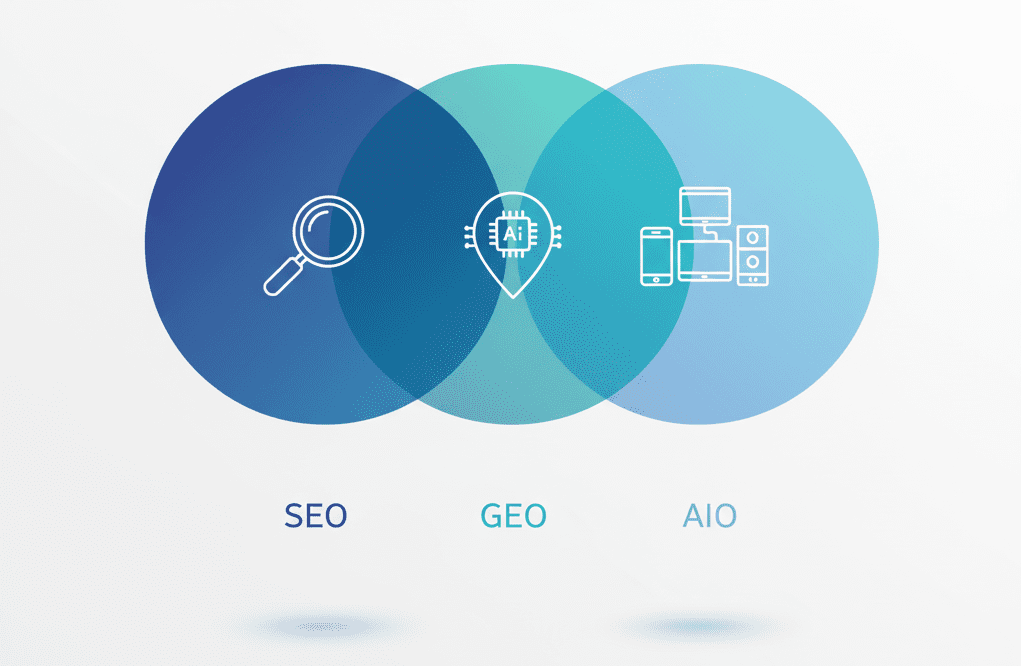
Everything covered here remains foundational, but search is evolving rapidly with AI. Generative Engine Optimisation focuses on how AI Overviews and similar features cite content, structured data, clear formatting, and authoritative signals become even more important when AI models decide what to reference. AI-Powered Optimisation extends beyond Google to platforms like ChatGPT, Claude, and Perplexity, which increasingly access real-time web data and cite sources. The good news is that if you've implemented the SEO fundamentals correctly, clean technical foundation, well-structured content, semantic markup, genuine authority, you're already positioned well for these AI-driven search experiences. The principles don't change, the distribution mechanisms evolve, but the fundamentals endure.
Key takeaways
- Technical foundation comes first, crawlability, speed, mobile-first, proper rendering.
- Structure content semantically with proper HTML, clear headings, and descriptive titles.
- Keywords are about intent, answer real questions naturally rather than keyword stuffing.
- Performance is a ranking factor, optimize Core Web Vitals systematically.
- Internal linking builds structure through topic clusters.
- Schema markup helps machines understand your content.
- Authority requires genuinely useful content that earns backlinks.
- Prepare for AI-powered search, since strong SEO fundamentals position you well for GEO and AIO.
- And measure and iterate continuously.