Server-Driven UI: Changing Layouts Without App Updates
Shipping a UI change through the app stores means waiting on review cycles, staged rollouts, and users who simply never update. For teams that need to iterate on layouts, onboarding flows, or promotional content quickly, that lag is a real constraint. Server-driven UI is one way around it: instead of hardcoding a screen's layout into the app binary, the server sends a structured description of what to render, and the client interprets it at runtime.
The core idea
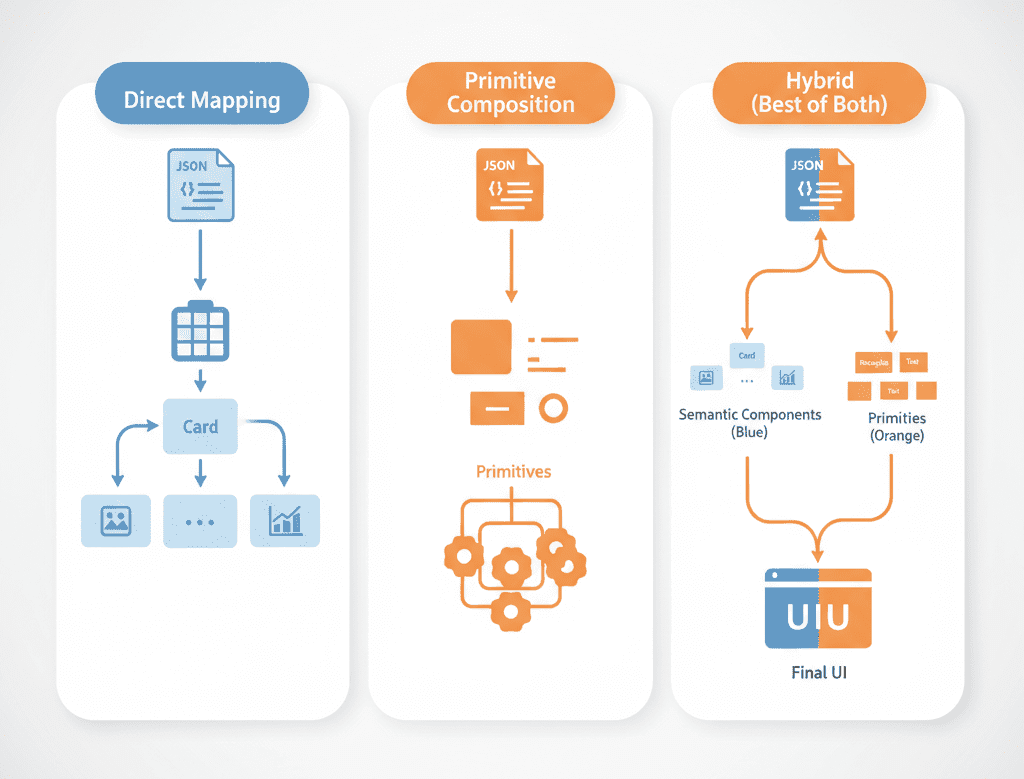
Rather than shipping a new app version every time a screen's content or structure needs to change, the client ships with a generic rendering engine capable of interpreting a JSON (or similar) description of components, arranging them, and wiring up basic interactions. The server controls what actually appears by sending different payloads. Change the payload, change the screen, no app store review required.
Where this pays off
This pattern is most valuable for content that changes often and doesn't need deep custom interaction logic: onboarding sequences, promotional banners, feature announcements, and simple informational screens. It lets product and content teams iterate independently of the engineering release cycle.
Where it doesn't
Server-driven UI isn't a good fit for screens with complex, highly custom interactions or animations that are hard to express generically. Pushing too much of the app's core experience through a generic rendering layer tends to produce a lowest-common-denominator UI and adds indirection that makes debugging harder. The pattern works best applied selectively, to the parts of the app that genuinely benefit from rapid iteration, not as a wholesale replacement for native UI code.
Key takeaways
- Server-driven UI trades some rendering flexibility for the ability to iterate on layout and content without app store releases.
- It's a strong fit for onboarding, promotions, and simple informational screens, and a weaker fit for complex, highly interactive core product experiences.
- Apply it selectively rather than as a universal architecture.