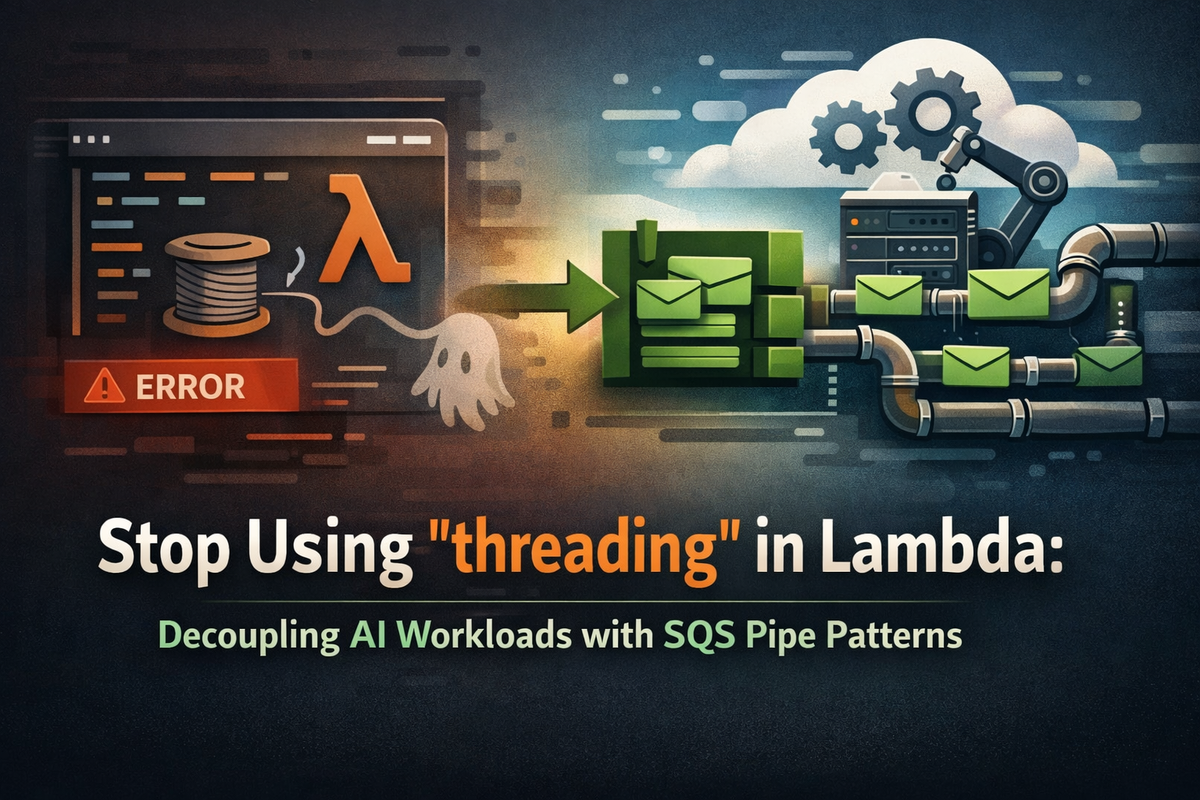
Stop Using Threading in Lambda
We started simple: a few functions, clean handlers, everything working beautifully. Then the application grew, and we needed to do more work than fits inside a single request. Generate AI insights. Send emails. Trigger analytics. Run follow-up jobs. And the temptation showed up: let's just spin up a background thread.
We did that too. This post is about why we're stopping, and what we're moving to instead.
The original problem: "just do it in the background"
The pattern seems reasonable. You want to respond quickly to users, but there's important work that needs to happen, not urgent enough to block the response but critical enough that it needs to get done. So you do what feels natural:
import threading

def handler(event, context):
    threading.Thread(target=do_heavy_work).start()
    return {"status": "ok"}
The intention is good: return fast to the client, do heavy work asynchronously, keep the experience snappy. This works perfectly on a traditional server where processes run for hours or days. But AWS Lambda is not a traditional server.
The silent failure: why this is dangerous in Lambda
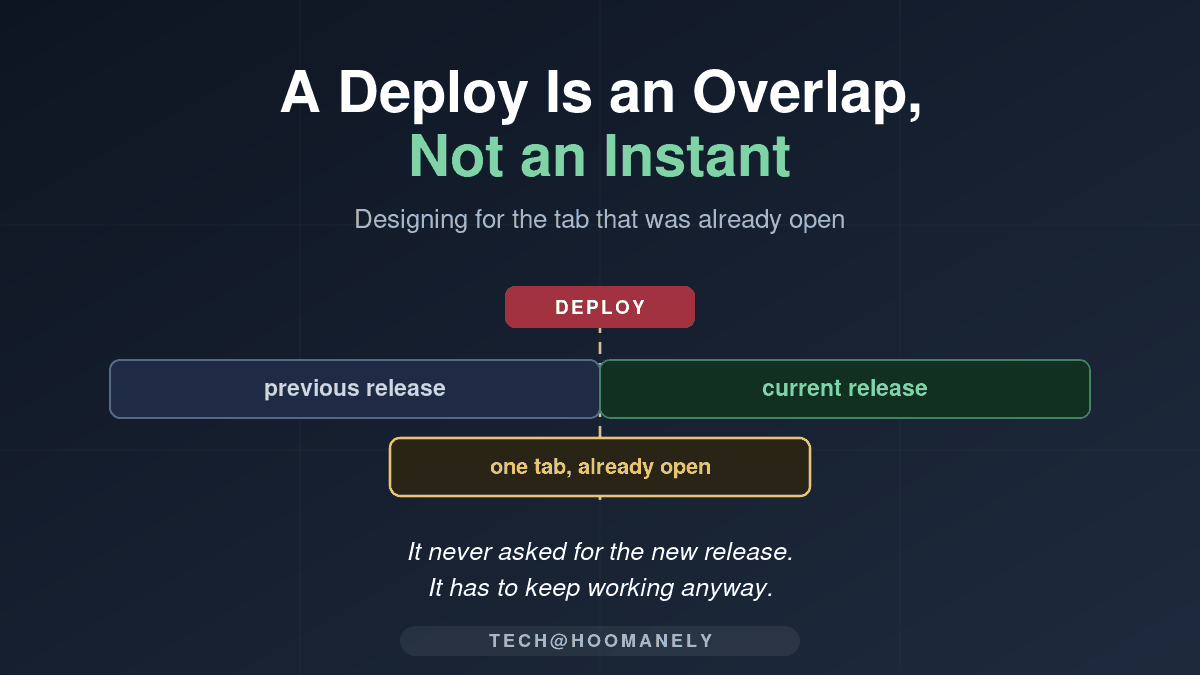
Lambda has a rule that's deceptively simple but catastrophically easy to miss: once your handler returns, AWS is free to freeze or terminate the execution environment immediately. That means background threads aren't guaranteed to finish. They may run sometimes, giving false confidence, or they may get killed silently, mid-execution, with no warning.
No exception gets raised. No retry happens. No log entry appears. The work just vanishes. This is the worst kind of failure in distributed systems, silent data loss. Monitoring shows success because the handler returned successfully, but the actual work is gone. The email never sent. The insight was never generated.
The truly insidious part is that this failure is non-deterministic. Under light load, when Lambda containers get reused frequently, background threads might complete most of the time and everything seems fine. Then traffic spikes, Lambda scales aggressively, containers get destroyed, and background threads start dying en masse with no visibility into what's being lost.
Why this is extra dangerous for AI workloads
AI jobs amplify this risk. Modern AI workloads are CPU-intensive, network-heavy when calling external LLM APIs, and have unpredictable latency, a simple prompt might take two seconds or twenty. These jobs are expensive both in compute and API cost, and they often update state in ways that expect atomic completion.
When a background thread running an AI job gets killed mid-execution, the consequences cascade: a half-generated insight where the LLM call completed but the database write didn't, a paid API call with a lost result, inconsistent state where the system thinks an insight exists but users can't see it, and no observability trail, no logs, no metrics, no way to know the failure even happened. Once we saw this pattern was fundamentally broken, the decision became clear. Threading inside Lambda isn't clever, it's undefined behavior.
The principle we're adopting going forward
After several production incidents and a lot of debugging sessions, we've adopted one non-negotiable principle: a Lambda function should only do the work it can finish before returning. Everything else must be decoupled.
No background threads. No fire-and-forget logic. No hidden async work. If work is important enough to do, it's important enough to do reliably, with visibility, retries, and proper error handling. This isn't about being conservative, it's about respecting the execution model of the platform. Lambda is designed to be ephemeral, stateless, and event-driven. Sneaking in background work by extending that contract introduces undefined behavior.
The fix: decouple with SQS pipe patterns
Instead of threading, we're moving to a queue-based pipeline using Amazon SQS:
API Lambda → Push to SQS → Worker Lambda → Heavy AI workThe API Lambda receives a request, validates it, enqueues a message to SQS, and returns immediately. A separate worker Lambda, triggered by SQS, processes the actual heavy lifting. The API Lambda stays fast and reliable, it's not doing AI generation or sending emails, it's doing one thing well: accepting requests and scheduling work. The heavy, slow, unpredictable tasks move to dedicated consumers with their own execution environment, retry logic, and observability.
Why SQS is the right primitive here
SQS gives guarantees background threads never could. Durability: messages are persisted across multiple availability zones, and if a worker fails, the message becomes visible again and gets retried automatically. Backpressure: under load, messages wait patiently in the queue instead of overwhelming downstream services. Observability: we can see how many messages are pending, how many failed and why, and processing latency distributions, none of that was possible with threads dying silently. Isolation: if AI generation starts failing or running slowly, it doesn't affect API response times. Correctness: every message is either successfully processed or explicitly moved to a dead letter queue after exhausting retries, nothing is lost silently.
What the new flow looks like
Here's the minimal pattern:
# API Lambda - Fast and deterministic
def handler(event, context):
    job = {"type": "generate_insight", "user_id": event["user_id"]}
    sqs.send_message(QueueUrl=QUEUE_URL, MessageBody=json.dumps(job))
    return {"status": "queued"}
That's it. No threading, no async surprises. The user gets immediate feedback. Behind the scenes, SQS delivers that message to a worker Lambda that does the heavy lifting. If something fails, the message visibility timeout expires and SQS retries automatically. After configured attempts, failed messages move to a dead letter queue for investigation. The system becomes self-healing, visible, and predictable.
Why this pattern is better for AI specifically
AI workloads benefit disproportionately from this decoupling. Variable latency: LLMs are unpredictable, the same prompt can take wildly different amounts of time, and queues absorb that variability cleanly, keeping the API fast regardless of backend performance. Cost control: you can throttle consumer Lambda concurrency to manage AWS costs and third-party rate limits, batch messages for efficient processing, and implement smart retry logic with exponential backoff, none of which is possible with hidden threads. Observability: with threading you had no idea if work was completing or being killed; with queues, you know exactly what's pending, processing, failed, and why, and you can track end-to-end latency and find bottlenecks.
Addressing the "isn't this overkill?" question
This is the most common pushback. Setting up SQS, worker Lambdas, and monitoring feels like a lot of infrastructure for what used to be one line of code. But that thinking misses the point: threading was never reliable, it just appeared to work under certain conditions. The simplicity was an illusion that shattered under production load.
Threading is cheaper to write but harder to debug and impossible to guarantee. Queues take slightly more setup but are extremely boring in the best possible way. They work predictably, fail visibly, retry automatically, and scale horizontally. The real question isn't whether queues are overkill, it's whether you can afford the silent failures and debugging nightmares that come with threading in Lambda. Once you've spent a weekend debugging why work isn't completing, the extra setup time for SQS seems trivial.
What we explicitly ban going forward
As a team decision, we now avoid threading.Thread inside Lambda functions, background tasks without acknowledgment semantics, fire-and-forget logic in request handlers, and hidden async behavior outside the main execution flow. If work can fail, it must be visible. If work is important, it must be durable. These aren't suggestions, they're architectural constraints we enforce in code review.
When this pattern applies, and when it doesn't
Use SQS decoupling for AI generation, email delivery, analytics processing, data aggregation, report generation, and any non-user-blocking work that needs reliability. Don't overuse it for simple synchronous validations, read-only queries, or ultra-low-latency responses where work must complete before returning.
The heuristic is simple: if work must complete before the user gets a response, keep it synchronous. If work can happen asynchronously and needs reliability, use a queue. If work is truly fire-and-forget, where failure is acceptable, document that explicitly and monitor appropriately.
Final thought
Using threading in Lambda works until it doesn't, and when it fails, it fails silently, invisibly, catastrophically. From now on we're choosing predictability over cleverness, durability over shortcuts, and decoupling over hacks. If you're running AI workloads on Lambda and still using background threads, this is your sign. Stop using threading. Start designing pipelines. Your future self, and your on-call engineers, will thank you.