Streaming to the Web from Flutter via Web Bluetooth
Hoomanely products aren't just mobile apps or hardware devices in isolation anymore. They're systems, a combination of sensors, firmware, mobile apps, dashboards, and cloud intelligence. As we build connected pet devices and real-time insights, one question keeps coming up: can we stream live device data directly to the web without forcing users to install another app or rely on cloud connectivity?
Web Bluetooth looks like the obvious answer. In theory it promises a clean, server-less path: connect to a nearby device or companion app and stream data straight into the browser. This post documents our experience streaming data to the web from Flutter using Web Bluetooth, what genuinely works today, what we deliberately avoid, and how we plan to evolve this architecture.
Why we even considered Web Bluetooth
Our devices generate continuous streams of data, feeding events, weight changes, device state, diagnostics. While our mobile Flutter app is the primary interface, there are real cases where the web makes more sense: internal debugging dashboards, device setup and calibration tools, partner demos without app installs, quick diagnostics during support calls, and factory or QA tooling.
The idea was appealing: no Wi-Fi required, no cloud round-trip, no backend dependency, just BLE to browser to UI. Web Bluetooth, supported in Chromium-based browsers, appeared to make this possible.
The high-level architecture
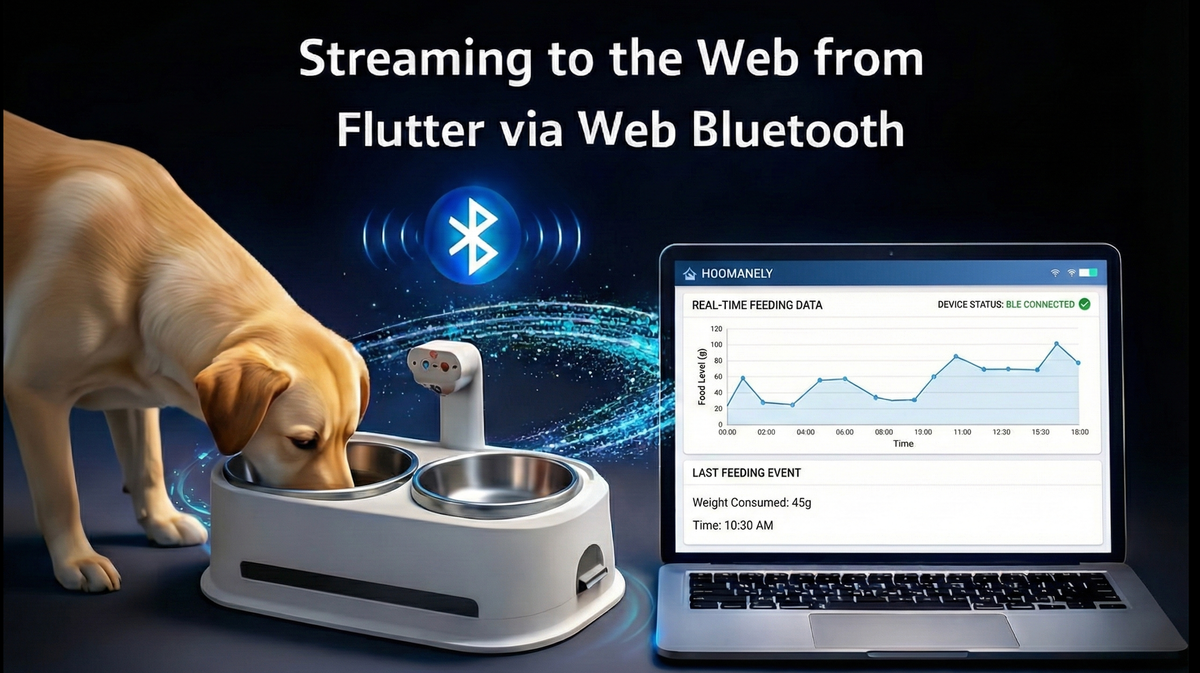
The simplest form of streaming looks like this: a BLE device or Flutter app sends BLE notifications, a web browser (Chrome) receives them, and a live dashboard renders them. In some cases the Flutter app itself acts as the BLE peripheral, proxying or simulating device data. In others, the browser connects directly to the hardware. Either way, the promise is real-time data without infrastructure.
What actually works today
The good news: Web Bluetooth does work, if you stay within its boundaries.
Chromium desktop browsers are reliable enough. Chrome and Edge on desktop are the only environments we consider production-viable, with stable BLE APIs, predictable permission prompts, reasonable connection lifetimes, and decent debugging tools. For internal dashboards, engineering tools, and demos, that's more than sufficient.
BLE notifications work well for small, structured payloads: tens of bytes, event-driven updates rather than continuous floods, and data serialized efficiently through binary or compact JSON. Feeding event markers, weight deltas, device status changes, and heartbeat pings all work well since that's exactly the pattern BLE notifications are designed for.
Short-lived, foreground sessions behave well: an active browser tab, a session lasting minutes rather than hours, and a connection the user explicitly initiated. This maps nicely to setup flows, diagnostics, and live demos, and the experience feels surprisingly smooth as long as expectations stay scoped correctly.
Flutter also works well as a BLE bridge, especially when the hardware isn't directly web-compatible, when you want to proxy data from multiple sources, or when you need app-level logic before exposing data. This lets us reuse business logic already in Flutter while still enabling web streaming.
What we actively avoid, and why
Safari, on iOS and macOS, doesn't support Web Bluetooth at all, with no reliable polyfills and no meaningful workarounds. Any architecture assuming Safari support is fundamentally broken.
High-frequency or continuous streaming is a problem because BLE isn't a high-throughput channel, and browsers make it worse. We avoid sub-second streaming loops, raw sensor dumps, and continuous charts without aggregation, since pushing too much data results in dropped notifications, UI jank, silent disconnects, and browser throttling. Instead, we aggregate, debounce, and window data before it ever reaches the browser.
Background or long-running tabs get throttled aggressively by browsers, along with inactive windows and battery-sensitive devices. Any architecture assuming a tab stays open and keeps streaming will fail unpredictably. Web Bluetooth is foreground-first by design, and we respect that.
Mobile web is another area we're cautious about. Chrome on Android technically supports Web Bluetooth, but the experience is fragile, permissions reset frequently, OS-level interruptions are common, and backgrounding kills connections. We treat mobile web BLE as experimental only for now.
And we never treat Web Bluetooth as a cloud replacement. It's a local transport, session-based and user-mediated, not a reliable data pipeline, sync mechanism, or source of truth.
What we're building toward at Hoomanely
Despite its limitations, Web Bluetooth still plays a role in our future architecture. Our direction is local BLE for instant feedback, background cloud sync for durability, and unified event models across both, with the same event schema flowing through device to app to web locally, and device to cloud to analytics asynchronously. That keeps experiences fast without sacrificing reliability.
Flutter isn't just a UI for us, it's the orchestration layer managing device state, user context, feature flags, permissions, and safety checks. Rather than exposing raw device streams to the browser, Flutter increasingly acts as a gatekeeper, data normalizer, and policy engine, which reduces surface area and keeps logic centralized.
Instead of generic live views, we're investing in task-specific dashboards for device calibration, feeding session playback, support diagnostics, and manufacturing QA, each with clear session boundaries, explicit user intent, and a narrow data scope. Web Bluetooth works best when the problem is well-defined.
We also treat Web Bluetooth as progressive enhancement, not dependence. If it's supported, great, if not, graceful fallback. That keeps us from shipping brittle features that only work on a subset of machines. Web Bluetooth is one tool in a broader connectivity toolbox, not the final answer.
Key takeaways
If you're considering streaming from Flutter to the web via Web Bluetooth: it's powerful, but narrow. It works best when sessions are short, payloads are small, browsers are desktop Chromium, and expectations are realistic. It fails when you treat it like a backend, expect mobile Safari support, stream too much data, or rely on background execution. At Hoomanely, embracing these constraints let us use Web Bluetooth where it shines without compromising the reliability of our core product.
Closing thoughts
Web Bluetooth isn't the future of all connectivity, but used carefully, it's a valuable bridge between hardware, mobile apps, and the web. As we keep building connected pet experiences, our focus stays the same: fast local interactions, reliable cloud intelligence, and thoughtful tradeoffs over hype. Sometimes staying sane means saying no to the shiny solution until it's actually ready.