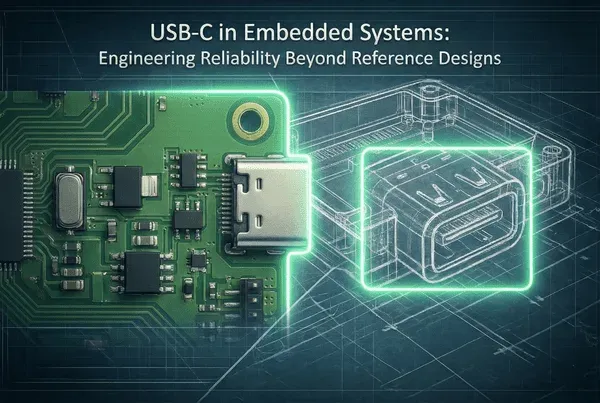
USB-C in Embedded Systems: Engineering Reliability Beyond Reference Designs
USB-C has become the default connector for modern electronics, but in embedded systems, it's rarely "just a connector." It's a power interface, a data interface, a mechanical stress point, an ESD entry path, and often the first thing users interact with, long before firmware boots or sensors activate.
At Hoomanely, USB-C sits at the boundary between the outside world and deeply integrated embedded systems. Our products operate in real environments:
- Homes
- Pets
- Moisture
- Repeated insertions
- User-supplied chargers
- Unknown cables
- Unpredictable handling
Designing USB-C in this context required us to move beyond reference schematics and think about behavior under uncertainty.
USB-C as a system boundary: multiple simultaneous roles
USB-C in our architecture fulfils several critical functions at once:
- Primary power entry supplying the entire system
- Firmware and diagnostics interface enabling updates and recovery
- Ground reference influencing EMI and ESD behavior
- Mechanical interface exposed to repeated insertion and side loads
- User touchpoint shaping perceived reliability from the first interaction
Treating USB-C as merely a "power jack" ignores the electrical, mechanical, and behavioral complexity concentrated at this boundary.
CC logic: designed for ambiguity, not ideal conditions
The Configuration Channel defines orientation, role, and power expectations. While many embedded products assume a simple "sink-only" model, real-world usage quickly invalidates that assumption. Chargers, cables, hubs, and adapters vary widely in quality and behavior. Our CC architecture is designed around explicitness and predictability.
The device always presents a clearly defined sink role, with no reliance on floating states, inferred behavior, or opportunistic negotiation, ensuring upstream sources interpret the device consistently. Both connector orientations are treated as equal electrical paths, routing symmetry, matched impedance, and identical return paths ensure flipping the cable never changes signal integrity or negotiation thresholds. Rather than optimizing for peak advertised power, our systems are designed to remain stable across a wide power envelope, operating reliably even when connected to weaker sources and scaling gracefully when higher power is available. And hardware-controlled sequencing ensures internal rails, clocks, and references are fully stable before subsystems activate, so firmware never has to "fix" power instability, it starts from a known-good baseline.
ESD protection: architecture over components
USB-C is one of the most ESD-exposed interfaces in consumer embedded products. Users touch it, cables carry charge, and the connector shell provides a direct discharge path. At Hoomanely, ESD protection is approached as a current-routing problem, not a checkbox component choice.
High-energy transients are given deliberate, low-impedance paths away from sensitive circuitry, with connector shell discharge handled separately from signal reference ground, preventing ESD energy from polluting analogue or digital domains. Protection elements are placed as close to the connector as physically possible, clamping voltage before it propagates, not absorbing it after damage has already occurred. And ground is treated as a structured network, ESD currents flow in well-defined regions that never overlap with precision references, clocks, or sensor domains. The result is ESD resilience that remains invisible during normal use, and never becomes a latent reliability issue.
Power entry: stability across unknown sources
USB-C enables high power delivery, but embedded systems benefit far more from stable power than from chasing maximum wattage. Our power-entry design isolates external variability from internal precision electronics. USB input power is intentionally conditioned before it touches system rails, inrush is controlled, noise is filtered, and downstream regulation ensures cable resistance, charger quality, and transient behavior never leak into sensitive domains. Noise-sensitive subsystems are separated from bulk power domains, and system behavior is designed to respect available power rather than assume it, loads scale intelligently, prioritizing core functionality while avoiding hard faults or resets under constrained conditions.
Signal integrity: designing for margin, not minimums
Even when USB is used primarily for configuration or updates, maintaining signal integrity matters. Poor margins manifest as intermittent enumeration, unreliable flashing, or compatibility issues that only appear in the field. Our approach emphasizes symmetric differential routing, consistent impedance across orientations, isolation from high-current switching paths, and controlled EMI behavior through layout discipline. By designing with margin rather than minimum compliance, the USB interface remains robust across cables, hosts, and environments.
Mechanical integration: USB-C as a stress concentrator
Schematics do not show mechanical force, but USB-C experiences it daily. Cable weight, accidental pulls, side loads, and repeated insertions all translate into stress at the connector interface. Without careful design, that stress accumulates in solder joints and copper pads.
At Hoomanely, mechanical and electrical design are tightly coupled:
- Connector forces are distributed into the PCB structure
- Not fragile pads
- Board thickness and copper density reinforce high-stress regions
- Enclosure geometry supports the connector
- Preventing cantilever loading
USB-C survives long-term use not because the connector is strong, but because the system around it is designed to absorb stress intelligently.
Hardware first, firmware aware
While firmware plays an important role in observability and optimization, basic USB-C safety does not depend on firmware correctness. Power sequencing, current limiting, and thermal protection are enforced in hardware. Even in early boot, update modes, or recovery scenarios, the USB-C interface behaves safely and predictably. Firmware enhances visibility and efficiency, but it's never responsible for fundamental protection.
Common failure modes, engineered out
Rather than reacting to failures, our architecture anticipates categories of failure and removes their root causes:
- Intermittent connectivity is addressed through mechanical reinforcement and layout discipline
- Power-induced resets are avoided through conservative negotiation and staged power entry
- ESD-induced latent issues are eliminated through structured discharge paths
- Cable variability is neutralized through explicit CC logic and signal margin
Reliability emerges not from overengineering any single block, but from consistency across the system.
Conclusion: USB-C as a trust interface
For users, USB-C represents a simple expectation: plug it in, and it should just work. For embedded engineers, delivering on that promise requires far more than compliance. At Hoomanely, USB-C is treated as a trust interface, where electrical behavior, mechanical design, and user interaction intersect. By engineering CC logic for ambiguity, ESD paths for reality, power entry for stability, and mechanics for longevity, we've built USB-C implementations that quietly disappear into the background. And in embedded products that live in real homes, that quiet reliability is the highest standard we aim for.