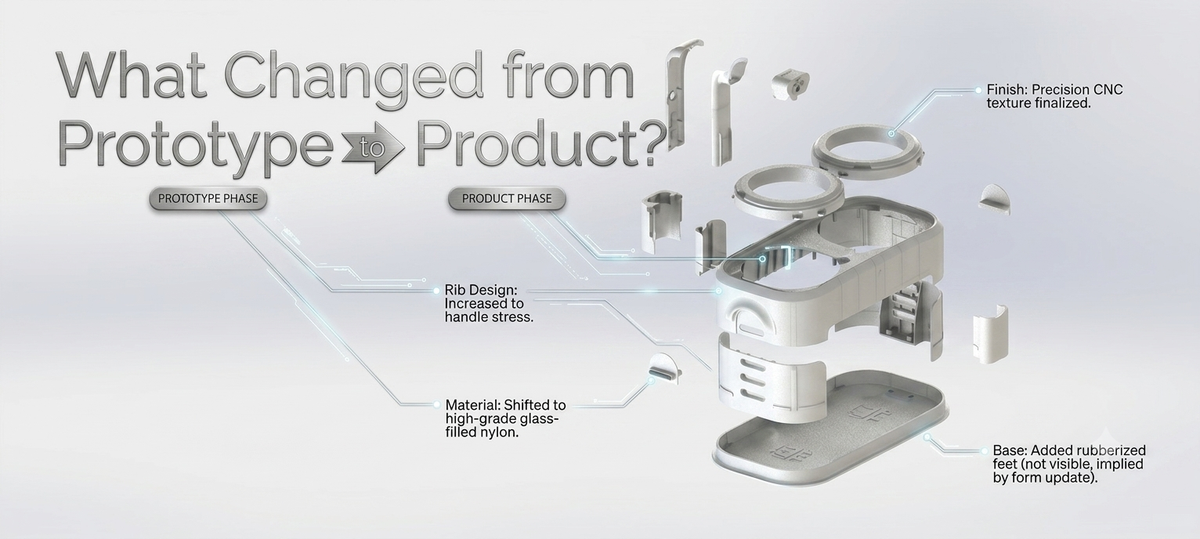
What Changed from Prototype and Product
Every hardware product starts as a prototype, but a prototype and a product are solving fundamentally different problems. A prototype answers "can this work?" A product has to answer something much harder: can this be built repeatedly, assembled efficiently, shipped reliably, and trusted by users over time?
While developing Everbowl, our smart pet-feeding system that measures food consumption through precision load sensing, we found that proving the concept was only the start. The first prototypes demonstrated sensing, electronics integration, and software function well. Moving toward a production-ready system exposed a completely different set of problems: assembly complexity, tolerance accumulation, alignment drift, serviceability, manufacturing consistency, and long-term reliability all became more important than the original proof of concept.
This post covers the architectural changes that took Everbowl from a working prototype to a product that can actually be assembled, tested, shipped, and operated reliably.
A prototype is optimized for learning
Early prototypes exist to maximize information: validating concepts, testing assumptions, checking sensing performance, evaluating user interaction, and surfacing unknown risks. Because speed matters most at that stage, prototypes tend to accumulate extra brackets, temporary fixtures, manual adjustments, oversized safety factors, and complicated assembly sequences. That's fine when the goal is learning rather than manufacturing, but every temporary solution left in place eventually becomes technical debt in the final product.
The move to production means optimizing for a completely different set of constraints than the prototype phase ever had to satisfy.
The challenge: when the design worked but the product wasn't ready
Assembly needed a lot of manual alignment. Part count was higher than it needed to be. Fastening methods varied between subsystems. Small assembly differences affected sensor consistency. Servicing required tearing the unit almost fully apart. The system worked, but it wasn't manufacturable yet, and what followed wasn't a redesign of the product's purpose, but a redesign of its architecture.
Reducing part count
One of the highest-impact changes came from aggressively simplifying the mechanical architecture. Every component adds manufacturing cost, procurement effort, inventory complexity, assembly time, and a potential failure point. Early prototypes often collect extra parts that solve a local problem quickly, alignment brackets, spacer components, reinforcement plates, temporary mounting structures. Each one looks harmless on its own; together, they add up to real complexity.
We consolidated multiple functions into fewer components by building alignment features directly into structural parts, cutting redundant components, combining cosmetic and structural roles where we could, and standardizing interfaces between subsystems. The reduction in unique parts meant fewer assembly operations, less inventory complexity, and less tolerance stack-up. More importantly, every part we removed eliminated a potential source of variation. As the saying in the shop went: the easiest part to manufacture, assemble, inspect, and maintain is the part that no longer exists.
Designing for assembly
The next big challenge was assembly complexity itself. A design looks easy to build when it's assembled by the person who designed it; production environments are different, and a product has to assemble consistently no matter who's doing the work. Early assembly trials showed alignment-dependent installation, manual positioning requirements, fastener accessibility problems, and sensitivity to assembly order, all of which increased both build time and variability.
We redesigned key interfaces around self-locating geometry, alignment tabs, registration features, and controlled assembly paths, with a simple goal: make the correct assembly method the easiest one. Assembly ended up faster, more repeatable, and far less dependent on operator skill.
Standardizing fastening strategy
Fasteners look like a minor detail, but they actually define structural behavior, serviceability, assembly consistency, and long-term reliability. We standardized fastening wherever we could: common fastener types, threaded inserts in plastic structures, better fastener accessibility, and a consistent assembly methodology throughout. That got us faster assembly, more consistent preload, less thread damage, and easier servicing.
Improving structural predictability
One lesson kept coming up during development: strength alone doesn't guarantee reliable performance. Everbowl's sensing architecture depends on controlled load transfer through aluminum rings, load cells, and fastened interfaces, and small structural inconsistencies could throw off measurement stability.
We increased the stiffness of load-bearing aluminum structures, optimized load paths, reduced torque sensitivity from eccentric loading, improved assembly alignment features, and tightened up consistency between metal and plastic interfaces. The system became less sensitive to assembly variation, more resistant to alignment drift, and more consistent unit to unit.
Designing against field failures
Prototypes rarely see extended real-world use; products do. As deployment scenarios expanded, potential failure modes became clearer: fastener loosening, alignment drift, sensor inconsistency, structural wear, and assembly-induced variation. Rather than reacting to failures after they showed up, we redesigned the architecture to remove the underlying causes, improving load distribution, preload retention, and interface robustness, and reducing how much the design depended on precise manual assembly.
Most field failures aren't caused by dramatic design flaws. They come from small sources of variation that build up over time.
What actually improved
By the time Everbowl reached its production-ready architecture, it was a noticeably different system from the original prototype. Manufacturing got a lower component count, simpler inventory, and less assembly complexity. Assembly itself needed fewer steps, was more accessible, built faster, and depended less on the individual operator. Reliability improved through better structural consistency, better alignment retention, lower sensitivity to assembly variation, and lower risk of field failure. Product quality improved through more predictable sensor performance, easier servicing, and more consistency between units. The final product wasn't defined by extra features. It was defined by less uncertainty.
Hoomanely context
At Hoomanely, product development is really the process of turning ideas into dependable systems. Going from prototype to product is rarely about inventing new functionality, it's about refining architecture, cutting variation, and improving repeatability. What we learned preparing Everbowl for production reinforced a simple principle: reliable products come from intentional simplification, not added complexity.
Key takeaways
- A prototype proves functionality; a product proves repeatability.
- Reducing part count improves manufacturability and reliability.
- Assembly should be designed, not assumed.
- Standardized fastening strategies reduce variation.
- Structural predictability matters more than maximum strength.
- Field failures are often the result of accumulated variation, not single dramatic flaws.
- Product readiness shows up as consistency, not just new features.
Conclusion
Looking back at how Everbowl evolved, the most important changes never showed up on a feature list. They were baked into the architecture itself: parts removed, interfaces simplified, load paths refined, assembly made easier, reliability made more predictable. The move from prototype to product was really a process of eliminating uncertainty, one architectural decision at a time, until the system could be manufactured repeatedly, assembled consistently, and trusted in real-world use. That's the real difference between proving an idea and shipping a product.