When Simulation Matched Reality (And When It Didn’t)
An honest look at how simulation guided Everbowl's mechanical development, and where physical testing forced us to rethink the model.
Introduction
Simulation is one of the most useful tools in hardware development because it lets you ask questions before you've manufactured anything: where will this deform, how much load can it take, which interface is likely to fail first? But a simulation is only as good as the assumptions sitting underneath it.
While developing Everbowl, we used mechanical simulation to understand load paths, structural stiffness, fastener interfaces, and how the aluminum ring and load-cell assembly actually behaved. Some of it matched what we later measured physically. Some of it didn't, and reality exposed effects the model hadn't captured. That comparison, more than any single simulation result, ended up being the most valuable part of the whole process. We stopped treating simulation as a pass/fail check and started treating it as a prediction that had to earn its credibility against real measurements.
The problem: a perfect simulation can still be wrong
A simulation model looks precise. You define material properties, geometry, applied loads, constraints, contact conditions, mesh size, safety factors, and the solver hands back exact numbers for displacement, stress, reaction force, and factor of safety. The problem is that a real product doesn't behave like a clean CAD model.
Real Everbowl assemblies carried manufacturing tolerances, fastener preload variation, adhesive interfaces, small alignment errors, sheet-metal variation, plastic deformation, contact between dissimilar materials, load applied off the ideal center, and the wear and tear of repeated assembly and disassembly. Simulation could capture some of that, but not all of it with equal accuracy. So the real engineering question was never just "does the simulation pass?" It was "how closely does this simulation actually represent the physical product?"
Starting with the load path
The first thing we needed to understand was how force actually travels through Everbowl's weighing structure. The bowl sits on the upper aluminum ring, force passes through the load cells to the lower ring, and from there into the main body. On paper that looks simple: bowl to top ring to load cell to bottom ring to body.
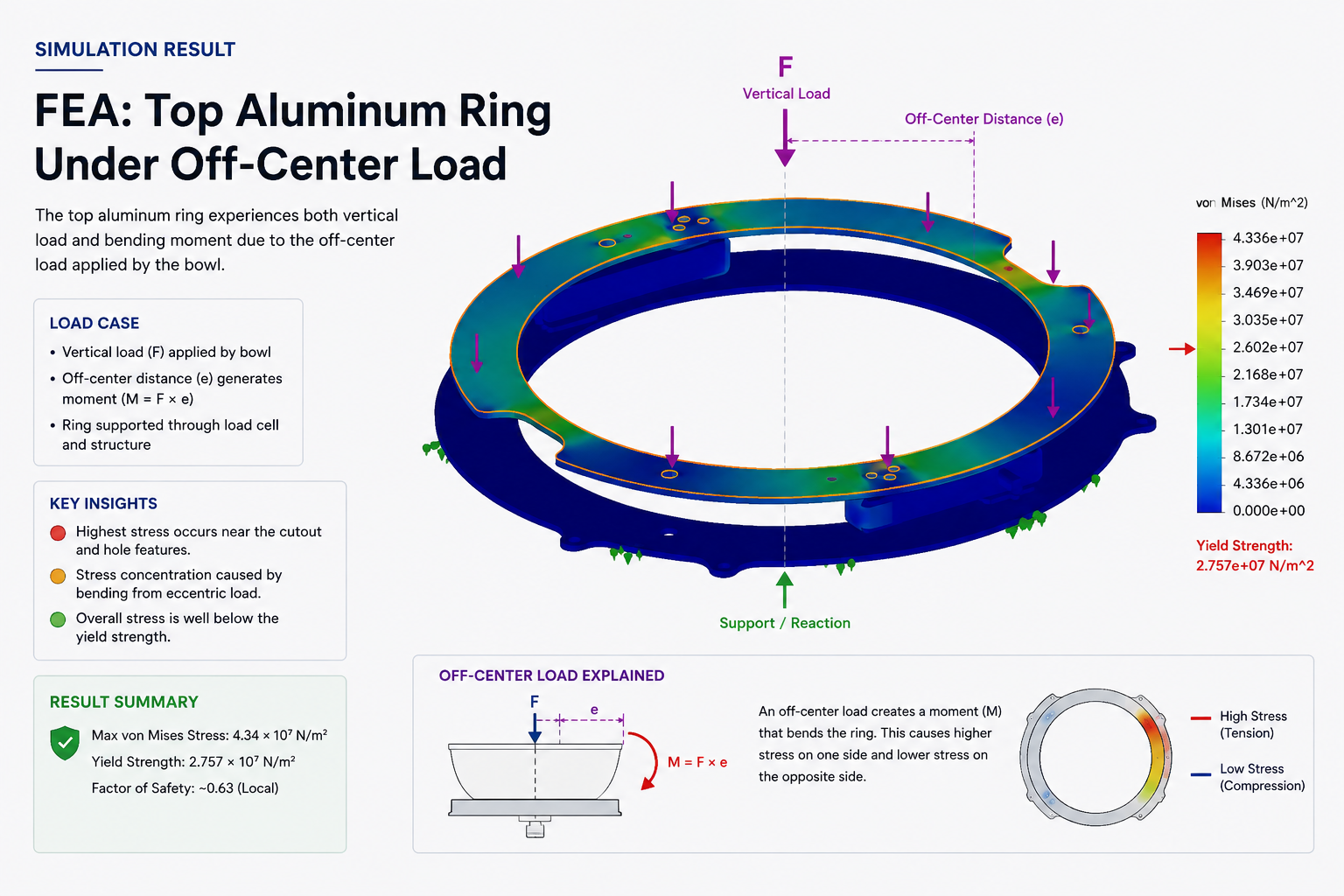
The real loading condition isn't that clean, though. A dog doesn't set food exactly at the bowl's center and push straight down through the geometric middle of it. Real loading is eccentric, which introduces both vertical force and torque, and that distinction mattered a lot once we got into the simulation itself.
What we predicted
The mechanical analysis centered on three things.
Deflection. How much would the aluminum structure actually move under load? This mattered more than it would on a purely structural part, because Everbowl's frame is also part of a measurement system. Excessive or inconsistent deflection can throw off how load actually reaches the load cells.
Stress. We cared less about the single highest stress value and more about where it showed up. High stress in a broad, well-supported region means something completely different from the same number concentrated around a screw hole, a sharp corner, an adhesive interface, or a thin section.
Factor of safety. FOS gives you a margin between the predicted operating condition and predicted failure, but we learned quickly not to treat it as a guarantee. A part can carry a comfortable FOS under one loading condition and still fail, simply because the real failure mechanism wasn't the one the model was checking for.
Where simulation and reality matched
The most useful simulations were the ones where physical measurements followed the same trend as the model. When we increased stiffness in the load-bearing aluminum components, simulation predicted less deflection, and physical testing showed the same thing. The absolute numbers weren't always identical, but the direction and relative size of the change lined up.
That distinction matters. For most design decisions, you don't actually need simulation to predict reality to the decimal point. You need it to correctly answer questions like: will configuration A be stiffer than configuration B? Which component is driving deflection? Where should material get added? Which interface is most sensitive? Does moving the support point actually improve the load path? When simulation got those right, it became a genuinely powerful design tool.
Where simulation didn't match
The more interesting cases were where it fell apart. One example came from the interfaces between components. A simulation might treat two parts as perfectly bonded, perfectly constrained, or connected through an idealized fastener. Real assembly doesn't get that luxury: a screw carries preload, an adhesive has compliance, a plastic part has manufacturing variation, a sheet-metal part has tolerance, and two features that line up perfectly in CAD might not line up the same way after manufacturing.
Those small differences change the actual load path. The geometry can be completely correct while the boundary conditions are wrong, and that mismatch was one of the biggest lessons we took from comparing simulation against physical hardware.
The boundary condition problem
Boundary conditions are often the most important part of a structural simulation, and also the most underestimated. Take a simple ring: in CAD you can constrain the bottom ring exactly where you expect the body to support it. In reality, contact might happen across several surfaces, screws introduce local clamping forces, plastic deforms slightly, and a small gap might not close until the structure is actually under load.
The simulation only sees the boundary condition you gave it. The product experiences whatever boundary condition manufacturing and assembly actually created. That gap explains why two models with identical material and geometry can still behave differently once they're real parts.
The load-cell interface made this more obvious
The load-cell interface was where this became especially clear. It sits between the aluminum rings and carries force through a relatively compact mechanical connection, which means it sees more than simple compression. Depending on loading position, it can see shear, bending, local bearing stress, peel forces, torque, and fastener loads all at once.
That mattered a lot when we were comparing joining methods. A connection that looked plenty strong as a simple tensile or shear joint could behave completely differently once the real bending moment showed up. Simulation helped us identify which load case actually mattered. Physical testing is what showed us the real failure mechanism.
When the failure mechanism was different from the model
One clear example was an adhesive interface. Our early analysis said the joint had enough strength. The physical joint didn't agree. It wasn't that the adhesive was simply "too weak." The geometry was creating a peel-dominated loading condition, so instead of the adhesive carrying load uniformly across the bonded area, bending concentrated stress toward one edge of it.
That's a good example of why a single FOS number can mislead you. The simulation only got genuinely useful once we started asking what was actually causing the joint to fail, instead of just what the maximum stress was. Changing the adhesive and rethinking the interface geometry produced a much more robust joint.
Simulation → prototype → measurement → correction
Over time our process became a loop instead of a straight line: simulation, then a prototype, then physical measurement, then comparing the two, identifying where they differed, correcting the model or the design, and testing again.
That changed what a disagreement between simulation and testing actually meant. A physical test that didn't match the simulation wasn't a failed prediction anymore. It was new information about the system.
Measuring the difference
To make the comparison worth something, we tracked predicted versus measured values for maximum deflection, load response, structural stiffness, interface behavior, failure location, and load distribution.
For example, if simulation predicted 0.40 mm of deflection and testing measured 0.45 mm, that works out to about 88.9% accuracy. The number itself is useful, but the real question is why that 11.1% gap existed. Was it material behavior, joint compliance, fixture stiffness, manufacturing tolerance, or an actual load that differed from what we assumed? That investigation is where the real engineering value sits, not in the accuracy figure itself.
Not every difference required a redesign
A gap between simulation and reality doesn't automatically mean the design is wrong. Sometimes it's just inside the uncertainty of the model itself: the material properties used in simulation might represent nominal values while the actual part behaves slightly differently, or the physical test setup introduces its own measurement uncertainty.
We started sorting differences into three buckets: a model limitation, where the simulation simplified away something that turned out to matter physically; manufacturing variation, where the physical part just differed from the nominal CAD geometry; and measurement variation, where the test setup itself introduced noise. Only once we knew which bucket a discrepancy fell into could we decide whether the model needed fixing or the product did.
What changed in our design process
The biggest shift wasn't a new solver, material model, or workflow. It was how carefully we started interrogating our own results, always asking what assumptions were actually driving a given number. For Everbowl that meant paying much closer attention to real assembly constraints, fastener interfaces, load application points, contact surfaces, component stiffness, manufacturing tolerances, adhesive behavior, and off-center loading. The simulation model gradually got closer to the actual product, not just closer to the CAD file.
The value of physical testing
Physical prototypes gave us something simulation can't hand you on its own: evidence of how all the imperfect pieces actually interact. A CAD model can hold hundreds of dimensions, but the physical product holds hundreds of interactions. A screw isn't just a cylinder, it creates preload once torqued. A ring isn't just a sheet-metal profile, it bends under load. An adhesive isn't just a material property on a datasheet, it changes the stiffness of whatever interface it's holding together. A bowl isn't just a mass sitting on the structure, it creates different moments depending on exactly where and how the load lands.
Simulation helped us isolate those variables one at a time. Testing told us which ones actually mattered in practice.
Engineering insight: Simulation isn't there to replace physical testing. It's there to make physical testing smarter. A good simulation tells you what should happen. A good experiment tells you what actually happened. Whatever gap sits between those two is usually where the real engineering learning lives.
What we took forward
By the later stages of Everbowl's mechanical development, simulation and testing had stopped being two separate activities and become one loop. Simulation flagged weak points before we ever cut metal. Prototypes exposed assumptions the model had gotten wrong. Measurements gave us the evidence to fix the model. And the improved model made the next design decision better than the last one.
That also changed how we documented results. Instead of just recording whether a simulation "passed," we started tracking the relationship between what we predicted and what we actually measured. Over time, that builds into something more useful than a folder of simulation files: an actual, growing sense of how our design assumptions map onto real physical behavior.
Key takeaways
- Simulation is a prediction, not a measurement.
- The quality of your boundary conditions can matter as much as the material model itself.
- Real assemblies introduce preload, compliance, tolerance, and contact behavior that simplified models often miss.
- Compare measured values, predicted values, and failure modes, not just a single FOS number.
- When simulation and reality disagree, investigate why before you touch the design.
- Relative trends can be extremely useful even when absolute predictions aren't exact.
- Use physical testing to improve the model, not just to check it off.
- Prediction accuracy only means something once you understand where the error actually came from.
How this shows up at Hoomanely
At Hoomanely, the goal is building technology that works reliably outside a controlled engineering environment. Everbowl reinforced a core part of that: the physical product is the actual source of truth. Simulation gave us a way to reason about the product before it existed. Hardware gave us the chance to challenge that reasoning. The strongest designs came from putting the two in conversation, using simulation to ask sharper questions and physical testing to keep the answers honest.
The most useful simulation result wasn't always the one that matched reality perfectly. Often, it was the one that told us exactly where to look once reality disagreed.